
Running Meta Ads Is Being Taken Over by AI: The 10 Mainstream Platforms, Explained in One Pass
An explainer article reviewing ten mainstream AI platforms for managing Meta ads, grouping them into fully managed, semi-managed, and single-function tiers, with notes on pricing, strengths, and how to choose based on budget and desired control.
A few days ago I had dinner with a friend who runs a cross-border e-commerce business. Somewhere between courses, he pulled out his phone to show me his Meta ads dashboard: a dozen-plus campaigns, dozens of ad sets, budgets, bids, creatives — all of it watched by him alone.
He said the first thing he does when he opens his eyes every morning is check the dashboard, and he takes one more look before going to sleep.
I asked: what about hiring someone?
He said: can't afford it. A media buyer who actually understands Meta costs hundreds of thousands a year. Hand it to an agency, and they'll take a hefty service fee off you on top.
I told him he really should go get acquainted with this new breed of things. There is now a category of AI platforms built specifically to manage Meta ads — they watch your data, adjust your budgets, and launch creatives in bulk for you. Some of them keep optimizing on your behalf in the middle of the night, all year round.
What is an AI ad-buying platform, exactly?
Put plainly: you hand the three jobs — reading the data, making the calls, making the changes — over to an AI that never gets tired, never forgets, and never slacks off.
Today I went through the 10 mainstream options on the market, one by one. Once you've read this, you should know which one you should be using.
First, the takeaway: automation has depth levels too
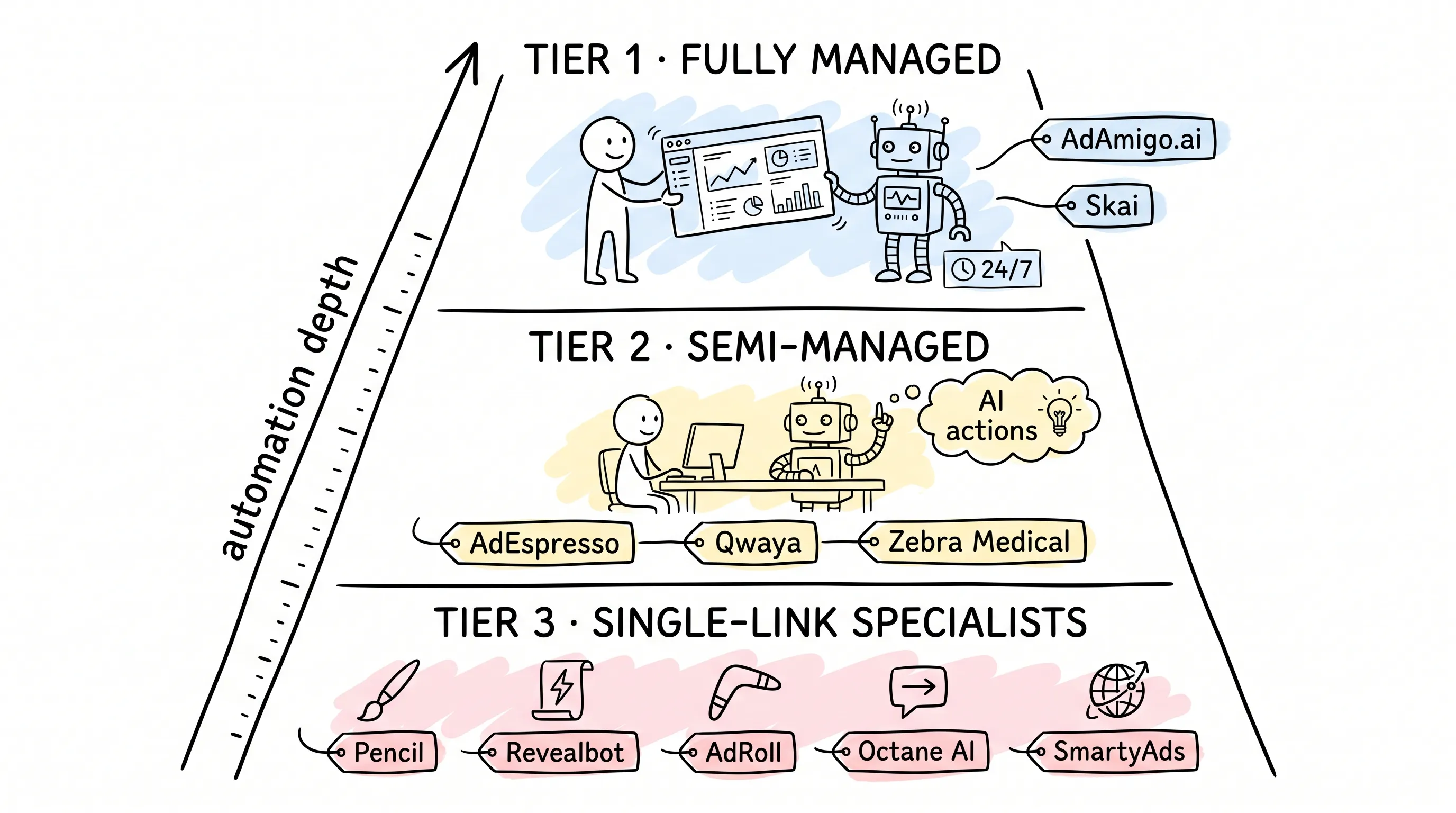
These 10 platforms are really three entirely different species. Ranked by how deeply AI gets involved, there are roughly three tiers.
The first tier: fully managed. You hand over the account, and the AI audits it, scales it, and optimizes it on its own. The standouts are AdAmigo.ai and Skai.
The second tier: semi-managed. The AI offers suggestions and does the repetitive work, but the key decisions stay firmly in your hands. AdEspresso, Qwaya, and Zebra Medical all belong here.
The third tier: specialists in one link of the chain. Each covers only one segment of the whole pipeline, but it does that segment thoroughly. Pencil does creative only, Revealbot does rules only, AdRoll does retargeting only, Octane AI does conversations only, and SmartyAds does cross-platform programmatic.
It's like hiring people. Are you hiring a full-service operator, or just a designer, or just a media execution person? The money and the playbook are completely different.
The one most worth a close look: AdAmigo.ai
Let me be upfront: AdAmigo.ai gets the most airtime in this piece. It's not favoritism — it's that it has walked the "fully managed" road more completely than anyone.
What is rules-based automation? That's essentially all that ad automation used to be. You hard-code one rule: if the customer acquisition cost goes past a certain number, pause the ad. The machine executes it, to the letter.
AdAmigo.ai takes a different road. It's an AI agent: it learns from your account's real performance and decides for itself what to do next.
It manages the entire lifecycle. Account audit, finding audiences, making creatives, bulk scaling, continuous optimization — the whole line. You give it a goal, and it keeps an eye on the rest.
Its strength is creative. From a single prompt, it can generate a batch of new ads modeled on your brand's look, matching your brand's tone, in all sorts of sizes. It also mines your best-running ads for inspiration — and even finds angles from competitor analysis.
Its strength is bulk. Dozens to a hundred-plus ads launched in one go, with copy, creatives, and targeting configured together, and assets pulled straight out of your Google Drive. Work that would take a human days takes it minutes.
Its strength is interaction. You give instructions by text, even by voice. Build a lookalike audience? Move the budget to 500? Say it, and it executes.
A user named Jakob K. wrote on G2: "Being able to launch ads with text or voice feels like magic! From creating lookalike audiences to adjusting budgets, a few sentences get it done — such a huge time-saver."
There are two modes, and you pick.
In full-auto mode, the AI is your media buyer: it watches 24 hours a day, analyzing and adjusting on its own.
In semi-auto mode, it hands you an "AI action list" every day, sorted by priority. It executes when you nod; if you want to examine it closely, you can too.
How is it priced?
The entry version is $99 a month, suited to accounts spending under $5,000 a month. Moving up unlocks unlimited AI actions and bulk scaling, with annual billing from $179 a month.
Let's do the math. $99, for one month. What does it cost you to hire a media buyer? What about an agency? One user put it even more bluntly — Rochelle D., in her own words on G2: budgets are under control, money is being spent smarter, and ROAS (return on ad spend) has climbed a big chunk. "The agency that charges us seven times as much has honestly been outdone."
On results, the official line is: up to 30% performance improvement in the first month, and ROAS gains of up to 83%.
For agencies, there's also a hidden use. The client accounts one media buyer used to handle can now be multiplied 4 to 8 times. Same person, output multiplied several times over. Senior colleagues finally have their hands free to do the work that actually requires thinking.
The other nine, each with its own job to do
For the remaining nine, here they are in a row, arranged by what they're good at.
AdEspresso (under Hootsuite), from $49 a month, semi-automatic. Its strength is testing: A/B tests, multivariate tests, rotating headlines and button copy to help you pick out the version that hits hardest, plus rule-based budget adjustments on the side. For small and mid-size teams that are testing-oriented but don't want to let go completely, this is the one to look at.
Pencil, from $119 a month, does one thing only: making creative. You feed it brand assets, and it runs the combinations for you: different headlines, different copy, different visuals. The best part is the real-time feedback loop — it doesn't just tell you which ad is good, it tells you why it's good, for instance "headline too long, suggest cutting it shorter." But note: it doesn't handle budgets or bids; you'll handle those yourself in the Meta dashboard, or pair it with another tool. It's a fine knife, not the whole kitchen.
Revealbot, from $99 a month, is the veteran of rules-based automation. You set the rules: conversion rate above target, raise bids by 15%; costs starting to creep up, cut by 10%. It does exactly as it's told, and it can bring Google Ads into the mix and manage both together. Performance-buying veterans who want fine-grained control will like it.
Zebra Medical, pricing by negotiation. Predictive AI that keeps calibrating its judgment with historical and real-time data, moving budgets to the best places in real time. It won't make creatives for you, but it helps you batch-test creatives and weed out the bad ones. Big-budget, data-driven large advertisers, this is the one to look at.
Qwaya, from $149 a month, with bulk operations as its signature. Dozens of campaigns built in one pass, scheduled in one pass, and its split testing and custom reporting are done with care too. Agencies with many clients in hand will find it clicks.
Skai (formerly named Kenshoo), enterprise-grade, pricing by negotiation. Deep learning plus predictive analytics; the most ruthless trick is that it can move budget away before the problem even happens, instead of waiting to fight the fire afterwards. Every year it handles ad spend for big brands measured in billions of dollars. Its own case data: ROAS up as much as 30%, customer acquisition cost down by as much as 20%. Large players with big volume and many channels, this is the one to look at.
SmartyAds, on the programmatic line, cross-platform automated bidding, pricing by negotiation. If you want one dashboard to manage multiple channels, this is the one to look at.
AdRoll, from $36 a month — the lowest threshold in the whole field. It specializes in retargeting: fishing back the people who saw your stuff and stopped one step short of buying. If you do e-commerce and want to try automation at low cost first, starting here won't sting.
Octane AI, from $50 a month, the most unusual of the lot. It doesn't touch ad buying itself; it specializes in conversations inside Messenger and Instagram DMs, and along the way collects "zero-party data" through quizzes and chats — that is, preferences users tell you directly. It rates 4.7 on the Shopify App Store. Brands that value customer interaction and want to feed conversation data into their buying, this is the one to look at.
So how do you actually choose?
My criteria come down to three.
First, look at how much you spend a month. Under $10,000 a month, the AdAmigo.ai / AdEspresso class is enough. Don't touch enterprise platforms — the learning and onboarding alone will slow you to a crawl.
Second, look at what you're missing. Missing creative? Get Pencil. Missing fine-grained control? Get Revealbot. Missing the manpower to manage a pile of client accounts? Get AdAmigo.ai or Qwaya.
Third, look at how much authority you dare hand over. If your stomach isn't settled, start semi-automatic: read the AI action list every day, and as you read you'll gradually dare to let go. If you're bold, go straight to full-auto — let it run a week first, then go back and review the data.
At bottom, this all connects to one truth:
What automation eliminates is never the media buyer — it's the media buyer who only knows how to adjust budgets by hand.
Back to that dinner
That night at dinner, I told my friend all of this. He asked me one last question: will there come a day when I don't even need to open the ads dashboard?
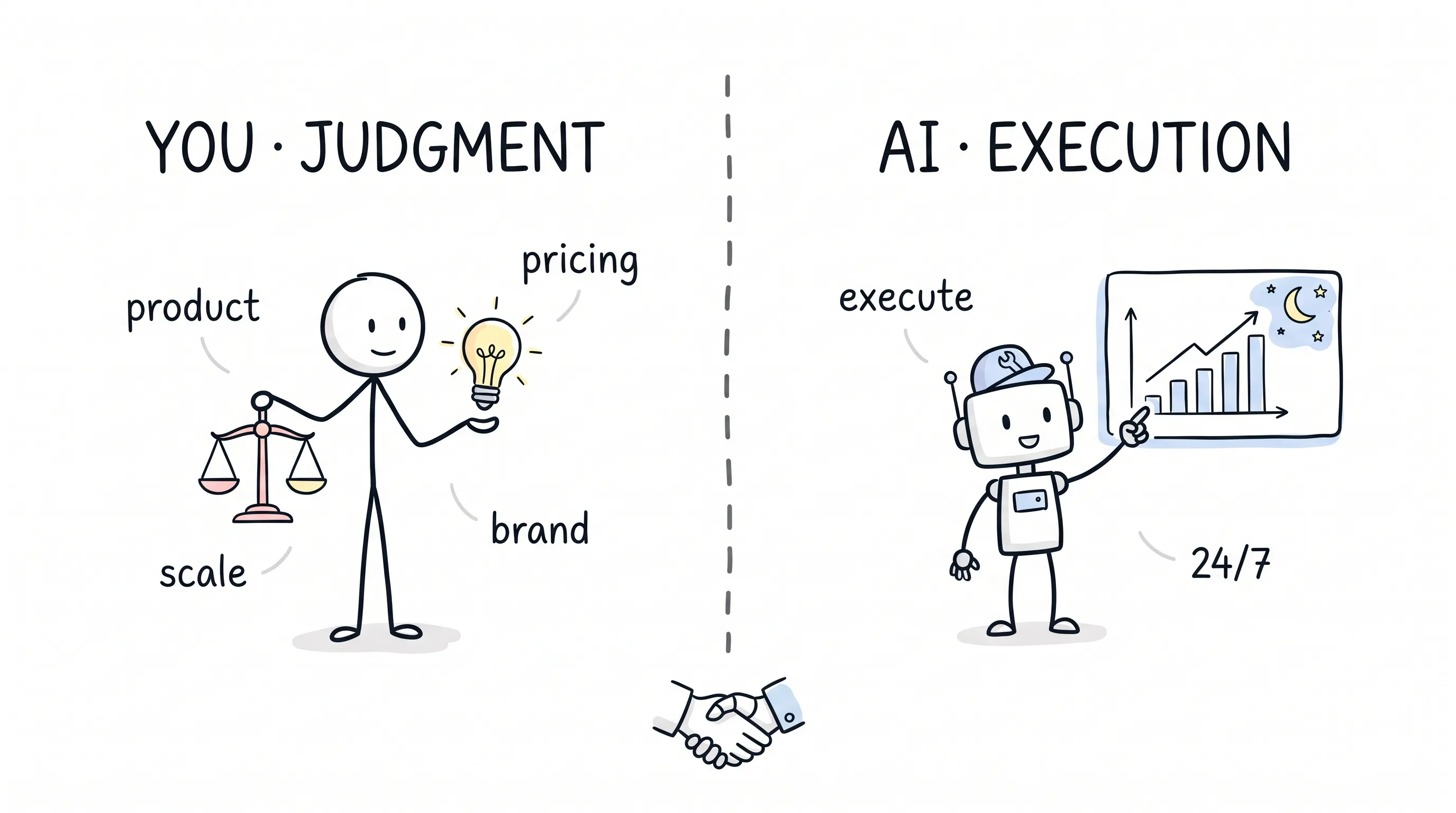
I said, most likely. And the time you save should have gone to the places that are actually valuable anyway: product, pricing, supply chain, brand.
The tools handle execution; you handle judgment.
That division of labor matters more than anything.
Here's to saying goodbye, sooner rather than later, to the nights you're still checking the dashboard in the small hours.
Continue reading
Related articles

It's 2026: Stop "Buying" AI Tools for Your Marketing Team — Start "Hiring" AI Agents
This learn article explains how AI agents differ from standalone AI tools in marketing, outlines three agent categories — build-your-own platforms, CRM-native agents, and vertical tools — and covers use cases across SEO, social media, advertising, and reporting, plus criteria for choosing one.

Did the Money You Spent on AI Marketing Ever Come Back?
A guide to measuring AI marketing ROI across three layers: ad reports, sales pipeline, and the financial ledger. Covers metrics such as ROAS and CPA, eight dashboard metrics, industry benchmarks, and common measurement mistakes.

How to Pick a Creative Automation Platform: First, Figure Out What These Eleven Actually Do
A learn article sorts eleven creative automation platforms — including Bannerflow, Celtra, Smartly.io, and Storyteq — into four functional groups and proposes five evaluation questions covering publishing reach, automation depth, ease of adoption, team fit, and verifiable evidence.