
15 B2B Marketing Automation Platforms — and the Bill Nobody Has Totaled Up
A learn article covering fifteen B2B marketing automation platforms grouped by team type, five questions to guide platform selection, usage practices such as segmentation, lead scoring, and attribution, six common failure modes, and a section on AI-native all-in-one platforms.
The other evening, an old friend who works at a B2B software company took me out to dinner. Halfway through the meal, he started sighing.
His company is just over two hundred people, with a five-person marketing team. Leads get chased by hand as they come in; emails go out one at a time. What prospects looked at on the website, and for how long? Sales has no idea.
He said: I want to get into marketing automation. But when I searched, it was HubSpot, Marketo, Pardot… dozens of platforms, every one claiming to be number one. He spent a whole evening reading and got more confused, not less.
I told him this deserves a proper walkthrough. So today we'll go through the fifteen platforms that most often land on shortlists — not just the platforms, but how to choose one, how to use it, and how these projects die.
Let's start with a question.
What Is Marketing Automation, Exactly?
Marketing automation means handing the repetitive, rule-bound parts of marketing over to a system.
What counts as repetitive and rule-bound?
Take lead nurturing. A stranger visits your website today; they won't buy right away. They need to read your emails, download your white papers, attend your webinars — and maybe, three months later, they'll finally reach out. A dozen-plus touches over those three months: five people can keep up with a hundred customers by hand. Can they keep up with ten thousand?
Take personalization, too. The email you send the procurement director of a hundred-person company and the one you send the procurement director of a ten-thousand-person enterprise should read completely differently. That kind of one-to-one tailoring is more than humans can keep up with — but a system can.
If CRM is the notebook where you record your customers, marketing automation is the assembly line.
The real problem with manual marketing isn't low efficiency. It's that it simply cannot scale.
So once a B2B company reaches a certain size, marketing automation isn't an elective. It's a required course.
All right, principle established. Fifteen platforms — how do we look at them?
Fifteen Platforms, One Map
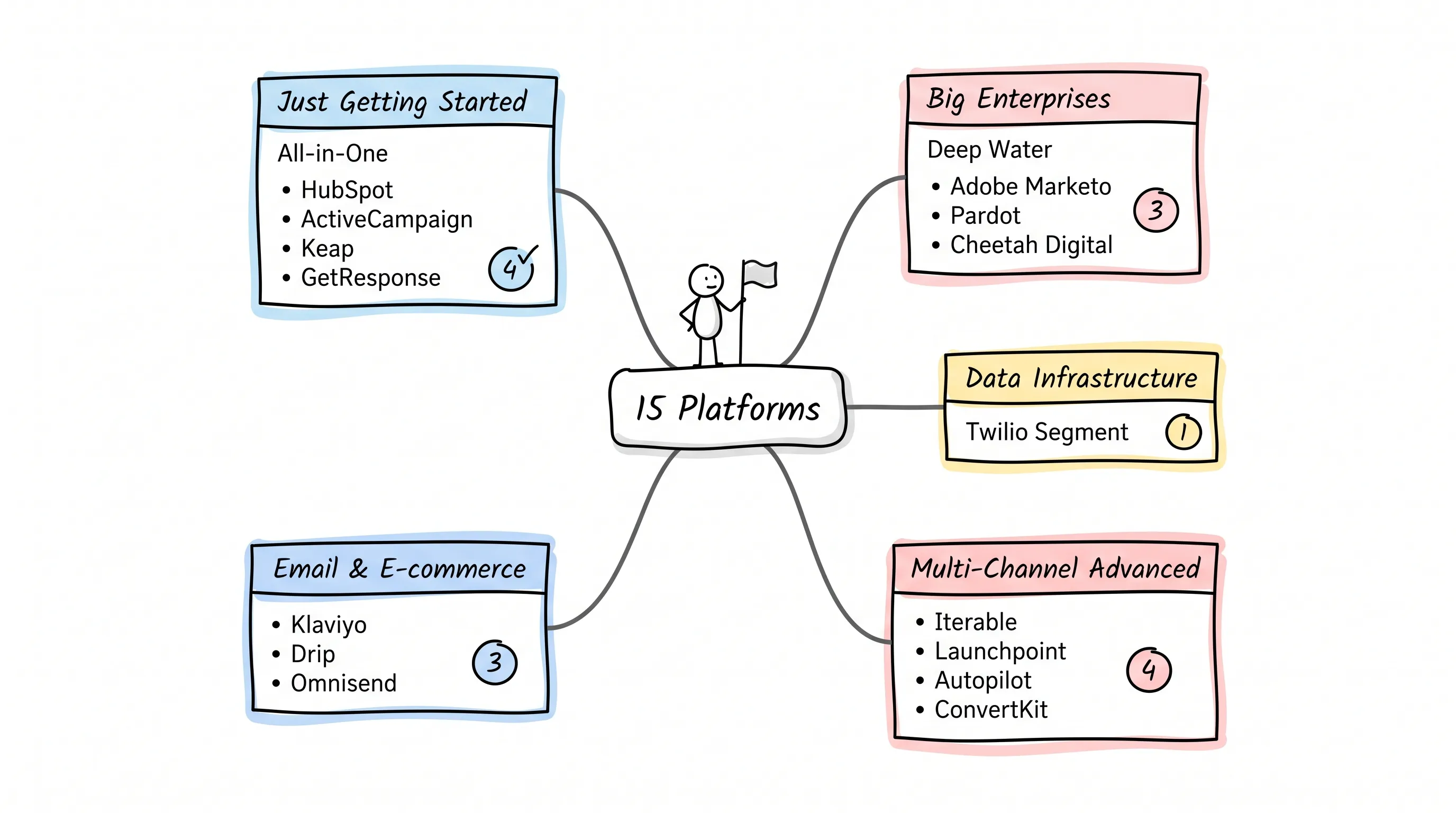
No rankings here; each has its own strengths. I've sorted them into five buckets by the kind of team you are. Start by finding the bucket you sit in.
Just Getting Started, Want One-Stop
HubSpot. Visual email editor, drag-and-drop landing pages, lead scoring, a built-in CRM, and a large app ecosystem. Its defining trait is ease of adoption: intuitive interface, abundant learning material. For small and mid-size teams that want marketing automation plus CRM in one package, HubSpot is almost always the first instinct.
ActiveCampaign. Also an all-in-one play, with strengths in behavior-based email triggers and lead scoring, plus a built-in CRM. Works for both B2B and B2C, with a friendly interface and solid training and support.
Keap (formerly Infusionsoft). CRM, email marketing, and sales automation sold as one bundle, with a visual campaign builder and e-commerce integrations. For small businesses: low barrier, friendly pricing.
GetResponse. Email, landing pages, webinars, CRM, SMS — a bit of everything. If your team runs webinars often, it's a natural fit.
Big Enterprises, Deep Water
Adobe Marketo. Advanced segmentation, dynamic content, tiered lead scoring, account-based marketing, revenue attribution — all enterprise-grade. But the learning curve is steep: you have to keep a dedicated marketing-ops team on staff just to stay in control of it.
Salesforce Pardot (now Marketing Cloud Account Engagement). Salesforce-native. If your CRM already lives on Salesforce, everything fits; if it doesn't, everything chafes.
Cheetah Digital. Advanced email marketing, behavioral triggers, dynamic content personalization, customer journey orchestration. Large enterprises that need deep behavioral-marketing capability should take a look; the learning curve is moderate.
The Data-Infrastructure Camp
Twilio Segment. Strictly speaking it isn't marketing automation — it's a customer data platform: it gathers customer data scattered across systems, resolves identities, then activates those audiences across your marketing channels, with 350-plus tool integrations. Very powerful, but you'll need developer resources to use it well. If your pain point is "our data is a tangled mess," look here first.
Born in Email and E-commerce
Klaviyo. Email plus SMS automation, dynamic segmentation, behavioral triggers, real-time analytics — and e-commerce integrations are its signature skill. But it leans e-commerce; for a pure B2B scenario, weigh it carefully.
Drip. Visual automation building, a built-in customer data platform, plenty of e-commerce features. A smooth pick for growth-stage companies doing email marketing.
Omnisend. Email, SMS, push, live chat — it has the multi-channel spread covered, easy to pick up, with good onboarding. Used mostly by e-commerce companies, though some growth-stage B2B teams use it too.
Multi-Channel Advanced Players
Iterable. Omnichannel coverage across email, SMS, and push, plus an experimentation platform and customer journey maps. Powerful, but with a real learning curve — built for mature marketing teams running multi-channel experiments.
Launchpoint (formerly Demand Gen). Email campaigns, lead tracking and analytics, segmentation, CRM integrations, a plain interface. Good enough for mid-size B2B teams doing email nurturing.
Autopilot. Its calling card is visual workflows — drag things around and the process takes shape. Teams that love what-you-see-is-what-you-get will love it.
ConvertKit. Crystal-clear positioning: built for creators. Tag-based segmentation, subscription growth tools, digital product management. For content-driven B2B, or anyone selling digital products, it's the right flavor.
That's the fifteen. But the story isn't over.
A New Species: AI-Native
The past two years have produced a batch of AI-native platforms, built on an idea completely different from the fifteen above.
Take Abmatic AI. What it does is fold the capabilities you'd previously need nine to twelve separate tools to assemble into a single platform: web personalization, A/B testing, de-anonymization of anonymous visitors (down to the specific "person," not just "some company"), agentic workflows, signal-adaptive AI outbound sequences, AI chat on your website, first-party plus third-party intent data, and advertising across Google, LinkedIn, and Meta. All modules share a single identity graph.
It targets mid-to-large B2B teams: two hundred to ten-thousand-plus people, watching fifty to fifty thousand target accounts. Two-way sync with Salesforce and HubSpot. From pixel installation to a fully running pipeline — measured in days, not quarters.
And the price? Starting at $36,000 a year. Three thousand dollars a month — a bit over twenty thousand yuan.
At this point you may be thinking: one platform replacing nine tools — imagine the savings.
I'd say don't get excited yet.
What it saves you is management overhead — not necessarily money.
What nine tools cost per year, you have to run the numbers yourself, then compare against $36,000. But there are things more expensive than money: nine tools means nine sets of accounts, nine copies of data, nine interfaces to wire together. If the data doesn't flow, your automation is automating nothing at all.
That said, don't flip to the opposite conclusion either — all-in-one isn't automatically better. Integrated suites are smooth but lock you in; point tools are sharp but leave you fragmented. Whichever stage you're at, that's where the answer is.
How to Choose? Answer Five Questions First
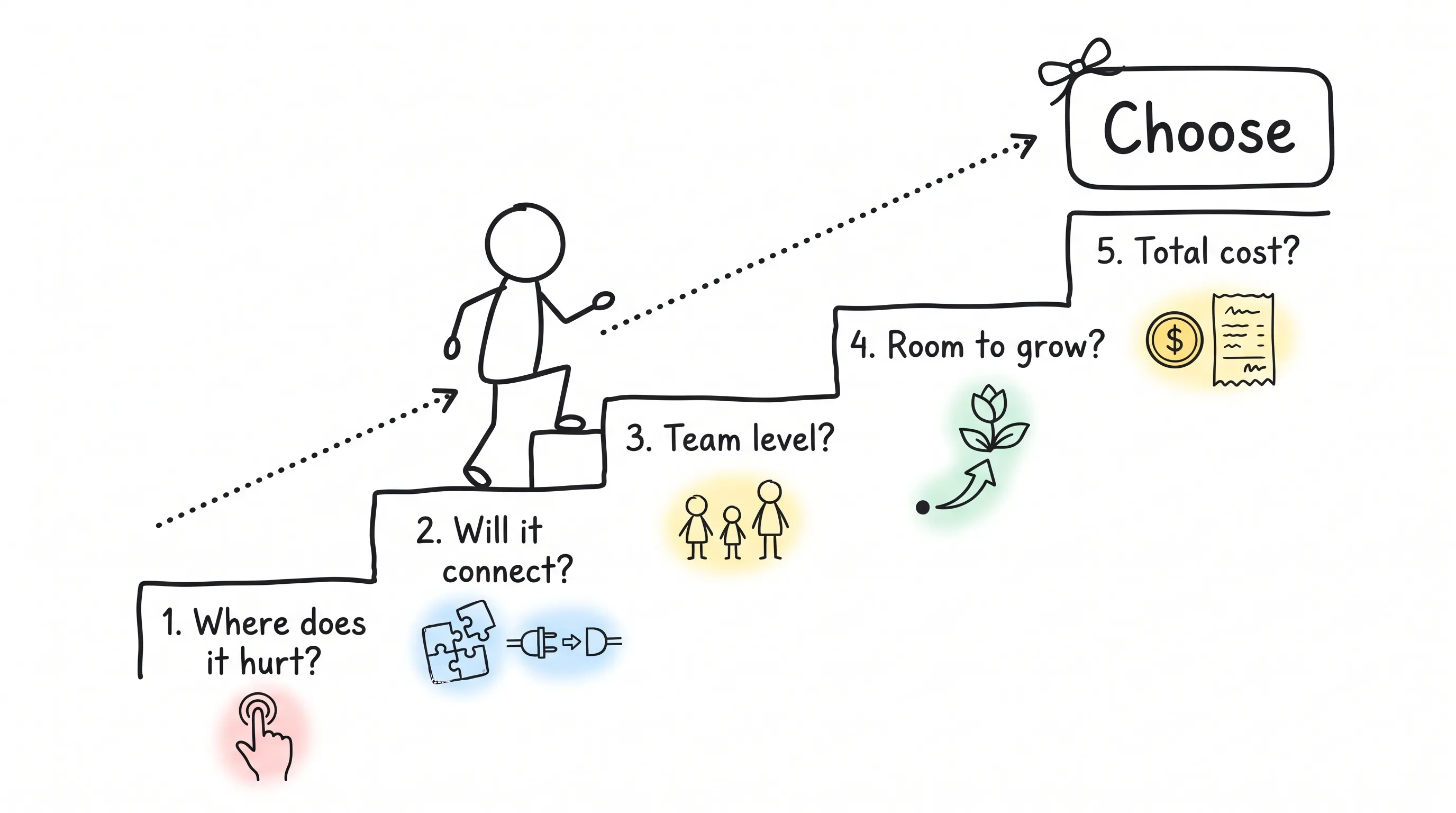
Question one: Where does it hurt most? Is it email you can't fine-tune, multi-channel that never gets moving, no lead scoring at all, or not even knowing who your visitors are? Find the finger that hurts the most first. Don't pay for features you'll never use.
Question two: Will it connect? Does it plug smoothly into your CRM, your data warehouse, your sales tools? If integration is botched, everything downstream becomes hand-carried data, and your automation turns into an automated porter.
Question three: What level is your team? A three-person marketing team shouldn't touch Marketo — you can't afford to feed it. Only a team with dedicated marketing ops can hope to master a complex system.
Question four: Can it keep up with your growth? Email is enough today. Will you need account-based marketing next year? Custom attribution the year after? A platform's extensibility decides whether you'll be migrating platforms again in two years.
Question five: What's the total cost? License fees are only the starting point. Implementation, integration, training, day-to-day operations — a whole line of them waiting behind. Some platforms are cheap to license and eye-wateringly expensive to implement; run the full tally, and the "cheap" one loses to the one that looked expensive.
Once You've Bought It, How Do You Use It?
Buying the tool only gets you to a passing grade. The same system produces multiples in growth for one team and leaves another sending piles of email that never reach the inbox. The difference lies in how you use it.
Segment your audience first. Slice by company size, industry, product fit, and engagement level. Don't expect one email to move everyone.
Then map the journey. Mark the key milestones from awareness to closed deal, and give each milestone, for each segment, its own automation flow.
Make content reusable. Build templates and components — one skeleton, many audiences. Writing from scratch for every batch? You'll never keep up.
Turn on lead scoring. Count both explicit behaviors (form fills, email opens) and implicit signals (company fit, account stage). When the score is high enough, hand the lead to sales. Every lead you hand over should be worth a salesperson's time.
Then, never stop testing. Email copy, send times, audience targeting, flow design — A/B test them one by one. Let the data decide, not the loudest voice in the conference room.
Finally, run attribution. How much pipeline and how much revenue did automation actually bring in? That number has to be computable. If you can't compute it, next year's budget will be decided for you — by someone else.
The Ways I've Watched This Die
The first: workflows built too complex. A five-layer nested automation that, three months later, even the person who built it can't decipher. Nobody dares touch it, so it gets torn down and rebuilt. Start simple; add a little at a time.
The second: lists never cleaned. Dead addresses and zombie contacts left uncleared, sender reputation sliding further by the day — the best email in the world won't reach the inbox.
The third: one-size-fits-all content. One email blasted to the entire database, and your open rate will honestly tell you the result. Slice by size, industry, and stage — and talk like a human to each one.
The fourth: orphaned leads. Leads that don't fit your ideal customer profile shouldn't be left to go moldy in a generic nurture stream. Either give them an exit, or hand them to whoever should own them.
The fifth: marketing and sales as two separate worlds. Marketing says, I delivered a thousand market-qualified leads (MQL — leads marketing has vetted as ready for sales). Sales says, those were all junk. The definition of that bit of industry jargon was never aligned, no feedback loop was ever built, and the more the automation produces, the more energy burns up in internal friction.
The sixth: data that never flows back to the CRM. Everything that happens inside the automation, if it doesn't stream into Salesforce or HubSpot, sales never sees it — which means it might as well never have happened.
Closing Thoughts
When that dinner ended, my advice to my friend was: get the process clear first, then pick the tool. Across fifteen platforms, the feature checklists look roughly the same. What actually separates the winners is whether you have a clear customer journey, a clean list, a lead definition aligned with sales, and a total bill you can actually reconcile.
What marketing automation demands was never the word "automation" itself.
It's putting the right content in front of the right person at the right moment; handing qualified leads over to sales in good order; and then proving that marketing earned back every cent it spent.
Here's hoping you, too, upgrade soon — from artisan workshop to automated factory.
Continue reading
Related articles

What Is an AI Marketing Agent? From "Using AI" to "Delegating to AI"
A learn article explaining what an AI marketing agent is, how it differs from rule-based automation, and which repetitive tasks such as lead qualification, reporting, and campaign monitoring can be delegated while humans keep key decisions.

Marketing Automation Is Shifting from "You Do It" to "You Say It"
This article explains how marketing automation is shifting from rule-based platforms that merely execute toward AI agents that plan, create, publish, and review campaigns, covering delegable tasks, underlying technologies, tool categories, adoption steps, and risks such as privacy and automating without strategy.

When AI Does the Creative, Mistakes Come in Batches Too
A learn article on the risks of using generative AI for marketing creative across brand, legal, compliance, and operational layers, with case examples and seven practices for review, rights clearance, documentation, and vendor governance.