
AI Made Content Infinite—and Made Trust Priceless
This article explains how AI-generated search answers are cutting organic clicks and making generic content invisible, arguing marketers should shift from a traffic mindset to evaluation-focused content built on first-hand experience, real reviews, and expert insight to earn user trust.
A few days ago I needed to look up a fairly technical question. I typed the keywords into the search box and hit Enter.
Right at the top of the results page sat an AI-written answer that explained exactly what I needed.
I read it for three seconds and closed the tab.
Guess how many websites I clicked into afterward?
Zero.
I'm not the only one who works this way. Search Engine Journal reported a set of numbers: once Google's AI Overviews rolled out, organic search clicks dropped by 38%; "zero-click searches"—where people never leave the results page and never click anything—climbed from 54% to 72%.
Put another way: of every 100 people who searched, 46 used to click through to some website. Now only 28 do.
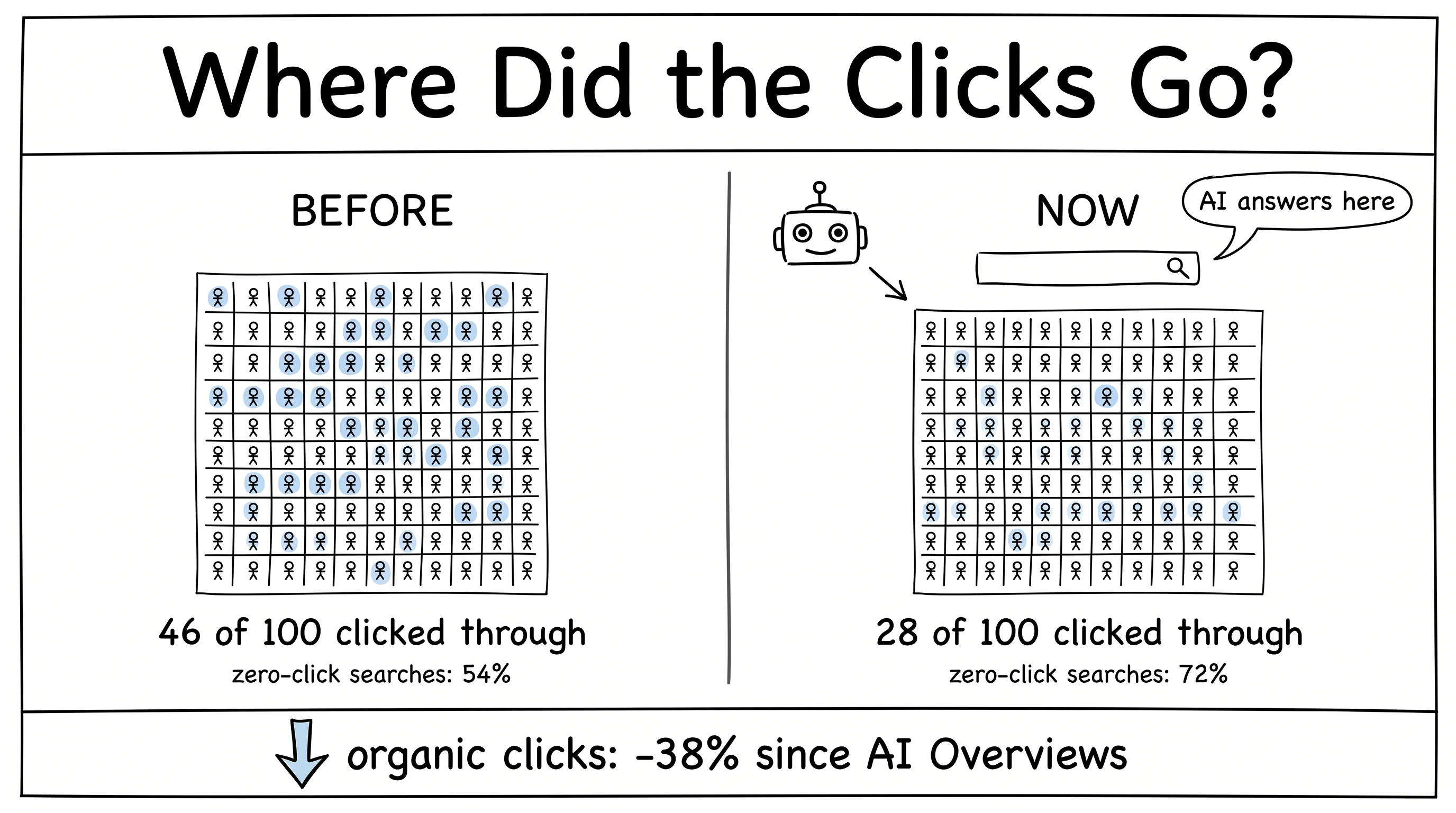
If you rely on content to pull traffic, these numbers should send a chill down your spine.
The content playbook of the traffic era is failing in droves.
AI Didn't Kill Content—It Killed Average Content
Many people say AI will kill content marketing.
I disagree. AI can't kill content; it kills mediocre content.
What is mediocre content? The kind AI can churn out a hundred pieces of in a minute: generic SEO articles, surface-skimming industry commentary, textbook-style explainers, and social media posts that repeat the same thing everywhere.
These pieces all share one trait: they're all saying the same thing.
Used to be, you could write "What Is Content Marketing," rank on page one of search results, and harvest free traffic for two years. Now? AI reads the answer out right in the search box. Users never even see your headline.
Brands still producing the kind of content AI can generate at a glance are becoming invisible.
On May 15, Google itself published an AI optimization guide, and it was remarkably blunt: don't create the kind of stuff generative AI can produce offhand. Then what should you write? Original opinions, first-hand experience, homework done deep. Google even said that doing this has a bigger impact on your visibility in AI search than every other recommendation in the guide combined.
Put plainly: photocopies are worthless now. Handwritten originals are what's valuable.
We're Living Through a "Trust Recession"
There's another side to this.
Users aren't just being kept inside the search box by AI. They're also growing more and more wary.
AI-generated fake images, synthesized videos, hallucinations delivered with a straight face, fake news flying everywhere… The more information there is, the less people dare to believe.
The 2025 Edelman Trust Report has a number on this: nearly 70% of consumers worry that false information is being deliberately used to mislead the public.
Seventy percent. That number carries a lot of weight.
That's why I say marketing is going through a "trust recession."
What do you do in a trust recession? Same logic as an economic one: whatever's scarce gets expensive.
AI can drive the cost of information to zero—and with the same stroke send the value of "authentic" through the roof.
Content can be generated without limit. Authenticity can't. What's scarce has always been worth money.
Customers No Longer Want Answers. They Want Confidence.
Content used to follow a simple formula: publish more articles, sprinkle more keywords, grab more traffic, then fence people into owned channels and nurture them slowly.
The underlying assumption of that playbook: customers lack information.
Do customers still lack information? Not at all. Pick up your phone and the answers overflow.
What they lack is the confidence to make up their minds.
Is this product actually any good? Does this company really understand my problem? Will I regret buying this way?
Think about the last time you bought something expensive—how many reviews did you scroll through first?
So the role of content has changed. It used to be "attract visitors." Now it's "help people finish making that decision."
Whichever brand can give users confidence is the one AI recommendation systems will hand traffic to. This isn't my speculation. The digital marketing agency Eyeful Media looked at its own B2C clients' data: rankings inside AI Overviews are up 104% this year.
The direction is already mapped out: shift your content strategy from a "traffic mindset" to an "evaluation mindset."
The Content Value Pyramid Is Being Reordered
Now that AI has stomped the barrier to making content flat into the floor, what kind of content is still worth anything?
The answer is a new pyramid. At the base sits awareness content—the kind AI can produce offhand—and it's racing toward zero. Going up, there are three things only "you" can create.
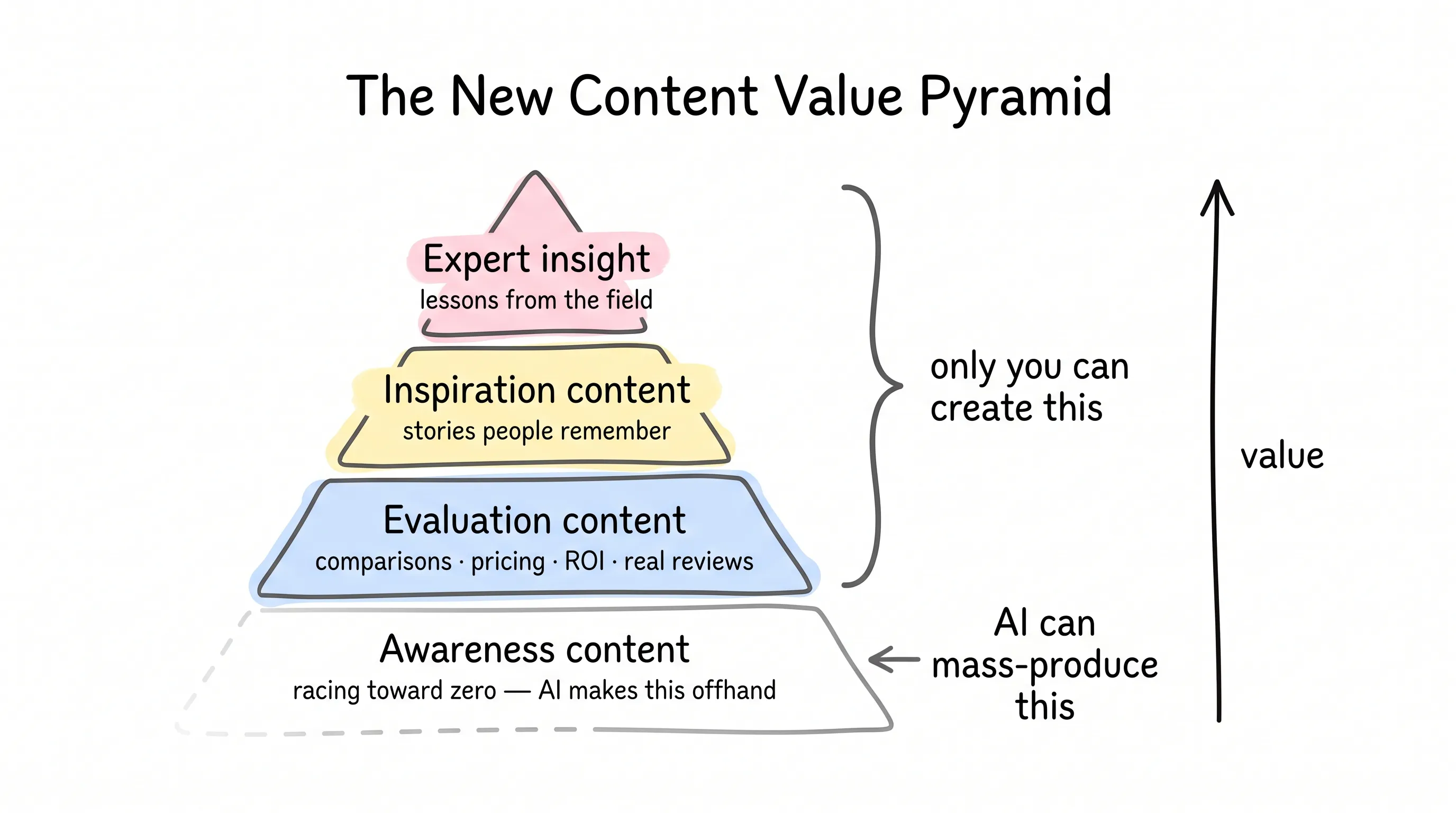
First, evaluation content. It helps users compare options, weigh risk, and commit: product comparisons, pricing breakdowns, how to calculate ROI, implementation guides, reviews from real people, long-term usage stories. B2B companies do it with webinars and client demos; B2C brands do it with buying guides and genuine reviews. Different formats, same job: thinking "is it worth it" through on the user's behalf.
Second, inspiration content. Stories, emotion—things people can't forget long after they've finished reading.
Third, expert insight. Lessons earned on the front lines, pitfalls actually stepped in, judgments validated by results.
Why is evaluation content worth the most? Because AI search systems can answer "what is it" on their own, but they increasingly love to cite content that answers "is it worth it." The reason is simple: the latter grows out of real experience, and AI can't manufacture that.
Eyeful Media's own numbers back this up. Since the start of 2026, AI referral traffic from large models like ChatGPT, Gemini, Claude, and Perplexity has grown 190% year over year across its B2B client portfolio. The driver: exactly this batch of mid-funnel evaluation content.
Even more interesting is the quality. Traffic referred by AI is still small in total volume, but the website conversion events it generates run 534% above the omnichannel average.
534%. A handful of this traffic is worth a whole sack of the other kind.
AI Can Do the Work for You—It Can't Do the Living for You
At this point you might ask: so should AI still be used at all?
Of course it should. For organizing research, boosting efficiency, accelerating production—lean on it hard.
But one thing needs to be clear: AI can summarize the world's information, but it can't summarize the pit you personally stumbled into. It has all of humanity's data and none of your time in the field.
Technology will keep changing. The algorithms may be a whole different set next year. But the human craving for "trustworthy"—from Stone Age marketplaces to today's search box—hasn't changed for a single day.
AI will decide how people discover a brand.
But who people decide to trust—that will always be a human call.
In the end, content isn't a contest of output volume. It's a contest of trust.
Here's wishing you, too, an early start on banking the kind of trust AI can't photocopy.
Continue reading
Related articles

It's 2026: Stop "Buying" AI Tools for Your Marketing Team — Start "Hiring" AI Agents
This learn article explains how AI agents differ from standalone AI tools in marketing, outlines three agent categories — build-your-own platforms, CRM-native agents, and vertical tools — and covers use cases across SEO, social media, advertising, and reporting, plus criteria for choosing one.

What Is GEO? How Your Brand Gets "Mentioned" in the Age of AI Search
An explainer on GEO (Generative Engine Optimization) for e-commerce and DTC brands: how it differs from SEO and AEO, why AI answers shape brand visibility, and eight practices covering question-focused content, consistent brand messaging, structured pages, external evidence, comparisons, and AI mention tracking.

AI Is Already Making Decisions for Your Customers. Are You on the List?
A learn article explains GEO (Generative Engine Optimization): why AI-generated answers now shape which brands customers see, and how SEO fundamentals, entity clarity, citable evidence, and monthly measurement affect visibility in AI answers.