
In 2026, Why Does AI-Written Content Still Deserve to Rank at the Top of Search?
A learn article explaining what AI content marketing is and why it matters in 2026, covering five rules for AI-assisted content workflows, common pitfalls such as mistaking efficiency for effectiveness, and the conditions under which AI-written content can still rank well in search.
A few days ago, a friend of mine who runs a cross-border e-commerce business invited me out for tea.
He told me that this year he cut his content team from five people down to two, and handed the other three people's work to AI. And guess what? Traffic didn't drop — it grew.
He was looking pretty pleased with himself when he said it.
I said, don't celebrate just yet. Are people actually reading those AI-written articles? Or are they just parked in the search results, baiting a click?
He went quiet.
This is the scene playing out at plenty of companies in 2026: content production is ten times faster, but the real value of content is quietly opening up a brand-new gap.
What Is AI Content Marketing?
First, let's get the concept straight.
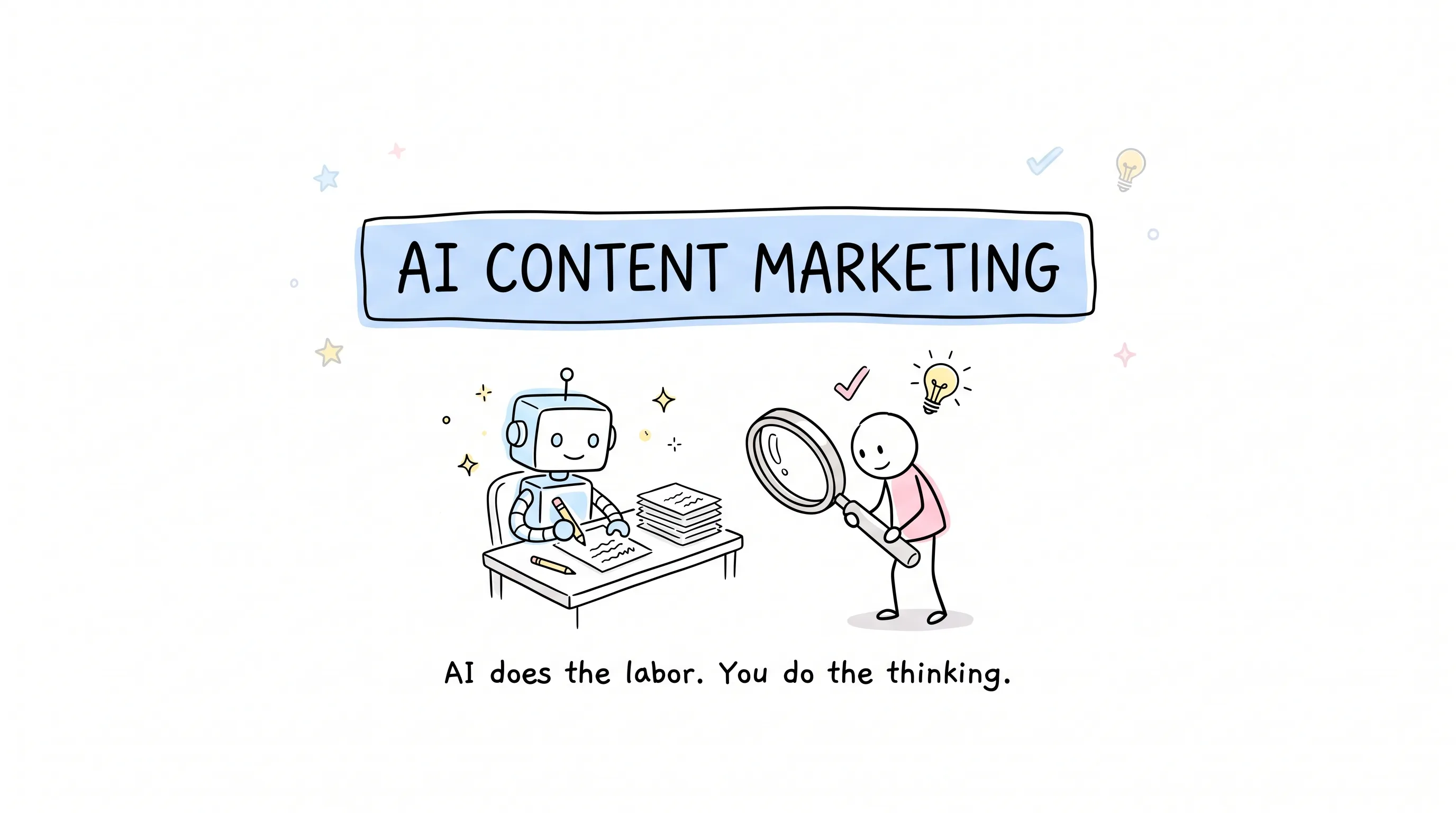
What is AI content marketing? It means using AI tools to do the work of content marketing: finding topics, writing first drafts, doing search engine optimization (SEO), and reviewing performance data.
Note: AI is only here to do the labor. The thinking is still your job.
HubSpot calls this transformation a "workflow upgrade." In plain terms: before, one person got one thing done a day; now, one person with AI gets ten things done.
Why Does This Suddenly Matter in 2026?
Three reasons.
First, speed. AI can turn out a draft, an outline, or a batch of topic ideas in minutes. Where teams used to publish one article a week, they now publish one a day. The publishing cycle has been compressed, and the team gets a breather.
Second, search optimization has been broken down into grunt work. Where to put keywords, how to write titles, how to lay out internal links, whether it reads smoothly, whether it matches search intent — the things that once depended on a veteran's instinct, AI can now check for you item by item.
Third, data. AI can watch user behavior and search trends, and tell you which topics will take off and which should be cut. It used to be guesswork; now it's math.
Think about what happens when these three stack up. Companies using AI: output up, coverage wider, rankings higher. Companies not using AI: still pitting human labor against computing power.
How Do You Actually Do It? Five Rules
-
Hand topic research to AI; keep judgment for yourself. AI is great at mining user intent for hot topics and related keywords — it knows what people are searching for. But "is this topic worth writing for us?" is something it cannot answer.
-
AI writes the first draft; a human must edit. This is the most important rule, and I'll come back to it. Blog posts, social media, ad copy, email — AI can draft all of it. But a draft is not a finished product; accuracy and originality need a human gatekeeper.
-
Let AI manage structure. Heading hierarchy, keyword placement, internal link suggestions, readability — the fundamentals of SEO, which AI handles fast and steady.
-
Personalization. AI can slice your audience into segments so different people see different content. The same email can speak two entirely different scripts to loyal customers and new visitors. That's how open rates climb.
-
Automated distribution. When to publish, and to which platform — AI can work out the schedule and run it on autopilot, keeping your content consistently visible.
Where Are the Traps?
The four I see most:
One, hand everything to AI, don't edit, publish straight away. Two, output goes up while quality goes down — screens full of bland, generic content that leaves no mark. Three, dropping SEO fundamentals on the assumption that AI handles it automatically. Four, mindless automation — three automated workflows today, five tomorrow, and no strategy anywhere.
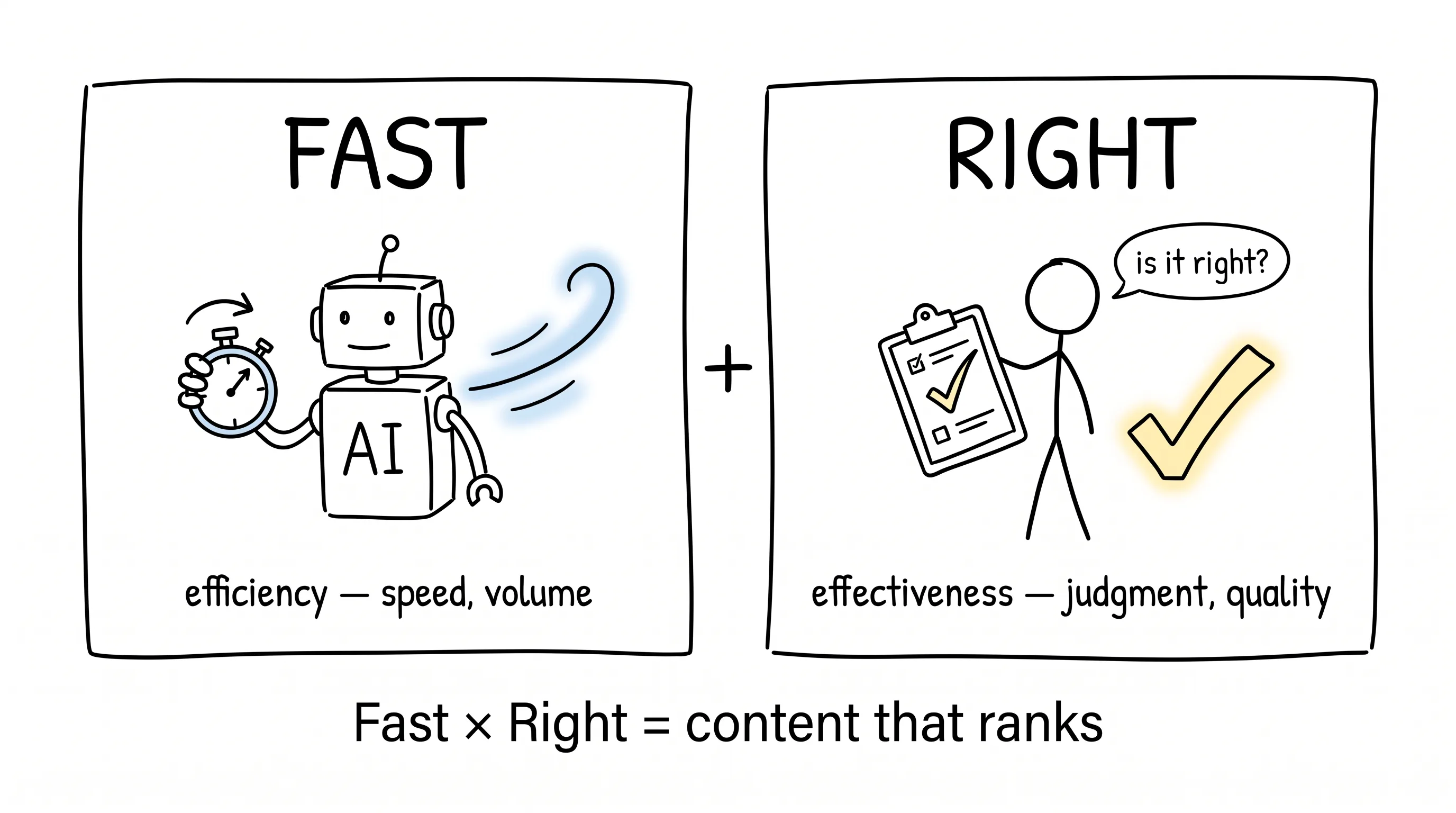
All four traps are the same disease: mistaking "efficiency" for "effectiveness."
AI gives you efficiency. Effectiveness takes human judgment.
AI is in charge of fast. Humans are in charge of right.
Will Search Rankings Actually Get Better?
Yes — with conditions.
What search engines reward has never changed: useful, clearly structured, genuinely answering the searcher's intent. AI can help you nail all three down — provided you treat it as a tool, not as an author.
Flip it around: if you use AI to pour out three hundred assembly-line articles a month that nobody wants to read, sooner or later the search engines will make you pay. After 2025, every search engine's ability to recognize low-value, mass-produced content is visibly getting stronger.
Starting Today, How Do You Set It Up?
Five steps: set goals and audience; let AI do the research and produce first drafts; tighten the SEO; watch the data; keep iterating.
None of these steps is mysterious. The hard part is watching the data and revising, over and over. Don't let AI become your excuse to slack off.
One Last Thing
Halfway through the tea, my friend asked me: so should I hire back the three people I cut?
I said, no need. But change one role: the people you keep should stop being "writers" and start being "editor-plus-strategists." Let AI do the writing; let humans set the tone, keep the gate, and make the call.
AI is responsible for making the content. Humans are responsible for making it worth making.
That, as I understand it, is AI content marketing.
And here's my wish for you: in an era when everyone writes with AI, may what you write still be something people read to the very end.
Continue reading
Related articles

It's 2026: Stop "Buying" AI Tools for Your Marketing Team — Start "Hiring" AI Agents
This learn article explains how AI agents differ from standalone AI tools in marketing, outlines three agent categories — build-your-own platforms, CRM-native agents, and vertical tools — and covers use cases across SEO, social media, advertising, and reporting, plus criteria for choosing one.

What Is GEO? How Your Brand Gets "Mentioned" in the Age of AI Search
An explainer on GEO (Generative Engine Optimization) for e-commerce and DTC brands: how it differs from SEO and AEO, why AI answers shape brand visibility, and eight practices covering question-focused content, consistent brand messaging, structured pages, external evidence, comparisons, and AI mention tracking.

AI Is Already Making Decisions for Your Customers. Are You on the List?
A learn article explains GEO (Generative Engine Optimization): why AI-generated answers now shape which brands customers see, and how SEO fundamentals, entity clarity, citable evidence, and monthly measurement affect visibility in AI answers.