
SEO Isn't Dead. But the Game Has Changed for 2026.
A learn article on how SEO is changing in 2026, covering AI-assisted content workflows, E-E-A-T evidence, brand mentions and dark traffic, intent-based content clusters, and metrics beyond clicks, drawing on cited industry surveys.
A few days ago, a friend of mine — an entrepreneur who runs a content business — grabbed dinner with me. He'd barely sat down before hitting me with the question: "So, is SEO just unwinnable now? AI answers everything directly, users search, get their answer, and leave. Who's still clicking links?"
I said, "Hold on. The answer to that question is worth more than you think."
SEO isn't dead. What died is the era when any old piece of content could pull in traffic.
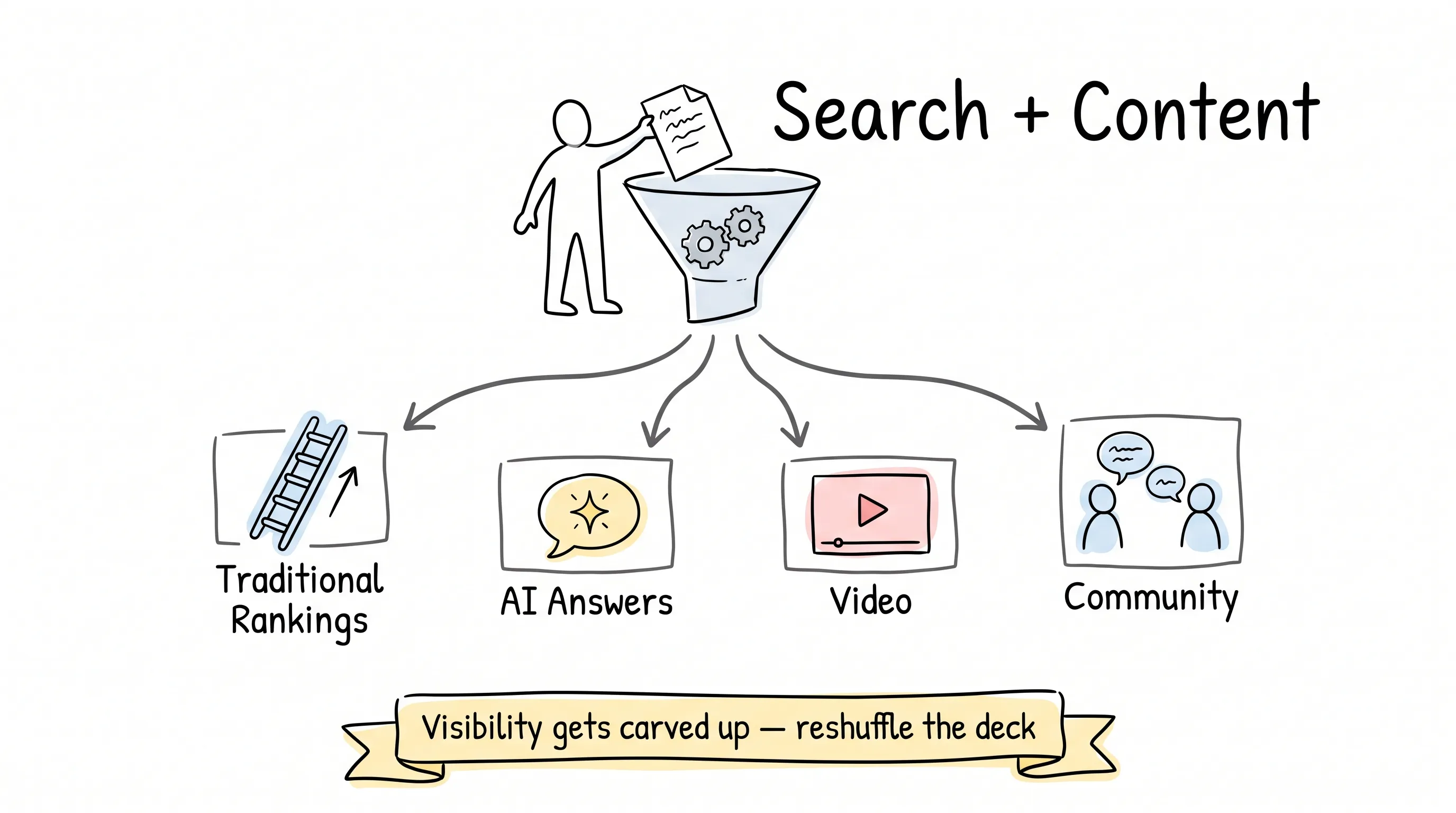
Why do I say that? I recently stacked up the industry surveys I'd been reading and went through them one by one, and one thing jumped out: search and content are no longer two separate lanes. They've grown into a single machine. Your visibility gets carved up and parceled out among traditional rankings, AI-generated answers, video platforms, and community discussions.
That sounds scary. But read on and you'll see: every time traffic gets fragmented, it's a chance to reshuffle the deck.
The First Thing: Everyone Uses AI. The Edge Lies Elsewhere.
What does "using it well" actually mean?
Start with a few numbers. Siege Media ran a survey: in 2025, 90% of content marketers planned to use AI to assist with content. HubSpot's number is even sharper — about 94% of marketers plan to bring AI into their content workflows in 2026. And SEO.com's take is that by 2026, AI will be everywhere in the workflow: finding topic gaps, building clusters, drafting outlines, editing copy — its fingerprints on all of it.
90%. 94%. What does that tell us?
That AI is no longer a moat. Your competitors have it too.
What actually separates winners from losers isn't which tool you pick — it's whether you have a process.
Teams with a process let AI produce the first draft, then humans hold the gate: verify the facts, swap in their own examples, double-check the takes. Teams without a process just publish whatever AI hands them. Short term, the second group looks much faster. Long term, they're slowly burning through their own credibility.
So my advice is one line: let AI handle speed; let humans handle trust.
Anything that touches facts, case studies, or positioning must pass through a human. Pair that with a minimal quality checklist: Did you verify the facts? Did you link to primary sources? Did you show the author's expertise? Does this piece say anything nobody else has said?
The Second Thing: E-E-A-T Went From Bonus Points to the Passing Grade
What is E-E-A-T? Experience, Expertise, Authoritativeness, Trust.
Google has been shouting this word for years, and most people filed it under "search engine optimization guidelines," glanced at it, and moved on. But its nature has changed now.
Good writing is just the passing grade. What actually separates you is the evidence behind the article. Who wrote this? Why are they an expert on it? Does anyone vouch for them?
Siege Media's survey lists "ranking is hard" and "matching intent is hard" as the two biggest headaches for content people — and the key to breaking through is precisely putting E-E-A-T at the center of your strategy. Marketer Milk puts it more bluntly: it's the most important ranking trend they see for 2026, and the way to act on it is more interviews, more reviews, more credible mentions.
How do you actually do it? Three moves.
First, add an "evidence block" to your key pages: who wrote it, what qualifies them, who reviewed it, what they cited — all laid out in the open.
Second, build assets that others want to cite: industry benchmark data, product teardowns, templates, small tools. These things attract links naturally.
Third, go do podcasts, partnerships, digital PR. Don't dismiss it as a vanity project. Third-party mentions are distribution infrastructure.
The Third Thing: They Stopped Clicking. Now What? Watch Your Share of Mentions.
This is where a lot of people feel the most anxiety: traffic numbers look fine, but attribution keeps getting blurrier. Where should the money go? You're flying blind.
How blind? Siege Media's 2025 survey says 66.5% of content marketers don't know how to allocate their resources. Nearly two-thirds.
SEO.com called out one thing by name: dark traffic. Dark traffic is when a user sees you in an AI answer, doesn't click through, then turns around and searches for your brand name.
This is the subtlest shift of all: users may never click your link, but they remember your name. Is that a win or a loss? I'd call it a win.
So stop staring at clicks. Watch these instead: Is branded search growing? In how many sales calls did the prospect mention "I've read your articles"? Are subscriptions growing?
Then add one internal report for yourself: which pages are being cited externally, which topics are showing up in AI answers, which assets are actually earning links. Answer those three questions once a quarter.
The Fourth Thing: Write Less, Write Better
The "publish more" road is a dead end now.
The data says so too. In that same Siege Media 2025 survey, the two things content people worry about most: 77.6% worry about rankings, 70.6% worry about matching user intent.
SEO.com's prescription is called micro-intents. The idea: behind any single keyword, there may be several different versions of "what does this user actually want to do right now."
What to do? Two things.
First, build "content clusters" around real intent. One core page, a few supporting pages, plus citable evidence assets — all interlinked. The effort you put into architecture early on makes every later piece more valuable.
Second, start pruning. Those vague, duplicative, no-substance pages — merge them or delete them.
Fewer pieces — but every one lands.
The Fifth Thing: Blogging Isn't Obsolete. But It Has Changed Shape.
A lot of people say blogging is dead. The data disagrees.
HubSpot's report says that in 2025, blog posts were the third most-used content format among marketers, at 38%, and still sitting in the top five for ROI. Heading into 2026, marketers plan to keep investing in them, alongside video-heavy content and UGC.
But there's a catch: plain-text pages are losing ground, because the search results page stopped being ten blue links long ago. It's now a mix of AI answers, videos, images, and community discussions.
So the right posture for a blog is to be a "hub." One core article, paired with a summary, images, a short video, a case study, plus internal links down to your deeper pages.
Then get serious about reuse. One good article can become a long LinkedIn post, a short video, a live talk, a downloadable checklist.
Write once, use it five times. That's the real value proposition of blogging today.
The Sixth Thing: A Trust Ecosystem Beats an Island of Content
What's a trust ecosystem?
You published an article — great. But you've also talked about it on podcasts, interviewed frontline practitioners, shared your behind-the-scenes work logs. These signals interlock and all point to the same conclusion: this company actually knows its stuff.
That's an ecosystem.
A Content Marketing Institute (CMI) expert roundtable ranked this as the most worthwhile thing to do in an AI-saturated environment: interviews, behind-the-scenes stories, expert insights. CMI's enterprise research has another number: 61% of enterprise marketers say their content strategy got better over the past 12 months. The main driver was strategy refinement, at 73%, plus reorgs and technology upgrades.
Notice: it's refinement, not a teardown.
Good strategies are grown, not swapped out.
The Seventh Thing: Budgets Didn't Shrink. The Scrutiny Got Sharper.
The good news: the budget is still there. Siege Media's survey shows 88.2% of teams saw budgets increase or stay flat from 2024 to 2025, and 11.3% of teams plan to spend over $45,000 a month in 2025.
The bad news: the boss has started asking "why, exactly?"
So tie your content to a small number of measurable business outcomes: pipeline contribution, qualified leads, retention, ammunition for sales.
And one more: build content around high-intent questions. Stop circling generic knowledge pieces.
A 2026 Homework Sheet You Can Copy
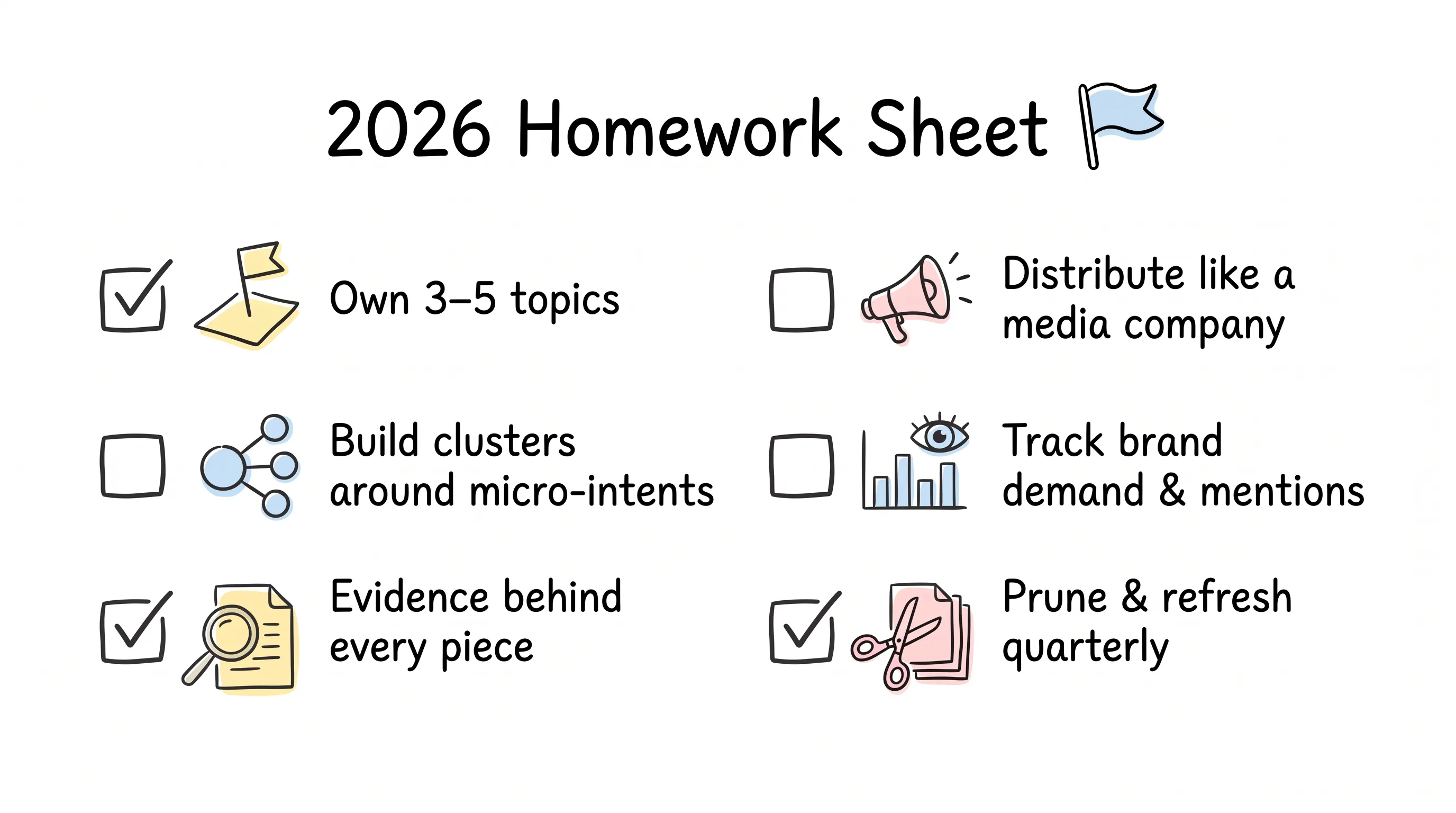
After all that, if you only take away one page, take this one:
- Pick 3–5 trustworthy topics you want to "own." Three to five — not thirty.
- Build content clusters around micro-intents, with one flagship piece per cluster.
- Back every piece with evidence: author credentials, primary sources, case studies, third-party mentions.
- Distribute like a media company: video clips, communities, partners.
- Upgrade your metrics: brand demand, assisted conversions, share of mentions. Stop watching only clicks.
- Refresh, merge, and prune once a quarter, and keep the site lean and mean.
Finally, Back to My Friend's Question
As dinner was wrapping up, I left him with one last thought.
Whether SEO is dead doesn't actually depend on the algorithm. It depends on whether what you've built in the past can stand up to scrutiny. AI has flattened the living space for generic content — and at the same time raised the payoff for something else: content with evidence, with a voice, with connections.
The SEO contest of 2026 isn't about who writes more. It's about who deserves trust more.
Do a little less, do it a little better, and make it a little easier for people to believe you.
It's that simple. And that hard.
Continue reading
Related articles

It's 2026: Stop "Buying" AI Tools for Your Marketing Team — Start "Hiring" AI Agents
This learn article explains how AI agents differ from standalone AI tools in marketing, outlines three agent categories — build-your-own platforms, CRM-native agents, and vertical tools — and covers use cases across SEO, social media, advertising, and reporting, plus criteria for choosing one.

What Is GEO? How Your Brand Gets "Mentioned" in the Age of AI Search
An explainer on GEO (Generative Engine Optimization) for e-commerce and DTC brands: how it differs from SEO and AEO, why AI answers shape brand visibility, and eight practices covering question-focused content, consistent brand messaging, structured pages, external evidence, comparisons, and AI mention tracking.

AI Is Already Making Decisions for Your Customers. Are You on the List?
A learn article explains GEO (Generative Engine Optimization): why AI-generated answers now shape which brands customers see, and how SEO fundamentals, entity clarity, citable evidence, and monthly measurement affect visibility in AI answers.