
What Is GEO? Your Brand Needs to Live Inside AI's Answers
An explainer on GEO (Generative Engine Optimization): how AI platforms decide which brands to cite, how GEO relates to SEO, and a five-step service methodology with client case examples.
I've recently noticed that one of my habits has completely changed.
Whenever I hit a problem, I no longer open a search engine and stare at ten blue links, clicking through them one by one. I just ask AI. I ask ChatGPT, I ask Perplexity. It gives me an answer, I read it, and the matter is settled.
One day over dinner, I got talking about this with a friend who runs a business. He said he does the same. Then he suddenly put down his chopsticks and asked me:
"Tell me — when AI answers other people, it mentions my competitors. It doesn't mention me at all. What am I supposed to make of that?"
I told him this problem is far more serious than "my website dropped two spots in the rankings."
What Is GEO?
GEO stands for Generative Engine Optimization.
Put simply, it means making your brand easy for AI platforms like ChatGPT, Gemini, Perplexity, and Google AI Overviews to understand, trust, and cite. A user asks a question, the AI generates an answer, and your brand shows up in the answer — that's GEO done right. If you're absent from the answer, no matter how beautiful your website looks, it counts for nothing.
You might ask: isn't that just SEO?
No. There's a crucial difference.
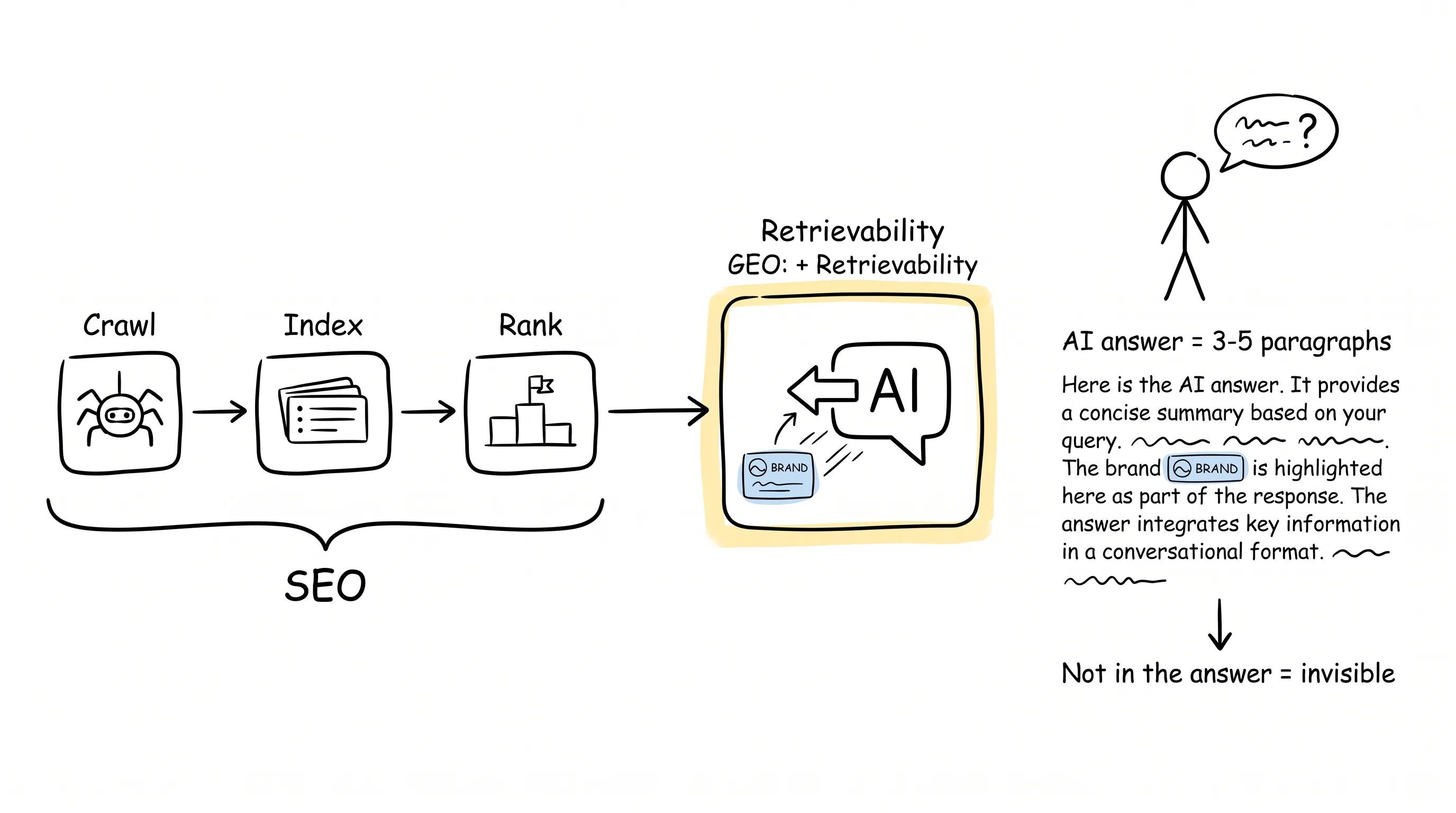
Traditional SEO is about three things: whether you can be crawled, whether you can be indexed, and whether you can rank. On top of those three, GEO adds a fourth pillar:
Retrievability: at the moment the AI generates its answer, can it find you, trust you, and choose to bring you in first?
Think about it: search engines rank; AI answers. With ranking, a hundred results is fine — users pick for themselves. With answering, the answer is only three to five paragraphs; there's no room for the twentieth result. If you don't make it into the answer, you don't exist.
How Does AI Decide Whether to Mention You?
This is the most counterintuitive part of the whole story.
Many people assume AI answers are copied from your website. Wrong. Large language models don't just look at your site. They learn from the entire internet: knowledge graphs, media articles, review platforms, industry directories — even the discussions on Reddit and Quora are on their reading list.
And they are entity-first.
What is an entity? The model treats your company, your products, your people, and your industry as individual "concept nodes." First it figures out who you are, what you do, and which topics you're connected to — then it decides whether to mention you in an answer.
This means the signals that influence AI are scattered across the whole web: Do you have a clear entity definition? Structured data? Credible third-party mentions? Content that's been updated recently? Authors who are real people with real titles? The industry calls this bundle E-E-A-T — Experience, Expertise, Authoritativeness, Trustworthiness.
The good news: you can actively cultivate these signals. The bad news: the vast majority of companies haven't even started.
One Company Made This Into a Business
Intero Digital, a US digital marketing company, specializes in GEO services and even gave its own methodology a name: Intero GRO™.
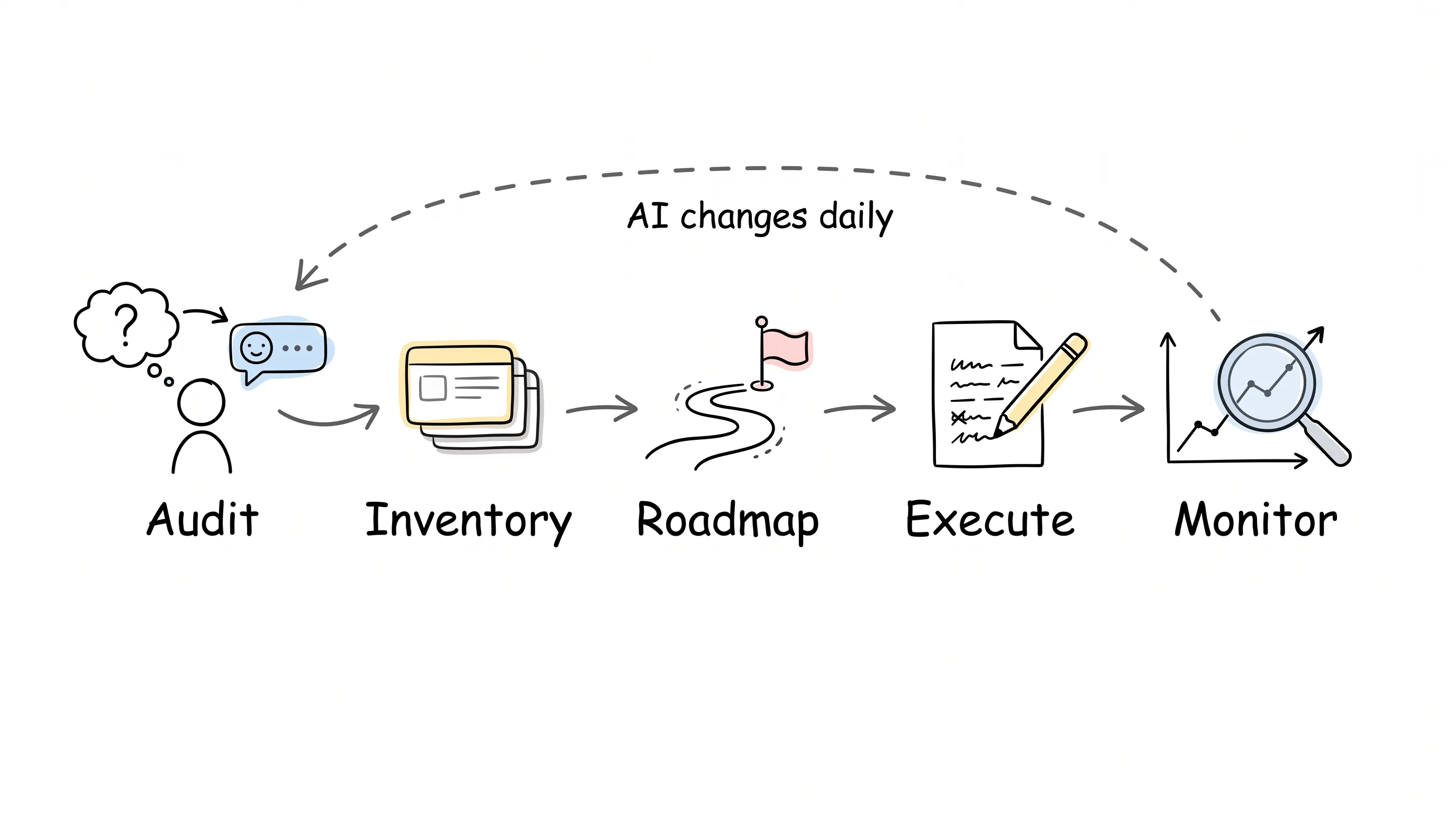
Their playbook has five steps. Let me walk you through it — see whether it sounds like a complete battle plan:
Step one: a checkup first. Search your industry's questions in ChatGPT, Gemini, Perplexity, and Copilot, and see how the AI describes you, who it mentions alongside you, and whose material it cites. Get a clear picture of the current state.
Step two: take inventory of your content assets. Of your existing content, what needs to be revised, what needs to be added, and what should be linked together.
Step three: set the roadmap. Not one template to serve all clients, but identifying the few opportunities most likely to move the visibility needle.
Step four: execute. Restructure content, run entity optimization, publish industry coverage, and take part in community discussions.
Step five: keep monitoring. AI platforms change every day — the sources that cite you today might be gone tomorrow. So you keep tracking: Is the AI mentioning you? Is the tone right? How much traffic is coming from AI channels?
And the results? Look at the numbers.
A cookware brand saw its generative search visibility grow 5,665%. You read that right — more than fifty-six times over. And traffic from AI channels grew 189% year over year.
Global Industrial, an industrial products company, went from zero to more than 1,200 appearances a year in Google AI Overviews, with revenue from organic traffic up 24%.
And TRACOM Group, a workplace training and assessment company, saw engagement from AI-channel users surge 1,214%.
Impressive. But the case that really made me feel "this is where the real opportunity opens up" is a different one.
Freshpet, a fresh pet food brand. They found that on certain AI platforms, asking about Freshpet would surface false information. And once the AI has learned something wrong, it stays wrong — with no one to correct it. Intero Digital helped them correct the misinformation in AI answers, bit by bit.
Let that sink in. In the AI era, brands don't just compete to be mentioned — they also have to manage how they are described. AI gets you wrong more easily than you'd think, and the error sticks around longer than you'd think.
What's the Relationship Between GEO and SEO?
Some people tense up the moment they hear this: Was my SEO all for nothing? Do I have to tear it all down and start over?
No. The two are like foundation and floors.
Much of what you do for GEO — structured data, content clarity, author authority, brand mentions — feeds straight back into traditional SEO. Conversely, without a decent technical foundation, AI can barely crawl you at all, and GEO never gets off the ground.
By the way, you'll keep running into a few more terms: AEO, LLMO, AI SEO. Don't get dizzy. They're different facets of the same thing, all pointing to the same reality: search is shifting from handing you a pile of links to handing you the answer directly.
How Long Until You See Results?
Someone asked me: how long does GEO take to show results?
Its curve looks a bit like SEO's.
The fast part can start moving within weeks: getting AI crawlers in smoothly, cleaning up your content structure, adding structured data. These are the "renovations" — they pay off quickly.
The slow part is compound interest: entity building, authority accumulation, brand mentions. These grow layer by layer. But once they've taken root, it's very hard for latecomers to catch up.
The ones who start early are banking compound interest. The ones who start late are paying tuition.
One Last Word
Back to my friend's question.
His competitors get mentioned by AI not because they got lucky, but because they did the homework first — the work of making AI understand and trust them. That homework, done today, is invisible to everyone; two years from now, the gap will be visible to the naked eye.
In the search-engine era, people went looking for information. In the AI era, answers come looking for people.
In the business competition of the future, the first round may not be fought over traffic, but over being mentioned.
And being mentioned is not something you can wait for.
That's just how I feel — I could be wrong.
Continue reading
Related articles

It's 2026: Stop "Buying" AI Tools for Your Marketing Team — Start "Hiring" AI Agents
This learn article explains how AI agents differ from standalone AI tools in marketing, outlines three agent categories — build-your-own platforms, CRM-native agents, and vertical tools — and covers use cases across SEO, social media, advertising, and reporting, plus criteria for choosing one.

What Is GEO? How Your Brand Gets "Mentioned" in the Age of AI Search
An explainer on GEO (Generative Engine Optimization) for e-commerce and DTC brands: how it differs from SEO and AEO, why AI answers shape brand visibility, and eight practices covering question-focused content, consistent brand messaging, structured pages, external evidence, comparisons, and AI mention tracking.

AI Is Already Making Decisions for Your Customers. Are You on the List?
A learn article explains GEO (Generative Engine Optimization): why AI-generated answers now shape which brands customers see, and how SEO fundamentals, entity clarity, citable evidence, and monthly measurement affect visibility in AI answers.