
When Your Customers Ask AI, Is Your Brand in the Answer?
A learn article explaining generative engine optimization (GEO): how AI assistants return a single answer instead of a list of links, why brands absent from that answer lose visibility, and practical steps such as publishing solid site content and building off-site brand trust.
A few days ago I had dinner with a friend who runs a pizza shop. He told me something strange: lately, new customers keep walking in and saying, "AI sent me here."
Which AI? I asked.
ChatGPT, he said. He'd asked it, "Who has the best deep-dish pizza in Rochester?" — and the AI named his shop outright.
When I heard that, my heart skipped a beat.
And this is bigger than he realizes.
The Battleground Has Moved
Anyone in business knows the old rule: go where your users go.
For the past twenty-odd years, where were the users? In search engines. So everyone did SEO, fighting hard to rank at the top of Google, while keeping an eye on the smaller players like Bing and Yahoo. That battle has been fought so long that the playbook is fully mature — everything that could be squeezed has been squeezed.
But.
Now, every day, countless questions are no longer typed into a search box. People ask ChatGPT, ask Claude, ask Gemini, ask Meta AI. And the AI gives them one answer.
Notice: one answer.
Traditional search hands you a page of links — ten results, and you pick for yourself. AI? AI has already picked for you.
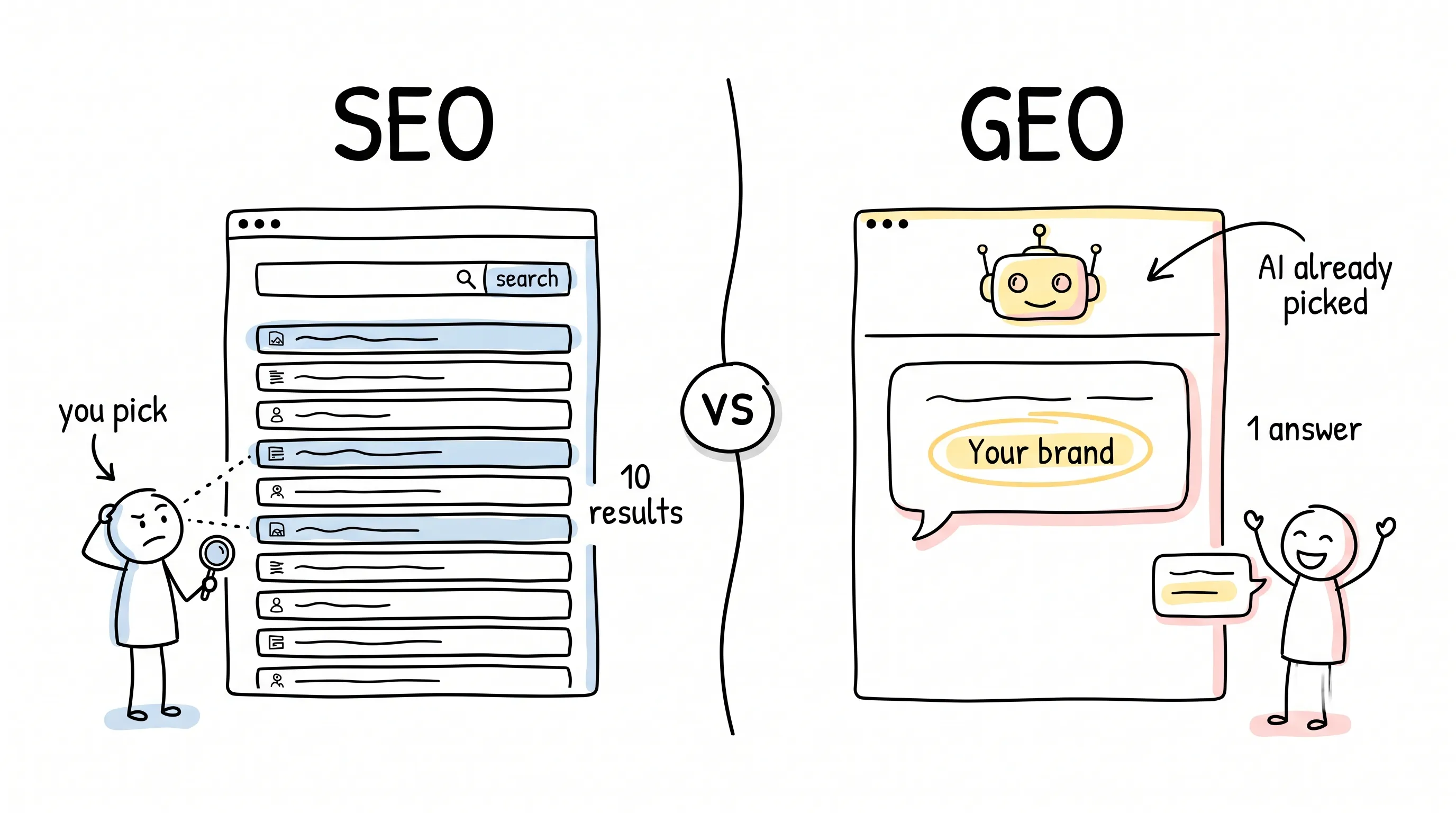
That's where it gets painful. If the answer doesn't include you, the user never even gets a chance to see you. You don't even qualify to be compared.
So what exactly is GEO?
GEO — Generative Engine Optimization. Put simply: making sure your business gets mentioned, gets recommended, when AI answers people's questions.
SEO optimizes your ranking in search results. GEO optimizes the answer the AI gives.
Why AI Is Pulling People Away
You might ask: the search box has worked fine for twenty years — what does AI have that it doesn't?
One word: precision.
Say you're trying to find a song. You can't name it; you only remember the feel of it: good for a first date, a little jazzy, not too loud. That kind of request, a search box can't take. Your only move is to search "jazz playlist for a date" and work through a pile of lists yourself, one track at a time.
AI can handle it. You describe what you want in plain words, and it hands you that song.
Or take my friend's case. Traditional search gives you a page of "Top 10 pizza places in Rochester." AI says it straight: go to his shop — nobody does deep-dish better.
One gives you a range; the other gives you an answer.
And what people want, of course, is the answer.
What Does This Have to Do with Your Wallet
Some business owners will be skeptical: GEO, another made-up buzzword designed to fleece the gullible?
My view is direct: this is a visibility problem, not a concept problem.
Think about it. A user asks AI, "Which trustworthy sustainable clothing brands are near me?" The answer names five stores. Those five stores have just been handed, free of charge, the most precisely targeted counter there is. For the stores that get mentioned, traffic, inquiries, and sales each feed the next link in the chain.
And the stores that don't get mentioned?
They never even make it into the game.
So GEO, at its core, is a fight for a spot at a brand-new counter. The counter isn't crowded yet — first come, first served.
So What Do You Actually Do
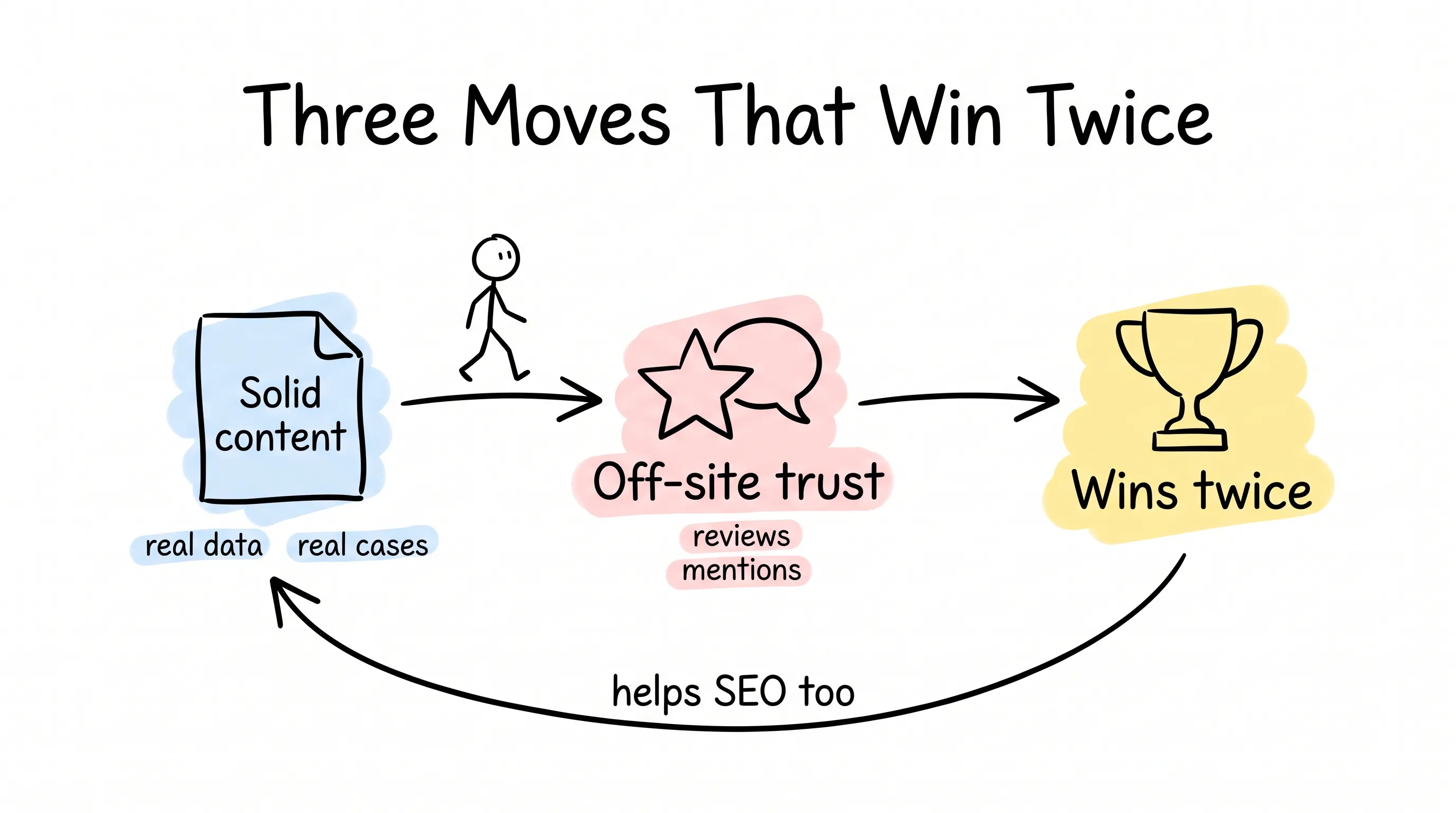
Enough theory; here's the method. Three things.
First, make the content on your own site genuinely solid. AI likes to cite content from people who truly know their trade, write professionally, and explain their products and services with total clarity. This goes double for sensitive industries like healthcare and finance, where AI won't dare recommend anything of unknown origin. One more thing: be specific. Bring real data, real case studies, real comparisons — none of those empty phrases that could apply to anyone. AI has no patience for fluff.
Second, build your brand's standing beyond your own site. Customer reviews, content on third-party websites, every trace you leave outside your own homepage — all of it helps AI build trust in you. What AI is willing to recommend is the brand it "knows" and can vouch for.
Third — and this is the best part — none of this effort goes to waste. Make your brand more authoritative, easier to understand, more recognizable, and traditional search benefits just the same. One move, points scored on two battlefields.
In other words: do GEO, and you deepen your SEO along the way.
One Last Thing
As that dinner wrapped up, I told my friend: you got lucky — you're among the first movers. He asked, so what should I do next?
I said: do what needs doing before your competitors wake up. The day you notice a rival showing up in AI's answers too, the good spots may no longer be yours.
"Go where your users go." The old saying hasn't changed; what's changed is the "where."
Here's to seeing your name in the answers — soon.
Continue reading
Related articles

It's 2026: Stop "Buying" AI Tools for Your Marketing Team — Start "Hiring" AI Agents
This learn article explains how AI agents differ from standalone AI tools in marketing, outlines three agent categories — build-your-own platforms, CRM-native agents, and vertical tools — and covers use cases across SEO, social media, advertising, and reporting, plus criteria for choosing one.

What Is GEO? How Your Brand Gets "Mentioned" in the Age of AI Search
An explainer on GEO (Generative Engine Optimization) for e-commerce and DTC brands: how it differs from SEO and AEO, why AI answers shape brand visibility, and eight practices covering question-focused content, consistent brand messaging, structured pages, external evidence, comparisons, and AI mention tracking.

AI Is Already Making Decisions for Your Customers. Are You on the List?
A learn article explains GEO (Generative Engine Optimization): why AI-generated answers now shape which brands customers see, and how SEO fundamentals, entity clarity, citable evidence, and monthly measurement affect visibility in AI answers.