
Customers stopped searching and started asking AI: how to actually do GEO in 2026
A guide to generative engine optimization: how AI answer engines cite sources, the three citation pathways, engine-by-engine differences, citable content formats, entity schema and llms.txt setup, prompt-audit measurement, and a 90-day action plan.
A while back, an old friend of mine who runs a B2B software company invited me out for tea. He looked worried.
"Something's weird," he said. His website ranks top three for its keywords, yet traffic keeps sliding down. I asked him one question: had he ever tried asking ChatGPT something like "recommend me a few vendors that make this kind of system?"
He froze.
He went back and tried it. The AI named three companies. One was a competitor. One was a company he'd never even heard of. His wasn't there.
Top three in the rankings, yet invisible to the AI. Two years ago, that was unthinkable. Today, it happens every day.
So what actually happened?
Search engines didn't die. They just gained a layer in front.
How did buyers used to find vendors? They'd scroll through the search results, scan titles and descriptions, and pick one to click. Now? They hand the whole question to ChatGPT, Perplexity, Claude, or Google's AI Overviews, and the AI reads the entire web on their behalf, then serves up a synthesized answer.
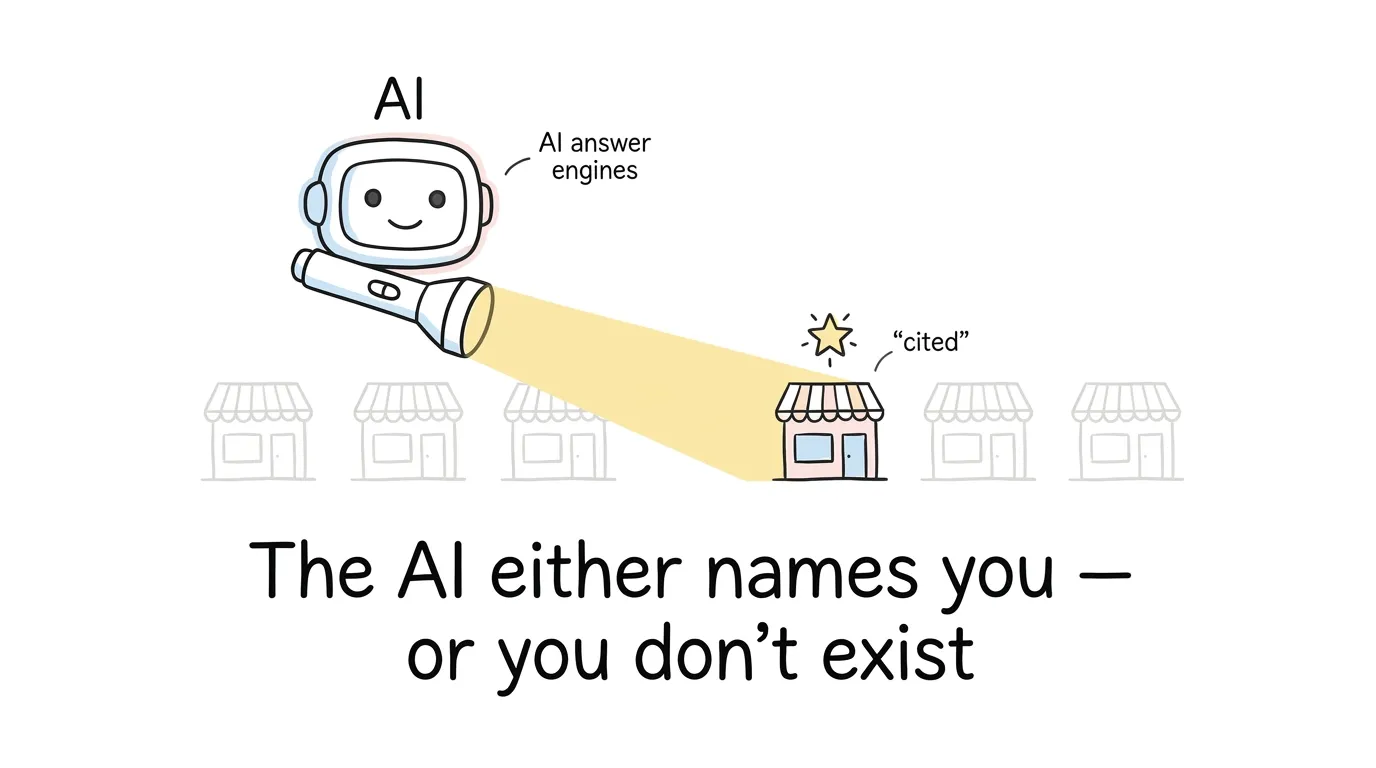
That answer names two or three sources. Everyone else is invisible.
Think about what that means. Used to be, ranking tenth in the search results still earned you a trickle of traffic. Now, being the eleventh source in an answer engine's eyes equals zero. Because there is no second page. The AI either names you, or acts as if you don't exist.
So what is GEO? SEO optimizes "what rank you hold in the list." GEO optimizes "whom the AI reaches for first when it synthesizes an answer." These are two different jobs, with different inputs and different playbooks. And the vast majority of B2B companies are still only doing the first one.
The good news: the window is still open. This work isn't hard, but it is fiddly, and in most professional-service categories only a handful of companies have actually rolled up their sleeves. The companies that get cited frequently in AI answers in 2026 tend not to be the ones with the biggest content budgets. They're the ones that were first to "translate" themselves into something machines can understand.
First, let's get the terms straight
GEO, AEO, AIO — the acronyms are flying everywhere. One at a time.
GEO, Generative Engine Optimization, is the most encompassing of the four: getting AI engines to pick you and cite you when they generate answers.
What about AEO? Answer Engine Optimization — shaping your content so it can be lifted out directly as an answer: definitions, FAQs, comparisons. This term predates the large-language-model wave; it grew out of the featured-snippet and voice-search era.
Then there's "AI SEO," which deserves special caution. It carries two meanings that are complete opposites: one is "optimize your content so AI cites you," the other is "use AI tools to produce SEO content faster." Only the first meaning is GEO. Blurring the two leads to some truly dumb strategic decisions.
Why does AI cite you?
This is the trump card at the heart of this whole piece. Nearly all wasted GEO effort comes from muddling three pathways into one.
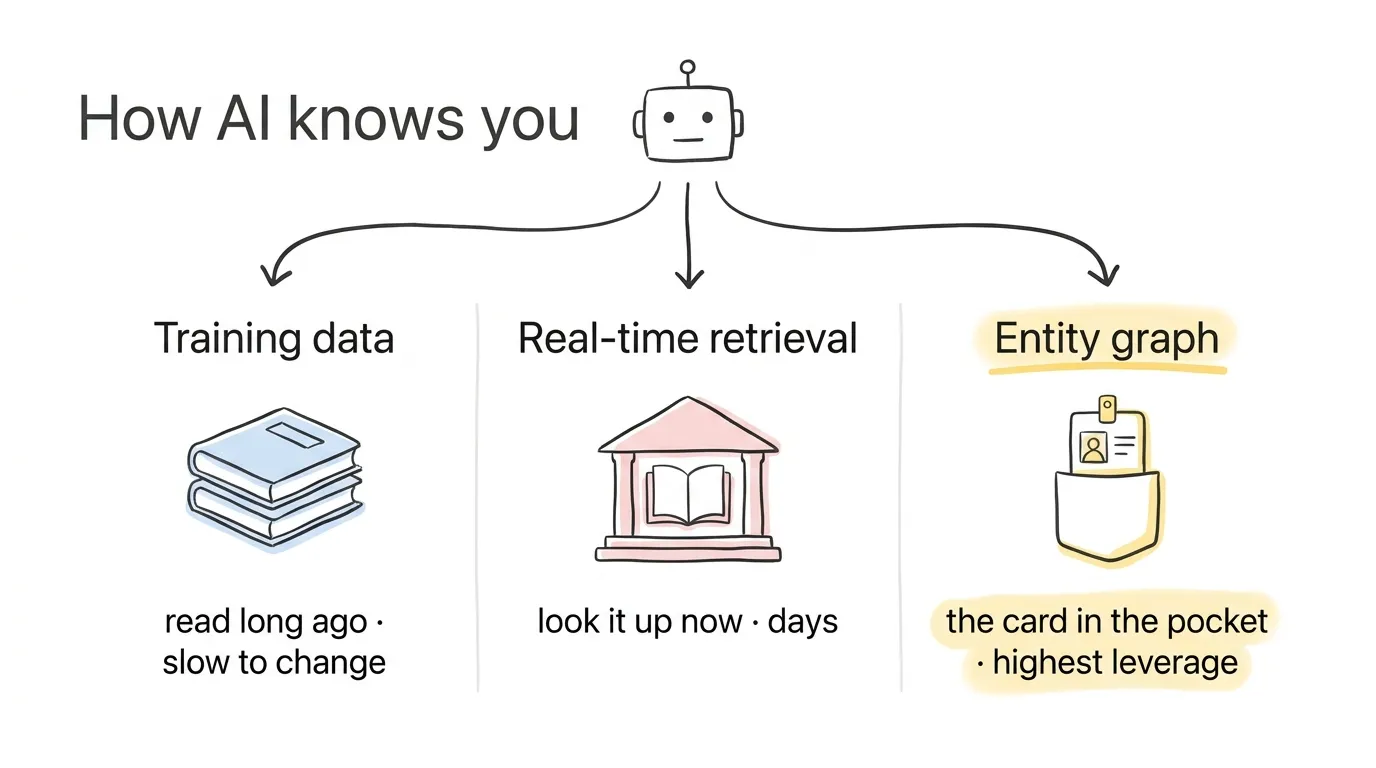
Pathway one: training data. The model "read" you during its learning phase. Brand mentions that recur, consistently and with matching details, across Common Crawl, Wikipedia, Reddit, GitHub, and news archives. Note this: even without a link, being mentioned counts, because models learn language patterns — they don't crawl along links. This pathway is slow, it moves with model versions, and once the model has learned you wrong, there is no going back to fix it.
Pathway two: real-time retrieval. At the moment it answers, the engine runs a live search and reads the pages that rank well and sit on trustworthy domains. Perplexity, ChatGPT with search enabled, Claude with the web turned on, Google AI Overviews — they all work this way. This pathway is the fastest: publish something that ranks, and you could be cited within days.
Pathway three: the entity graph. Wikidata, Wikipedia, Crunchbase, LinkedIn, plus the structured data on your own site. When a model needs to answer "what does this company do," it leans on this layer. It's the cheapest pathway with the highest leverage — and in B2B, almost nobody touches it.
Here's an analogy. Training data is like the books a person read in their school days. Real-time retrieval is like heading to the library to look something up right now. The entity graph is like the cardholder in their pocket. The books can't be changed; the library can get you fresh material the same day; and you can reprint the cardholder today.
While we're here, a splash of cold water: stop worshipping backlinks. Bought links and mass-blasted links are basically useless for GEO citations, because they were never part of the mechanism. What actually works is being mentioned consistently and accurately, again and again, on the high-authority sources these models "eat" — plus a handful of editorial links that genuinely lift rankings.
And what matters more than volume is consistency. If your company description exists in three different versions across your website, LinkedIn, Crunchbase, and podcast bios, every piece of evidence gets diluted to a third of its strength. If it's word-for-word identical everywhere, the picture sharpens fast. This is the cheapest move in all of GEO; the only cost is discipline: write it once, paste it everywhere.
Seven engines, seven temperaments
Think of them as seven judges with different tastes.
Google AI Overviews draws from its own index and favors pages that already rank. Video is an unexpected bonus: brand mentions in YouTube titles and captions correlate with AI Overviews exposure to a surprising degree.
ChatGPT feeds on "consensus sources." Wikipedia alone accounts for a sizable share of its citations. In ChatGPT's world, nothing is worth more than "being a verifiable, well-known entity."
Perplexity is retrieval-first, always shows its sources, favors first-hand experience and concrete specifics, and weighs community discussions surprisingly heavily.
Claude wants depth and sources that hold up under scrutiny — few citations, but selective. Copilot runs on the Bing index, which is severely underrated because ranking competition on Bing is far looser than on Google. Gemini leans on Google's Knowledge Graph, where your entity data can do real work. And Grok can't live without real-time social.
So which engines should you bet on? Look at your buyers. For B2B software and services, ChatGPT usually leads, then Google AI Overviews, then Perplexity. For research-minded audiences, Perplexity leads. For developer tools, Claude and ChatGPT call the shots.
Here's one number you should commit to memory. Independent citation studies conducted between 2025 and 2026 calculated that the domains ChatGPT cites and the domains Perplexity cites overlap by only about 11%.
11%.
Winning on one engine proves almost nothing. Don't fantasize about "getting GEO done once." Build and measure per engine, separately.
Where do the citations actually come from?
Several large-scale analyses published between 2025 and 2026 — including studies of tens of millions of AI citations by Peec AI and SEMrush, plus pattern analyses by Contently and Profound — reached conclusions that catch almost every marketing team off guard.
The most-cited domain is Reddit. In Peec AI's analysis, roughly 47% of Perplexity's top citations went to Reddit. Nearly half. That's wild.
On the B2B and professional-questions side, the most-cited source is LinkedIn.
Within ChatGPT's citations, Wikipedia accounts for about 7.8%.
To be clear upfront: these numbers are for choosing your battleground, not for setting KPIs. Change an engine's retrieval mechanism and the ratios wobble with it. The direction is stable; the decimal points are not.
A few direct implications:
Reddit is not a "do it on the side" social network. It is the most-cited source, full stop. The subreddits where your buyers gather deserve your sincere, regular presence.
LinkedIn does double duty in B2B: a distribution channel and a citation source. And the personal accounts of founders and frontline operators consistently outperform corporate official accounts. Because weight and trust attach to people, not to logos.
Video is Google AI Overviews' most underrated lever, but the mechanism is text: what the engine reads is titles and captions. If you spent serious money producing a case-study video and didn't add real captions, you threw away half its GEO value.
Wikipedia and Wikidata carry far more weight with ChatGPT than their size suggests. One accurate entity record beats a hundred directory listings. Note: Wikipedia has a notability threshold and doesn't allow writing your own entry; Wikidata is different — as long as your organization record can be verified against independent sources, you can create and edit it yourself. Most of the entity-graph lever sits right here.
SEO isn't obsolete. It's load-bearing.
A misconception worth straightening out: doing GEO does not mean dropping SEO.
Think back to pathway two. The essence of real-time retrieval is that the AI runs a search on the spot, then reads the results. If you don't rank, it can't retrieve you; if it can't retrieve you, it can't cite you. Technical SEO has gone from being your competitor to being GEO's foundation. Crawlable, fast-loading, proper canonicals, a valid sitemap — that's the floor, not a bonus.
As for how you write, the change is real: from keyword-stuffing to making answers extractable. For the AI to cite you, it needs a passage it can lift whole with confidence — the first sentence aimed straight at the question, a direct answer within two or three sentences, details after. However beautifully you write, if the conclusion is buried under six paragraphs of buildup, it's essentially unusable to the engine.
What does content that actually gets cited look like?
Definitions and glossaries. One term per page, opening with a crisp two- or three-sentence definition. Definition pages are among the most-cited content types, because they're unambiguous and self-contained.
Question-shaped titles. Use, as the title, the exact question a buyer would type, and answer it right at the top. "How much does a ×× system cost in 2026" will always beat "Our pricing philosophy."
Comparison pages. X versus Y maps directly onto how people ask AI to help them decide. But it has to be genuinely fair. A comparison where you win every single round reads as an ad, and the AI will discount it.
Real FAQs. Questions buyers actually ask, each answered in two or three sentences, marked up with FAQPage structured data.
Original data. The strongest citation magnet there is. A number that can't be found anywhere else can only be cited with your name attached.
And here's a self-check you can use every single day: for each important page, ask yourself — if the AI were allowed to lift only three sentences, which three would they be? Are they sitting together, right at the top of the page? Buried mid-page or scattered around? Go back and rewrite the opening. This one habit will move your citation results more than any technical trick.
Then there are four fundamentals. Cover the topic thoroughly, so the AI never needs a second source — a half-finished answer always loses to a complete one. Date your content and keep it current: freshness is a real retrieval signal, and a stale date drags citations down. Be honest about the limits of what you offer — content that admits "where this doesn't apply" reads as more reliable to both humans and models. And write in the words your buyers use, not internal jargon: engines match on semantics, but they retrieve by the phrasing people actually type.
"Translating" yourself for machines: the entity layer
The highest-leverage, most neglected part.
Before a machine can recommend you, it has to know what you are, whom you serve, and why you're credible. Most websites have never made these three things clear in a form a machine can parse.
Move one: one canonical description, everywhere. Write a paragraph — what you do, who you serve, what credentials back you up. Then paste it, word for word, on your website, LinkedIn, Crunchbase, every directory, every speaking bio, every podcast bio. Resist the urge to customize a version for each platform. Variation dilutes the signal; repetition sharpens it.
Move two: complete your Organization schema. Most websites stop at a name and a logo. The fields that actually help models reason are precisely the ones nobody fills in: a stable @id; sameAs pointing to every homepage that genuinely exists; knowsAbout describing your real areas of expertise; a founder node; and disambiguatingDescription, which almost nobody uses.
Move three deserves its own spotlight: disambiguatingDescription is the hidden-gem field. As long as any other company, product, or person shares your name, the model will blend you together and then confidently describe you wrong. Stating plainly "this is who I am not" is the most effective antidote. I've watched too many companies get burned by name collisions because no one thought to fill in this one field.
One discipline: only put links in sameAs that actually open. Every entry is a verifiable claim. Dead links, abandoned homepages, wishful titles — each one drags down the whole record. Fabricated partnerships and credentials corrupt entity trust, and in the end that corruption lands on you. Only include what's real and verifiable.
llms.txt: a clean map for crawlers
There's a new convention called llms.txt: place a markdown file at your site's root that spells out, in plain language, what your organization is and where your core pages live. No engine has promised to read it. Don't expect magic.
So why bother? Because it's cheap, it's becoming a convention, and — more importantly — it forces you to explain "who we are" in plain words. You'll use that paragraph whether or not a crawler ever reads it.
The effective way to write it: a hand-written header carrying the core statement you want to be quoted on — what you do, who you serve, why you're credible — followed by an auto-generated link directory, so it stays anchored no matter how much content you add. Write that header like an encyclopedia entry, not ad copy. Neutral, specific, verifiable. Because you should assume that the first paragraph is exactly what an AI will reuse, verbatim, when answering "what is ×× Company?"
Off-site: the models eat from someone else's table
Your website is necessary but nowhere near sufficient. Most citations point elsewhere.
Community platforms. Find the two or three communities where your buyers actually ask questions, and show up regularly to do genuinely useful things: give concrete numbers, give short frameworks, give honest caveats. Be open about who you are, with at most one link that truly helps. A freshly registered account posting ads gets cleaned out by moderators before any model ever sees it. This path rewards patience and punishes shortcuts.
LinkedIn. The B2B stronghold, for reasons already covered. Founder account, steady cadence.
Video. Go back and add real captions to every video you own, especially the case-study ones.
Media coverage. One proper mention in a publication the models trust does double duty: it feeds the training-data pathway a link-free mention, and it lifts the rankings that real-time retrieval depends on. Companies without a PR budget can pitch through matchmaking services like Qwoted or Featured, or contribute bylined articles to respectable industry publications.
And let's get the ugly part said out loud. Paid link networks, spammy site clusters, directory blasts, mass AI-spun content — none of it has any value for GEO, because it was never in the mechanism, and it carries real ranking and reputational risk. Don't stuff knowsAbout with keywords either; an entity record padded too fat gets discounted.
Measurement: if there's no dashboard, build one
Answer engines have no rank trackers. This is where most GEO projects quietly die: you can't tell which actions compound and which are just for show, the feedback loop is too slow, and intuition can't carry you.
The good news: a good-enough dashboard takes one afternoon.
Start with a prompt audit. Write down 10 to 20 complete questions your buyers would ask — not keywords, full sentences, including the ones you most want to appear in but haven't yet. Type them verbatim into each engine that matters, and repeat on a fixed schedule. Each run, record four things: whether you were named, whether you were cited with a link, roughly where in the answer you appeared, and whom you appeared alongside.
From this you get four metrics. Mention rate: in what share of the questions do you show up. Citation rate: in what share were you actually linked. Share of voice: your mentions divided by mentions of all brands. Accuracy: does what it says about you hold up.
Accuracy deserves its own emphasis. Being described wrong is worse than not being mentioned, because errors reproduce themselves. If an engine says you offer a service you discontinued long ago, or pins someone else's incident on you, fix it immediately. Usually that means publishing a clearly structured, unambiguous correction — and updating your entity records at the same time.
Also, in your analytics, slice out traffic coming from AI sites like chatgpt.com, perplexity.ai, and claude.ai. The volume will be small, but the intent is extremely high, and its trajectory is the control experiment that tells you whether your audit data is lying.
Run it by hand for a month or two first, get a feel for the answers, and once your question set has stabilized, write scripts or simply buy a monitoring tool — the likes of Profound, Otterly, Peec, Scrunch.
When the AI gets you wrong, what then?
You can't edit the answer. You can edit the evidence it reads.
Sooner or later, some engine will describe you with an outdated price, a discontinued service, or the history of a company that happens to share your name. There's no support ticket to file. What you have is a playbook:
- Screenshot everything. Engine, date, exact wording, cited sources — record it all, or you'll have no way to judge whether things later changed.
- Trace the source. Real-time-retrieval engines show citations, and the error often lives on one stale page, an old press release, or a competitor's comparison table. Training-data errors come with no citation, and their correction cycle is far longer.
- Publish a correction. On your own domain, write a clearly structured, clearly dated, unambiguous statement. A vague clarification does nothing; specifics do.
- Fix your entity records. Structured data, sameAs homepages, directories still carrying old information — update them all together.
- If it was a name collision, use disambiguatingDescription. That is precisely what the field exists for.
- Re-run that prompt regularly. Real-time errors may correct within weeks; what the model learned in training waits for the next model generation.
Oh, and if the criticism the engine surfaced is true, don't try to bury it. Publishing a dated, factual "here's what we changed" outlasts any deletion. Engines reward recency and specificity; one credible "here's when we fixed it" beats burial every time. Besides, it's the right thing to do anyway.
Ninety days: how to sequence it
There's exactly one principle: do the cheap, compounding moves first.
Weeks one and two: lay the foundation. Write the canonical description and lock it; clear the crawl blockers — robots, sitemap, canonicals, misconfigured noindex; complete your Organization and Person schemas, including disambiguatingDescription and a sameAs where every link opens; ship llms.txt; run your first prompt audit and archive it. Don't skip the archiving step — it's your baseline, and you must measure before you change anything.
Weeks three through six: build out the entity and answer layers. Create or fix your Wikidata record and your main B2B profiles, all with the same description; publish your first batch of answer-shaped content — glossary pages for your domain's vocabulary, three or four comparison pages, real FAQs with markup; add captions to every video you've published.
Weeks five through ten: accumulate authority and presence. Begin sincere participation in the two or three communities where your buyers live; establish a steady rhythm for your founder's account on LinkedIn; use matchmaking services to land two or three media mentions. If you hold exclusive data, publish it now — original numbers are the strongest citation magnet.
Weeks eight through twelve: measure the compounding. Re-run the audit, compare against the baseline, and classify every question where you didn't appear: content gap, ranking gap, or entity gap. Fix accuracy first, then coverage. Then run the cycle monthly. GEO is a rhythm, not a project.
Be honest about expectations too. Real-time retrieval reacts within weeks; the entity graph takes a month or two to propagate; training data waits for the next generation of models. Anyone who promises fast results, anyone who guarantees AI citations, is selling something. The fast pathway is genuinely fast; the slow pathway is genuinely slow.
The most common mistakes
- Treating GEO as link building with a reskin. The mechanisms are fundamentally different; volume can't move it.
- Dropping technical SEO. The fastest pathway — real-time retrieval — is closed to you.
- A different company description in every channel. Aligning them costs nothing; leave them misaligned and you bleed quietly.
- Publishing fifty thin pieces of content. Five pages that answer buyers' real questions thoroughly beat them.
- Never measuring. Without a baseline and a rhythm, you're gambling — and this is a slow game you can't afford.
- Ignoring name collisions. As long as anything in the world shares your name, the model will blend you together — until you say otherwise, explicitly.
- Publishing videos without captions, then wondering why AI Overviews shows no activity.
- Chasing every engine. Pick the two or three your buyers actually use, and go deep. Spread wide without depth, and you win nothing.
What to do on Monday morning
- Run the prompt audit first. Ten questions, every engine that matters, write it all down. Measure before you change anything.
- Write that one canonical description, then paste it unchanged across the entire web.
- Complete your Organization schema: @id, sameAs links that all open, knowsAbout, founder, disambiguatingDescription.
- Ship llms.txt, writing the header to the standard of "will be quoted verbatim."
- Rewrite the openings of your five most important pages so the answer lands in the first three sentences.
- Add captions to the videos you already have.
- Pick two communities and start genuinely helping people.
- Re-run the audit in thirty days and compare.
Back to that friend from the opening. His product was solid, his content was earnest. The problem was only this: the machines never understood who he was.
One of the nice things about this era is that AI is picking "the best answer," not "the biggest spender." A small company that speaks clearly, writes complete answers, and keeps its entity records accurate can out-punch a much bigger rival inside AI answers. The window is still open. It won't stay open forever.
Here's to becoming the one whose name the AI says first.
Continue reading
Related articles

It's 2026: Stop "Buying" AI Tools for Your Marketing Team — Start "Hiring" AI Agents
This learn article explains how AI agents differ from standalone AI tools in marketing, outlines three agent categories — build-your-own platforms, CRM-native agents, and vertical tools — and covers use cases across SEO, social media, advertising, and reporting, plus criteria for choosing one.

What Is GEO? How Your Brand Gets "Mentioned" in the Age of AI Search
An explainer on GEO (Generative Engine Optimization) for e-commerce and DTC brands: how it differs from SEO and AEO, why AI answers shape brand visibility, and eight practices covering question-focused content, consistent brand messaging, structured pages, external evidence, comparisons, and AI mention tracking.

AI Is Already Making Decisions for Your Customers. Are You on the List?
A learn article explains GEO (Generative Engine Optimization): why AI-generated answers now shape which brands customers see, and how SEO fundamentals, entity clarity, citable evidence, and monthly measurement affect visibility in AI answers.