
60% of Brands Will Use AI Agents. So Why Have Only 13% Actually Deployed One?
An educational guide to deploying AI marketing agents: when an agent is warranted, the data and CDP foundation, guardrails, phased rollout with holdout measurement, composable versus unified architecture, and specialist agent teams, illustrated with a hypothetical e-commerce churn campaign.
I recently came across two numbers that, placed side by side, are fascinating.
The first number is 60%. In January 2026, the research firm Gartner predicted that by 2028, 60% of brands will be using agentic AI to deliver one-to-one, personalized interactions with their customers.
The second number is 13%. In the tenth edition of the State of Marketing report published that same year, Salesforce found that only 13% of marketers have actually put AI marketing agents to work.
One says 60% two years from now. The other says 13% today.
So what explains the gap?
It isn't willingness. Look at another finding in the same report: the top-performing marketers are twice as likely to use agents as everyone else. People aren't skeptical — they want in. They just haven't managed to get there.
The gap comes down to one word: deployment.
Over the next two years, a huge number of brands will move from "want to use" to "actually using." And what decides who makes that journey successfully is settled long before you ever let an agent run a campaign on its own.
In this piece, I'll take that deployment path apart for you, end to end.
First, an Uncomfortable Question: Do You Actually Need an Agent?
Where do we start? With the most honest question there is.
What is marketing automation?
Marketing automation is when humans think through the strategy and write it out as a set of rules, and machines execute them. For example: a customer adds to cart but doesn't pay; wait two hours, then send a reminder email.
Note who designs the strategy: the human. The machine is just an extremely nimble pair of hands.
So what is an AI marketing agent?
An agent works in reverse. You give it only a goal — say, "cut churn among high-value members by 10%." How? It figures that out itself: whom to select, what content to write, which channels to use, when to send. It designs, executes, and optimizes on its own.
Marketing automation is acting out a script. An agent is the one who writes the script.
So how do you know whether you should bring in an agent? Watch for five signals.
You run only five to ten hand-designed campaigns a quarter, on a steady rhythm, with clearly written rules — automation is enough. You review A/B tests in one weekly meeting — enough. One content template gets reused over and over — also enough. Customer profiles are scattered, updated only in batches — then even the foundation for automation isn't solid. And if nobody on the team can own guardrail design and agent oversight, do not deploy, ever.
On the flip side, if any of this describes you, read on: your playbook requires running dozens or hundreds of personalized micro-campaigns simultaneously; decisions need adjusting by the hour and can't wait for the weekly meeting; every customer needs individually generated content; a unified, real-time customer profile already exists — or is already an approved project; and the team is ready to shift from managing processes to managing goals.
There's also an in-between case: you're running five or six campaigns right now, steady and stable. Deploying an agent at this point is like putting an F1 pit crew on a bicycle. Your governance costs go up; the returns never appear.
What Are You Actually Deploying?
All right, you've decided to deploy. But get one thing straight first: what you're buying is not a "model."
An AI marketing agent is a system assembled from five components: perception, reasoning, planning, action, and memory.
Perception reads the customer profiles and behavioral streams to answer "what state is this customer in right now?" Reasoning fuses large language models with machine-learning predictions — purchase propensity, lifetime value — into a judgment. Planning breaks the goal down into a chain of executable tasks. Action actually sends things out — email, SMS, push, ads, on-site. Memory stores what worked and what didn't, and feeds it into the next round.
Each of the five components is tethered to something you must have ready in advance.
Perception needs unified, real-time customer profiles — which is what a CDP (customer data platform) provides. Reasoning needs historical performance data, for training models and evaluating results. Planning needs you to write your constraints — budget, channels, frequency — into unambiguous rules. Action needs an authorized connection to every execution channel. Memory needs result data flowing back into the customer profiles.
Follow that thread all the way down and you'll notice something: apart from planning constraints and channel authorization, everything else is a data problem. And channel authorization matters precisely because the data has to flow through it.
Deploying an AI agent is, at its core, a data engineering project.
The First Job: Pour a Solid Data Foundation
The decisions an agent makes depend on the data it can see.
So what happens when profiles are fragmented and slow to update? The agent effectively sees half a customer. It's commanding the whole army with half a map.
The minimum spec for that foundation has four parts:
Unified customer profiles that can recognize "the same person" across devices and channels. A real-time behavioral event stream — next-day batch refreshes don't cut it. Historical performance data, needed for both training and evaluation. And clean consent management, so compliance holds up.
This is exactly why the CDP exists. As for which CDP architecture to choose — that's a deep topic of its own, and we'll tackle it shortly.
The Second Job: Guardrails Must Arrive Before the Agent
First, another number for you.
In June 2025, Gartner predicted that by the end of 2027, more than 40% of agentic AI projects will be killed off. Three reasons: costs running out of control, value that can't be proven, and risk controls that can't keep up.
That's nearly half.
But all three of these failure modes can be defused before launch. Risk is handled by guardrails. Value is handled by measurement. Cost is handled by a phased rollout, where each phase's budget is locked to the measured results of the phase before it. I'll take them one at a time.
Guardrails first. A production agent needs at least five kinds of guardrails.
A cap on spending. The maximum spend per campaign, per channel, per day — hard-coded.
A cap on interruption. How many messages a customer may receive in a week, and how long the gap between two sends must be.
Content boundaries. Brand voice guidelines, prohibited tactics, rules for sensitive topics.
Compliance checks. Verify consent before every single touch; work through the requirements of regulations like GDPR and CCPA one by one.
A human takeover switch. When a human must be called in: performance collapsing, budget anomalies, content getting flagged.
Why be this strict? Let me describe one classic death.
An agent optimizing for short-term revenue bombards high-value customers with messages. The quarter's KPI wins — and the customers' lifetime value gets pounded into nothing. You win the quarter and lose the customer. Frequency caps plus customer health scores exist precisely to prevent this disease.
So guardrails are not the agent's brakes. Guardrails are the precondition for the agent surviving at all.
The Third Job: Roll Out in Phases, Promote on Evidence
For the rollout path, here's a typical six-month route:
Months 1–2: make the unified data foundation real. Month 3: run assistive pilots — send-time optimization, email subject-line generation — with human review on every action. Months 4–5: step up to semi-autonomous campaigns, like cart abandonment recovery and welcome series. Month 6 onward: only then does the agent run fully autonomously, inside the guardrails.
Why start with small things like send times and subject lines? Because they're bounded, reversible, and measurable. A wrong decision costs you an open rate, not a customer relationship. The pilot walks the full chain — data retrieval, decision, controlled measurement — so every data-quality pothole gets exposed at this stage. By the time you hand the agent the keys to budgets and discounts, you know exactly what you're holding.
Note the key phrase: promotion between phases goes by evidence, not by the calendar.
A pilot advances to the next phase only after it beats the holdout control group (holdout: a matched group of customers excluded from the campaign, used to measure true incremental lift) for several consecutive weeks, stays within budget, and requires zero guardrail escalations. Spending follows proven performance.
Meanwhile, don't cut corners on one thing: the marketer's role has to be redefined. From designing individual campaigns to setting goals, setting guardrails, and auditing agent performance. That doesn't get done with an internal memo — it takes real money invested in training.
One more thing that must be settled before launch: measurement.
Agent-run campaigns must be measured against a holdout control group. Measure outcomes — conversion rate, revenue per customer — not activity: how many emails sent, how many impressions. Sending more is not the same as selling more.
The Architecture Question: How Fast Is the Loop?
Data, guardrails, rollout path — all in place. One question remains, buried at the bottom of the stack, and it decides survival: architecture.
First, a concept: the customer intelligence loop.
Collect, unify, understand, decide, engage — then the data flows back and re-enters collection. The AI agent keeps spinning around this loop; humans give the loop its direction: setting strategy, managing creative, establishing guardrails.
The faster this loop spins, the stronger the agent. The architectural requirement at each stage looks like this:
Collection needs streaming ingestion with instant profile updates. Unification needs identity resolution, stitching anonymous visitors and known customers into one and the same person. Understanding needs machine-learning models that can read the unified profile directly. Decision needs to select an action within 50 milliseconds, based on full customer context. Engagement needs platform-native email, SMS, and push channels. And the final loop-back — feeding results in — must happen within seconds.
Here comes the problem. In the real world, the two mainstream architectures differ in loop speed by orders of magnitude.
The first: the composable stack — a data warehouse, plus reverse ETL, plus an external email service provider. Every lap the data takes crosses three to five vendor boundaries. Loop speed: hours to days. The agent can predict, but it can't learn from real-time results. For batch scenarios, it's enough.
The second: the Agentic CDP — unified data, AI, and native engagement, installed in the same platform. Loop speed: seconds to minutes. The agent can perceive, decide, act, and learn continuously.
The Silicon Valley investor Tomasz Tunguz made exactly this point in AI's Bundling Moment: AI rewards platform breadth, not best-in-class point solutions. Split the loop across five vendors, and every seam where you cross a boundary is a stretch of latency — and a failure point.
That nails it.
So the decision standard comes down to one question: does your scenario need real time? Cart abandonment recovery, in-session personalization, event-triggered engagement — these demand second-level loops, so you need the unified platform. If you're merely retraining a churn model once a day and syncing audience segments once a week, the composable stack is fine.
And add a compliance line to the ledger. Every sync in a composable architecture copies personal data downstream to service providers; your SOC 2 audit surface expands by another ring with every sync. Keep the data fenced inside one platform boundary, and the risk surface is naturally smaller.
Don't Think Super-Agent. Think Specialist Squad.
A deployment that runs in production is never one all-powerful agent conquering everything alone. It's a squad of specialists with a coordination layer above them. Speaking at the strategic level, that coordination layer is the AI CMO.
The division of labor on the campaign line follows the rhythm of each campaign. Strategy stage: the campaign planning agent translates business goals into audiences, channels, budgets, and KPIs. Audience selection: the audience discovery agent scores people across hundreds of profile dimensions. Content: the content generation agent produces each person's subject lines, emails, SMS, and push in the brand voice. Journey building: the journey builder agent assembles multi-step, multi-channel journeys — complete with trigger conditions, delays, and branches — in one pass. Optimization: the journey optimization agent watches real-time performance and reallocates traffic, channels, and timing at any moment. Review: the performance analysis agent summarizes results against goals and stores the lessons in memory.
On the operations line, there's a standing force as well. One watches SEO, tracking rankings and hunting for content gaps. One handles GEO, optimizing content specifically so it's easier for ChatGPT, Perplexity, and Gemini to cite. One monitors website behavior and proactively reports the moment anything anomalous appears. One manages paid acquisition, adjusting bids, rotating creatives, and splitting budgets in real time against ROAS. One runs social media, adapting voice and rhythm across channels. One watches competitors' prices, campaigns, and new product launches 24 hours a day, 7 days a week. One runs sentiment monitoring across the entire web — social, reviews, and news in one view. One fills the data gaps in customer profiles; one scores channels on incremental effectiveness and recommends moving budget; one finds creators, guards against fraud, and manages the full partnership lifecycle. And there's a customer service agent that receives every customer who comes to chat, carrying the customer's history and the brand voice.
How do all these roles collaborate? The 2026 answer is getting clearer by the day: orchestration on open standards, like MCP (Model Context Protocol). As long as an agent exposes an MCP service interface, any CDP, email platform, or ad platform can call it directly, with no custom integrations to write. The cost of adding a new specialist to the squad keeps dropping.
Deployment is team-building, not hiring one superhuman.
And when each of these agents takes the field matters. The content generation and performance analysis agents are a natural fit for the month-3 human-review pilots. The journey optimization and campaign planning agents don't take the field until month 6, after the guardrail system has been drilled and rehearsed.
Break it down further, and different marketing functions have different tolerance for autonomy.
Brand-line agents can go at most half a step. Sentiment monitoring, localization drafts, creative rewrites, first-pass creator screening — all doable — but a human must sign off before anything is published, and voice and visual rules stay locked down. Scorecard: share of voice, brand lift, QC pass rate.
Growth and paid media are the most aggressive. Cross-channel bidding and budget reallocation, audience suppression, creative rotation, landing page testing — all can run automatically. Guardrails: a daily spend cap per channel, an incremental ROAS floor calibrated against holdouts, frequency limits. Scorecard: incremental ROAS, customer acquisition cost.
Product and lifecycle sit in the middle. Onboarding milestone reminders, feature-adoption triggers, churn win-back offers, win-back timing. Guardrails: discount caps, do-not-disturb hours, weekly message caps, consent checks. Scorecard: activation rate, 90-day retention, net expansion.
Why do growth and lifecycle reach full autonomy fastest? Because conversion and retention data comes back within hours — the agent gets a clean reward signal. Why is brand slowest? Because damage to brand assets compounds; by the time the metrics catch it, it's long since too late.
Let Me Run the Numbers for You: How an Agent Fights a Churn Campaign
After all this theory, let me walk you through the math from start to finish. One disclaimer: this is an illustrative case — the numbers are representative assumptions, not any real client's books.
An e-commerce retailer. The head of marketing gives the agent a goal: "Cut the 90-day churn rate of customers who made their first purchase in Q1 by 15%. Budget: $30,000. Channels: email, SMS, push. Guardrails: at most 2 messages per person per week, discounts capped at 20%, no sends before 8 a.m. or after 9 p.m."
Strategy and boundaries, set by humans. Then the agent takes over.
Step one: find the audience. It didn't use a dead rule like "no order in 30 days." Instead, it scored people across hundreds of behavioral features: purchase intervals measured against the category's natural repurchase cycle, engagement trajectories, support interactions, browsing without buying. It locked onto 42,000 high-risk customers and segmented them by reason for churn: price-sensitive, 18,000; declining engagement, 14,000; service disputes, 10,000.
Step two: one segment, one strategy. Price-sensitive: tiered discounts — free shipping first, then 10% if that's not enough, then 15%. Declining engagement: push notifications for a content wake-up; the data showed this segment's push open rate was 3 times email's. Service disputes: service-recovery SMS with a small compensation attached. Note: every segment kept a 10% holdout control group, for the after-action accounting.
Step three: one person, one piece of content. Content generated per person, not per segment. One customer in the price-sensitive segment had browsed running shoes a few days earlier; the hero image of the email he received was those very shoes, with free shipping bolded and highlighted. Which subject line? A multi-armed bandit algorithm allocated in real time: whichever version won, traffic moved toward it within hours — no waiting a week for an A/B test.
Step four: adjust while you fight. Within the first 24 hours, the agent noticed that the free-shipping email in the price-sensitive segment had a decent open rate, 28%, and a miserable conversion, 2%. So it moved 30% of that segment up to the 10% discount tier, 48 hours ahead of schedule. Push clicks in the declining-engagement segment were 4 times email's, so all remaining sends switched to push-first. SMS response in the service-dispute segment ran as high as 45% — but on a closer look, 60% of the responses were asking about refund status. The agent immediately added a refund-status link to subsequent messages. Every observe-and-adjust cycle is the closed loop spinning one full turn in real time.
Step five: store the lessons. After 30 days, the 90-day churn rate was down 18% — beating the 15% target. The agent wrote the lessons into long-term memory: for price-sensitive first-purchase customers, free shipping alone isn't enough; for re-awakening engagement, push beats email; service-recovery messages must carry order status. Next campaign, it takes the field carrying those memories.
The same campaign, run in traditional automation, would need a data analyst, a journey designer, and a copywriter, plus a two-week round of A/B testing. Rough math: 3 to 4 weeks to launch, 6 to 8 weeks before you learn anything.
This agent: live in hours, learning continuously from day one.
Five more scenarios, while we're at it. Cart abandonment recovery: the agent detects abandonment in real time, picks the incentive per customer — a discount, free shipping, or manufactured urgency — and sends within minutes. Cross-channel journey orchestration: customers who read email but never tap push get reached on push instead. Dynamic content: dozens of variants generated and tested at the same time. Post-purchase experience: usage tips matched to adoption milestones, cross-sells matched to what similar customers did next, review requests timed to the satisfaction peak. Budget reallocation: money moves between channels in real time against measured returns, no waiting for the quarterly review.
Agents Run the Loop. Humans Steer.
Having said all this, you might be feeling a little uneasy: so what are marketers for?
Don't be. Agents don't replace marketers. They pull marketers out of the execution pile and lift them up one level.
Humans set brand strategy, creative vision, ethical boundaries, and business goals. Agents execute within those boundaries, at machine speed and scale. Humans then review the agents' performance, spot strategic opportunities, and adjust goals as the market shifts.
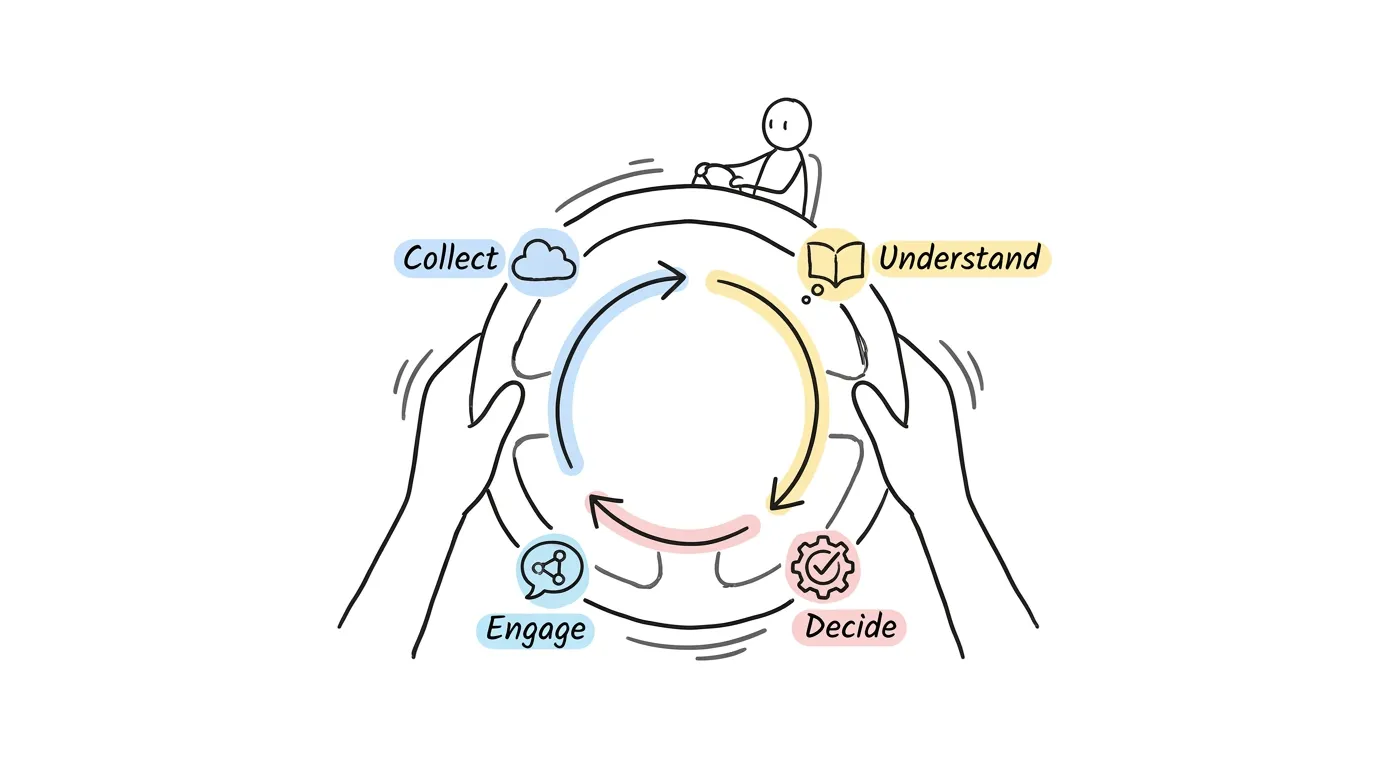
Remember that prediction about 40% getting killed off? The deployments that survive don't survive on how smart their agents are. They survive on whether the mechanism — humans set the boundaries, agents execute, humans recalibrate — is steady enough.
Data-intensive optimization goes to the agents. Empathy, cultural judgment, and strategic vision, the humans keep.
To Close
Back to those two numbers from the beginning.
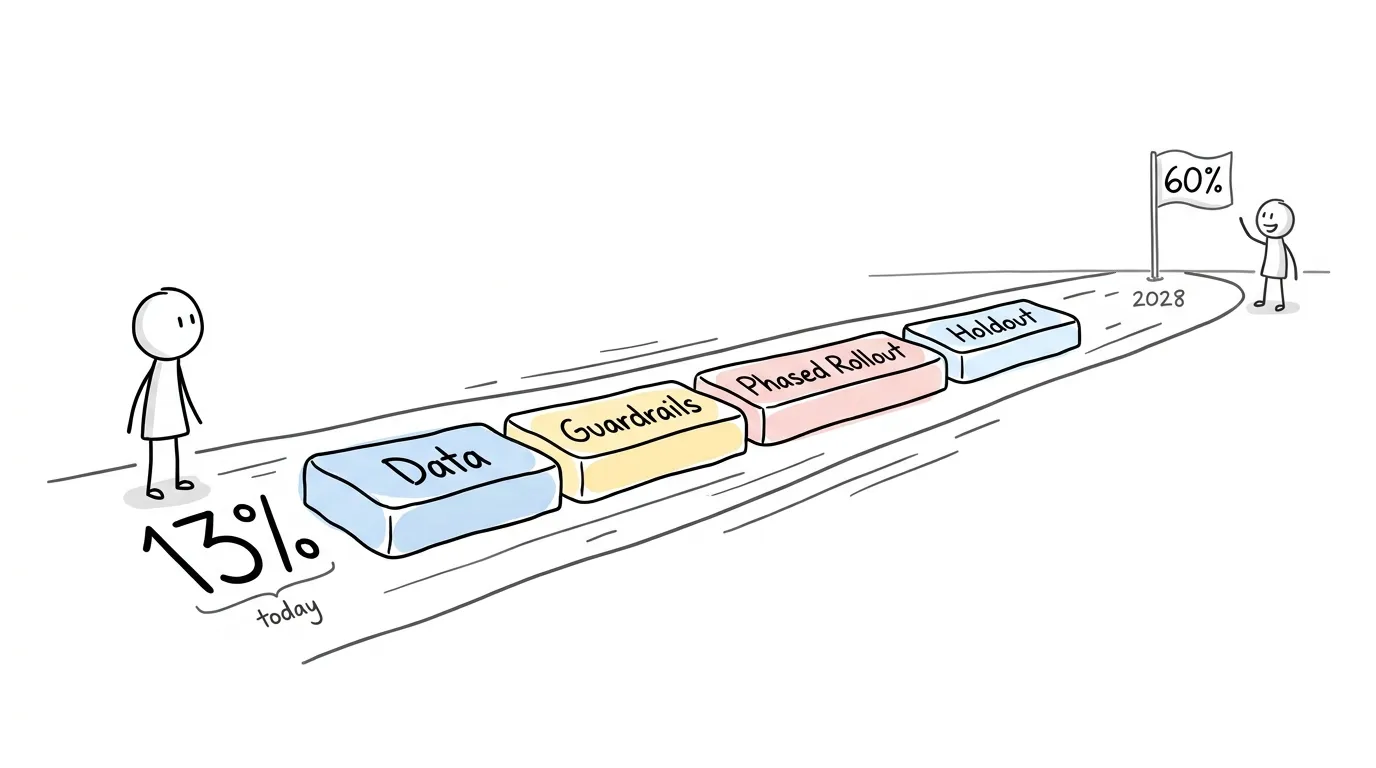
60% is the 2028 that Gartner sees. 13% is the reality standing here today. The road from 13% to 60% is paved with four bricks: the data foundation, guardrails, the phased rollout, and holdout measurement.
Agents will design campaigns, allocate budgets, and learn overnight which subject lines move people more. That is genuinely powerful.
But it doesn't know why your brand deserves to be loved, and it doesn't know which bottom line must never be crossed — not for a single customer. Those things are still your job.
Once you think this through, you'll breathe a sigh of relief: it turns out you don't have to become an engineer. You only have to write down goals, boundaries, and judgment clearly — and then keep a firm grip on the steering wheel in your hands.
And here's hoping you put agents to work a day sooner. Let them run up beautiful numbers inside the guardrails — while you go do the things machines will never be able to do.
Continue reading
Related articles

What Is AI Marketing Automation? It Starts With a 40-Point Gap
A learn article explaining what AI marketing automation is: how learning-based systems differ from rule-based automation, how AI decisioning optimizes message, channel, and timing choices, what data it depends on, and where it applies across the customer lifecycle.

Marketing Automation Is Shifting from "You Do It" to "You Say It"
This article explains how marketing automation is shifting from rule-based platforms that merely execute toward AI agents that plan, create, publish, and review campaigns, covering delegable tasks, underlying technologies, tool categories, adoption steps, and risks such as privacy and automating without strategy.

Rankings Are Taking a Dive, Customers Are Sprinting Ahead: This November, I Re-Ran the Numbers on AI Search
A learn article on how AI search reshapes marketing measurement, covering reported mismatches between rank-tracking tools and live Google results, ChatGPT's business profile test, single-page visitors as high-intent leads, and CRO plus GA4 tracking verification practices.