
Your Traffic Didn't Drop — AI Intercepted It: How Small Teams Get Cited by AI at the End of 2026
A learn guide on how AI-generated answers intercept search clicks and how small teams can become citable sources in ChatGPT, Perplexity, and Google AI Mode through free visibility audits, intent-focused pages, answer blocks, entity-based copy, schema, consistent brand facts, and AI drafts with human review.
A while back, I had my team run a small experiment.
We took the ten questions clients ask most often, fed them in verbatim, one by one, into ChatGPT, Perplexity, and Google's AI Mode. Then we kept score: who got cited, and who didn't.
The results stung a little. The ones AI called out by name were, without exception, a handful of our peers. Us? Page one? We were there. Clicks? A trickle.
That was the moment something finally clicked for me: ranking on page one is no longer the ticket. Whether AI is willing to cite you — that is.
Today's article is about exactly that.
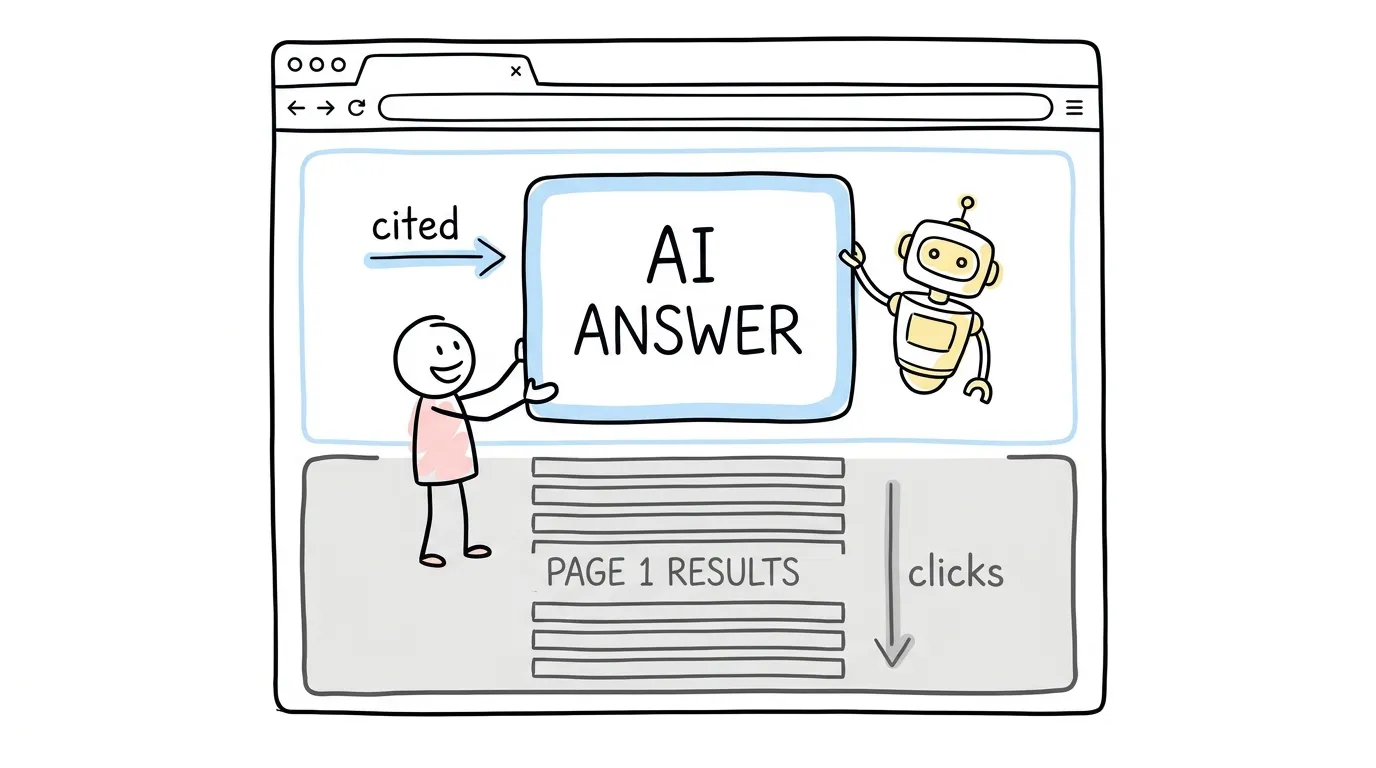
What is AI SEO, anyway?
The term sounds mystical. Strip it down and it's two things.
First: using AI to do the SEO work faster — keyword research, outlines, first drafts, technical audits.
Second — and this is the one that really matters: shaping your content into something AI is willing to cite.
Think about it. ChatGPT, Perplexity, Google's AI Overviews and AI Mode — these engines don't read your page the way a person does, from top to bottom. They break your paragraphs apart, lift them out, and drop them into an answer they wrote themselves. Whether your page can be lifted out determines whether your content keeps living — or gets reduced to background reading.
Search Engine Land put a remarkably clean definition on it: make your content discoverable, extractable, and trustworthy. You'll also hear newer terms floating around — GEO, AEO. Don't agonize over them. The names change with every season; the goal is one thing: showing up inside AI-generated answers.
Run three numbers first
Theory's done. Now the math. I like to talk in numbers, because numbers don't do politeness.
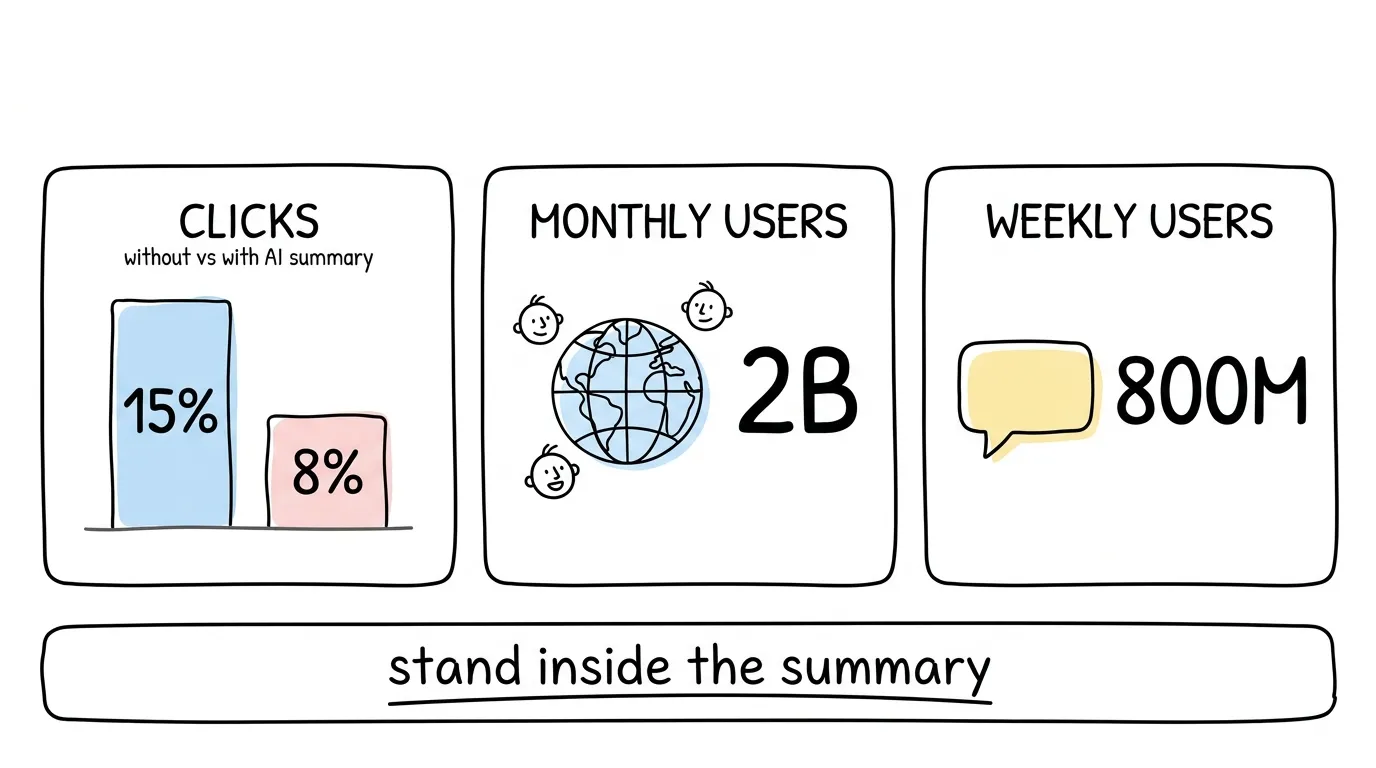
First number. In July 2025, Pew Research Center published a study: when an AI summary sits on the results page, roughly 8% of users click the traditional organic results; without an AI summary, it's about 15%.
Close enough: cut in half.
Second number. Alphabet disclosed in 2025 that AI Overviews had passed 2 billion monthly users. In October 2025, OpenAI said ChatGPT had roughly 800 million weekly users.
The third is the simplest: buyers ask millions of questions inside AI search every day, and plenty of them carry explicit purchase intent.
Put the three numbers together and the conclusion surfaces on its own: if clicks get cut in half the moment an AI summary appears, then the only way to win this fight is to stand inside the summary yourself.
You rank third, the dashboard looks lovely — and AI reads the answer out loud right over your head. The client listens, then leaves. This may be the quietest way to lose in this era: every line on the dashboard looks normal, and the clients have already stopped coming.
This month, six things happened in the field
For this November 2026 round, I went through the guides, the tool reviews, and the agency playbooks, and picked out six things small teams should actually care about.
First: short pages are beating the big, catch-all long pages.
StudioHawk's Lawrence Hitches published a widely shared explainer in March 2026, and by November it was still the framework agencies kept citing. The core judgment: AI retrieval favors short pages that answer exactly one intent at a time. Those four-thousand-word "ultimate guides" that cram ten questions onto one page look, to an AI, like ten signals tangled together — it has to guess which one you're actually answering. And the moment it guesses, you get downgraded.
This one hits home for me. Language works best for machines when every sentence carries one clear subject, one clear claim, one clear context. Witty asides, planted setups, an "it" dangling three paragraphs back — those are charm for humans; for machines, they're getting lost.
Second: the new rules are only eight items long, and not one of them mentions word count.
Those eight items have become the checklist many teams measure themselves against. I'll copy them straight to you: one intent per page, an answer block up front, full schema, clean internal links in a topic cluster, pursue information gain, keep content fresh, crawlable and fast-loading, use AI to speed up the work.
What's information gain? It's something on your page that nobody else has: your own data, your own pricing, your own hard-won mistakes. AI has already read the generic version of every article out there — why would it cite you? There's exactly one reason: you're holding something new.
Third: AI doesn't rank your pages. AI cites your pages.
BrightEdge puts it bluntly: AI search engines generate personalized answers based on intent and context — they cite web pages; they don't rank them. Ask the same question from two different people, and the sources cited back can be different.
So the old habit of "watching one keyword's ranking" is essentially dead. Your "ranking" is now a probability spread across thousands of personalized answers. What you watch has changed: impressions, mentions, citations.
Fourth: GEO tracking has grown up into its own tool category.
In 2026, Whatagraph tested 15 AI SEO tools, and the category split is interesting: alongside content editors like Clearscope, Surfer, and Ahrefs AI Content Helper, an entire group of "AI visibility tracking" tools has surfaced — AIclicks, Rankscale, SE Ranking — dedicated to watching who mentions your brand inside ChatGPT and Perplexity.
The tools are real. But I'd tell you to keep your wallet closed for now. Open three browser windows, run the ten buyer questions through, and write down who gets cited. This manual move costs nothing and tells you eighty percent of what a paid tool would tell you in the first month.
Fifth: "autopilot"-style AI SEO agents are being sold to the busiest founders.
The pitch is seductive: zero extra work, new pages shipped automatically every week, a ten-minute setup — some even bundle automated link exchanges. BrightEdge has its own Autopilot, which keeps watching and adjusting after your content goes out.
I build AI agents myself, so I can say this with full weight: automation is good for scaffolding, not for judgment. Let AI pull research, produce drafts, straighten structure — no problem. But every single claim about your product, your pricing, your expertise has to pass a human review before it goes out. Automated link exchanges, above all, steer clear: Google has been cracking down on manipulative link schemes for years, not days. An agent that ships 52 pages of generic filler a year on your behalf hands you 52 pages of noise wearing your own brand.
Sixth: a good number of agencies will admit it themselves — AI SEO looks a lot like good old SEO.
LP Agency says AI-SEO is still on-page, off-page, and technical work — the same few disciplines; you just apply the effort where AI engines pull their answers. Wingman Planning and GreenBananaSEO say roughly the same thing. And GreenBananaSEO adds a very practical line: buyers now ask chatbots directly "who's good near me," which makes local SEO heavier, not lighter.
I like this kind of honesty. Every eighteen months somebody sells you a "brand-new discipline," and you pull it apart to find it's mostly the old foundation: crawlable, clearly structured, credibly attributed, fast pages. The genuinely new layer is exactly one thing — the extraction layer, where a machine lifts a passage out of your page and drops it into an answer. Get that layer right, and none of the old craft goes to waste.
Dig one level deeper: five mechanisms
Tactics expire; mechanisms don't. Five levels down.
Level one: this is a language-interface problem.
An LLM reads your page the way an ultra-precise, slightly rigid international student reads a textbook. One clear subject, one clear claim, one clear context per sentence — that's when it reads smoothest. You write "it can help you solve this problem." Who is "it"? Which one is "this"? The moment the machine has to guess, your odds of being cited slide down.
Level two: entities beat adjectives.
"We are the best design company" carries, to an AI, exactly zero information. Swap it for "This studio is a three-person team in Rotterdam that has done packaging since 2019 for 40 Dutch food startups" — name, size, service, city, niche, timeframe: six entities the machine can verify one by one. Every time you revise an About page, trade adjectives for entities, and the page becomes instantly more citable.
Level three: trust is now proven through cross-web consistency.
AI cross-checks. Your website says founded in 2021, LinkedIn says 2020, a directory says 2019 — what the machine sees is a garbled entity. Your facts should look identical everywhere, and never require anyone to verify them by hand.
Level four: small teams hold the asymmetric advantage this time.
Big companies sit on thousands of old pages that contradict one another, where changing a single sentence takes three weeks of approvals. One person, one weekend, can restructure a thirty-page site. AI SEO is one of the rare battlefields where clarity and speed are worth more than budget.
Level five: proprietary experience is the only moat left.
Neil Patel has said that LLMs are becoming a substitute for search, and that content needs expertise and proprietary insight. I'll push it one step further: whatever AI can generate from public data, it will generate itself — and skip your page. What it can't generate: your customer interview results, your pricing experiments, that painful pivot that took a long time to stop hurting. Failure is a content asset. Write it down, and it's information gain.
So how do you actually do it?
If I were starting a project from scratch tomorrow, with no SEO budget, here's the path I'd take.
Step one: run a free visibility audit first. Write down the 10 to 20 questions buyers ask before they commit, feed each one into ChatGPT, Perplexity, and Google AI Mode, and note who gets cited and whether you're in the room. Redo it monthly, all in one spreadsheet. That's your baseline, and it costs nothing.
Step two: one intent, one page. "What is it / how much / how does it compare / how do I do it" each get their own page. If you sell bookkeeping for freelancers, don't cram costs, VAT, and software comparisons into one giant guide.
Step three: under every H2, lead with a 40-to-60-word direct answer before any story, before any background. Make the heading the question itself wherever possible. Machine extraction rewards this — and so do impatient humans.
Step four: replace every adjective with an entity and evidence. "Delivered anywhere in the EU within 48 hours," not "fast shipping." "Four engineers with 60 combined years of CAD experience," not "a seasoned team." Price is written as price; founders are named by name.
Step five: complete your schema. Organization, Person, Product, FAQPage, LocalBusiness — most WordPress plugins cover these — then use sameAs to thread your social profiles and directory listings all together, telling the machine: every one of these is the same business.
Step six: one hub page per topic, internal links with descriptive anchor text. Retire "read more" for good.
Step seven: publish one piece of data per month that only you can publish — a survey of 30 customers, one pricing experiment, one post-mortem with real numbers attached.
Step eight: earn mentions where the AI engines look: fix your directory listings, supply expert quotes to journalists, answer questions seriously in the communities where buyers gather. A handful of real mentions beats hundreds of low-quality links. Automated link swapping — skip it.
Step nine: AI drafts, humans gatekeep. Research, outlines, first drafts, schema code, meta descriptions — hand them to the machine. Claims, tone, examples, ethics — those stay with a person. Your name is on the page, so the judgment has to be inside the page too.
Step ten: set a quarterly alarm. Prices, dates, figures, screenshots — refresh them quarterly, and show a "last updated" on the page. A page still carrying 2023 prices is telling the machines nobody's home.
Take one example. A freelance UX designer in Lisbon: one portfolio, one "services" page crammed to the edges, a blog untouched since 2024. She asks ChatGPT "which freelance UX designers in Portugal suit fintech startups" — three peers come out, none of them her.
Following the path above: split the services page into three — "UX audits for fintech apps," "UX research for early-stage startups," "SaaS design systems"; put a price range and a delivery timeline at the top of each page; rewrite the About page in entities — years, named fintech clients, city, languages; publish one case per month with before-and-after numbers, like cutting onboarding drop-off from 40% to 22%; add Person and Service schema and thread in her portfolio homepage; then go get herself listed accurately in the local startup communities and design directories, earning citations.
Not one step needs a developer. Not one step needs a big budget. What it takes is three things: clarity, honesty, and a calendar.
How do you pick tools?
One line of principle: get the manual version working first; go paid only when it becomes the bottleneck.
For auditing content and finding gaps, look at Clearscope, Surfer, and Ahrefs AI Content Helper. For chasing AI visibility, wait until the questions you're monitoring pass 20, then consider AIclicks, Rankscale, or SE Ranking. For drafting and workflow, Writesonic and AirOps, plus general-purpose assistants like ChatGPT and Claude. For outreach and links, Pitchbox and Ranking Raccoon — real outreach only. BrightEdge's suite (Content Advisor, Copilot, Autopilot) is an efficiency layer for after you have a marketing team. Auto-publishing agents like SEO.AI: if you use one, pair it with strict human review — and with automated link exchanges, if you're not sure, switch them off.
The most common traps
I see these mistakes every week. Avoid them, and you're already ahead of most of your peers.
Shipping dozens of AI-generated generic pages at once — without information gain, all that volume stays invisible. Opening every page with three hundred words of story and burying the answer at the end — the machine can't lift it out, and the impatient never get there. One giant page trying to answer every question — all the signals mushed into a blur. A founding year that doesn't match across website, LinkedIn, and directories — the machine sees a garbled entity. A security plugin or a robots.txt template that quietly blocks AI crawlers — you shut your own door, then wonder why nobody comes. Watching only traditional rankings — you're third, and the clicks still sit near zero. Letting an autopilot agent write your product claims — the day it invents a customer logo, that's a legal and reputational double failure. Skipping schema because it sounds too technical — in truth, plugins can handle most of it in an hour. Treating AI SEO as a one-off project — AI answers shift month by month; a quarterly cadence beats an annual deep clean. Copying a competitor's structure — you're bringing identical materials to compete for the same citation slot; on what grounds would you win?
Five hours a week — how do you split them?
I ran this math for founders who have neither budget nor headcount.
Hour one: five buyer questions, run through all three engines, citations logged. Hours two and three: rewrite or newly build one focused page, with an answer block, entities, and schema. Hour four: log one piece of data only you have — a customer's own words, a number, a lesson. Hour five: earn one external mention — fix one directory listing, answer one community question, pitch one journalist.
Twelve weeks later, you'll be holding 12 sharper pages, 12 pieces of proprietary insight, and a dozen-plus new mentions. Put week 1's citation log next to week 12's — that is the most honest progress bar you can get in this field.
The questions people ask most often
Will AI replace SEO?
No — but the rules are changing. Neil Patel's answer matches my own judgment: hand the repetitive labor and the data analysis to AI; judgment, creativity, and strategy stay human. Search engines still need good content, and people still need useful information.
Is there a difference between AI SEO, GEO, and AEO?
Basically none. As StudioHawk has said, these labels all point at the same goal. Pick one term to use internally, and spend the energy on the work itself.
Why isn't my long guide making it into AI answers?
Catch-all pages are hard to extract. Split it into focused pages, add answer blocks, string them into a cluster; if the old guide has strong backlinks, keep it as the hub page.
Should I buy tools right away?
No. Manual citation checks, a free schema plugin, a general-purpose AI assistant — enough. Go paid once the manual version starts eating more than a few hours a week.
Does this affect local businesses?
Yes, and not mildly. Buyers now ask chatbots for recommendations directly. Keep Business Profile, address, opening hours, and reviews consistent across every directory.
If I rank outside the top ten, can AI Overviews still cite me?
Yes. Cited sources don't simply mirror the top-ten organic results. Comparison pages, decision guides, calculators, templates, checklists — these commercially valuable formats let small sites win on precision and original evidence.
Is there a separate AI Overviews algorithm I can "do"?
No. Google cites pages that are already indexed, summarizable, and trustworthy. First confirm your key pages return 200, aren't blocked by nosnippet, and are in the index — Search Console's URL inspection tool settles that in minutes.
Do ChatGPT, Perplexity, and Google AI Mode find sources the same way?
The broad framework is the same; the data pools differ. ChatGPT search leans heavily on the Bing index, so remember to submit your sitemap in Bing Webmaster Tools. Perplexity favors fresh pages with clean citations. Google AI Mode uses its own index and Business Profile.
How do I make my pages easier for machines to read?
Put the key answers in plain HTML text — never locked inside images, PDFs, slides, or JS-loaded tabs. The test is crude but honest: open the page source; if the answer isn't in there, many AI crawlers can't see it either.
No clicks — so how do I measure results?
Watch share of voice: how often your brand shows up in AI answers to buyer questions, measured against competitors. Pair it with branded-search growth, direct traffic, and one added question in your forms: "How did you hear about us?" Many buyers influenced by AI arrive at your site with no referrer at all.
What do RankBrain, BERT, and MUM mean for keyword research?
Intent and context matter more than exact match. Expand topics by intent and synonyms, and write naturally. MUM also understands images and multiple languages, so alt text and multilingual pages benefit along the way.
Can AI help me spot trends early?
Yes. Machine learning finds patterns in search behavior and seasonality faster than a person flipping through tables. The guides from Salesforce stress this play too: every month, feed Google Trends exports, Search Console queries, and competitor sitemaps to AI, let it surface rising topics, then publish early and bank citations before anyone else shows up.
What about voice search?
Voice assistants and AI chat share the same pool of complete questions. Put the exact words from sales calls and support tickets into your headings, with answers of one or two sentences that read aloud smoothly.
How do I get YouTube videos into AI summaries?
Treat one video as one content object: title, thumbnail, description, captions, and spoken script should all tell the same story — and the topic should be said out loud in the opening. An AI summary may quote what you said in place of the title.
Here's one more question that gets searched often: what do AI digital marketing jobs pay?
Taking the US as the example: entry-level AI marketing or AI SEO roles run roughly $55,000 to $80,000 a year, mid-level $80,000 to $120,000, senior strategy and manager roles with AI search skills $130,000 and up, and freelance consultants price by the hour or by project.
Ever heard of that 10/20/70 rule?
It came from Boston Consulting Group (BCG): when a company brings in AI, 10% of the effort goes to algorithms, 20% to technology and data, and 70% to people and process. Whether most AI projects succeed or fail doesn't hinge on the software — it hinges on whether the people were reorganized. Applied to AI SEO, it holds exactly the same: the free, manual moves are already enough to get you started.
The 30-Day Checklist
For this November 2026 round, the big lesson comes down to one sentence: AI cites sources that are clear, specific, consistent, and carry original information — and ignores the rest.
Over the next 30 days, do six things, in order:
One. Ten buyer questions: run one free visibility audit.
Two. Split your biggest catch-all page into focused pages, and add an answer block to each.
Three. About page: swap every adjective for an entity.
Four. Complete your schema, and use sameAs to thread all your profiles together.
Five. Publish one insight that only your business could have written.
Six. Fix one place where your brand facts disagree across the web.
I keep telling founding teams one sentence: what you're missing isn't inspiration — it's infrastructure. AI SEO is exactly that kind of infrastructure: the audit is your dashboard, the focused pages are your load-bearing walls, the consistent facts are your foundation. Most of your competitors are still paging through old ranking reports, wondering where the clicks went.
Back to the experiment from the opening. We now rerun those ten questions every quarter. The first time we ran it, the citation list had none of us in it; now, for several of those questions, the machine reads our name out loud. The change didn't start with some clever trick — it started with taking one thing apart clearly, and writing one fact down specifically.
Here's to being the one who gets cited, in this fight where AI is redistributing attention.
Continue reading
Related articles

It's 2026: Stop "Buying" AI Tools for Your Marketing Team — Start "Hiring" AI Agents
This learn article explains how AI agents differ from standalone AI tools in marketing, outlines three agent categories — build-your-own platforms, CRM-native agents, and vertical tools — and covers use cases across SEO, social media, advertising, and reporting, plus criteria for choosing one.

What Is GEO? How Your Brand Gets "Mentioned" in the Age of AI Search
An explainer on GEO (Generative Engine Optimization) for e-commerce and DTC brands: how it differs from SEO and AEO, why AI answers shape brand visibility, and eight practices covering question-focused content, consistent brand messaging, structured pages, external evidence, comparisons, and AI mention tracking.

AI Is Already Making Decisions for Your Customers. Are You on the List?
A learn article explains GEO (Generative Engine Optimization): why AI-generated answers now shape which brands customers see, and how SEO fundamentals, entity clarity, citable evidence, and monthly measurement affect visibility in AI answers.