
95% of Deals Are Decided Before You Ever Show Up
A learn article on how B2B buying decisions increasingly form before vendor contact, covering the Day One shortlist, buyer use of AI research tools, the dark funnel, and tactics such as shifting budget to brand and creating content that AI engines can cite.
A few days ago, I had dinner with a friend who sells B2B software.
He looked miserable. Sales kept getting harder, he said: the clients he finally managed to book would open with hyper-specific questions — pricing, integrations, data compliance — probing in more detail than even the seller. Then, at the end: "We'll compare a few more options." And that was the last he heard.
So I asked him: have you considered that your customer may have already finished deciding who to buy from — before you ever showed up?
He froze for a second.
This isn't me guessing. In 2025, 6sense published a report based on a survey of nearly 4,000 B2B buyers across North America, Europe, and Asia-Pacific. One number in it made my stomach drop the first time I saw it:
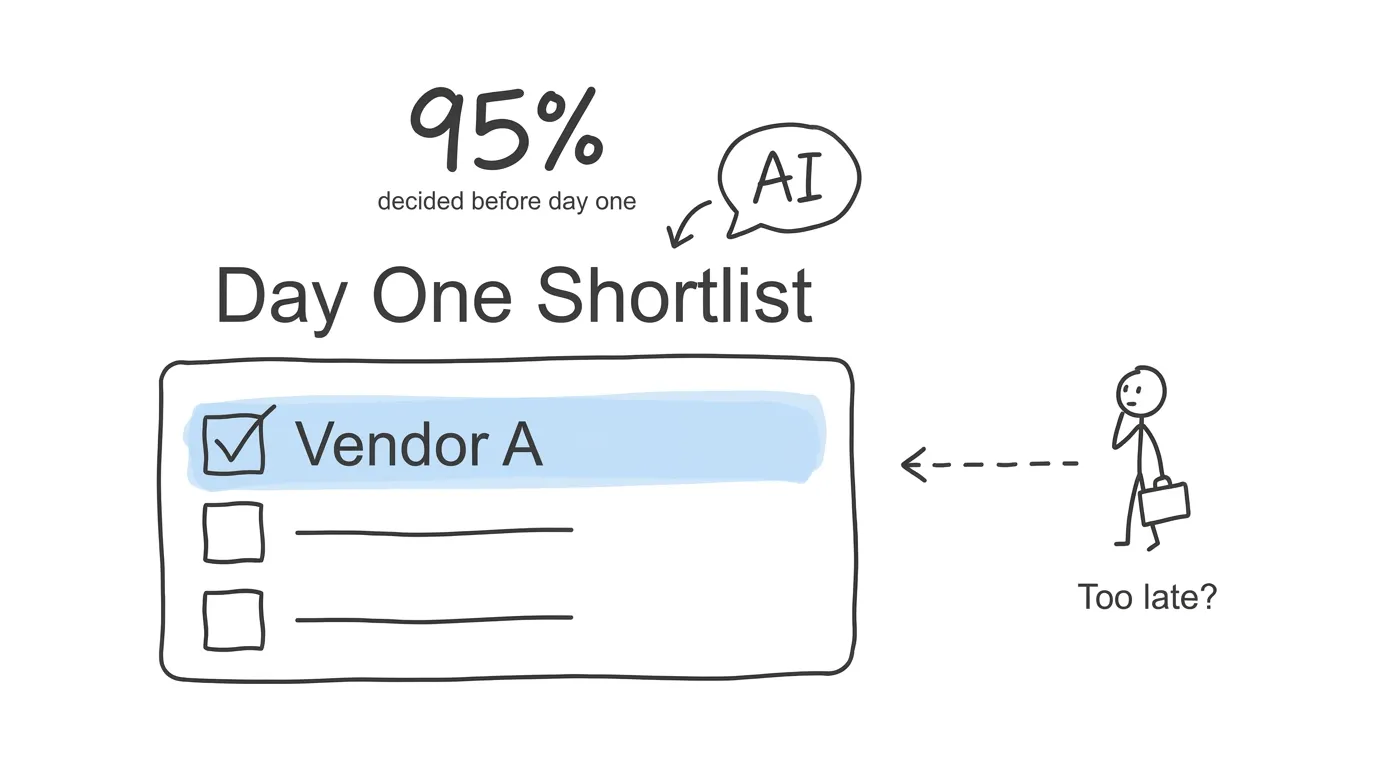
95% of winning vendors were already on the buyer's candidate list on day one of the buyer's formal evaluation.
Think about what that means. Of every twenty deals, nineteen go to a winner who was there before you made your first call. And the company that leads before any contact happens wins about eight in ten of those deals.
In 2026, the B2B buying battle isn't being fought on your turf anymore. Where is it fought? Inside the AI chat window.
Let's break it down layer by layer.
What Exactly Is the Day One Shortlist?
The day a buyer starts evaluating vendors formally, they already have a list in their head. That list is the Day One shortlist.
The key question: when did that list get formed?
Not during the comparison-and-evaluation phase, and not after they visited your website. It was put together before formal evaluation even began — out of brand awareness, products they've used before, and the homework AI did for them.
Two details in 6sense's data sting even more.
First: buyers evaluate five vendors on average, and four of those five are ones they'd already dealt with, or knew of, beforehand. In other words, the prerequisite for making the list is being known before the search even starts.
Second: the list is shrinking. Apollo's 2026 tracking shows the average shortlist has gone from 3.2 vendors a few years ago to 2.5.
The shorter the list, the worse the position of anyone who didn't make it. And your chances of making it are generated almost entirely before contact happens.
What Are Buyers Actually Using AI For?
Now look at something even more fundamental: how buyers get information has changed.
Forrester's buyer surveys: in 2024, 89% of B2B buyers were using generative AI; by 2025 that rose to 94%. The more important shift is in the rankings: in "most valuable information sources," generative AI and conversational search now rank above official websites, product experts, and even salespeople.
Forrester also put a number on it: buyers complete 70–80% of their research before they ever contact sales.
Platform choices matter too. ChatGPT leads by far — in April 2026 it accounted for 76.85% of all AI chatbot referral traffic across the web (Statcounter's data), with Google Gemini at 9% and Perplexity at 7.73%. But the B2B scene has one exception worth writing down separately: Microsoft Copilot. Enterprise buyers use it at four times the rate of ordinary consumers, and 61% of buyers use the AI tool their company issues uniformly. Whatever your customer's company hands them, that's what they use.
Two sets of numbers from G2's April 2026 buyer survey stuck with me. 51% of software buyers said they increasingly ask AI first instead of opening Google. And 69% admitted that because a vendor showed up in AI's recommendations, they ended up buying a vendor that wasn't in their original plan. Honestly, I didn't quite believe it at first glance. Then I thought about how people around me actually buy software — and yes, that's exactly how it goes.
Picture how lethal this is: a single AI chat window can knock you off your customer's preferred list.
The Cycle Got Shorter — But You've Probably Got the Reason Wrong
The same 6sense report has another number: the average B2B buying cycle shrank from 11.3 months in 2024 to 10.1 months in 2025. More than a month trimmed off in a single year.
Many people's first reaction: ah, buyers don't do research anymore, they just buy on gut feel.
It's the exact opposite. Research didn't decrease — it increased. AI simply made research more efficient: what used to take three weeks of digging now takes one evening of asking AI.
One more detail worth pulling out. 58% of buyers say they contact vendors earlier now. Why? They want to see how well those vendors are actually using AI. 6sense has another number: nearly 90% of buyers say the solutions they purchase already come with AI features built in. Vendors who can't articulate their AI strategy fall behind at the shortlist stage.
So when buyers reach out early, much of the time they're coming to vet you: is AI genuinely built into your product? Can you explain it clearly?
If your sales team still picks up the phone with a script built to educate customers from zero, you're basically pushing buyers out the door.
What Is the Dark Funnel?
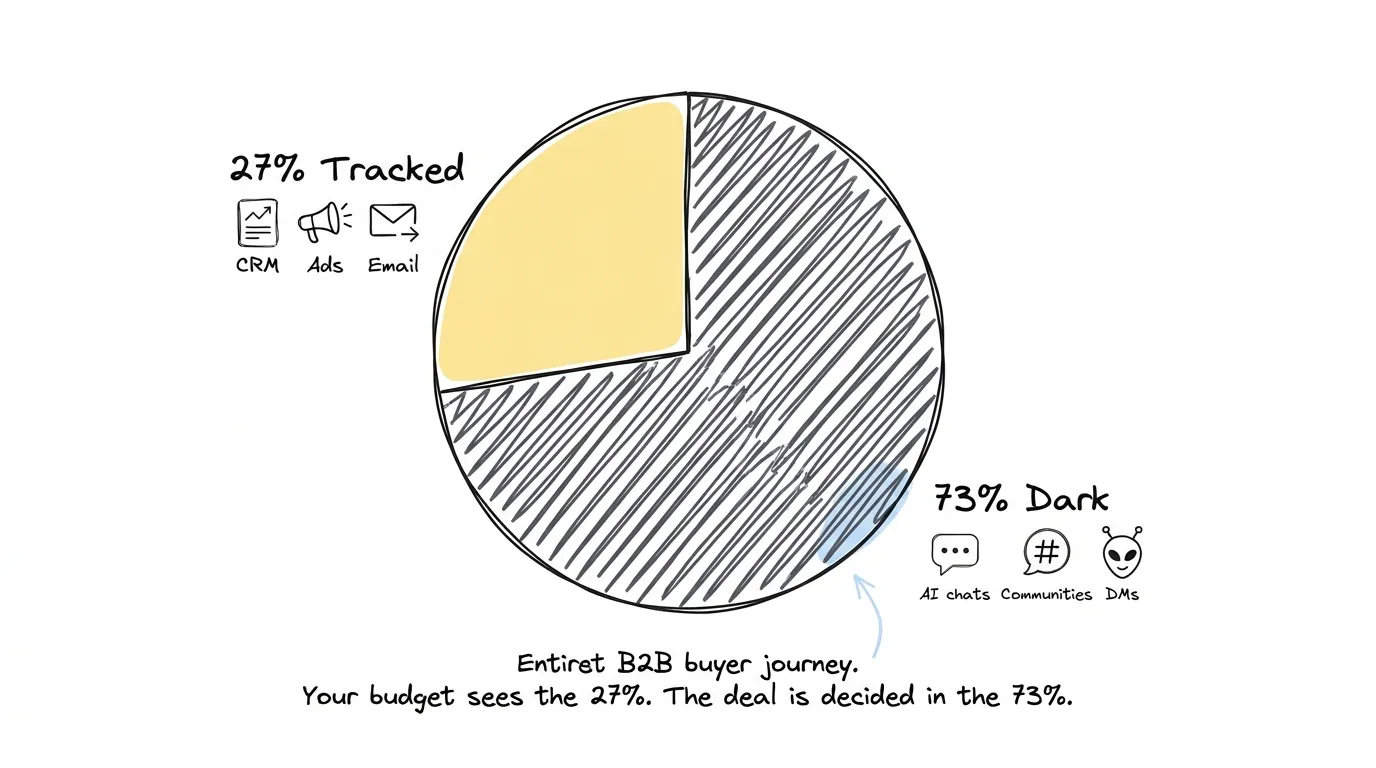
It's everything that happens between buyers and you — or buyers and your competitors — that your marketing and sales systems can't see or record. Private Slack communities, Reddit threads, LinkedIn DMs, a casual recommendation on a podcast, word of mouth over dinner with peers. None of it ever touches your CRM.
And AI just added a huge new block to it: the conversations buyers have with AI behind closed doors.
Google published research in October 2025: 60% of B2B buyers use tools like ChatGPT and Gemini to expand their candidate lists, summarize materials, and dig up competitors. Those conversations happen inside the buyer's own browser, and not a single byte of them ever flows into your attribution system.
TrustRadius's 2025 research fills in the other side: 72% of buyers encounter Google AI Overviews during research — the AI-generated summary at the top of search results — and 90% of those who see one click through to the sources it cites.
Rough math: traditional attribution tools capture only about 27% of the B2B buyer journey. The other 73% happens in the dark.
Your marketing budget measures the visible 27%, while the win or loss is already decided in the invisible 73%.
Buyers Aren't Naive — AI Just Raised the Bar for Trust
At this point you might be thinking: that's it, then — from now on buyers believe whatever AI says, and whoever gets blessed by AI wins.
Not that simple. Buyers use AI, but they're not easy to fool.
6sense cross-checked one pair of numbers: in 2024, buyers interacted with the vendor that ultimately won an average of 17 times. In 2025, buyers' AI adoption rose sharply — and that number barely moved, at 16. AI didn't replace contact with vendors; it moved contact earlier and made it more selective.
TrustRadius's research has one more number: among buyers who use AI heavily for research, 62% often or always verify AI's claims against the original sources.
AI gives you a chance to be seen. But when buyers verify you, they still look at the hard stuff: do you have credible case studies, third-party reviews, industry-grade insight?
In Demand Gen Report's 2025 survey, "industry expertise" ranked first among final-selection factors at 52%, ahead of price (49%) and product fit (46%).
Trust wasn't diluted. Trust is being verified harder than ever.
So Where Should the Money Go?
Now that we've seen the table clearly, let's talk strategy. Three moves.
First, shift budget upstream. LinkedIn's own research recommends: B2B marketing budgets, 60% to brand building, 40% to lead capture. Most small and mid-sized B2B companies are configured exactly backwards. The reason is simple: the list is decided before contact, so no matter how hard you pull on the back end, you're only catching the 5% outside the list.
Second, build content AI wants to cite. What determines whom AI recommends is whose content on the open web is more structured, better backed by data, and reads more like an actual expert. Stop stacking thin keyword pages. And take care of Bing's index while you're at it — Copilot's answers are built on Bing's index, and Bing Webmaster Tools now has a dedicated report showing which of your pages Copilot cites and what questions it answered with them.
Third, get peer validation solid. Review platforms, customer case studies, third-party endorsements — those are the deciding votes for a shortlist. TrustRadius's data: buyers who treat public review platforms as their most important information source went from 13% in 2021 to 31% in 2024.
By the way, this isn't necessarily bad news for smaller companies. Big brands get mentioned by AI naturally, but AI has a real soft spot for specialization: if you're deep enough in a niche and have real data, AI will preferentially cite you on that narrow question. A giant's breadth doesn't always beat your depth.
McKinsey estimated that generative AI alone could unlock $0.8–1.2 trillion in productivity in sales and marketing. That pool is enormous — worth staking your claim early.
Closing
Back to my friend from the beginning.
I told him: your customers didn't get smarter — the rules of procurement changed. It used to be contact first, then filtering. Now it's reversed: filter first, the list gets set, and only then does contact happen. The call your sales team receives isn't the starting gun — it's the final inspection.
He asked: do we still have a chance, then?
Yes. But where is the chance? In the 73% you can't see yet.
The center of gravity in B2B buying has moved. Whoever sees where it moved first comes out on top in the next reshuffle.
May your company show up on your customer's Day One list.
Continue reading
Related articles

It's 2026: Stop "Buying" AI Tools for Your Marketing Team — Start "Hiring" AI Agents
This learn article explains how AI agents differ from standalone AI tools in marketing, outlines three agent categories — build-your-own platforms, CRM-native agents, and vertical tools — and covers use cases across SEO, social media, advertising, and reporting, plus criteria for choosing one.

What Is GEO? How Your Brand Gets "Mentioned" in the Age of AI Search
An explainer on GEO (Generative Engine Optimization) for e-commerce and DTC brands: how it differs from SEO and AEO, why AI answers shape brand visibility, and eight practices covering question-focused content, consistent brand messaging, structured pages, external evidence, comparisons, and AI mention tracking.

AI Is Already Making Decisions for Your Customers. Are You on the List?
A learn article explains GEO (Generative Engine Optimization): why AI-generated answers now shape which brands customers see, and how SEO fundamentals, entity clarity, citable evidence, and monthly measurement affect visibility in AI answers.