
ChatGPT Opens a Back Office for Merchants — Why Publishers Are Thrilled and Uneasy
OpenAI's Business Hub gives merchants and publishers first-party data on how their sites appear in ChatGPT, including mentions, views, clicks, and topics. The article weighs its value for GEO measurement against legal terms and data limitations.
A few days ago a piece of news popped up in my feed, and I stared at it for a long while.
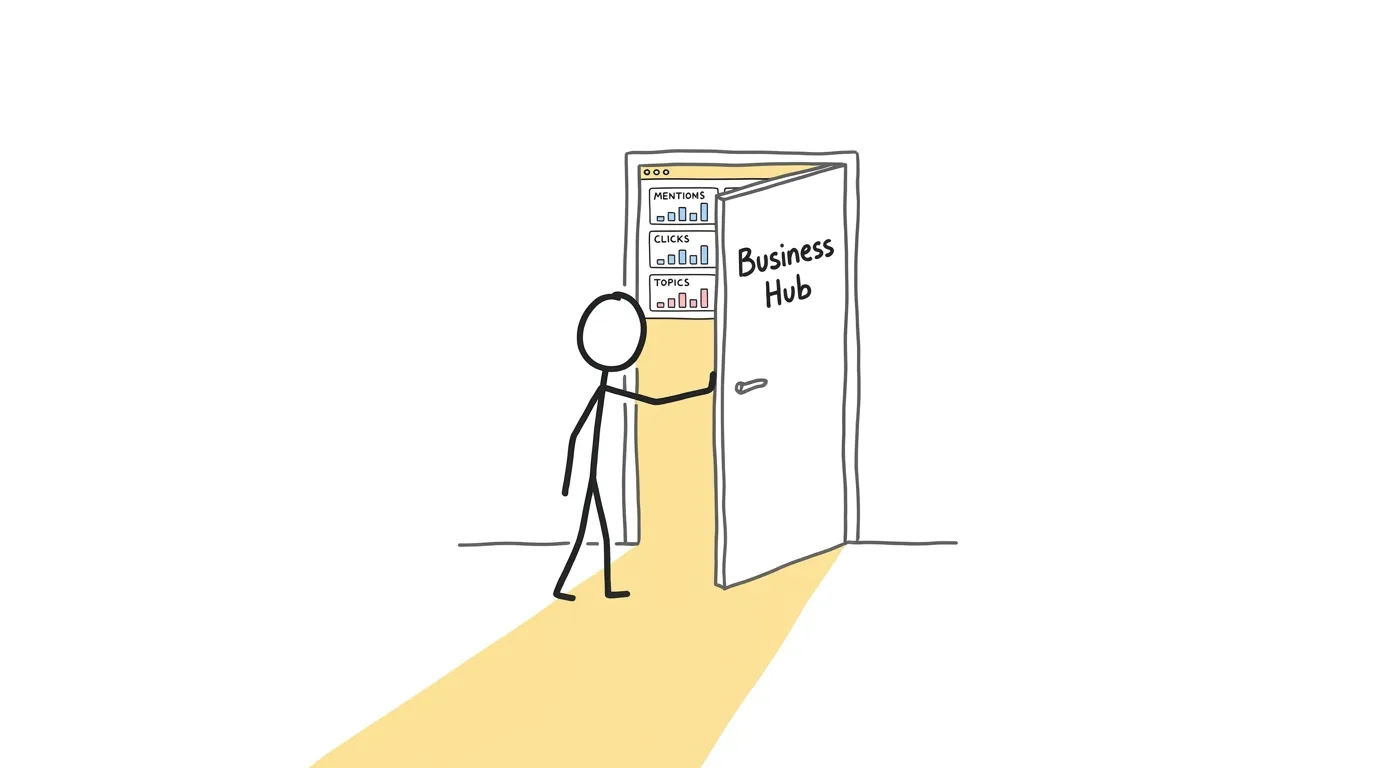
OpenAI has launched a new back office called Business Hub. Once merchants and publishers claim and verify their accounts, they can see one thing: how your website actually shows up inside ChatGPT. How many times it was mentioned, how many times its homepage was viewed, how many clicks it sent your way, and which topics the AI has tied you to.
Publishers have never gotten these numbers firsthand before.
Word is, half of six major publishers are already building out their accounts.
Why does this dashboard matter? Start with an old story.
Anyone who ran a website back in the day remembers the flying-blind stretch: rankings were guesswork, and traffic could only be pieced together after the fact from stats. Then Google opened up Search Console, and you could finally see which queries brought impressions and which brought clicks. From that point on, the entire SEO industry had an official dashboard.
Now it's AI's turn.
John Shehata, who analyzes publisher SEO, described this dashboard as "a very early, very limited Search Console moment." I think the phrase is spot-on. Early, because the data is still thin; limited, because a lot remains invisible. But the direction is right: the platform itself has started showing you the numbers.
The Celebrators
First, the happy ones.
What is GEO? Put plainly, it's a new way for publishers to do business: make content for brands, hoping ChatGPT will recommend the brand's product in its answers — with a citation link pointing to the publisher's article.
The thorniest problem in this business: how do you prove it works? Third-party tools guess back and forth, and clients remain more than a little skeptical.
Shehata says that with client-authorized first-party data, publishers can finally prove that recommendations really move the metrics on the platform. That fills in the missing measurement loop in every GEO pitch.
But he was quick to add: a publisher's own citation count is not the same as a brand campaign's return. Brand-level results still need brand-level evidence. What this dashboard sells is better evidence and better decisions, not citation counts.
Carly Steven, who runs SEO at Daily Mail, is more optimistic. She says these numbers are exactly what they need to sanity-check the success criteria they set for themselves: whether impressions and citations actually count.
But There's Always Another Side
First, the terms hide traps.
One publishing executive who asked to remain unnamed warns: legal should read the fine print before deciding whether to click "Agree." OpenAI's terms of service state that businesses must commit not to pursue certain legal claims — including disputes related to content already published on your website before signing.
For publishers, this is delicate. On one side, precious first-party data; on the other, legal teams already struggling to protect content. Give up a slice of legal rights just to see a dashboard?
OpenAI's response is that the terms "were not designed with this scenario in mind in the first place." Whether to believe that is legal's call.
Second, the dashboard only counts you.
Lily Ray, who does SEO research at the marketing agency Amsive, pointed out a key detail: what the dashboard counts is your website being mentioned, not your brand name being talked about.
Where do the two differ? Think about it. One publishing executive gave an example: a brand buys GEO services from a publisher, and the publisher writes an advertorial about the brand's product. ChatGPT recommends that product when answering a user, and cites that advertorial. So tell me — will the dashboard tell the publisher "this product was mentioned"?
No. It only counts the merchant's own mentions.
So publishers still have to keep using third-party tools to watch those citations. The executive has a vivid metaphor: brand mentions are like billboards. Nike putting up a billboard makes sense. A publisher putting one up — for what?
Ray's own dashboard also shows how coarse the data still is: 25 mentions, 4 clicks. The numbers are almost cute in their smallness, and the click-through rate computed on that basis is clearly inflated. Still, she concedes the data comes from the platform itself — and that makes it immensely valuable. Her exact words: it won't replace any tool I use, but it adds one more data point to a particularly winding channel.
Third, no prompt data.
Barry Adams, who consults on news-site SEO, puts it more bluntly: no prompts in the dashboard, no per-article breakdown, no competitor comparison — you simply don't know in what context your site is being mentioned. Reports like that are hard to mine for anything useful.
But he leaves room for hope: Google's Search Console, back then, grew bit by bit too. Business Hub probably will as well.
So What to Do Now
Shehata gave three steps, and I think they're worth stealing.
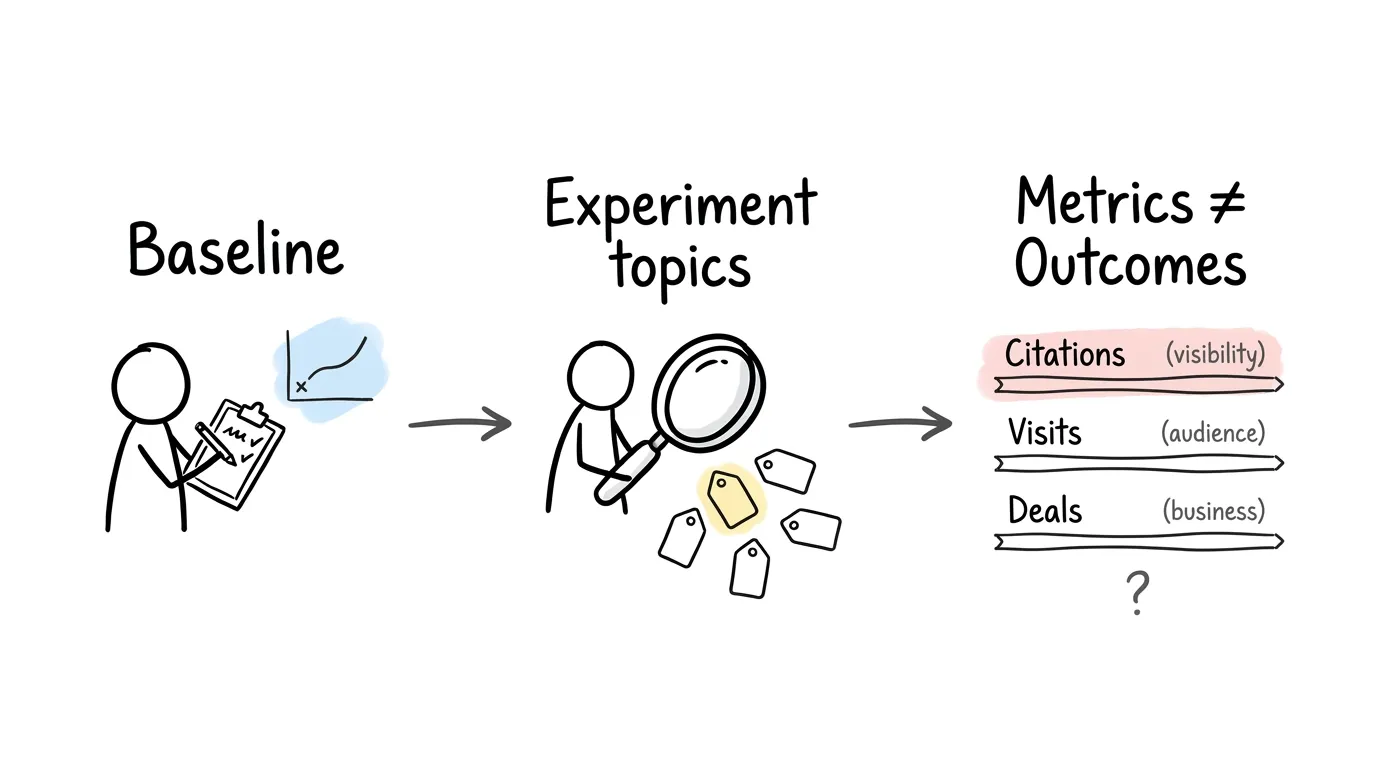
Step one: set a baseline first. Don't rush to celebrate when the data arrives — record baselines for mentions, clicks, and topics, so you have a reference when you read the trends later.
Step two: experiment with the topic data. The discovery topics in the dashboard are the most valuable part for content teams: which topics the AI already treats you as an authority on; which gaps you'd like to claim but haven't yet. He gave an example: a travel publisher notices the AI stirring on the family-travel topic, so they fill in a batch of guides with original reporting, then watch the numbers to see whether anything moves.
Step three: separate metrics from outcomes. Citations are a visibility outcome, visits are an audience outcome, and subscriptions and closed deals are the business outcome. Measure the three apart. If the dashboard shows impressions climbing steadily while referral traffic doesn't budge, the dashboard itself can't resolve that contradiction. The answer has to be found back in your own analytics.
A Final Word
Back to that Search Console moment.
The first generation of webmasters, seeing Google finally willing to open up its data, probably felt the same: so limited, and so precious.
Data the platform itself volunteers will always be worth more than what third parties guess. Even if it opens only a crack.
Even a crack lets in light.
May you get your own dashboard soon. And before legal clicks "Agree," read the terms all the way through.
Continue reading
Related articles

It's 2026: Stop "Buying" AI Tools for Your Marketing Team — Start "Hiring" AI Agents
This learn article explains how AI agents differ from standalone AI tools in marketing, outlines three agent categories — build-your-own platforms, CRM-native agents, and vertical tools — and covers use cases across SEO, social media, advertising, and reporting, plus criteria for choosing one.

What Is GEO? How Your Brand Gets "Mentioned" in the Age of AI Search
An explainer on GEO (Generative Engine Optimization) for e-commerce and DTC brands: how it differs from SEO and AEO, why AI answers shape brand visibility, and eight practices covering question-focused content, consistent brand messaging, structured pages, external evidence, comparisons, and AI mention tracking.

AI Is Already Making Decisions for Your Customers. Are You on the List?
A learn article explains GEO (Generative Engine Optimization): why AI-generated answers now shape which brands customers see, and how SEO fundamentals, entity clarity, citable evidence, and monthly measurement affect visibility in AI answers.