
Buyers Stopped Searching. You're Still Doing SEO? Time to Learn GEO, the New Homework
A long-form explainer on GEO (Generative Engine Optimization): how AI answers shape B2B buyer shortlists, why brands get omitted from citations, and a checklist spanning schema, content structure, off-site trust, and measurement.
A while back, a friend who has spent twenty years in precision machining invited me over for tea. His question was very specific:
"The traffic is still there, but the customers are gone. My website still gets tens of thousands of visits a month, yet the inquiries get thinner every year. Tell me — is it my people?"
I said, don't rush to blame your people. I asked him one question back: do your buyers still go to Google and search for "precision machining suppliers" today?
He paused.
High-value buyers today open ChatGPT, Perplexity, Gemini, or Claude and ask directly: "Who can do five-axis titanium machining with AS9100D certification?" Then the AI hands them a shortlist. And their candidate list grows out of that answer.
If you're not on the list, the problem isn't the third-round interview. The problem is that you were never invited.
A buyer's purchase doesn't start with contacting you. It starts with asking AI.
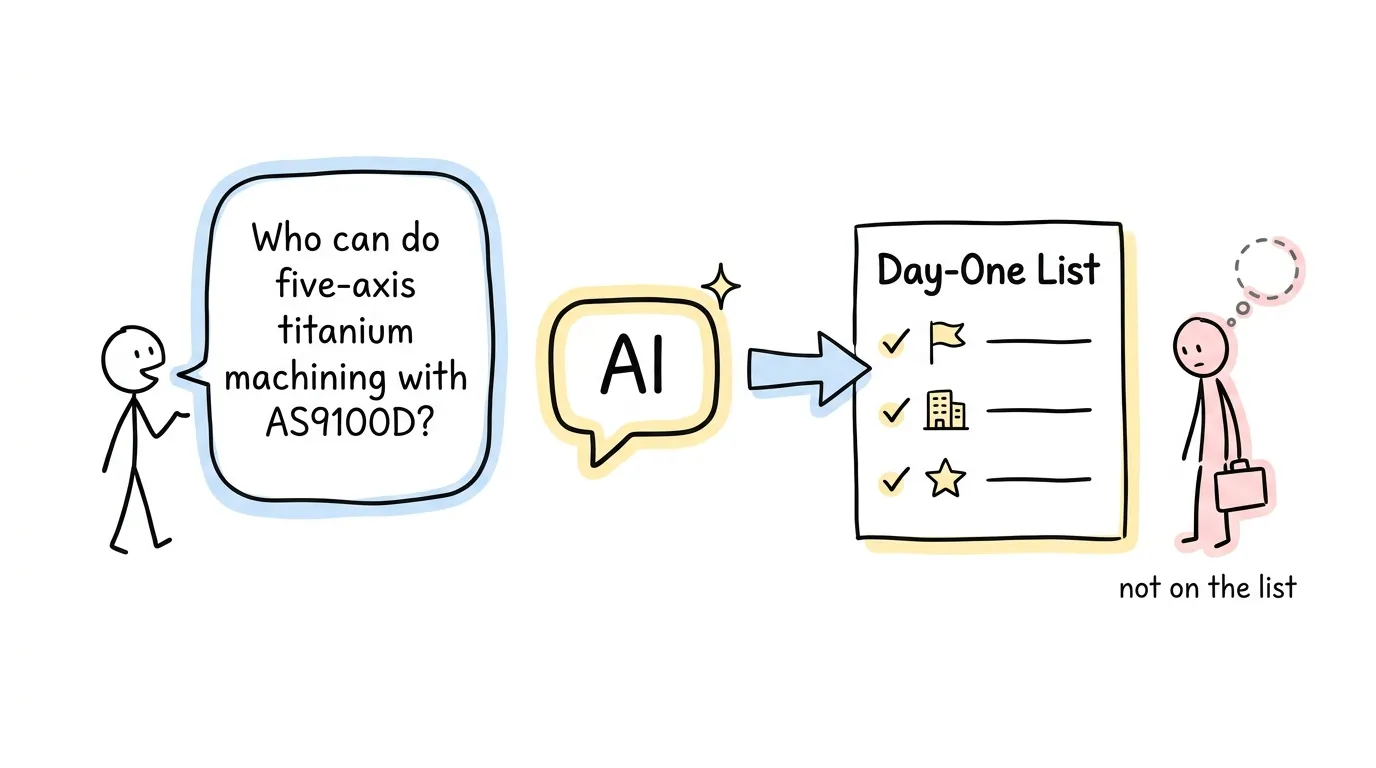
That's what this piece is about: GEO, Generative Engine Optimization.
What Is GEO?
What is GEO?
One sentence: make your brand the kind that large language models "can recall, can look up, and dare to cite."
When buyers ask AI "which vendors in this category are good," the AI names certain brands in its answer. Everything GEO does is aimed at making you the one that gets named.
This is a different game from SEO. SEO is about getting your shelf onto page one of the search results and waiting for buyers to browse. GEO is about being the name in the consultant's mouth when buyers stop browsing shelves and ask the consultant directly.
This playbook got its formal name in 2024. Teams from Princeton University, Georgia Tech, and others published the foundational paper at KDD 2024, turning it into a discipline with experiments and data. By 2026, most large enterprises' marketing departments already have GEO programs; most mid-sized companies haven't started. That gap is the opportunity.
An Invisible Loss
Let's do the math first, because it's the scariest one.
Bain gave a number in its 2025 buyer experience report: 95% of B2B purchases went to the supplier that was already on the buyer's "day-one list" — before any salesperson got involved.
What's a day-one list? The candidate list a buyer already has in mind before formally requesting quotes.
This list used to accumulate slowly — through industry reputation, trade shows, and old friends' recommendations. Now, it's increasingly written inside AI conversations. The buyer asks one question — "who's the best in this category" — and the list takes shape.
If you're not on that list, you're not third. You don't exist.
The cruelest thing about this loss is that it's invisible. There's no column in GA4 called "ignored by AI." Your pipeline looks perfectly fine — until one month, the curve quietly rolls over and goes flat. Meanwhile your competitors, cited by AI every single day, keep watching their citation counts climb, their brand familiarity climb, their list positions climb. You're losing in a conversation you never even knew was happening.
A few more numbers:
On search results pages where AI summaries appear, organic click-through rates fall by an average of 61%. Between 2024 and 2025, 73% of websites experienced noticeable traffic declines, averaging 34%. Gartner predicted back in 2024 that traditional search volume would shrink by a quarter by 2026.
But visitors coming over from AI platforms convert at 14.2% on average. Google organic traffic? 2.8%. Five times. Why? Because buyers arriving from AI already have the list and the budget in their pockets — they're one step from the inquiry.
In Q1 2026, AI-driven traffic to US retail websites grew 393% year over year — that's Adobe Analytics' number. This channel is no longer a "future trend." It's one of the fastest-growing sources right now.
One tide is going out. The other is coming in. The opportunity lives in the gap widening between those two lines.
How AI Decides Whom to Recommend
To get recommended, you first have to understand how AI "thinks."
Engines like Perplexity and Google AI Overviews run on RAG (Retrieval-Augmented Generation). It sounds arcane, but it's really a top student in an open-book exam, performing four moves:
First, break down the question. Your question — "who can do five-axis titanium machining" — gets split into several smaller questions, each answered separately.
Second, open the books. It crawls the web for pages it can parse and picks out clean passages.
Third, synthesize. It stitches information from several sources into one coherent passage.
Fourth, sign its name. It marks the sources in the answer.
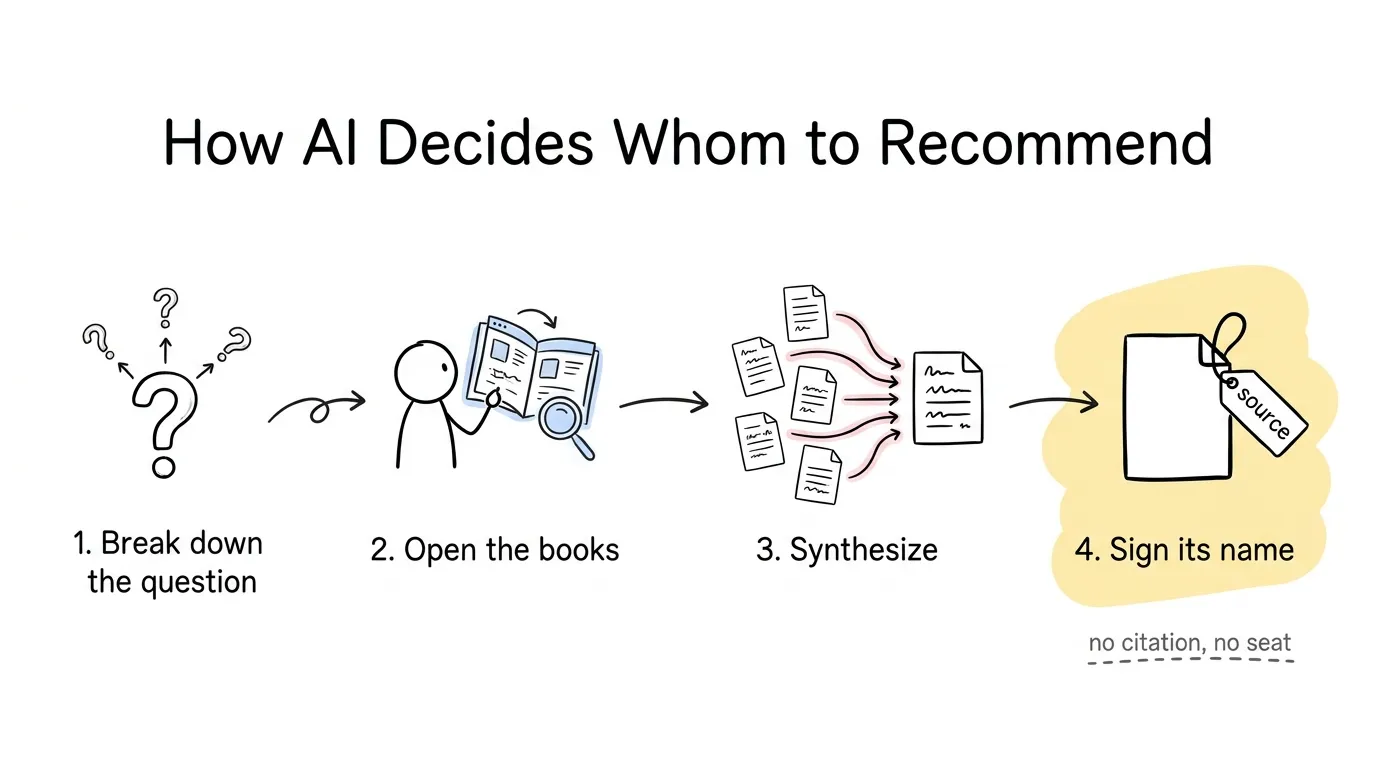
That fourth step is the life-or-death line. Every attribution in an AI answer is a card dealt; a brand that never gets cited never gets a seat at the table.
Why It's Not Your Turn
When brands disappear from AI answers, it almost always comes down to three reasons.
One: machines can't read your website.
Your website was built for humans: beautiful visuals, emotionally compelling copy. But AI crawlers want a different set of things: JSON-LD structured data, clean heading hierarchies, facts that can be extracted directly. Without them, the crawler can't read what you wrote with confidence — and citing content it can't read confidently is a hallucination risk. It would rather not cite you at all.
Two: your content was written to move people, not to be cited.
Most brand content tells stories, builds emotion, shapes a tone. That works on humans; it does nothing for machines. The KDD paper above ran the numbers: adding expert quotes to content lifts visibility by 41%; adding data lifts it 32%; citing authoritative sources lifts it 30%. You don't need to rebuild your website — you need to restructure. Yet in the vast majority of brand content, not one of these is in place.
One more detail from the paper: 44% of AI citations come from the first third of an article. An answer buried past the fifth screen might as well not exist.
Three: nobody off your site speaks for you.
A September 2025 study on arXiv found that AI search clearly favors third-party authoritative sources over brands talking about themselves. If you can't be found on Reddit, Wikipedia, G2, or Capterra, the AI is missing "corroborating evidence" — and won't dare write you into the answer.
Saying it a hundred times yourself is worth less than three mentions from someone else.
Five Signals That Move AI Citations
These research threads converge into five signals. Note: they compound. Miss one, and the other four all lose value.
1. A machine-readable foundation. Roll out every relevant JSON-LD schema type — Article, Organization, FAQ, Product, HowTo. Every entity mentioned on a page — products, certifications, integration partners — needs a corresponding annotation in the structured data, not buried inside a paragraph.
2. Citation-first content structure. In the first 60 to 120 words, give the answer straight, then unpack the argument. Every H2 and H3 heading should grow out of a buyer's actual question. Every section carries at least one data point.
3. Named-entity density. Brands, products, people, institutions, studies — all of them should appear. Copy that is all "our solution is flexible and efficient" is a blur in the AI's eyes. Vague can't be cited. Specific is what reads as expertise.
4. Off-site trust footprint. Editorial coverage in industry media, a review presence on G2 and Capterra, community presence on Reddit and Quora — plus the one thing most easily missed: your brand name and description, character-for-character identical across every external platform. An October 2025 statistic showed Reddit and LinkedIn have become high-frequency citation sources for the major models.
5. Freshness. Seer Interactive, an agency, analyzed thousands of URLs: 85% of citations in AI summaries go to content published within the last two years; pages updated within 30 days get cited 3.2 times as often as stale content. So this isn't a one-time content checkup. It's a refresh mechanism that runs month after month.
Widely Circulated Myths
Myth one: "GEO will replace SEO." Exactly the opposite. 87% of ChatGPT's citations overlap with Bing's top ten results; 93.7% of Google AI Overviews' citations point to at least one page in the organic top ten. The thicker your SEO foundation, the faster GEO pays off.
Myth two: "Only big brands get cited by AI." Yext analyzed 6.8 million AI citations in October 2025, and the conclusion is counterintuitive: 86% of citations come from sources the brand itself can control — brand websites account for 44%, business listings 42%. In niche categories, small brands with strong structure lift visibility by 36%. In a narrow lane, optimization beats size.
Myth three: "Pay the AI platforms and you'll get listed." As of 2026, no mainstream AI platform sells placement inside generative answers. Citations are earned: content quality, structural retrievability, entity density, off-site trust. There is no ad slot.
Myth four: "Get the schema right and you're done." Schema can raise the probability that AI discovers you by 67%, but it's not enough on its own. Brands present on four or more platforms are 2.8 times as likely to be recommended by ChatGPT. And only 38% of AI citations come from the organic top ten — the remaining 62% can't be won with schema alone.
Myth five: "Traffic from AI doesn't convert." 14.2% versus 2.8% — we did the math above. For B2B, a more accurate framing: what arrives isn't traffic. It's an inquiry with the requirements sheet in hand.
How to Land It: Four Phases
Phase one: establish the baseline. Before touching anything, find out how buyers actually ask. Not keywords — full sentences, in three types: category queries ("who's the best supplier for this kind of use"), comparison queries ("you versus your competitor — who fits which project"), pain-point queries ("how do I solve this problem"). Write down these 10 to 20 sentences. They are the target for everything that follows.
Phase two: dissect the competition. Look at which competitor pages are being cited by AI, and what data, what structure, sits at each citation point. Your content gaps should be reverse-engineered from citation patterns — not guessed from keyword search volume.
Phase three: deploy the infrastructure. Three tracks in parallel, not in sequence: technical — site-wide JSON-LD schema, FAQ structure on high-value pages, entity relationships wired together; content — retrofit existing content into citation-first structure, and build a content backlog ordered by the query list from phase one; visibility — go earn editorial coverage, review-platform presence, and community presence.
Phase four: keep optimizing. Watch the pages where "AI saw us but didn't cite us." Add new data, swap in new cases, delete expired claims. The models' retrieval logic will change; you change with it.
A Checklist of Twenty Items
Down to execution: one checklist, four sides.
Technical side, five items: Article schema on every content page; FAQ schema on high-value pages; Product schema with prices and specifications on product pages; Organization schema with sameAs linking up every official account; lastmod dates in the XML sitemap that are real.
Content side, five items: a direct answer within the first 60 words of every page; headings that mirror buyer questions; at least one data point per section; at least one named entity per paragraph; an FAQ block on high-value pages.
Trust side, five items: get on G2 and Capterra; manufacturers add industry directories like ThomasNet and GlobalSpec; service providers add Clutch; at least three editorial features in industry media; a living, human presence in the communities where buyers gather (Reddit, LinkedIn, vertical Slack and Discord groups); a partner or technical lead publishing on LinkedIn weekly; brand entity information identical on every platform.
Operations side, five items: refresh top pages monthly; test 10 to 20 queries per week across the four AI platforms; run a competitor citation audit quarterly; verify schema after every deployment; track AI-sourced traffic in GA4 with UTM.
How to Measure: Three Pillars to Show the CFO
Pillar one, visibility: can AI see me? Track share of voice and query coverage.
Pillar two, citations: does AI trust me? Track citation rate. When an AI lists your domain as a numbered source, that carries more weight than a passing mention — it means the AI is willing to attach facts to your name.
Pillar three, sentiment: does AI like me? Are the words it uses about you "recommended" and "leading," or "expensive" and "hard to integrate"? Sentiment moves conversion more than frequency does. A report that only shows share of voice will rank your priorities wrong.
For the weekly report, four metrics: citation frequency, share of voice, AI-sourced traffic, and the citation gap against your top competitor.
One warning: GA4 and Search Console can't track any of these three layers. They only record after a click happens — and GA4 misses 30% to 40% of AI-sourced traffic anyway. So in your inquiry form, make sure to add a "How did you hear about us?" field — and put "AI assistant" in it.
How do you show returns on a long purchase cycle? Three-layer attribution: weeks 1–8, watch citation growth to prove the pipe is connected; weeks 4–12, watch AI-sourced visits and self-reported attribution; months 3–12, watch closed deals tagged by first-touch source. Most B2B clients see citation growth within weeks, and pipeline movement within one sales cycle.
By Industry, the Playbook Changes
The framework is universal. The questions are not.
Manufacturers: buyers ask about capabilities and certifications, not brands. Who can do five-axis titanium, with AS9100D, four-week lead time, what MOQ — these parameters must live in structured data so AI can cite a precise answer. The unit of value is one qualified RFQ, not a vague visit count. In publicly shared data from the service provider Mersel AI, manufacturing clients mostly went from zero to 5 to 10 AI-attributed inquiries per month within 90 days of deploying capability pages.
Agencies and consultancies: buyers ask "the best consulting firm in [industry]" — firms absent from the answer never make the list. Named-expert content, partner pages with real names, parseable case blocks: these are the highest citation-density materials. Sales cycles run long — usually three to six months — which actually rewards early positioning: firms cited repeatedly in the first three months get invited into the formal pitch in month six.
Distributors and channel partners: own the "authorized distributor of [brand] in [region]" queries. sameAs in Organization schema, live inventory data, authorization proof — these are the citation signals AI anchors on. If you win on breadth of stock, fast lead times, and service, then write those attributes as machine-readable structure, not brochure paragraphs.
B2B software: buyers ask "the best software for [use case]" and "A versus B — how to choose." Answer comparison questions head-on, with structured feature-comparison tables and pricing data. McKinsey's 2025 statistic: 88% of organizations use AI in at least one business function — and evaluation habits will only migrate faster. Self-contained "answer blocks" (lead answer on top, citable data table, proof bullet, scope box) are 4 times as likely to be cited as narrative content. One more thing: AI frequently gets software pricing wrong — use structured pricing data to take back the narrative.
Three Real Service Accounts
Three client accounts from Mersel AI's public record, all from Q1 2026.
A B2B furniture distributor, Solo Gallery: within six weeks of launching its citation-first capability page, it closed its first deal, and now receives 15+ qualified inquiries a month from designers, architects, and hotel buyers.
An anonymous OEM contract manufacturer, AS9100D certified. Previously, all digital-channel inquiries were zero — only cold calling. After deploying a capability page plus certification schema, from the third month onward it receives 7 qualified inquiries a month, at an average deal size above $50,000. Attribution came from GA4 source data plus that form question, "How did you hear about us?"
A vertical consultancy: within eight weeks, its AI share of voice under the "best consulting firm in [industry]" query went from 12% to 38%.
Of course, results vary with competitive density and domain authority. But these three accounts share one lesson: this channel ramps up in weeks, not years.
The Execution Gap Nobody Solves
At this point, you may have already opened one of those GEO monitoring tools.
Profound, AthenaHQ, Scrunch — these tools do one genuinely useful thing: tell you how big the problem is. Which queries you're missing from. How much your competitors occupy. And then?
Then the report lands in your inbox: "Your brand is absent from 73% of high-intent queries in your category." And then — you're on your own. The content team's calendar is already overflowing. The engineers' iteration plan is booked out six months, and without a ticket nobody moves. Hiring someone who truly understands GEO takes three to six months, and the budget may never get approved.
Knowing what to do, and actually getting it done, are two different problems. Most companies are stuck on the second one.
That's exactly the gap Mersel AI's Cite engine is built to fill. It works on two layers:
Content layer: it starts from buyers' real questions, not the guesses of keyword tools. Take "who can do five-axis titanium machining with AS9100D certification" — for every question like this, it builds one dedicated page: which industries we serve, one page; which certifications we hold, one page; our MOQ, one page. Within six months, it lays down 100+ high-intent pages under a cite/ subdirectory on your domain, backed by 20+ backlinks from authoritative third parties. At the same time it connects your Search Console and GA4, so you can see which pages earned citations across the four platforms and which queries brought qualified inquiries — real signals, fed back to refresh existing pages. It snowballs.
Infrastructure layer: this is the layer most often skipped, yet it decides whether AI can read you at all. When GPTBot, PerplexityBot, and ClaudeBot arrive at your website, what they see is marketing language written for humans, rendered in JavaScript. Mersel deploys a layer of AI-native structure behind your existing site: clean entity definitions, product descriptions written for extraction, complete schema, llms.txt configuration. Human visitors feel nothing. Not one line of business code changes.
Then three more pieces come with it: a leads dashboard that alerts only on qualified RFQs; a brand knowledge base — the single source of truth for products, specifications, certifications, and pricing, so AI anchors here instead of guessing from stale third-party data; and automated content refresh, because the AI platforms change their detection and citation logic weekly, and your pages update along with them.
Choosing a Provider: Ask Six Questions First
This market is expanding fast, and plenty of old SEO services have repackaged themselves as "AI visibility." Here's your sieve.
If you see any of the following signals, walk away:
They promise a specific number of citations or a specific ranking position. Nobody can control what a large model does.
They sell "AI-friendly content" that is really just reformatted blog posts — no query mapping, no data feedback loop, no schema.
They offer only a monitoring dashboard, with no execution capability.
They can't show verifiable client pages and cases, or they only show off "visibility growth" without tying it to pipeline metrics.
They require you to rebuild your CMS or migrate your website. A serious GEO provider works alongside your existing site — it doesn't tear it down.
They can't explain the difference between robots.txt, llms.txt, and JSON-LD, or can't tell OAI-SearchBot from GPTBot. Those people can't do the infrastructure layer.
Then ask six questions:
One: how do you decide which queries to target? "Keyword research" is the wrong answer. The right answer: sales call recordings, support tickets, competitor citation patterns.
Two: how do you know your content got cited? The answer should include: manual cross-platform query testing, GA4 source filtering, and crawler verification from server logs.
Three: what infrastructure do you deploy? Specifics: which categories of JSON-LD schema, llms.txt, entity sameAs, robots.txt audit.
Four: can I see some published client pages? "It's all confidential" won't fly. Fully confidential means there's nothing there.
Five: how does citation growth connect to pipeline revenue? A good answer gives you a three-layer model — direct attribution, influence attribution, and cycle acceleration — not a line like "we track share of voice."
Six: how many hours per month does my team have to invest? A managed service should say it plainly: two to five hours a month, for strategy alignment and content approval. If the answer is "over 20 hours," that's a tool, not a service.
You can take these same six questions to Mersel AI, too. These standards are the ones they wrote into their own guide. If they can't answer — you've saved yourself the money.
Back to That Cup of Tea
At the end of that tea conversation, here's what I told my friend: you don't need to finish all twenty checklist items today. Today, do just one thing.
Open ChatGPT. Type the one sentence your buyer is most likely to ask, with your category in it.
Look at the answer. Are you there?
If yes — congratulations. Double down. If no, then at least you now know what you're losing. It isn't traffic.
AI is writing the market's first candidate list. Your job is to show up in the places it dares to cite.
And one more wish: may you never learn about this for the first time only after your competitors are already written into the list.
Continue reading
Related articles

It's 2026: Stop "Buying" AI Tools for Your Marketing Team — Start "Hiring" AI Agents
This learn article explains how AI agents differ from standalone AI tools in marketing, outlines three agent categories — build-your-own platforms, CRM-native agents, and vertical tools — and covers use cases across SEO, social media, advertising, and reporting, plus criteria for choosing one.

What Is GEO? How Your Brand Gets "Mentioned" in the Age of AI Search
An explainer on GEO (Generative Engine Optimization) for e-commerce and DTC brands: how it differs from SEO and AEO, why AI answers shape brand visibility, and eight practices covering question-focused content, consistent brand messaging, structured pages, external evidence, comparisons, and AI mention tracking.

AI Is Already Making Decisions for Your Customers. Are You on the List?
A learn article explains GEO (Generative Engine Optimization): why AI-generated answers now shape which brands customers see, and how SEO fundamentals, entity clarity, citable evidence, and monthly measurement affect visibility in AI answers.