
The Work of Email Marketing? AI Agents Are Already Doing It
A learn article explaining how AI agents differ from AI features in email marketing, arguing that platforms should handle data-driven deterministic tasks while LLMs handle open-ended work, with guidance on deliverability monitoring, permission limits, and ESP selection.
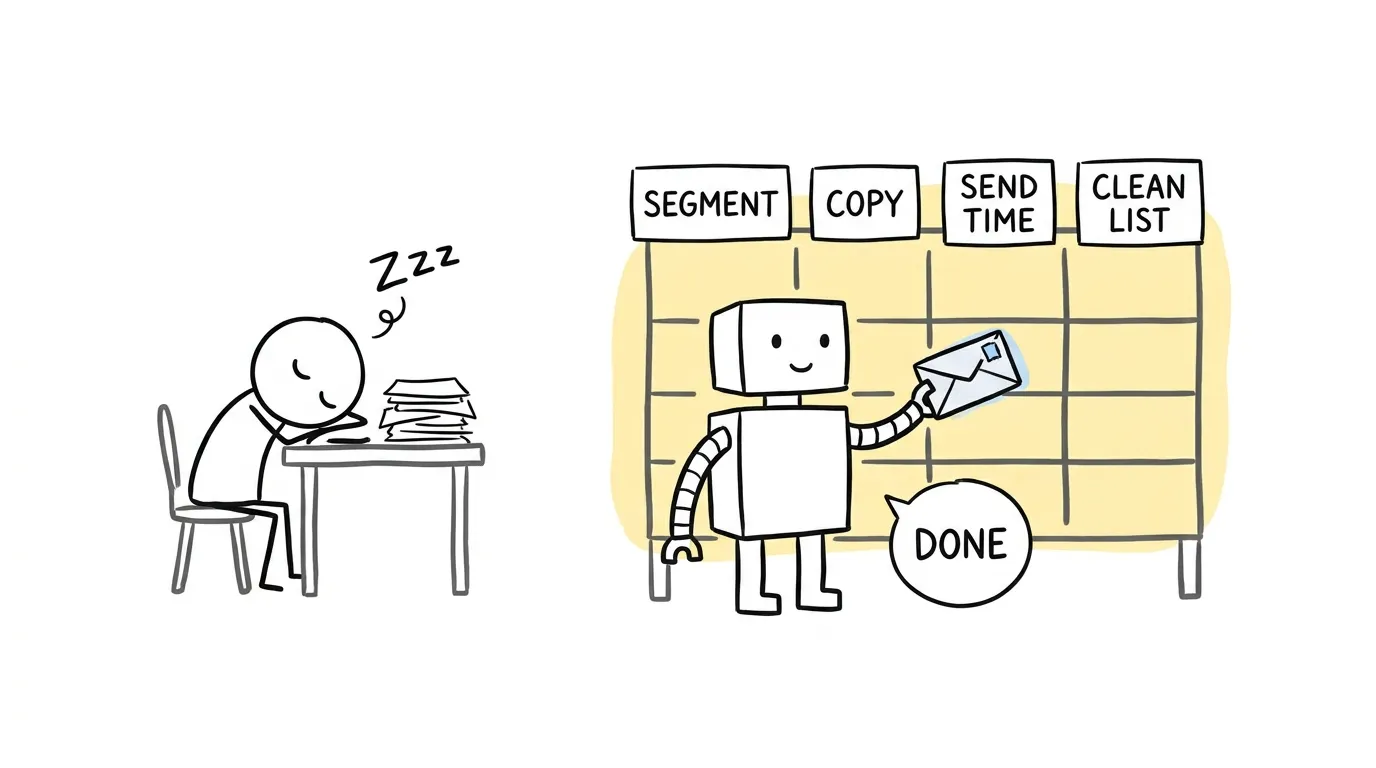
A while back, I caught up with a friend who runs a cross-border e-commerce business. On his team there's a young woman whose entire job is: writing email copy, slicing segments, sending campaigns, watching bounce rates, purging dead contacts. How busy? Come ten at night, she's still on the third revision of a subject line.
I asked him: why not let AI do this?
He blinked, then said: it's not that I won't — I don't know how. The market is flooded. Some things are called "AI features," some are called "agents," and prices run from free to thousands of dollars a month. He couldn't tell which ones were fortune-tellers and which ones were workers.
I told him that was exactly the right question. It might be the thing most worth thinking through for anyone doing email marketing in 2026.
What's an AI Feature? What's an Agent?
Many people lump the two together. But they are two different species.
An AI feature — say, Mailchimp's subject-line assistant or Salesforce Einstein's send-time optimization — is essentially a prediction model: it runs your accumulated historical data and spits out a suggestion. The math is good. But it can't lift a finger. It advises; you click the button.
An agent is different. An agent acts on its own. You hand it one plain-language sentence, and it breaks that sentence into steps — calls the APIs, wires up the workflow, writes the copy, lays out the schedule — and returns a draft that's ready to send.
Klaviyo's Marketing Agent works exactly this way: you say "run a win-back round for my loyal customers," and it hands back a complete marketing plan — campaigns, flows, forms, all configured. Customer.io's AI Agent pushes it further: one prompt in, one fully configured campaign out — triggers, content, timing, logic, everything.
Where's the difference? In one line: AI features give advice; agents do the work. And "doing the work" means it holds authority.
With authority comes risk. More on that later.
Why Email, of All Things?
Everyone talking about agents these days talks social media, paid ads, SEO. Email barely comes up.
I think that's a shame. Because email may be the perfect first proving ground for agents.
Why do I say that? Three reasons.
First, the tasks are broken up just right. Email marketing comes apart into roughly ten jobs: segmentation, copywriting, send-time selection, deliverability monitoring, list cleaning, nurture-flow orchestration, churn prediction, inbox preview, compliance checks, weekly reporting. Each one has clear inputs, clear success criteria, and a clear way to fail. This kind of "bounded work" is exactly what agents are best at. Tell it "make my paid ads perform" and it won't know where to start; tell it "purge the dead contacts from my list" and it works fast and steady.
Second, the cost of error is low. A misfired email is embarrassing; a misfired ad campaign burns money. That's why, in email, you dare to give an agent more autonomy. On channels that spend money — would you dare?
Third, and easiest to overlook: the platforms have already laid the data. Email service platforms (ESPs) like Klaviyo, HubSpot, and Customer.io have years of behavioral data in hand: who opened what on which day, who bought what, who prefers which channel. An agent making judgments on top of that data layer leaves a bare large language model eating its dust.
So the question for 2026 is no longer "should we use AI," but: which task gets which kind of AI.
Let the data-rich platforms do the deterministic work; let the thinking models do the open-ended work.
Division of Labor Is the Core of This Business
What counts as deterministic work?
Send-time optimization. List hygiene. Bounce handling. Deliverability monitoring. Basic segmentation.
These jobs are won on data volume, not cleverness. Take send time: Salesforce Einstein's STO needs 90 days of engagement data and a 72-hour warm-up before it even opens for business; Klaviyo's Smart Send Time is a model trained on behavior across the entire platform. Build your own on 12 months of data and you cannot win. Third-party tests put the lift from such features at 5% to 23% more opens (Prospeo's numbers). One small trap: Apple's Mail Privacy Protection (MPP) prefetches mail for users, manufacturing waves of machine opens that inflate raw open rates. When you read the results, remember to squeeze that water out first.
In short: for this kind of work, building your own is waste. The platform gives it away for free, and you insist on digging your own well — right next to the water company.
Building in-house where the platform has a data advantage is spending months of engineering time to rebuild a feature someone else already ships.
What counts as open-ended work?
Writing copy. Compliance checks. Designing lifecycle orchestration. Turning a week of data into plain English.
These jobs are won on understanding: they require holding your brand voice, the regulatory red lines, and the campaign context in mind at once, then writing like a human being. That's the large model's home turf. Anthropic's own case study says that feeding Claude Sonnet 4.6 a full brand-voice description cut ad copywriting from 2 hours to 15 minutes.
And the price is friendly. Sonnet 4.6 costs $3 per million input tokens and $15 per million output tokens. A month of email copy might run you a few dozen dollars, max. For demanding scenarios, step up to Claude Opus 4.7 ($5 input / $25 output). Cheap, fast classification work — like spam-word scoring — goes to Gemini 3.5 Flash.
And there you see the arithmetic: most teams shouting about "fully in-house agents" overestimate what a large model can accomplish alone and underestimate what the platform's data layer gives away for free. The real skill is in the division of labor.
The One Email Job You Should Hand to an Agent Right Now
Which brings me to what I believe is the single most important sentence in this entire piece:
Deliverability monitoring is no longer a job for human eyes. It must go to an always-on agent.
Some background first. Google's official bulk-sender guidelines draw a hard line for anyone sending 5,000+ messages a day to personal inboxes: complaint rate above 0.3%, and you get rejected. Before November 2025, crossing the line mostly meant warnings and education; as of November 2025, Gmail began rejecting senders outright — permanently — with a 5.7.x error code. Microsoft's Outlook, Hotmail, and Live followed with the same enforcement in May 2025.
What does 0.3% mean in practice? Send 10,000 emails and 30 people click "report spam" — you've hit the line. And Google recommends you actually stay under 0.1%.
Why the 3x gap? Buffer. One botched campaign, one win-back email sent too wide, and your complaint rate can leap from 0.05% in an instant. Anyone flying close to 0.3% day to day loses the inbox permanently after a single incident.
The problem: humans can't keep watch. Glancing at the complaint dashboard every Friday afternoon — that's the pre-2024 approach. By the time you see it, the mail has already been rejected.
The right architecture: an always-on agent wired to Gmail Postmaster data and your ESP's complaint data, with the tripwire set at 0.08% — the moment it's approached, it automatically suppresses the problem recipients.
Note: this agent holds only "suppress" — a low-risk permission. It has no "send" permission. That sense of proportion is what the next section is about.
Authorize Agents the Way You'd Authorize an Intern
There's an organization in security called OWASP. In its large-language-model security checklist, risk number six is called "excessive agency." In plain language: you handed it more permission than the job requires.
How widespread is this in marketing? A ProGEO AIMM Index survey in April 2026 found that 75.9% of marketers use generative AI every day. But only 43.8% of companies govern that use with policies that have technical guardrails. The majority of companies are running with no guardrails at all.
Let me paint you a scenario.
You enthusiastically give your agent send permissions across the entire list — full automation, so convenient. One night, it sends a win-back email to the whole list, including a crowd of people who unsubscribed long ago. By morning, complaint rates have broken through the ceiling and your mail gets permanently rejected. Now do the math: under the US CAN-SPAM Act, each violation carries a fine of up to $53,088 — the price as adjusted in January 2025. Mail an unsubscribe list, and every single email is a violation.
"The agent did it." That sentence means nothing to a regulator. Legal liability always lands on the sender, not the tool.
So how do you authorize? Remember one risk gradient:
Auto-suppressing contacts, auto-building segments — low risk, hand it over freely. The worst case is one email not sent.
Auto-sending to the full list — high risk, requires human sign-off.
Let agents build, configure, and draft. Let a human press the send button.
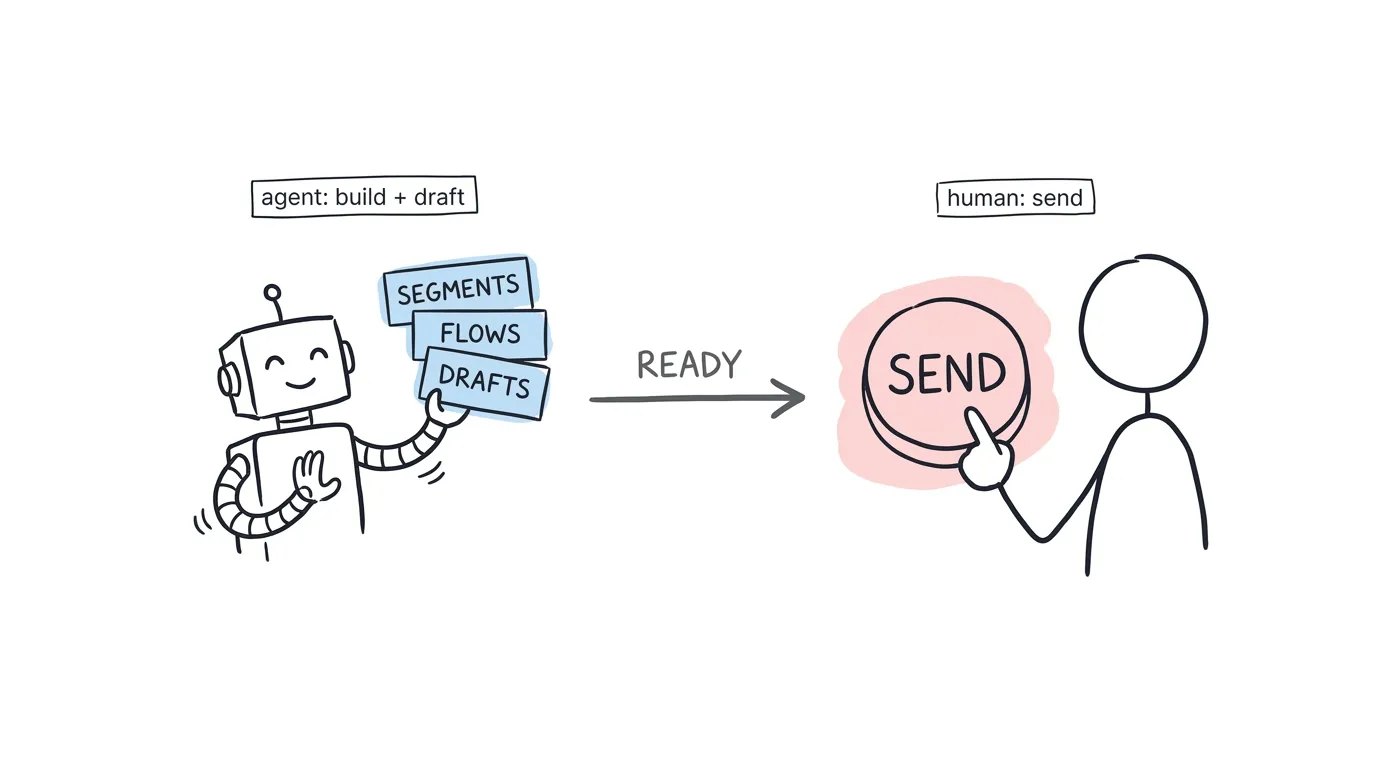
This model isn't someone's brainchild. Klaviyo's Marketing Agent and Customer.io's AI Agent ship exactly this way out of the box: the agent produces a "ready-to-send" complete plan, and the send button stays in human hands.
One more thing: every change an agent makes — building a segment, editing a flow, touching the list — must go into an audit log. It must be findable in the platform's logs, not just buried in your chat history with it.
Choosing a Platform Is Choosing Where Your Data Advantage Lives
Finally, how to choose. Choosing an ESP is, at bottom, choosing where your agent takes root.
Running e-commerce on Shopify? Klaviyo is the default answer. Segmentation AI, Smart Send Time, Marketing Agent — the whole set, ready to go. By its own disclosed numbers: Black Friday–Cyber Monday 2025, the platform generated $3.8 billion in attributed value, up 27% year over year, and sent out 22.7 billion messages. That kind of scale is the proof of its data advantage.
B2B on HubSpot CRM? Look closely at Breeze's three tiers: a free assistant tier, a paid agent tier (billed in Credits), and a no-code builder tier in beta. Don't be misled by "Breeze is free" — only the assistant is free. Also, HubSpot runs an official MCP server, live in January 2026, letting external agents read and write contacts, companies, deals, and email sequences directly.
A word on MCP. It's a standard protocol that lets external agents read and write platform data in structured form, without wiring up each connection one by one. Readiness varies wildly: HubSpot, Klaviyo, and ActiveCampaign have official support; Mailchimp still didn't as of mid-2026, and the community version carries no official endorsement; Customer.io and Braze require you to wrap a layer yourself. Though Customer.io has a clever workaround: its workflows can call a large model directly and store the output as journey properties, which downstream steps can pick up — no external MCP client needed at all.
Product-led SaaS, event-driven? Customer.io fits best. Mobile-first, multi-channel retention? Braze's Sage AI is the match — its churn prediction can flag a user 14 days before they go silent. One case study says the media app Upday used it with push notifications to win back 528,000 users. One caution: that's a vendor-reported number. Take it with a grain of salt.
Newsletter creators: Beehiiv is enough — AI writing is built right into the editor, no fuss. Substack is nearly absent on AI, leaning on third-party tools. The day your volume takes off, you'll naturally graduate to Customer.io or Klaviyo.
Back to My Friend
I walked him through the logic: platforms do the deterministic work, large models do the open-ended work, deliverability goes to an always-on agent, and the send button stays with a human.
He said: sounds simple, actually.
Right — it is simple. What's hard is the judgment: which permissions you dare to grant, and which you must keep.
Looking further out, as MCP coverage widens and models swallow ever-longer context, agents will gradually gain autonomy at the planning layer. But send authorization is something humans will likely hold forever. Not because agents will get it wrong, but because CAN-SPAM, GDPR, and CASL all put the liability on the sender. The law isn't ready to catch a system that sends mail by itself.
That's not conservatism. That's an accurate read of reality.
The tools will keep getting more capable. But the signature on the line is always a person's.
Here's to handing off those ten little chores — the sooner, the better.
Continue reading
Related articles

What Is an AI Marketing Agent? From "Using AI" to "Delegating to AI"
A learn article explaining what an AI marketing agent is, how it differs from rule-based automation, and which repetitive tasks such as lead qualification, reporting, and campaign monitoring can be delegated while humans keep key decisions.

Marketing Automation Is Shifting from "You Do It" to "You Say It"
This article explains how marketing automation is shifting from rule-based platforms that merely execute toward AI agents that plan, create, publish, and review campaigns, covering delegable tasks, underlying technologies, tool categories, adoption steps, and risks such as privacy and automating without strategy.

When AI Does the Creative, Mistakes Come in Batches Too
A learn article on the risks of using generative AI for marketing creative across brand, legal, compliance, and operational layers, with case examples and seven practices for review, rights clearance, documentation, and vendor governance.