
91% of B2B Orders: The Winners Were Decided Before the Race Started
A B2B marketing learn article arguing that most orders go to brands already on buyers' early candidate lists, covering multi-channel visibility, SEO fundamentals, video and storytelling, budget experimentation, and how AI recommendations favor brands that are already remembered.
A while back, I came across a number that left me staring at it for a long time.
91%.
In B2B purchasing, the vast majority of orders ultimately go to the brands that were on the buyer's candidate list from the very start. And that list usually has only 2 to 4 spots.
In other words, by the time procurement formally kicks off and everyone starts pitching and quoting, the cards have long since been dealt.
If you're not on the list, no matter how well you perform afterward, odds are you're just running someone else's race.
The conclusion comes from The B2B Institute, a research outfit specializing in B2B marketing. It also has a more gut-punching observation: B2B buyers spend only about a quarter of the year actually in "buying mode."
What about the other three quarters?
They're working, in meetings, scrolling their phones. They don't have a need, so naturally they don't think of you.
So the real question is: how do you move into their heads before they even have a need?
That's a question B2B marketing in 2026 can't get around.
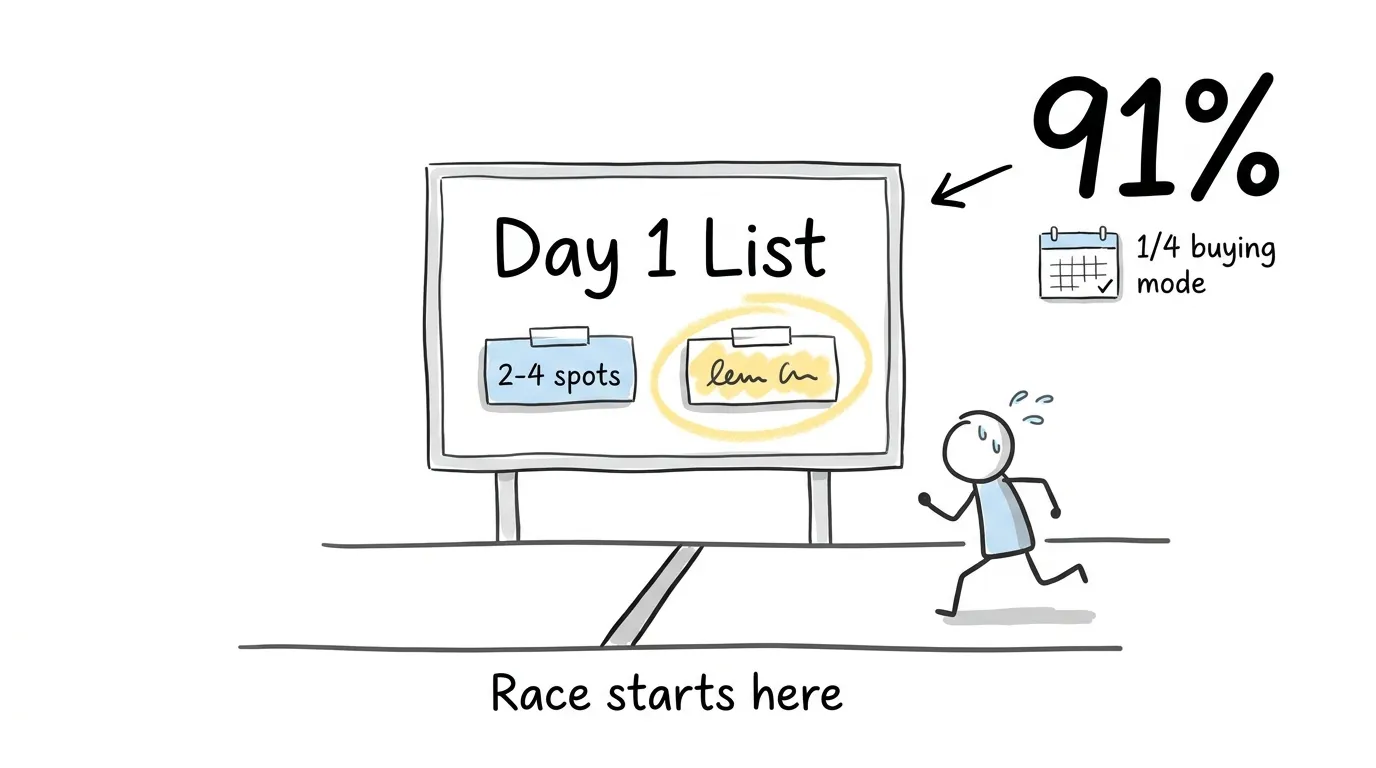
What is a Day 1 list?
Buying a B2B service is nothing like buying a cup of bubble tea. Long decision chains, big budgets, long cycles. When the need finally surfaces, the buyer's first instinct usually isn't to search — it's to ask themselves: who have I heard of?
The handful of names that pop into their heads on day one of the need — that's what the research calls the Day 1 list.
If you're on the list on day one, every subsequent step tilts in your favor. If you're not, then sorry — every effort you make afterward is a competition against someone else's first impression.
And this year, a new variable has made this even more brutal: AI.
Buyers still do their research. Only now, AI reads the material first on their behalf.
So on what basis would AI recommend you? On how many traces of you it has come across in its training data and search results.
See — round and round it goes, back to the same thing: first, you have to be remembered.
How to be remembered? First figure out where people are
Let me state a common-sense fact many people overlook: today's users live in four states at once. Searching, watching videos, hanging out in communities, shopping — switching at any moment.
With attention this fragmented, the era of conquering the world with one channel is over.
So what do you do? Start with insight. Don't guess where your users are off the top of your head — go look at the data. For example, there's a tool called Spark Toro that can look at clickstream data and tell you which websites your target audience frequents, what content they consume, and how that compares to the average. If you think in finer detail than your competitors, you win at the starting line.
Then look at ads and content. If these two each fight their own battles, the money gets wasted halfway. The search business is evolving: at first, everyone stared only at Google's results page; later, they fused paid and organic into a single push; now, you have to step outside Google — wherever users search, that's where you show up.
The channel mix works the same way: the more dispersed it is, the smaller the loss when any single point fails.
And by the way, don't assume SEO is obsolete the moment you hear "multi-channel." SEO's fundamentals have never changed: a site that can be crawled, content that matches intent, and people willing to link to you. It's a marathon. Whoever counts on results in three months won't finish the whole race.
How to spend the money? Leave a bite for innovation
When it comes to marketing budgets, the worst moves are the two extremes: going all-in on familiar channels to play it safe, or spiraling into trying every new toy.
There's a simple algorithm: set aside 5% to 10% of the budget exclusively for experiments. Try new channels, new formats. Win, and it graduates into the core budget next year; lose, and the tuition was capped.
At the same time, use an "input-output matrix" to prioritize — look at both first-party and third-party metrics, then pipe in CRM data, so every dollar can be traced back to the business. The boss never wants view counts; the boss wants results.
Why is video suddenly so important?
Because the people watching videos have changed — it's a new generation.
Among today's B2B buyers, Gen Z plus millennials make up 70%. This cohort grew up swiping through short videos, and video is simply how they take in information.
Just how powerful is video? Two numbers.
After watching a video, information retention can reach as high as 95%. Ten sentences — they remember nine and a half.
Combine video with lead collection, and lead-generation efficiency is 60% higher — that is, 1.6 times. People who have watched the video are another 18% more likely to convert.
No wonder LinkedIn has spent the past two years aggressively building out its video-ad toolbox: there's a pre-roll format built specifically for laying down mind share, called Brand Lift; and there's Reserved Ads, which locks in placement, guaranteeing that the first ad your target user scrolls past that day is you.
That first-impression slot is worth paying to grab. Because the way you yourself remember a brand also starts from "the first time you saw it," right?
One more warning from The B2B Institute worth keeping in mind: since you can't guess which quarter a buyer will enter buying season, don't target too narrowly. To grow share of mind, cast a wide net.
Forget B2B — speak to people
Everything above was technique. This last thing is the way.
There's a view I've always thought was exactly right: there is no such thing as B2B marketing in the world, only marketing to people.
Because the ones who make the final call are, in the end, people. People have emotions, preferences; they get bored, and they can be moved by a single sentence.
How fast does the human brain react to emotion? 12 milliseconds. Not even enough for one blink.
Tell a good story, and human memory retention improves 13 times. 71% of buyers say it's the memorable creative that pulled them to a brand.
Look at the reverse: our industry is full of copy that moves only the people who wrote it — future-oriented, flexibly scalable, secure and reliable. Your competitors use these words too, and users can't tell who is who.
Instead of listing the technology you use, tell people what overtime it saves them.
There's a banking example. When Monzo entered the market, all banks looked pretty much the same. It insisted on being completely different — visuals to experience, the whole package redone. The result: one mention, and people remember it.
There's also the department store John Lewis. That 2025 Christmas ad barely mentioned products at all — it was all about emotion — and it was just as unforgettable.
So, how do you play 2026?
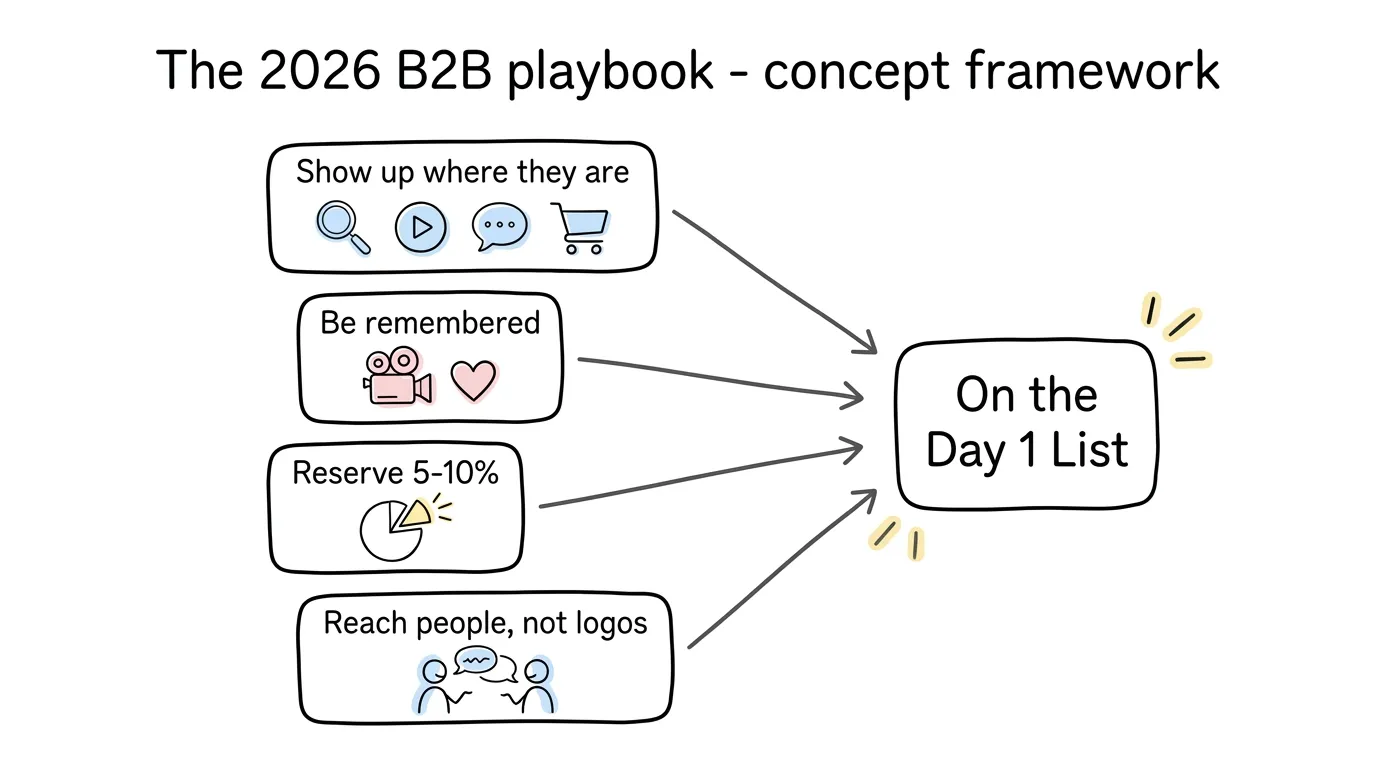
String everything above together, and it's really one sentence: finish building the memory of you before the buyer is ready to buy.
On channels: where people are, there you are. On content: use video and story to make people remember. On budget: leave a bite for innovation. And in the AI era, these memories are exactly the reason AI recommends you.
In business, most wins and losses already have their owners before the negotiation begins.
By the time you start running ads, the customer has already chosen.
Here's to your brand, forever on someone's Day 1 list.
Continue reading
Related articles

It's 2026: Stop "Buying" AI Tools for Your Marketing Team — Start "Hiring" AI Agents
This learn article explains how AI agents differ from standalone AI tools in marketing, outlines three agent categories — build-your-own platforms, CRM-native agents, and vertical tools — and covers use cases across SEO, social media, advertising, and reporting, plus criteria for choosing one.

What Is GEO? How Your Brand Gets "Mentioned" in the Age of AI Search
An explainer on GEO (Generative Engine Optimization) for e-commerce and DTC brands: how it differs from SEO and AEO, why AI answers shape brand visibility, and eight practices covering question-focused content, consistent brand messaging, structured pages, external evidence, comparisons, and AI mention tracking.

AI Is Already Making Decisions for Your Customers. Are You on the List?
A learn article explains GEO (Generative Engine Optimization): why AI-generated answers now shape which brands customers see, and how SEO fundamentals, entity clarity, citable evidence, and monthly measurement affect visibility in AI answers.