
AI Sculpted You a "Virtual Customer" — Would You Dare Make Decisions With It?
This learn article explains what customer personas are, how large language models turn them into chat-ready virtual customers, why answers beyond the supplied data are guesses, and how Big Five profiles and decision models can improve accuracy.
A few days ago, I tried out a tool. The sales pitch was seductive: AI generates "virtual customers" for you — chat with them about anything you like.
And chat I did. I asked about price sensitivity, talked through product preferences. Back and forth, question for answer — it all looked convincingly real.
I had a good laugh for about three minutes. Then I broke out in a cold sweat.
Because however much the answers sounded like a real person, it was still just a large language model playing a part. And the part it played was built on one thing only: the description I fed it.
Feed it something, it plays that. What you didn't feed it, it makes up.
What do I mean by that? Let me start with a story from more than sixty years ago.
What Is a Customer Persona?
So what is a customer persona?
A customer persona is a concrete "representative" you sculpt for a crowd of abstract people.
You're facing thousands upon thousands of customers, every one of them different, and you can't study each one — so you sculpt a stand-in: 35 years old, a mother of two, a forty-minute commute, price-sensitive but unwilling to settle for less on quality. From then on, every discussion revolves around this stand-in.
Designers have done this for decades, and so have marketers. Why? Because it truly works. Turn an abstract "market segment" into a person with a name and a face, and everyone on the team instantly gets it: who you're designing for, who you're writing copy for.
Put simply, the value of a persona is that it translates a "crowd" into a "person."
How a Group of Nuns Profiled Maria
In 1959, The Sound of Music gave us a song called "Maria."
In it, the nuns are debating a single question: how do we deal with "this Maria problem"?
Look at how they describe her.
Behavioral traits: on her way to mass, she waltzes the whole way there, with curlers hidden under her habit.
Attitudinal traits: the nuns call her a "lovable little scatterbrain" — never a serious bone in her body.
And they argue themselves into a frenzy: is she a demon or a lamb? Some say she's nothing but trouble; some say she's pure delight.
Argue all they like — by the end of the song, a living, breathing person is standing in your head.
Good heavens. That's a persona. A few lines of lyrics, and a fully dimensional human being.
This is something even the nuns of 1959 understood: to capture a person clearly, you need behavior and attitude — you can't leave out either one.
A Stand-In That Talks
Now — what happens if you feed a persona to a large language model?
It comes "alive." You can hold a conversation with this virtual customer: If I raise prices by 10%, what would you do? A friend recommended another brand — would you switch?
You can try this at home. Paste Maria's description into the chat box and add one line: Speak to me in Maria's own voice — keep it short, sound like her, not like a bystander describing her.
Powerful stuff.
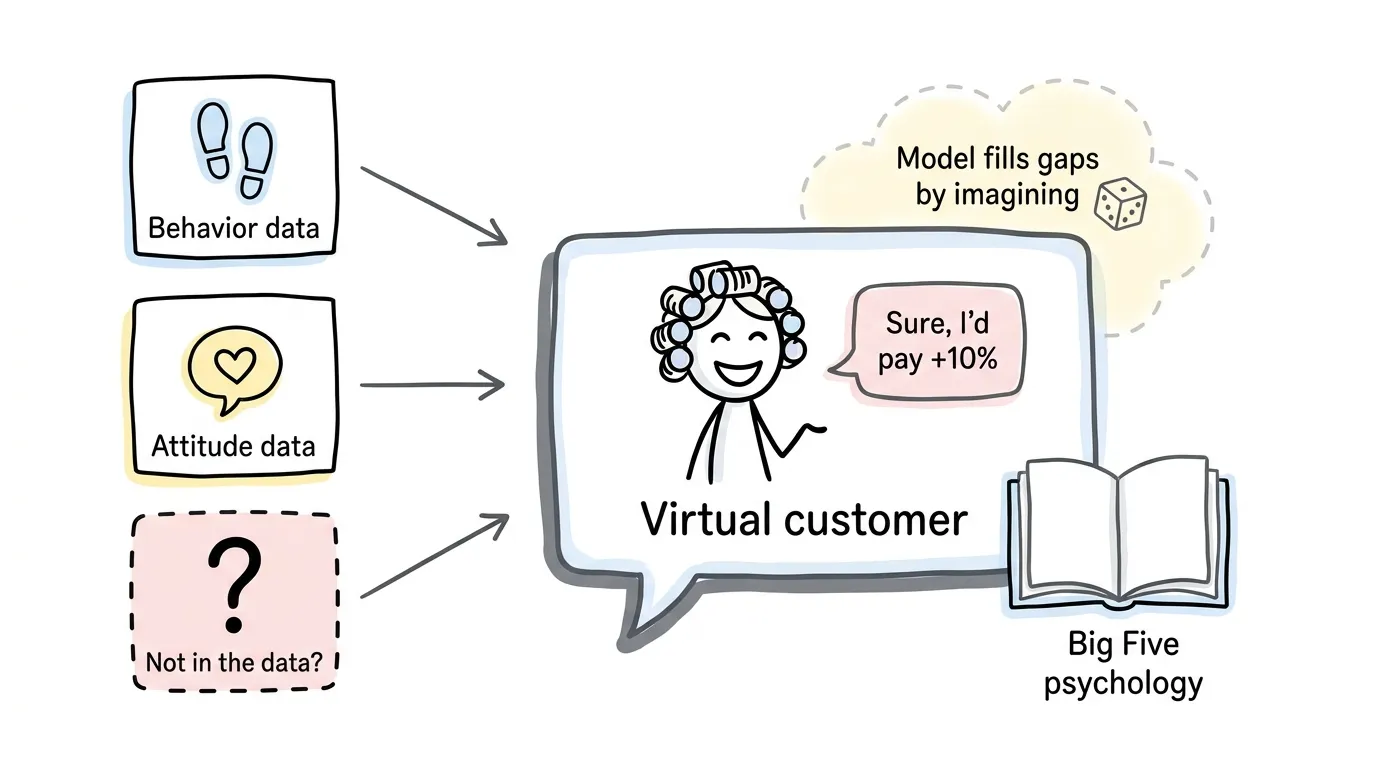
She really will banter back with that fearless, nothing-can-touch-me spirit. Most "virtual customer" tools today run on precisely this humble principle: a persona description, plus instructions, plus safety guardrails.
Fill it with real users' behavioral and attitudinal data, and it honestly is a good thing — a solid grip for probing how deep your customers go and how warm your market runs.
But Here Comes the Problem
But here comes the problem.
Whatever the persona says, that's what she'll be. And what it doesn't say?
The model fills in the blanks by imagining it.
Here's an example. You're holding the persona of a Gen Z user, packed with richly detailed attitudinal data about how she shops for cars and picks brands. Then you ask her: Do you have any pets?
What does she answer?
All the model can do is fill in the gap with "how a typical Gen Z kid would probably answer." It sounds close enough — but that's no longer "her." That's a stereotype of an entire generation.
The persona is as accurate as your data reaches. Beyond where the data reaches, it's all guessing.
And when you're making decisions, the worst thing you can do is mistake "guessing" for "certainty."
Psychology Had the Answer Written All Along
How do you make a persona guess less and land closer to the truth?
The answer has been sitting there for a while, actually. Psychology has spent decades accumulating research that happens to be exactly what we need.
So what are the Big Five personality traits?
The Big Five is a framework that scores a person's character across five dimensions: openness, conscientiousness, extraversion, agreeableness, and neuroticism.
What's fascinating is where it came from. In the 1930s, researchers advanced the "lexical hypothesis": the richer and finer-grained a culture's vocabulary for describing people, the more real those personality differences must be. In other words, language is the fossil record of personality.
Think about it: today's large language models feed on language — nothing else. A discipline that studied people through language ninety years ago, and machines that imitate people through language today, have met at the same crossroads.
Let's score Maria on the Big Five:
Openness: sky-high. A daydreamer, ready to burst into song at any moment, improvising as she goes.
Conscientiousness: low. Late for everything, forgets the rules, leaves her things behind wherever she goes.
Extraversion: high. The bigger the crowd, the more fired-up she gets — one song, and she owns the room.
Agreeableness: high, but with edges. Kind and trusting — yet if she thinks you're wrong, she will say it to your face.
Neuroticism: low to moderate. Most days optimistic and good at shrugging things off; but when her emotions get the better of her, she'll simply walk away.
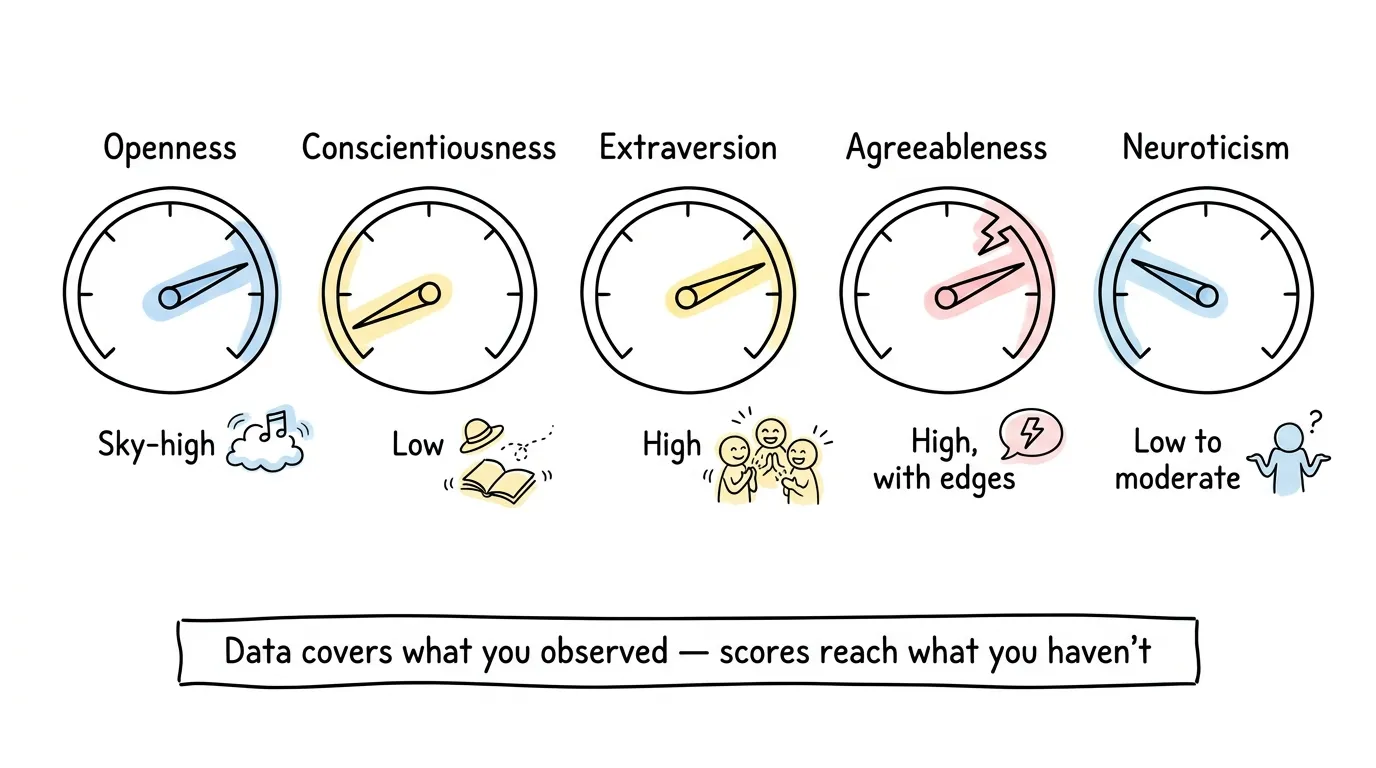
With these five scores, you can infer the behaviors her data never covered. For instance: would she rather sign up for a trek across a snowy mountain, or lie back at an all-inclusive resort?
No need to ask. The answer is written in the scores.
That's the real point: scattered behavioral descriptions can only cover the scenarios you have observed; data fitted into a psychological framework can reach the scenarios you haven't.
The Next Step: From Chatting to Predicting
The next step for virtual personas is already clear.
Sculpt three things together: real behavioral data, attitudinal statements, and a psychological profile (say, the Big Five). Then layer a decision model on top — prospect theory, for instance: people decide asymmetrically when facing gains and losses; when they're winning they want to pocket it, when they're losing they want to win it back.
What you get is a "hybrid persona."
And the way we use them will change. Today's virtual personas are chat tools: you ask, she answers. The next generation will be prediction tools: without waiting for you to ask, they'll tell you what this person would do when she runs into a brand-new situation she has never seen.
A Final Word
Some people will always say: aren't personas all made up? Can you trust something made up?
They are made up. Personas have been made up since the day they were born.
But being made up has never stopped them from being useful. The Maria those nuns made up in 1959 still lives in our hearts today.
The real dividing line is not whether it's made up, but what it's made from: pulled out of thin air, or standing on decades of psychology research and real behavioral data.
Data is what makes a persona "lifelike." Psychology is what makes a persona "accurate."
Here's to the next persona you sculpt: lifelike, and accurate.
Continue reading
Related articles

It's 2026: Stop "Buying" AI Tools for Your Marketing Team — Start "Hiring" AI Agents
This learn article explains how AI agents differ from standalone AI tools in marketing, outlines three agent categories — build-your-own platforms, CRM-native agents, and vertical tools — and covers use cases across SEO, social media, advertising, and reporting, plus criteria for choosing one.

Did the Money You Spent on AI Marketing Ever Come Back?
A guide to measuring AI marketing ROI across three layers: ad reports, sales pipeline, and the financial ledger. Covers metrics such as ROAS and CPA, eight dashboard metrics, industry benchmarks, and common measurement mistakes.

How to Pick a Creative Automation Platform: First, Figure Out What These Eleven Actually Do
A learn article sorts eleven creative automation platforms — including Bannerflow, Celtra, Smartly.io, and Storyteq — into four functional groups and proposes five evaluation questions covering publishing reach, automation depth, ease of adoption, team fit, and verifiable evidence.