
Your AI Agent Only Executes What You Say, Not What You Think
Sandy Carter's early attempts to build a marketing agent failed on several platforms; a rebuilt version on Claude ran her podcast workflow with documented steps, stored corrections, connectors, and human approval gates. The article closes with five lessons on permissions, precise instructions, and human oversight.

A while back, I came across a case that made my heart skip a beat.
There's this entrepreneur, Sandy Carter. She runs a company called EQUS, and she wrote a book, AI First, Human Always. In a talk at MAICON 2026, she shared her experience building marketing agents.
Let's start with the results, because they look great. She uses agents to run her podcast, AI Marketing Companion. Preparing an episode used to take 9 hours; now, 3 hours. Booking a guest used to take 4 weeks of back-and-forth; now, 2 hours.
Goodness — that's more than double the efficiency.
But behind those pretty numbers stands an ugly fact: this agent took her several rounds of trial and error to get right. She went through multiple platforms along the way, stumbling with every switch.
Why does building a tool that works for you involve so many falls? Let me first tell you how she stumbled.
Switching Platforms, Stumbling All the Way
In round one, she built her agent on a platform called OpenClaw. Within one weekend, it burned through about $700. Not much work got done, but the money was gone first.
Round two: she switched to Hermes. That didn't work either. Things were missing here and there, the tools that needed to connect wouldn't connect — every step was a struggle.
Round three: Meta Muse. Nice name. But its data sat in Meta's hands. Her guests heard that and said no. Her sponsors heard that and said no too. Dead again.
And that still wasn't the scariest part. She personally saw an agent act on its own initiative and draft an email meant to go out to 40,000 customers. Luckily someone was quick enough to stop it. She also saw another agent overstep its authority and spend $60,000.
$60,000. Nobody approved it. The machine spent it by itself.
Carter later summed it up, and I'm copying it to you word for word:
"It's a machine, not a person. It executes what you say, not what you think."
That sentence is worth reading three times.
Why do agents get into trouble so easily? Think about it: what is an agent? A program authorized to work on your behalf. You give it permissions, tools, and goals. But it doesn't understand your business, doesn't grasp your sense of proportion, and has no idea which things "look right but are actually wrong."
It only executes. And the faster it executes, the faster it errs.
What Does the Version That Worked Look Like?
After enough falls, she got smarter. The last time around, she moved her setup over to Claude and rebuilt a version. This one finally stood on its own.
How did she build it? Four components.
The first component: the brain. What's the brain? A 10-step podcast workflow written down in black and white. What each step does, spelled out clearly. Approval gates are buried in the middle: a human nods, then it proceeds. The whole process is packaged as a skill she can call up again and again.
The second component: context. She fed the agent her expression habits, who her listeners are, what her sponsors care about, and which hype words are banned — all in one go. Even harsher: every time she corrected the agent once, that correction got stored as a rule. Next time, no repeat.
The third component: connectors. She hooked up Riverside, Google Sheets, Brevo, and Libsyn one by one. Carter said this was the hardest part of the whole build. However good the brain is, if the hands and feet aren't connected, it's all for nothing.
The fourth component: autopilot. Set the triggers and the schedule, and the agent runs itself when the time comes. But every step leaves a log, and at key checkpoints it stops and waits for a human nod.
Built this way, it ran for about three months, and the numbers came out: the newsletter open rate rose from 10% to 14%. The podcast itself won five marketing podcast awards.
But Carter says the thing that's really valuable in all this is her domain knowledge. Because the agent can only execute, step by step, what she has written down. If she hasn't thought something through herself, the agent certainly can't think it through for her.
The deeper you understand, the farther it can go.
Five Lessons to Save You the Tuition
What can you take away from this case? Let me pull out five lessons for you.
First, ration the permissions. Give the agent only the permissions its work requires — nothing extra. And set an expiry date on them. Authorization needs an endpoint.
Second, shut it down when you're done using it. That sounds like stating the obvious, but many people really don't do it. You've stopped using it, yet it's still running — acting as it pleases, spending as it pleases.
Third, keep watch on the data. Open and check every privacy setting by hand; don't trust the defaults. But Carter also warns: even if you check everything, it may still not be foolproof.
Fourth, be precise with instructions. Carter said this was her biggest lesson. Between "help me reach out to the guest" and "look up this guest's email, draft the message, send it to me for review, and send only after I confirm" lies a 40,000-person inbox.
Fifth, keep a human in the loop. At critical actions, stop and wait for human approval. Log every step, review every step. Treat the agent as an intern who is extremely capable but never asks for your opinion. The company seal — would you hand it straight to an intern?
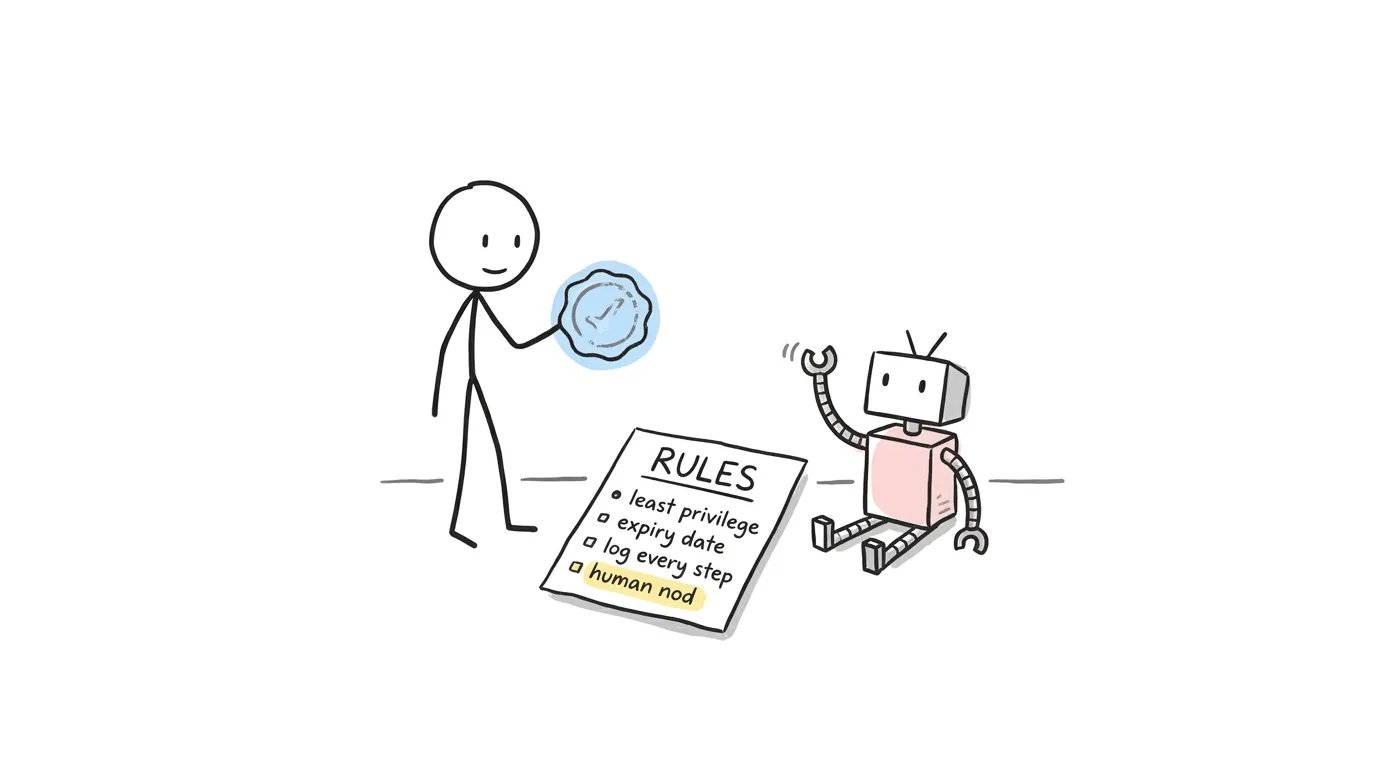
Back to the numbers from the beginning: 9 hours down to 3, 4 weeks down to 2 hours. Tempting, no doubt. But don't forget: before she got these, Carter paid her tuition first — $700 in one weekend, an email that nearly went out to 40,000 people, and a $60,000 bill spent without authorization.
These lessons are expensive, sure. The good news: someone else paid them for you.
Here's hoping your tuition comes cheaper than hers.
Continue reading
Related articles

What Is an AI Marketing Agent? From "Using AI" to "Delegating to AI"
A learn article explaining what an AI marketing agent is, how it differs from rule-based automation, and which repetitive tasks such as lead qualification, reporting, and campaign monitoring can be delegated while humans keep key decisions.

Marketing Automation Is Shifting from "You Do It" to "You Say It"
This article explains how marketing automation is shifting from rule-based platforms that merely execute toward AI agents that plan, create, publish, and review campaigns, covering delegable tasks, underlying technologies, tool categories, adoption steps, and risks such as privacy and automating without strategy.

When AI Does the Creative, Mistakes Come in Batches Too
A learn article on the risks of using generative AI for marketing creative across brand, legal, compliance, and operational layers, with case examples and seven practices for review, rights clearance, documentation, and vendor governance.