
Your Next Customer Might Not Be Human: What Changes — and What Doesn't — in B2B Marketing, 2026
A long-form analysis of 2026 B2B marketing predictions covering AI agents joining buying decisions, visibility in AI answers, email filtering, trust, and first-party buying signals.
A few days ago, I was having tea with a friend who works in enterprise software.
The moment he sat down, he sighed: every time he opens LinkedIn these days, someone is declaring "SaaS is dead," claiming they ran an entire marketing department with a single AI agent. He asked me: am I already falling behind?
I didn't answer directly. Instead, I pulled up a set of predictions I'd read earlier this year and handed them to him.
The person behind those predictions is Jon Miller. The name may not ring a bell, but odds are his work has shaped you anyway: he co-founded Marketo and served as its first CMO, and he was a major champion of account-based marketing (ABM). In 2026, he is publishing his predictions for B2B marketing for the fourth consecutive year. Best of all, he scores last year's predictions every year — and admits it when he's wrong.
Predictions from someone like that are worth hearing.
That day, I picked three of his judgments to share with him. The rest, I'm breaking down for you today.
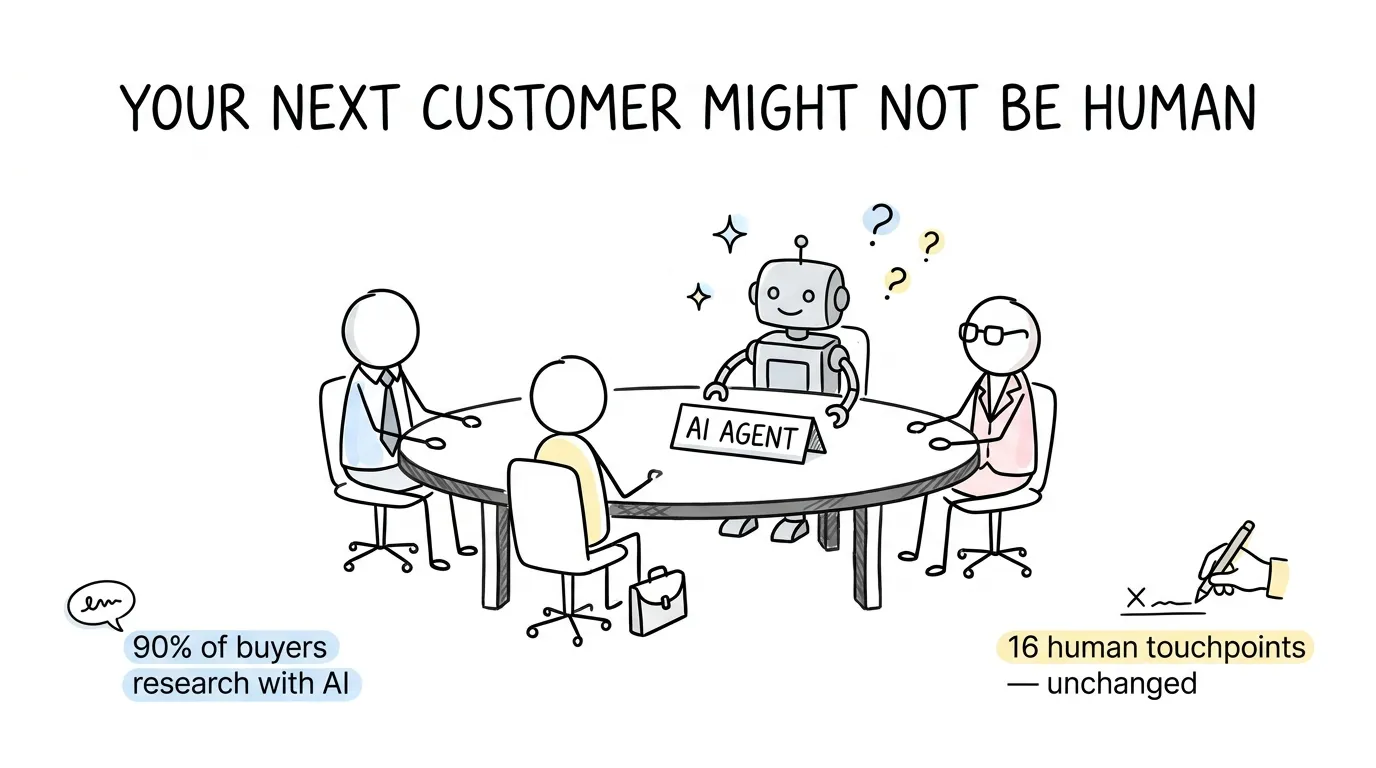
One: Your Next Customer Might Not Be Human
The first prediction: in 2026, there will be an AI in the room at your next purchase decision meeting.
B2B marketing used to be made for human eyes. However convoluted the buyer's process, the final call was made by a person.
Now, more and more of the buying journey is being completed by AI agents: they research on their owner's behalf, compare specs, and draw up candidate lists. AI agents are joining the buying committee.
This isn't mysticism — there's data. TrustRadius's 2025 buyer survey found that 90% of B2B buyers use tools like ChatGPT for purchase research, and 72% have encountered Google's AI Overviews while evaluating vendors. The annual industry report Martech for 2026 found that 63% of marketers have already started publishing "AI-friendly" content: structured FAQs, schema markup, plus an active presence on platforms like Reddit and G2 that large models love to cite.
So if you're a CMO, the one KPI most worth adding this year might be: how AI describes you.
Leadership teams used to obsess over Google rankings; from now on they'll obsess over "which vendor ChatGPT names first when you ask which company leads a category." This is, at heart, analyst relations for a new generation — except the analyst is now a model.
Advertising will arrive even sooner. Perplexity is already placing sponsored follow-up questions inside AI results, and Google has embedded search and shopping ads in its AI Overviews. As for paid AEO that can bid separately for "known customers and target accounts," I'd guess that comes after 2026 — but the direction is set.
And here's the one that stings. When a company's AI agent crawls your website for pricing and product specs, what is that? That is a first-party intent signal. An agent from an unknown startup poking around is probably noise; an agent from a Fortune 500 company comparing your capabilities one by one against competitors — that might be pipeline. So the prediction goes: agent visitors should be counted as "marketing qualified accounts" (MQA), just like human visitors. There's one precondition: you have to recognize who it is first. The industry term is "agent de-anonymization."
There's an even more interesting possibility further out. If an agent drops by your site every so often to scrape updates, that gets computationally expensive — it might learn to do what humans do and "subscribe," proactively registering to receive updates. The day that happens, "agent nurturing" becomes a new channel. Pure speculation — but I like it.
What about content? You have to serve two kinds of readers at once. The prediction offers a "headless" architecture: at the bottom sits a layer of core data, content, and services; above it, two distribution paths fork off. Humans go to the brand website and get the emotional experience; agents call the interface directly and get dynamic pricing APIs and a knowledge base that can answer product questions. Qualified, which does conversational selling, has been building exactly these kinds of systems — probably one of the reasons Salesforce acquired it.
So what doesn't change?
People. 6sense's Buyer Experience Report shows that in 2025, the average human buyer had 16 touchpoints with a vendor — identical to the year before. Agents compress research time, not trust time. Research can be outsourced to AI. The signature is always human.
Oh, and one counterintuitive prediction I particularly love: techniques for optimizing "static content" for AI are most likely transitional products.
What is static content optimization? Planting markup, writing machine-friendly FAQs. Jon Miller says it looks exactly like early SEO: everyone stuffing keywords and gaming the algorithm. Yet Google said years ago — don't create content for machines, create it for people. Its official documentation now states plainly that no separate machine-readable files are needed for AI. The people who stuffed keywords back then were eventually wiped out by the algorithm's progress. The ones who survived were the people who made content genuinely for humans. The "headless" infrastructure described above may well endure; these static tricks won't.
Two: "SaaS Is Dead"? Check Your License First
The second prediction: AI will completely reshape marketing software — but not in 2026.
The phrase my friend was anxious about was "SaaS is dead."
The picture in your head goes like this: you open no software, you say "push our Q4 launch to enterprise customers in financial services," and AI takes care of content, timing, channels, and budget on its own.
That future is coming. But in 2 to 5 years.
Why so slow? Think about autonomous driving and it becomes clear. What 2026 brings us is not driverless cars — it's advanced driver assistance: AI handles the lane changes, keeps pace in traffic, parks the car — but you don't dare take your hands off the wheel.
The data says the same. In 2025, 81% of enterprise AI usage was "assistance only"; agents acting autonomously came in under 10%.
Let me run a few numbers for you.
Enterprises turn slowly. Martech's Law, coined by Scott Brinker, says: the pace of technology change always outstrips the pace at which organizations can absorb it. How many years did it take to go from mainframes to enterprise software? And from enterprise software to SaaS? The MQL, a metric that should have been retired ages ago, is alive and well today.
Enterprise requirements are hard. Compliance, security, audits, scalability — these aren't interfaces, they're a decade of accumulated engineering. However clever the AI, it can't pass your security audit for you.
Hallucination persists. Would you let an agent autonomously decide whether to email a customer who unsubscribed? Let it handle a GDPR deletion request? You wouldn't. So human-in-the-loop is here for the long run.
The most honest ledger is hiding in the pricing. If SaaS were truly dead, everyone would have moved to outcome-based pricing by now. But Salesforce's newly launched agent enterprise licensing agreement, though billed in credits, is seat-based at its core. Its CFO Amy Weaver put it plainly: customers want seats because they're "predictable." The vote enterprises cast with their wallets is the real vote.
Of course, the direction is genuinely shifting. Brendan Short has a take: the next big GTM company won't sell software — it will sell "labor." You stop buying tools to help your people work, and start hiring AI to do the work, paid on results.
So what will enterprise customers want in 2026? The answer is refreshingly practical: a "better Marketo," not a teardown. AI drafts the campaign, but you can see the workflow before it executes; intelligent segmentation, but with human review; AI does "air traffic control" to keep two campaigns from colliding, but the approval step stays.
One more trend worth watching: rather than bolting AI onto legacy systems, new platforms designed natively for agents will run faster. They're API-first by birth, support MCP (the universal protocol that lets every tool plug straight into AI), and stay compatible with today's manual workflows. Think of it as building a bridge: pedestrians use the walkway today; cars roll across tomorrow.
Three: Context Is AI's Real Bottleneck
The third prediction: what determines whether AI is any good isn't the model — it's "context."
What is "context engineering"?
Everyone says poor data quality is the number one killer of AI adoption. But the term "data quality" badly undersells the problem. The real gap is: AI doesn't understand your business.
Wiring AI into your CRM, your data warehouse, your call recordings is only step one. It also needs an "enablement layer" that knows what all this data means: what the naming conventions for campaigns are; which customer types must be excluded at which stage, and why; what your company's "one webinar" specifically involves — what actions, what follow-ups, what hand-offs; and what logic hides behind that Salesforce field schema that ten years of customization have mangled beyond recognition.
Where is this knowledge written down? Nowhere. It's scattered across group chats and inside veterans' heads. The day your best marketing operations colleague quits, it walks out the door with them.
Traditional marketing platforms can't help. They know "which campaign this lead is in," but not "why that campaign exists." Old systems store outcomes, not decision logic.
So the prediction: in 2026, "context engineering" becomes a formally recognized practice for GTM teams. Operations teams will teach AI "skills" one by one, the way they onboard a new hire: how to read a data table, how to run a webinar, which segment to use in which scenario. The difference: new hires job-hop, but the knowledge you teach AI stays with the company forever. And marketing operations thereby levels up from "the ticket-fixer" to the strategic role that "makes AI actually useful."
One adjacent prediction while we're here: rule engines, your time is up.
"Title contains VP, add 10 points. Opened the email, wait two days, send another." Rules like these are brittle, can't learn, and need humans to maintain. Reasoning AI understands context, tests hypotheses, and recognizes patterns no one spelled out. The playbook for 2026: keep rules where you need stability and explainability; bring in reasoning where you need judgment and adaptability. Marketing operations won't disappear — it just stops writing rules and starts supplying AI with ammunition: business goals, success metrics, guardrails, data pipelines.
Four: Playlists, Not Shuffle
Further in, there were more judgments I'd underlined. This is the one that excited me most in the whole piece.
1:1 personalization — you've been hearing that phrase for a decade, right? Every vendor claims they can do it, and buyers went numb long ago. Why has it never worked? Because B2B journeys are non-linear, buying committees are packed with people, and the flowcharts drawn by rule engines all end up as one tangled ball of yarn.
Jon Miller's answer is one word: playlist.
First, think about TikTok and Instagram. Not a single piece of content they show you is made just for you. They take a vast pool of existing content and arrange it into a feed that feels custom-made.
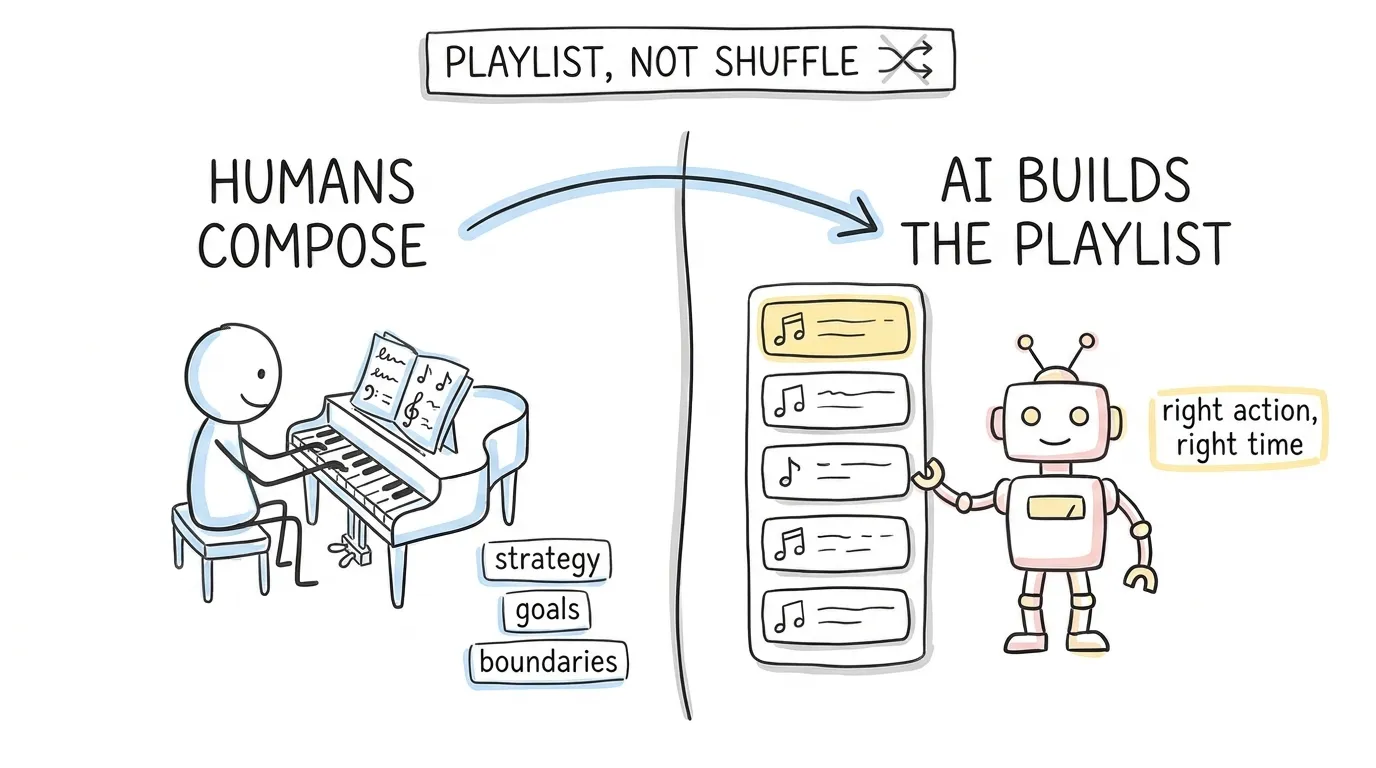
Right. The essence of personalization isn't necessarily "create one-of-a-kind content for you" — it's the right action at the right time. An action equals content times channel times timing times offer. Most of the time, the content doesn't need to be one of a kind; unique timing is enough.
Back to playlists. The way most personalization engines play the game today is picking the "next-best action." That's shuffle mode: no single track is unpleasant, but the album's artistry is gone. B2B deals have never closed because of one touch. Just as a large model needs to look several tokens ahead to write a coherent sentence, a good journey has to look several steps ahead.
So the "playlist" is this: humans set strategy and goals (the genre, the mood), AI dynamically arranges a sequence of actions for each buyer, then adjusts in real time based on engagement signals. You don't know whether that exec reads email on Sundays? Try once and you'll find out. TikTok doesn't know a user likes cat videos either — until it pushes one.
In this model, what do humans do? Make great content and set firm boundaries: who must be reached, who must never be touched, frequency caps, budget red lines. Humans compose. AI builds the playlist. As for the combinatorial math — don't fight it head-on; we can't out-calculate it.
But one line is permanently reserved for humans: explainability. Why did this person receive this message? Why was this customer cut? If you can't explain it, the team learns nothing — and nobody trusts the system.
Five: The AI Gatekeeper in Your Inbox
The next shift is happening quietly: email is turning from "owned media" into "earned media."
Email used to be treated as private property: the list is mine, and when it goes out is my call.
In 2025, more than 376 billion emails are sent worldwide every day — roughly half of them unsolicited. How are buyers fighting back? By installing an AI gatekeeper. Yahoo Mail now replaces subject lines with AI summaries; Apple Mail collapses promotional emails from the same brand into a bundle showing only one AI-generated line; tools like Outlook Copilot and Fyxer AI go further still — sorting, drafting, and intercepting on your behalf, and plenty of emails are never seen by human eyes at all.
Note: buyers don't have it in for you. They're drowning, and they're saving themselves.
So the prediction: starting in 2026, email becomes "earned media." A recipient's attention can only ever be earned, never bought. AI gatekeepers are simply enforcing that long-standing truth — harder.
Four moves for B2B marketers:
Send less, send better. A weekly blast of boilerplate is training the filter to demote your domain. Send when you have something worth saying: one insight, a piece of your own research, a genuinely useful resource. When a subscriber and their AI assistant both conclude "this sender is useful," you get allowlisted twice over.
Send as a real person. Plain-text emails from a CEO or the salesperson themselves routinely beat polished HTML templates. They read like a human, so they get replies; they're light on code, so they load fast and don't trip spam rules.
Feed the AI reader first. Say the point in the very first sentence — AI summarizers grab the opening, and so do busy people. Straightforward subject lines, no cleverness; a clever pun won't survive the AI rewrite. Make the sender's name instantly recognizable, because in a summary view that may be the only thing showing.
Stop watching open rates. In the AI inbox era, open rates are completely distorted. Watch clicks, replies, meetings booked, pipeline generated.
Email isn't dying. There are still 4.6 billion users worldwide, projected to hit 5 billion by 2028. What dies is "batch-and-blast"; what lives is "the genuinely valuable letter." If what you send is truly useful, the AI filter is doing cleanup for you.
Six: When Content Is Free, Trust Is the Scarce Asset
AI has driven the cost of producing content toward zero — and filled the information stream with "AI slop": glossy on the surface, empty on the read, with personalization that's perfunctory at best.
The prediction: in 2026, buyers will use "source" as their filter. People they trust make the allowlist; strangers get swiped away.
Forrester's take is harsher: trust has fragmented, and B2B buyers now lean more on personal networks and hand-picked sources than on institutional and brand promises.
Which three things pull signal out of the noise?
Taste. The ability to judge what's worth consuming. Technical fluency, editorial sensibility, design sense, storytelling — all four, no exceptions.
Trust. People trust people, not logos. That's why human-sent email beats HTML, why an individual's post outperforms the corporate account, why some people happily pay to subscribe to one individual's newsletter. It's also why "founder brand" has moved from nice-to-have to strategic. Forrester also predicts that in 2026, 75% of large B2B enterprises will increase their investment in influencer relations.
Accountability. Picture a court stenographer: however flawless the AI transcription, the record only becomes official when someone signs their own name. For professionals who use AI for research, the value isn't in the output — it's in being willing to stake your name on it.
So the leader's homework is three things: go deep in communities and partnerships — one "we actually used it and it works" beats ten thousand words of advertorial; move budget to in-person moments — meeting real people, meals, events; and be generous about showing "this took real craft" — handwritten notes, exclusive data, deep teardowns. When "being able to generate" is no longer scarce, "being willing to sign" becomes the asset.
Seven: Public Signals Are Commodity; Your Own Signals Are the Alpha
One more, and if you're in growth, underline it.
Job changes, funding news, website visits, G2 activity — these public signals can be bought by anyone with a budget. AI enrichment tools have since driven the cost of processing them through the floor. The result: everyone holding the same lists, blasting away like crazy.
Jon Miller borrows a word from investing: alpha — excess returns. Information everyone has produces no alpha. Public signals: fully commoditized within 24 months.
So where does new alpha come from?
Your own first-party signals. Demo requests, content engagement, product trials, interactive walkthroughs — these are exclusively yours; competitors can't buy them. Stop treating an inbound lead as "a hot MQL" and calling it a day: it's merely the strongest of many timing signals.
Signal combinations. A single job posting is an entry ticket. But "job posting + visited the competitor-comparison page + a surge of visits from multiple stakeholders at the same company"? That combination tells a story.
Timing precision. As discussed, the core of personalization is the right action at the right time. Signals are the same: knowing whom to contact and what to say matters less than knowing when to move.
Eight: The Composable Stack — Under 20% in 2026, Standard by 2030
Assemble these predictions and you can see the endgame for marketing platforms: signal-driven orchestration.
In industry parlance, this is a three-story building — what a "composable stack" grows up to be. The data layer turns CRM records, product usage, online behavior, web scraping, and call recordings all into clean, usable signals; the decision layer is the brain, computing the optimal multi-step action sequence for every account, every person, every agent from all signals plus human-set strategy; the delivery layer is where channels degenerate into API execution endpoints, each still doing its own specialized optimization — ad platforms run the bidding, email platforms handle deliverability.
The predicted timeline: by 2030, this modular, AI-native, signal-driven stack becomes the B2B standard. But in 2026, fewer than 20% of teams will actually run a full composable architecture.
Why so slow? Flexibility doesn't eliminate complexity — it transfers the complexity onto you; managing five vendors is far harder than managing one; data warehouses were built for engineers, not marketers; and orchestration has to close the loop — without feedback data coming back, AI learns nothing. The Digital Bloom's stack analysis shows the share of marketing automation platforms serving as the "center" of the B2B stack fell from about 31% to about 26% in a single year, while custom-built solutions rose from 2% to 10%. The trend is clear; the pace is slow.
So the realistic path is the "composable lite" stack: data-first, decision-first, but no need to tear everything apart in one step. The warehouse becomes the authoritative source of truth; scoring and segmentation migrate over gradually; but final orchestration stays in the marketing automation platform for now.
One more drama worth tracking: cloud warehouse giants like Snowflake and Databricks won't be content to hold just the ground floor — they're climbing upstairs, straight for the decision and orchestration layers. Everyone wants to be the brain, and this brawl will get ugly. But when the dust settles, the platforms will be stronger.
Delivering the whole building takes years. The foundation can be poured this year: get your signal infrastructure solid, feed your business context to AI, organize your best offer content into a tagged asset library — then ask yourself, honestly: is your current platform able to climb with you, or will it pin you on the ground floor?
Nine: Quick Hits
A few smaller predictions, run through quickly:
More and more executives will figure out: when pipeline is broken, check positioning first. Without clear positioning, tactics are just painkillers.
Attribution models will keep receding. Journeys are too non-linear — stop pretending you can precisely assign credit to a single touch.
AI trial budgets will keep producing piles of pilots, but "add-ons" don't have the stickiness of a core platform, and a year from now you can expect a field of unsubscribes.
AI will take over huge amounts of customer service, and human service becomes a premium good instead. Angelo Robles has a line on this: "AI-free" will become the new "GMO-free."
AI will run the entire shoot and video production pipeline end to end: humans only set creative direction. Models and actors — time to rethink that profession.
Ten: The Heaviest Section, and the Most Important
Something beyond the predictions. Jon Miller says that when he wrote this year's predictions, he was more worried about the world than at any other point in his career.
He's not crying wolf. The World Uncertainty Index has surged past its levels at the start of the 2008 financial crisis and the early pandemic. And in this round of uncertainty, AI is an accelerant: deepfakes eroding trust; people starting to talk to AI instead of to people; and the disappearance of entry-level jobs.
On jobs, there are numbers you have to see.
Research from the Stanford Digital Economy Lab shows that in "AI-exposed" occupations — software development, marketing, customer service — employment fell 16% to 20%, with the damage concentrated on people early in their careers. Pave's data shows SDRs' share of the workforce dropped from 1.98% in January 2023 to 1.45% in August 2025. In big tech, the share of employees aged 21 to 25 fell from 15% to 6.8%.
Note: this is not a layoff wave. Angelo Robles calls it a "silent freeze": companies aren't cutting people, but they've also stopped backfilling junior roles. The problem is that the ladder got pulled away. No juniors hired, so who grows into seniors? We are building a barbell-shaped society with our own hands: at one end, the electricians and plumbers AI can't take; at the other, a tiny handful of strategists; hollow in the middle.
And it won't stop at junior roles. There's a benchmark called the Remote Labor Index, testing whether AI can complete real commissioned work at commercially acceptable quality. Current models score about 2%. Sounds low? At the pace other benchmarks improved last year, it could be 20% in 2026. From there, replacement climbs up the skill ladder. When will robots get their own "ChatGPT moment"? Nobody knows — but nobody dares say it won't happen.
Ethan Mollick's take is calmer still: even if AI stopped advancing tomorrow, we'd face a full decade of rolling shocks, because organizations need time to absorb it. AI won't stop — but remember the line: today's AI is the worst AI you will ever use.
So what do you do? Standing still is not an option.
Build your winter reserves through efficiency. When you don't know what's coming, efficiency is your safety cushion. A lean company can turn on a dime; a bloated one can't even make the corner.
Teach your team to use AI to challenge AI. Not accepting the first standard answer, but pushing back with professional judgment. Vague prompts get you mediocre results.
Use AI to develop people. AI is an extraordinarily patient coach — all day, every day, personalized for every learner. Make it deliver that dividend for your team.
Redesign the organization. The age of hyper-specialization is over; marketing needs generalists who can move across data, content, and execution. Managing AI agents increasingly looks like doing HR.
Frontline managers should move outward. Once reporting, supervision, and routine check-ins are absorbed by AI, managers should become the people closest to the customer.
Finally
The line from analyst Nicolas de Kouchkovsky, copied here word for word: "2026 won't so much be predicted as groped through. The ground is moving faster than teams can make reliable predictions."
These predictions will get scored at year's end too, and a few are bound to miss. But the value was never in the predictions themselves — it's in the act of forcing yourself to think clearly about what's changing and what isn't.
What's changing: AI joins the customer list, tools move from software to agents, attention shifts from bought to earned.
What isn't, I'll write at the very end: Make content for humans. Keep trust for real people. Put your name behind every sentence you say.
Before we parted that day, I sent the full set of predictions to my anxious friend. He replied with three words: "I feel grounded."
And my wish for you, in this year when the ground keeps moving: may every step land solid.
Continue reading
Related articles

What Is GEO? How Your Brand Gets "Mentioned" in the Age of AI Search
An explainer on GEO (Generative Engine Optimization) for e-commerce and DTC brands: how it differs from SEO and AEO, why AI answers shape brand visibility, and eight practices covering question-focused content, consistent brand messaging, structured pages, external evidence, comparisons, and AI mention tracking.

AI Is Already Making Decisions for Your Customers. Are You on the List?
A learn article explains GEO (Generative Engine Optimization): why AI-generated answers now shape which brands customers see, and how SEO fundamentals, entity clarity, citable evidence, and monthly measurement affect visibility in AI answers.

Google Is Stuffing Ads Into AI Search: These Recent Stories Are Really One Story
A news roundup linking recent AI marketing stories—Google adding ads to AI Mode, Amazon's Ads Agent, ChatGPT image updates, a UK startup tracking brand mentions in AI answers, and an AI ransomware warning—arguing that control over ad data and visibility is shifting toward platforms.