
Is Investing in Influencers Actually Worth It? I Broke Down These Dozens of Numbers and Ran the Math for You
A learn article that compiles industry data on influencer marketing, covering market size, ROI measurement practices, nano versus mega creator pricing and engagement, platform budget allocation, AI tooling, and ad disclosure compliance.
A while back, a friend of mine who runs a company invited me out for tea. He asked me: "The company next door has thrown several million in budget at creators this year. Should I follow suit?"
I said, don't rush to follow.
First, get one thing straight: just how big a business is this, and how is the math actually done?
He pulled out his phone to search. I said don't bother — I just happened to have gone through these dozens of numbers myself, so let me walk you through them.
How Big Has This Business Gotten?
First, the size of the pie.
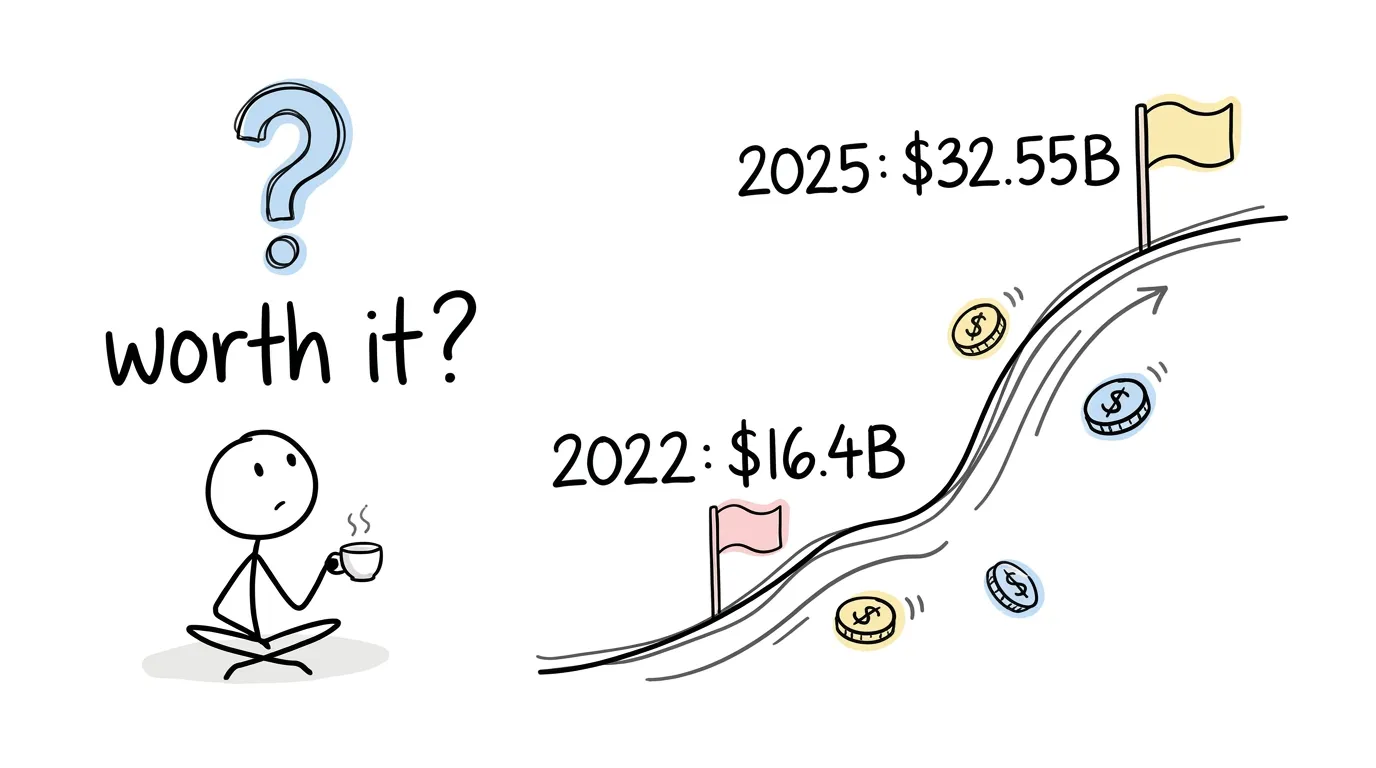
The research firm Influencer Marketing Hub has run the numbers: in 2022, the global influencer marketing market was $16.4 billion. In 2025, $32.55 billion.
Three years, doubled.
Now look at the US. IAB and PwC measure "ad spend placed through creators": $37 billion in 2025, a projected $44 billion in 2026.
Zoom out further, and this stops being just a "marketing budget" story. Goldman Sachs has sized the entire creator economy at roughly $250 billion, approaching $500 billion by 2027. As for creators worldwide who make a living off content, Linktree counted about 200 million of them, 66% of whom consider themselves part-timers.
Part-timers are the majority. That's the unglamorous truth of this industry.
And here's a set of numbers I particularly like. CreatorIQ's 2026 survey shows that companies spend an average of $4.8 million a year on creator marketing, up 33% from the year before; 66% of companies increased their spend over the past year. What's more, roughly two-thirds of the new budget was carved out of the traditional-advertising and digital-advertising pots.
Oh, and one more set of numbers I really like. CreatorIQ's 2026 survey shows that companies spend an average of $4.8 million a year on creator marketing, up 33% from the year before. What's more, roughly two-thirds of the new budget was carved out of the traditional-advertising and digital-advertising pots.
Money is the most honest thing there is. Where it flows tells you what actually works.
So the question becomes: with all this money pouring in, what are the returns actually like?
The Returns Are Real, but the Way People Do the Math Is Old-Fashioned
CreatorIQ surveyed 2,000 brands and agencies, and here's what the 2026 edition says: 48% of brands report that creator marketing delivers an ROI above 3x. A year ago, that number was 37%.
73% of agencies say client projects are returning better than last year.
Good grief, those are some beautiful numbers.
But hold your excitement, and look at how these people actually do their accounting.
In Influencer Marketing Hub's 2026 benchmark report, what do marketers use to measure performance? Promo codes rank first, at 45.9%. Then affiliate links, at 26%. Native store features, 25%.
What's a promo code? The creator shouts in the video, "Use my discount code, $50 off instantly," and then you count how many people place an order.
Half the industry is still using this most old-fashioned method to account for its most expensive spend.
And here's something even more interesting: 65.9% of marketers "expect" to break even within one month of a campaign, and 48.4% "expect" to break even within two weeks.
Note my word choice: expect.
Expectations are expectations; actual results are actual results. Do not mix up these two ledgers.
That said, money spent on real humans does give you something you can feel. In Sprout Social's 2025 survey, 69% of marketers admitted that content produced by the creators themselves performs better than what the brand writes itself; 92% said it reaches wider, 83% said it converts higher. 86% of consumers bought something on a creator's recommendation at least once over the past year.
Once a year at minimum. You tell me — does this business look fake?
Who to Back? My Answer Is Clear: the Small Ones
With the math settled, the next question: who gets the money?
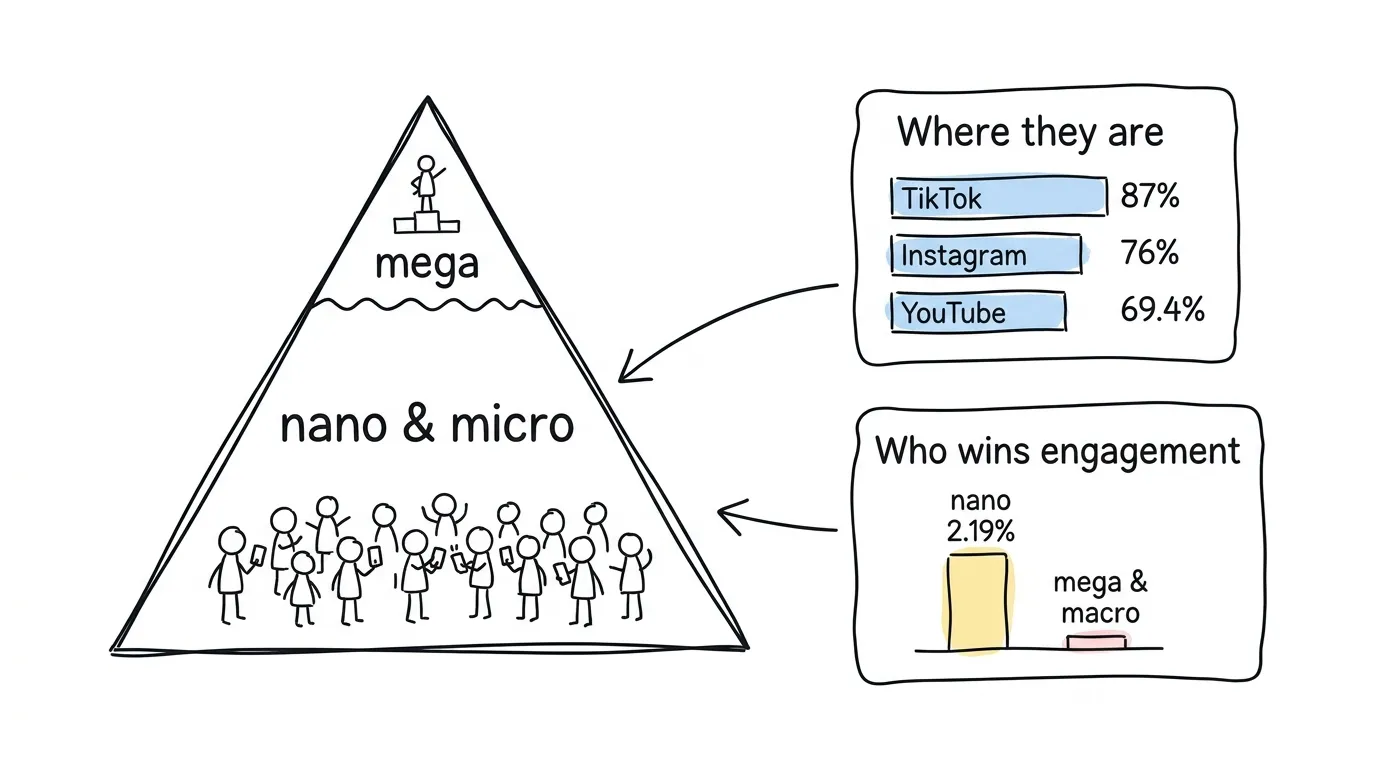
Start with a set of numbers that stunned me. HypeAuditor analyzed nearly 200 million accounts and found the share of nano creators (under 10,000 followers): 87% on TikTok, 76% on Instagram, 69.4% on YouTube.
What does that mean? In this arena, the overwhelming majority of players are small creators.
And small isn't just plentiful — it works. The highest engagement-rate tier on Instagram is precisely the nano creators, at 2.19%. The big-name accounts are left far behind.
Why is that?
Think about it: do a megastar's fans relate to him the way a small creator's followers relate to her?
A mega creator is like a billboard at the airport: everyone sees it, but hardly anyone confides in a billboard. A small creator is like your best friend: the follower count isn't big, but when she says "this face cream is really good," you genuinely believe her.
Buy reach, go to big creators. Buy trust, go to small ones.
Marketers have also been voting with their feet. In the 2026 benchmark report, 52.8% plan to increase spend on micro creators (10,000 to 100,000 followers), 51.4% on nano creators, and half plan to start using UGC creators. And note: on UGC, not a single respondent plans to cut back. Only 20.6% plan to expand macro creators.
By the way, 85.2% of YouTube channels average fewer than 10,000 views.
That's the real-world distribution. Only a few can stand at the tip of the pyramid, but the base of the tower is packed with living, breathing people.
There's also another play: casting the net. 52% of B2C brands work with 6 to 10 creators at the same time. Don't bet on one horse; bet on a handful of small ones. It's the same logic as a portfolio: a single small creator is volatile, but a basket of small creators steadies the odds.
Incidentally, vertical niche matters too. Sprout Social counted it up: on Instagram, gaming creators have a 3.15% engagement rate, travel 2.82%, fashion only 1.59%. Switch to a different pool, and travel on TikTok reaches 3.21%. Same fashion content — depending on where you post and what you post, the engagement rate can differ by a factor of two.
How Much Does It Cost? Prices Differ by Three Orders of Magnitude
So, hiring one creator — how much, exactly?
I went through Influencer Marketing Hub's 2026 rate ranges and reached one conclusion: in this line of work, prices can differ by three orders of magnitude, top to bottom.
One Instagram post: nano creators start at $10 to $100. Mega creators (over a million followers), from $10,000. If it's a Reel, mega-tier rates can go as high as $150,000 per piece.
One video. $150,000.
On TikTok, a mega creator charges $5,000 to $50,000 per video. YouTube is even steeper: mega-tier, $20,000 to $50,000 to start.
Don't panic — let's look at the other end. Sprout Social's 2025 survey says half of creators quote between $250 and $1,000 per piece. UGC creators are cheaper still: roughly 80% of their quoted ranges land within $500.
And 71% of creators are willing to give a discount for long-term partnerships.
35.4% of marketers say creator price hikes are their biggest pain point. So long-term contracts are becoming a must-have. On the same budget, signing someone familiar beats swapping in a fresh face every quarter, by a wide margin.
Where to Put It? Keep the Base and the Growth Separate
How do you choose platforms? This question has to be answered in two halves: the base, and the growth.
Among CreatorIQ's customers, between August 2025 and July 2026, 99% used Instagram, 93% used TikTok, 80% used YouTube, and 79% used Facebook.
Instagram has 3 billion monthly active users. YouTube ads can reach 2.77 billion people, TikTok ads 2.33 billion, and that reach still grew 17.4% over the past year. This is the base. There's nothing to argue about.
But the growth is on TikTok.
In 2025, the average engagement rate for brand posts on TikTok was 3.70%. Instagram? 0.48%. Facebook 0.15%, X 0.12%.
That's nearly an 8x gap.
In the 2026 benchmark report, 31% of marketers listed TikTok as the platform they most want to add spend to — more than twice the share for Instagram. Among those doing social commerce, 66% use TikTok Shop, while only 13% use Instagram Checkout.
My judgment is simple: keep the base on Instagram, and bet the incremental budget on TikTok.
Oh, and YouTube Shorts gets more than 200 billion views a day. On short video, no one can afford to sit this one out.
There's a counterintuitive wrinkle on format, too. In the 2026 benchmark report, 83% ranked long-form video among the top three most effective; short-form, 80%; live shopping, 62%. Meanwhile stories — the thing we scroll every single day — only 14%.
You'd think people only love the short stuff. The data says people actually love the long stuff too, as long as the content deserves it.
AI Is a Tool, Not Yet a Strategy
At some point in the past two years, you've surely been asked: are you using AI yet?
On the creator-marketing side, what is AI used for the most? Finding creators. 36.67% of marketers mainly use AI for this. Content generation ranks second, at 21%.
But there's a number that stings: 47% of marketers say AI has made creator marketing more complicated. Only 37% say simpler.
Why? Because as the tools multiplied, the fake data multiplied too. 56.5% of fraud problems are fake followers, bot followers.
Good grief — now even "are these followers real or fake" takes AI to check.
And there's an even more speculative corner of the market: virtual influencers. No real human needs to show up at all. Grand View Research has estimated this market at $11.2 billion in 2025, forecast to reach $110.4 billion by 2033.
AI can help you pick people and check for fake followers, but the person who ultimately pays you is still a living one.
B2B and Compliance: One Needs to Be Always-On, the Other Will Tighten Sooner or Later
Two easily overlooked corners.
First, B2B. In 2020, only 34% of B2B marketers had used influencers. In the 2024 survey, that number reached 85%. What's more, B2B teams without always-on, always-running operations are 17 times more likely to say their programs are ineffective. Among mature programs, the "significant results" rate is 79%.
Second, compliance. This is the weak spot — and a glaring one at that.
In 2024, the European Commission spot-checked 576 influencers: 97% had posted commercial content, but only 20% systematically disclosed "this is an ad." Among commercial posts inspected in Ireland, 48.4% carried no disclosure. France examined 60 influencers; six in ten were non-compliant.
Over in the US, the FTC revised its endorsement guides in 2023: paid partnerships must be disclosed clearly and conspicuously.
My view: this will tighten sooner or later. A 20% disclosure rate can't be tolerated forever.
For those who comply early, it's a cost. For those who comply late, it's an incident.
One last operational fact worth knowing: 66.3% of brands run influencer marketing entirely with their own teams, no outsourcing. Only about 11% hand it all to agencies.
In other words, the core capability of this business is something everyone is pulling in-house. That's probably why understanding people and understanding content has become worth more than understanding channels.
Back to That Cup of Tea
Later, I met that friend again.
He said that after hearing this pile of numbers, he was no longer agonizing over "whether to invest" — he was agonizing over "how to invest."
I said, that's exactly right. These dozens of numbers really say five things: pick the right people — trust sits in the hands of small creators; do the math right — don't book expected payback as actual results; pick the right pool — bet on the base and the growth separately; sign long contracts — 70% of creators are willing to discount; get compliant early — don't let a cost drag out into an incident.
May every dollar you spend be backed by a real, living person.
Continue reading
Related articles
The EU Is Handing the Pause Button Back to You
The EU's draft Digital Fairness Act targets dark patterns, addictive design, undisclosed influencer ads, silent subscription renewals, and game spending by minors, while keeping dynamic pricing legal but banning drip pricing; fines could reach 6% of annual turnover.
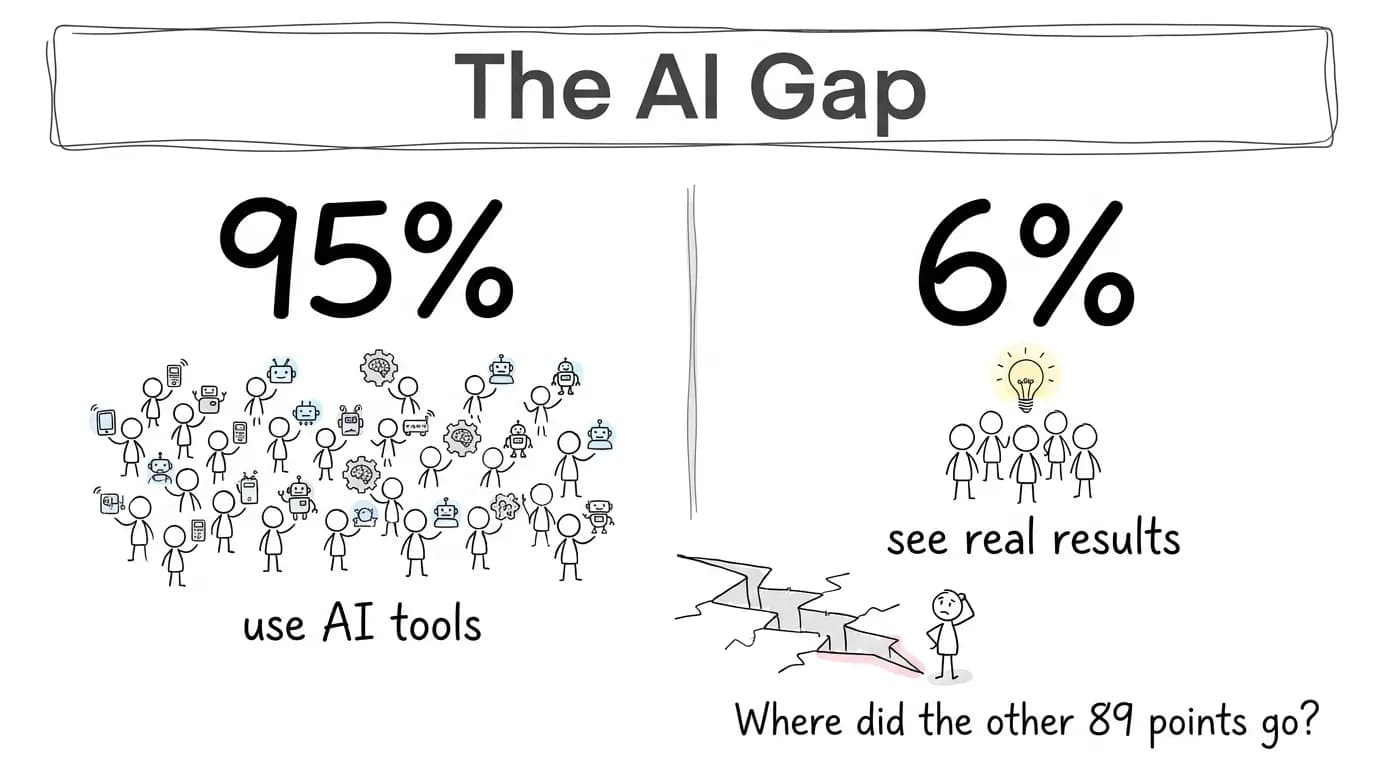
95% of Companies Use AI. Only 6% See Real Results. What's the Gap? Kolsquare's New Report Nails the Answer
A recap of a Kolsquare webinar on AI in influencer marketing, covering adoption gaps, AI-labeled content engagement, AI influencer limits, and generative engine visibility. It also outlines four practical moves for 2027 planning.
The EU Has Finally Had Enough of the Tricks You Fall For Online
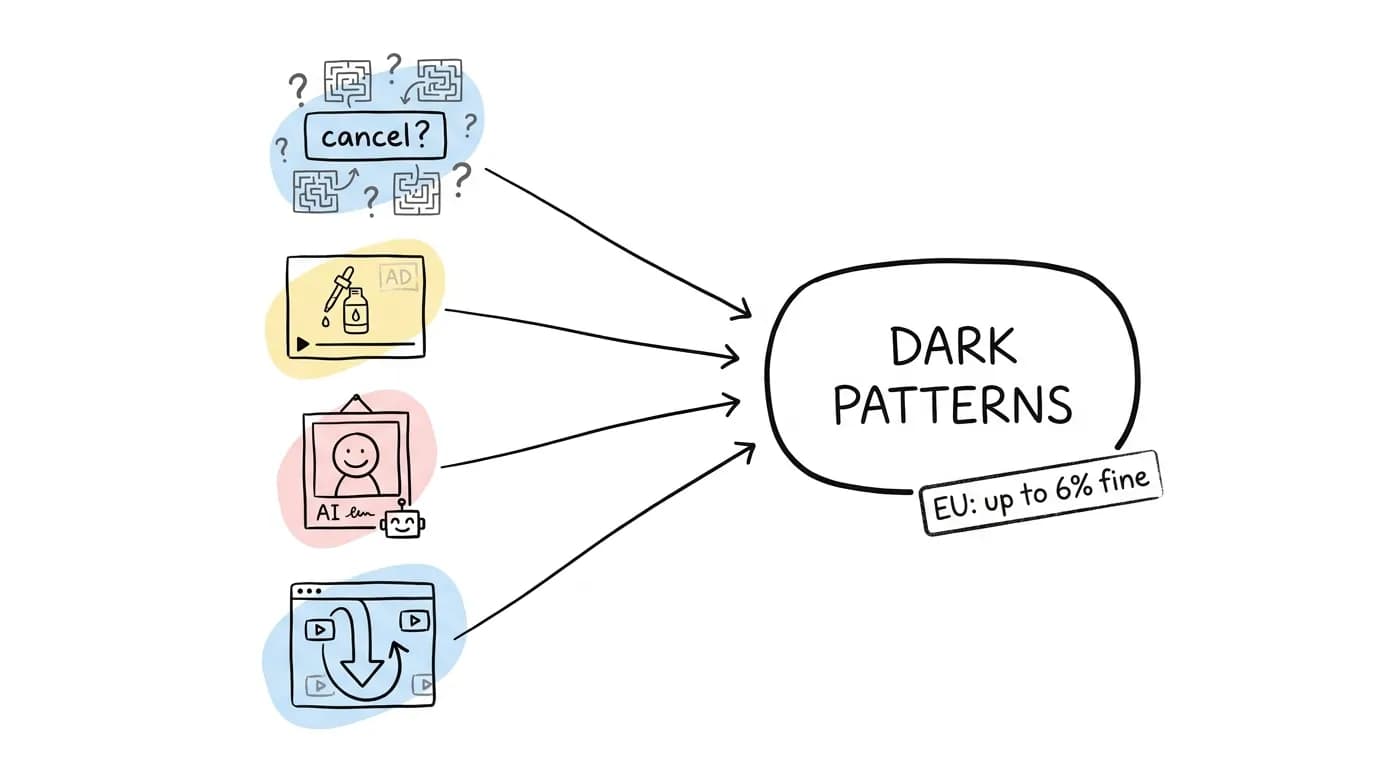
The EU's proposed Digital Fairness Act targets 'dark patterns' such as hard-to-cancel flows, undisclosed paid influencer posts, AI-generated virtual influencers, and addictive autoplay design, with fines of up to 6% of global annual turnover.