
The Buyer Has Already Chosen Before Sales Ever Calls: The New Rules of B2B Content Marketing
A learn article arguing that B2B buyers complete their research before ever talking to sales, so content must answer real buyer questions and earn citations from AI answer engines. It covers strategy before planning, interactive demos, AEO tactics alongside SEO, channel focus, and pipeline-based measurement.
A while back, a friend of mine who runs a SaaS company invited me to dinner. No sooner had we sat down than he sighed: "We've written over two hundred blog posts, we produced the white papers, we never stopped running ads — so why won't our leads grow?"
I asked him: have you ever considered that your buyers, right now, are simply not where you publish content?
He froze for a second.
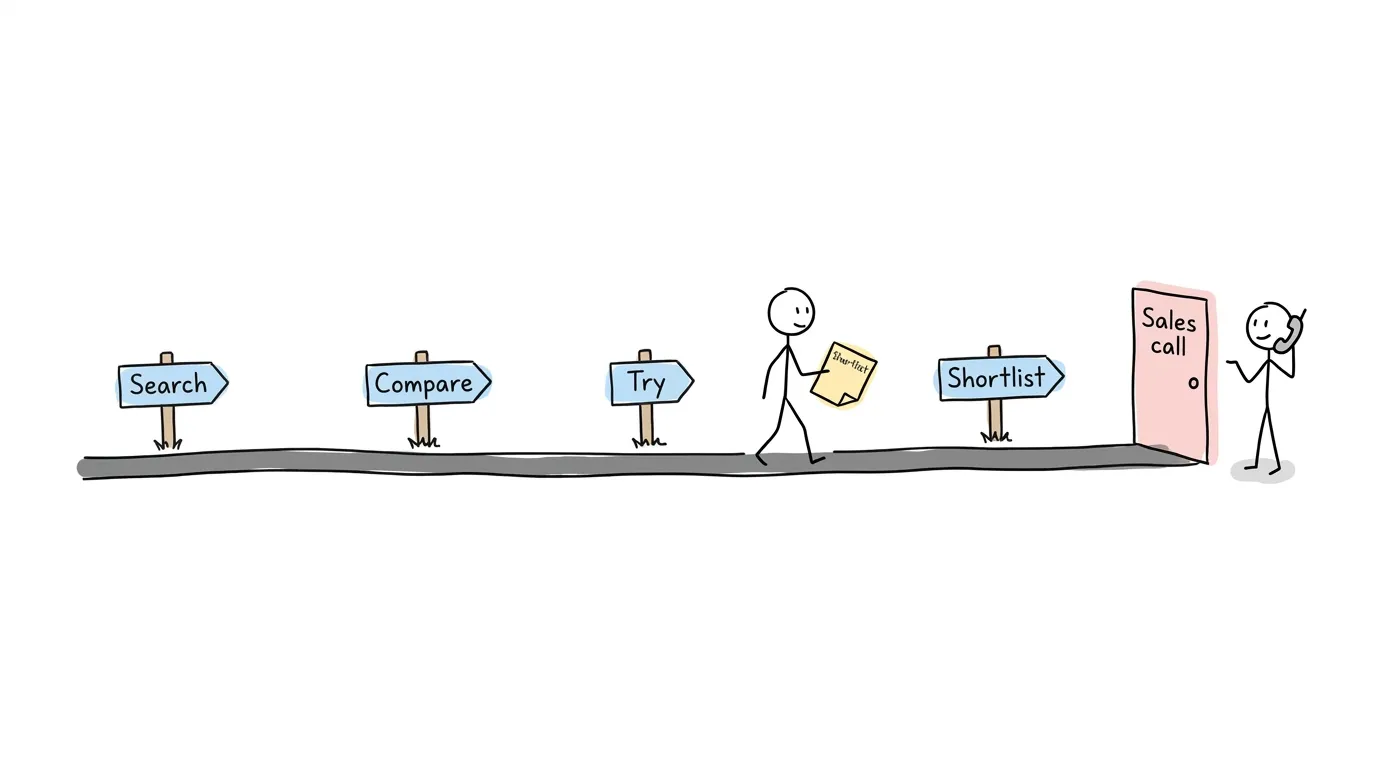
Here's what I told him: you may not have realized it yet, but before your buyers ever meet your sales team, they've already walked the entire buying journey on their own. They searched on their own, compared on their own, tried things on their own, and drew up their own shortlist. By the time your sales rep picks up the phone, they may already have a shortlist in their head. Guess what — is your company on it?
Behind all this is a quiet, massive migration. In this article, I'm going to walk you through it.
What Is B2B Content Marketing?
What is B2B content marketing?
The old answer was: write blogs, make ebooks, publish white papers, pull the traffic back to your website, then hand it to sales for follow-up.
But today, that answer needs to change.
B2B content marketing is the content that lets buyers finish the coursework on their own before they ever meet sales. When buyers have a question, you answer it for them; when buyers need to compare, you lay it out clearly for them; when buyers want to try, you let them play with the product right inside the content. It's as if the content sat in for sales and taught the pre-meeting class.
A bit abstract? Let me show you a set of numbers.
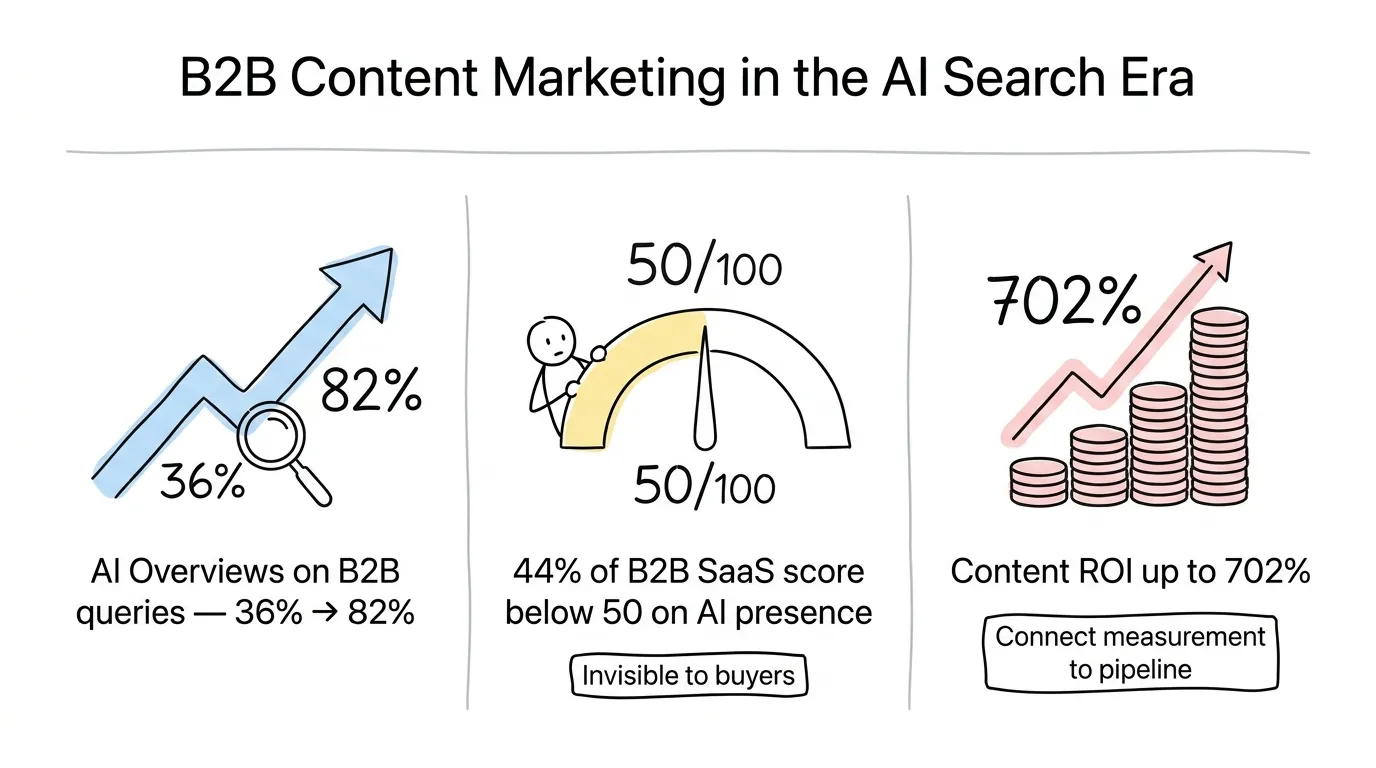
The search engine monitoring company BrightEdge ran a 12-month tracking study across 9 industries: among B2B technology queries on Google result pages, the share that trigger an AI Overview rose from 36% to 82%.
What does that mean?
It means that when a buyer searches a question, eight times out of ten the first thing they see is no longer a row of blue links — it's an answer summarized by AI.
Here's another set of numbers. A survey by the research firm DerivateX (covered by Demand Gen Report) found that 44% of B2B SaaS companies score below 50 out of 100 on AI presence.
What is AI presence? It's whether your company gets mentioned when buyers go ask AI engines like ChatGPT and Perplexity, "What tool should I use?"
Scoring below 50 practically means: to the buyers who use AI, you're invisible.
That's staggering. Nearly half of all companies are being quietly blocked by AI, and they don't even know it.
Why Does Everything Look Different Now?
Three things have flipped the table on the way the game was played over the past few years.
The first: AI search has inserted itself between buyers and content.
The playbook from 2022 was aimed at Google's blue links. Today, ChatGPT, Perplexity, and Google's AI Mode are all sitting between buyers and traditional search results. Your article can rank number one on Google, but if the AI engines don't cite you, that large chunk of traffic has nothing to do with you.
The second: buyers have finished the education themselves.
Buyers used to depend on sales to learn about products. Sales reps ran discovery calls, talking about the industry, the pain points, the solution. And now? Buyers search on their own, learn on their own, and only agree to meet you very late.
What does this mean?
Content has to go do what sales used to do. Explain clearly what kind of industry this is, where the problems come from, what a solution looks like, and also make buyers feel that "this company understands me." One good piece of content is worth a sales call.
The third: interactive content is leaving static content further and further behind.
Companies that build product demos, ROI calculators, and assessment tools grow faster than companies that only publish blogs and ebooks. And most B2B teams still haven't put interactive content into their plans.
What does that mean? If you do it now, it's a competitive advantage. If you start two years late, it's the passing grade.
Strategy and Plan — Don't Get Them Backwards
Many teams start by laying out a content calendar. What to publish today, what to publish tomorrow, on which account.
Let me ask you three questions: Who is it written for? What problem of theirs does it solve? How does it get exchanged for revenue?
If you can't answer, then it isn't marketing — it's just hauling content around.
A content strategy is the answer sheet that answers those three questions. Whose problem, what problem, and whether it converts into money. The plan, meanwhile, translates that answer sheet into a calendar, channels, and metrics. Strategy comes first, plan comes after; the order can't be reversed. When most B2B content projects fail, it's not because execution was poor — it's because the strategy step was skipped entirely.
So what does the expert's approach look like? Five steps. Let me go through them one at a time.
Step one: map the real journey of your ideal buyer. Note that this is not the pretty funnel in the slide deck; it's the actual chain of questions happening in their head, from "I seem to have a bit of a problem" to "I've picked this one." Every piece of content answers only one specific question, for one specific person.
Step two: match your inventory against the journey. Many people are stunned the moment they take stock: 50 pieces of content about awareness, 0 pieces about decision-making; 30 case studies piled up, and not a single piece that helps anyone make a comparison. Fill in whatever is missing. Stop producing the hundredth copy of what you already have.
Step three: pick formats. Software buyers like clickable demos and short videos; services buyers like case studies and methodologies; big-enterprise buyers like in-depth research and reports. Pick two or three that you can steadily do for a year — that's enough. Don't be greedy.
Step four: before you publish, lay out the distribution first. Publishing without distribution isn't publishing content — it's burying it in a graveyard. Before every piece of content goes out, answer one question first: how does it reach the reader? Search? LinkedIn? Email? In the hands of sales? Or cited by AI engines?
Step five: before you scale, connect the pipeline first. Hook content activity to the CRM and see which pieces of content actually touched the deals that eventually closed, not which pieces had high pageviews. Pageviews are labor, not revenue. Scaling something without knowing it works — that's not growth, it's rolling the dice.
A Few Plays Worth Stealing
Talking theory is easy; looking at examples is what's satisfying. Let me tell you about a few cases that actually ran and delivered. They have one thing in common: the content is the product experience, not the product manual.
First, Zapier. It embedded interactive demos directly into its content, so buyers can click and play with workflows inside the article without registering. As a result, the number of booked meetings grew by 70%.
That's powerful. While others "introduce" their product in an article, it lets the product speak for itself.
Second, RudderStack. For every product release, it doesn't make static launch materials; it makes a shareable interactive demo. This one asset does three jobs at once: the launch announcement, the ammunition for sales follow-up, and the demo on the website. One job, three outputs. Its product-launch pipeline doubled outright.
Third, Labelbox. It does original research, digging exclusive insights out of its own customer data, then pairs them with an interactive demo that lets buyers test things on the spot with their own data. MQLs (marketing qualified leads) grew by 30%.
Why is original research valuable? Note this down for now: exclusive data is the biggest moat in the content business. Only the things others can't copy deserve to be called a barrier. When we get to measurement later, I'll mention it again.
Fourth, Capchase. It turned customer interviews directly into content ideation sessions: every time an interview dug out a new pain point, a new piece of content grew out of it. Using this method, the speed of new proofs of concept (POC) was 4x faster.
What does the fourth case show? Customers are the content factory.
Oh, and there's one more type of content that looks unremarkable but converts at extremely high rates: comparison content. "Alternatives to so-and-so." "How to choose between so-and-so and so-and-so." When a buyer searches these terms, it's the moment they're closest to pulling out their wallets. If you don't write it, that moment belongs to your competitor.
By the way, one word on the tooling side. There are already products on the market built specifically for this kind of interactive demo — platforms like Arcade, for example, that record a product into an interactive demo, where one screen recording can simultaneously become blog material, a short video, a demo for sales follow-up, and help documentation. One recording, four outputs, no need to re-record. For a content team's production speed, that's a very real boost.
For SaaS Companies, the Product Itself Is the Biggest Marketing Asset
Content marketing for SaaS is different from general B2B. Where's the difference? Three points.
First, buyers default to "try before you buy." Your content still asks people to "book a demo before you can look," while the company next door lets buyers click open and play immediately. Guess whose door buyers knock on?
Second, the product itself is a distribution channel. Mature SaaS companies run onboarding, feature launches, and in-context help all as content placements. The blog is only one of the channels, not the center of the universe.
Third, speed. Competitors ship new features every week, and that static intro page on your website already went stale last month. Interactive demos and dynamic content have one advantage: the moment the product changes, they update along with it automatically, no rewriting needed.
How Do You Get the AI Engines to Cite You?
OK, now let's talk about something new. What is AEO? Answer Engine Optimization.
SEO in the old days studied how to rank higher on Google. AEO studies how to make ChatGPT, Perplexity, and Google's AI Overviews cite you when they answer questions.
What they look for in content isn't quite what Google's ranking rewards. I've summarized five rules, all of which you can start using immediately:
- Answer first. In every section, the first sentence gives the answer, then you explain. When AI engines pick sentences to cite, they mainly pick from the first one or two. Burying the answer in the third paragraph is a bad habit left over from the SEO era, and it's stealing your citations.
- Turn headings into questions. AI engines favor content whose headings are the actual search questions. Any subheading that can be changed into a question, change it into a question.
- Add structure. Tables, term explanations, and FAQs all get extracted at rates noticeably higher than pure paragraphs. If a claim can go into a table, don't write it as prose.
- Produce exclusive data. AI engines love to cite things that exist nowhere else. One exclusive number from your own customer base has far higher citation value than a public number being passed around by 50 blogs.
- Cite primary sources. If everyone cites secondhand aggregator sites, the AI will file you into the "echo chamber" pile too. If you're going to cite, cite primary.
Remember one sentence: AEO isn't a replacement for SEO; it's a parallel second discipline. The winners of 2026 will have content that both ranks on Google and gets cited by AI. Most content occupies only one of the two.
How to Choose Channels? Few but Deep
The channels that can feed the pipeline — there are eight mainstream ones: long-form pillar content (still the foundation), interactive product demos, long-form LinkedIn posts from founders and executives (personal accounts perform 5 to 10 times better than company pages), podcasts, original research reports, customer story videos, comparison content, and sales enablement content.
How does that list make you feel? You want to do all of them, right?
Stop.
The real play is: pick the 3 to 4 that you can keep doing for 12 months straight without dropping the ball. Ignore all the rest.
It's like opening a restaurant. You want to do Sichuan, Cantonese, Japanese, and Western food all at once, and in the end not a single dish is authentic. The depth of a channel beats the number of channels. One reminder along the way: the search rankings for the high-difficulty keywords behind pillar content take 6 to 12 months of endurance before they begin to compound — but once they begin, they can keep climbing for several years. A team that can't hold out until the compounding inflection point can't be saved by any number of channels.
How Do You Do the Math?
Finally, let's talk about money. How exactly do you calculate content marketing ROI?
First, here's an astronomical number: in the 2026 B2B SaaS benchmark report from Averi.ai, the ROI of SEO and blog content can reach as high as 702%; for teams that do it well, the three-year average is 844%; by month 36, it can roll past 1,100%.
Sexy numbers. But hold your excitement — these numbers come with one precondition: measurement must be connected to the pipeline. If you measure the wrong thing, all the numbers are hallucinations.
What you should really watch are four metrics.
One, pipeline attribution. Use multi-touch attribution in HubSpot or Salesforce to see which pieces of content touched the deals that eventually closed. Not only the first touch, not only the last touch — every content contact in between.
Two, AI citations. Use tools like Profound to track which AI engine mentioned you, and in answering which question. Citations are the rankings of the AI era.
Three, the quality of new traffic. A counterintuitive fact: pageviews that are rising but bringing in all the wrong people are much worse than pageviews staying flat while the people coming are more and more right. Watch whether people are coming, and, even more, watch whether the people coming are the ones you want.
Four, what sales is using. Which pieces of content do sales reps love to forward in their daily work? Which ones do they take to push deals toward closing? The content that sales uses repeatedly is the most valuable asset in your hands. Because it lives at the very bottom of the funnel.
Stop reporting "content engagement." Engagement is the process. Revenue, citations, and deal-closing speed are the results.
Finally, Back to My Friend
Remember the friend at the beginning, the one over dinner?
Later, I told him about everything in this piece. When he finished listening, he stayed silent for a long time. In the end he said one thing: so my two hundred blog posts weren't badly written — they simply never answered the questions buyers were actually asking, and they never hooked into the new entrances.
Right.
In the battle of content marketing, the rules have been swapped. AI has taken over the entrance, buyers have taken over the education, and content has taken over for sales. Whoever understands these three sentences first gets to claim the position before everyone else comes to their senses.
There's an old saying: where the traffic is, that's where the budget goes. But today, I want to add a second half to it.
Wherever the buyers are, that is where content has to grow. Even if that place didn't exist yesterday.
Here's wishing you, too, a content machine that brings buyers to your door on their own — without a single cold call.
Continue reading
Related articles

It's 2026: Stop "Buying" AI Tools for Your Marketing Team — Start "Hiring" AI Agents
This learn article explains how AI agents differ from standalone AI tools in marketing, outlines three agent categories — build-your-own platforms, CRM-native agents, and vertical tools — and covers use cases across SEO, social media, advertising, and reporting, plus criteria for choosing one.

What Is GEO? How Your Brand Gets "Mentioned" in the Age of AI Search
An explainer on GEO (Generative Engine Optimization) for e-commerce and DTC brands: how it differs from SEO and AEO, why AI answers shape brand visibility, and eight practices covering question-focused content, consistent brand messaging, structured pages, external evidence, comparisons, and AI mention tracking.

AI Is Already Making Decisions for Your Customers. Are You on the List?
A learn article explains GEO (Generative Engine Optimization): why AI-generated answers now shape which brands customers see, and how SEO fundamentals, entity clarity, citable evidence, and monthly measurement affect visibility in AI answers.