
90% of Companies Are Using AI — Why Do Only 6% See a Return?
A commentary on HubSpot's State of AI report findings: most surveyed companies use AI, but only a small share describe themselves as transformational adopters. The piece links returns to data quality and judgment about where AI should be applied.
A few days ago, I came across a report HubSpot had just released. Yes, that CRM company. Every year they publish a State of AI report, built on more than 6,000 survey responses from marketers, salespeople, service teams, and executives around the world. And at UNBOUND 2026, they devoted part of their opening keynote to exactly this.
Reading it left me with one conclusion: everyone is using AI, but for the vast majority, it's going to waste.
Let's start with a number.
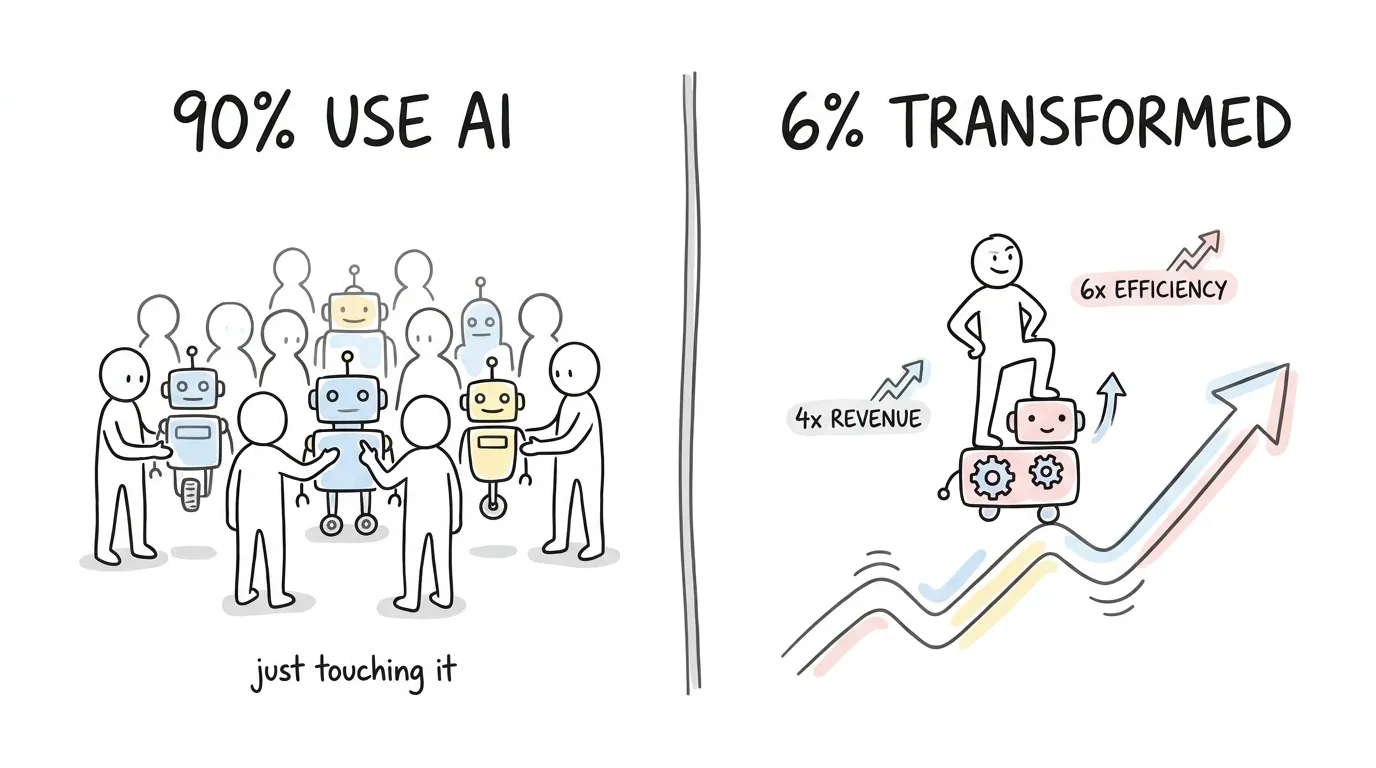
90% of surveyed companies say they're already using AI.
Impressive, right? But the report also asked a follow-up: which type of AI adopter are you? Only 6% of companies were bold enough to call themselves "transformational."
What does transformational mean? It means AI has grown into your business processes and become your muscle — not a newly bought toy.
Put those two numbers side by side and it stings: 90% are using it; only 6% are being transformed by it.
And that 6%? They're genuinely making money.
The data shows transformational adopters are 4x as likely as other companies to hit their revenue goals, and 6x as likely to hit their efficiency goals.
Four times. Six times.
How does the same AI budget turn into a money printer the moment it lands in someone else's hands?
An analogy comes to mind that fits perfectly: the gym.
Every January, gyms are flooded with new sign-ups. 90% of those people are "working out." But fewer than one in ten ever build the physique they came for.
What's the difference?
Signing up isn't the same as training, and training isn't the same as training properly.
AI works the same way. Installing a Copilot or letting your support team fire off a few canned auto-replies — that isn't using AI. That's merely touching it.
So what does using it properly look like?
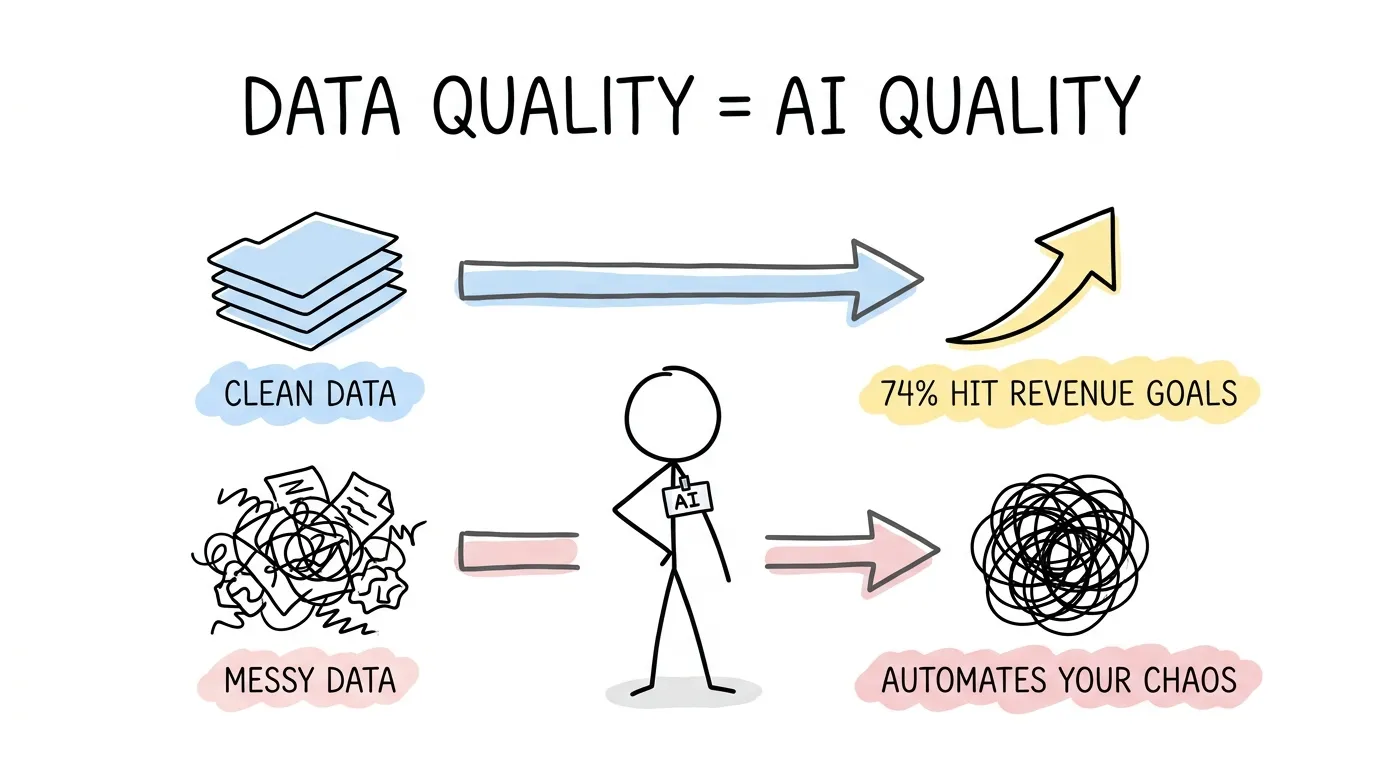
One particularly interesting number is tucked away in the report: among companies that say they're using AI well, the ones with good data quality saw 74% hit their revenue goals.
Yes, 74%. The deciding variable isn't how smart your model is. It's how good your data is.
The logic isn't complicated. AI is like an exceptionally capable new hire — sharp, quick to learn anything. But you have to hand over a clean knowledge base. If you give them a pile of expired business cards, duplicated customer records, and three spreadsheets that never agree, then no matter how brilliant they are, all they can do is automate your chaos.
The quality of your data determines the quality of your AI.
Here's a number that surprised me even more.
The report asked salespeople: do you use AI for pipeline prioritization? That is, letting AI judge which of your many prospects is most worth pursuing first.
Only 10% were doing it.
The interesting part: of the ones who did, most reported measurable gains.
So there you have it: on one side, "use it and it pays off"; on the other, "nine in ten people don't use it." This isn't a tool problem — it's an imagination problem.
It's like GPS. The navigation app tells you the road on the right is jammed, but you insist on charging ahead on the instinct of a ten-year veteran driver.
Marketing is a different story: 42% of marketers say their department's AI adoption has reached an advanced stage. Marketers really are running faster — copywriting, creative assets, ad buying are all places where AI pays off most directly.
But my favorite part of the report isn't a number at all. It's what HubSpot CEO Yamini Rangan said in the UNBOUND 2026 opening keynote.
After nearly three years of watching AI's ups and downs, she said, she believes one thing more and more.
Transformation doesn't happen in the maxxing phase.
Maxxing means cranking it to the max: cramming AI into every workflow, running everything through AI, as if not using it makes you outdated.
Transformation happens, she went on, when we stop asking what technology can do and start asking what it should do.
What it can do is a capability question. What it should do is a judgment question.
God, that's beautifully put.
Why is that judgment worth so much?
Because anyone can figure out what a tool can do — open it, click around, and you know the limits. But what it should do requires genuinely knowing your own business: where does it hurt most? Which action is worth the most? Where would AI be real help — right where it's needed most?
The gap in tools is shrinking. The gap in judgment is widening.
So back to the opening question: 90% are using AI — why do only 6% see a return?
The answer is clear by now.
That 6% did two things nobody else did: they got their data foundation clean, and they thought hard about where AI should go.
The remaining 90% are still stuck at the "it works" stage. They bought the membership, took the mirror selfie, and occasionally stroll on the treadmill.
And the people who actually build a physique at the gym are never the ones with the best gear.
They just train — without missing a single day.
Here's to you being one of the 6%.
Continue reading
Related articles

What Is AI Marketing Automation? It Starts With a 40-Point Gap
A learn article explaining what AI marketing automation is: how learning-based systems differ from rule-based automation, how AI decisioning optimizes message, channel, and timing choices, what data it depends on, and where it applies across the customer lifecycle.

Marketing Automation Is Shifting from "You Do It" to "You Say It"
This article explains how marketing automation is shifting from rule-based platforms that merely execute toward AI agents that plan, create, publish, and review campaigns, covering delegable tasks, underlying technologies, tool categories, adoption steps, and risks such as privacy and automating without strategy.

Rankings Are Taking a Dive, Customers Are Sprinting Ahead: This November, I Re-Ran the Numbers on AI Search
A learn article on how AI search reshapes marketing measurement, covering reported mismatches between rank-tracking tools and live Google results, ChatGPT's business profile test, single-page visitors as high-intent leads, and CRO plus GA4 tracking verification practices.