
AI Marketing Daily · 2026-10-24
Daily digest covering WFA survey findings on AI adoption and KPI gaps, Meta and TikTok AI ad tool launches, HubSpot's AEO guides on prompt tracking and AI visibility gaps, plus industry data on AI marketing ROI and compliance risks.
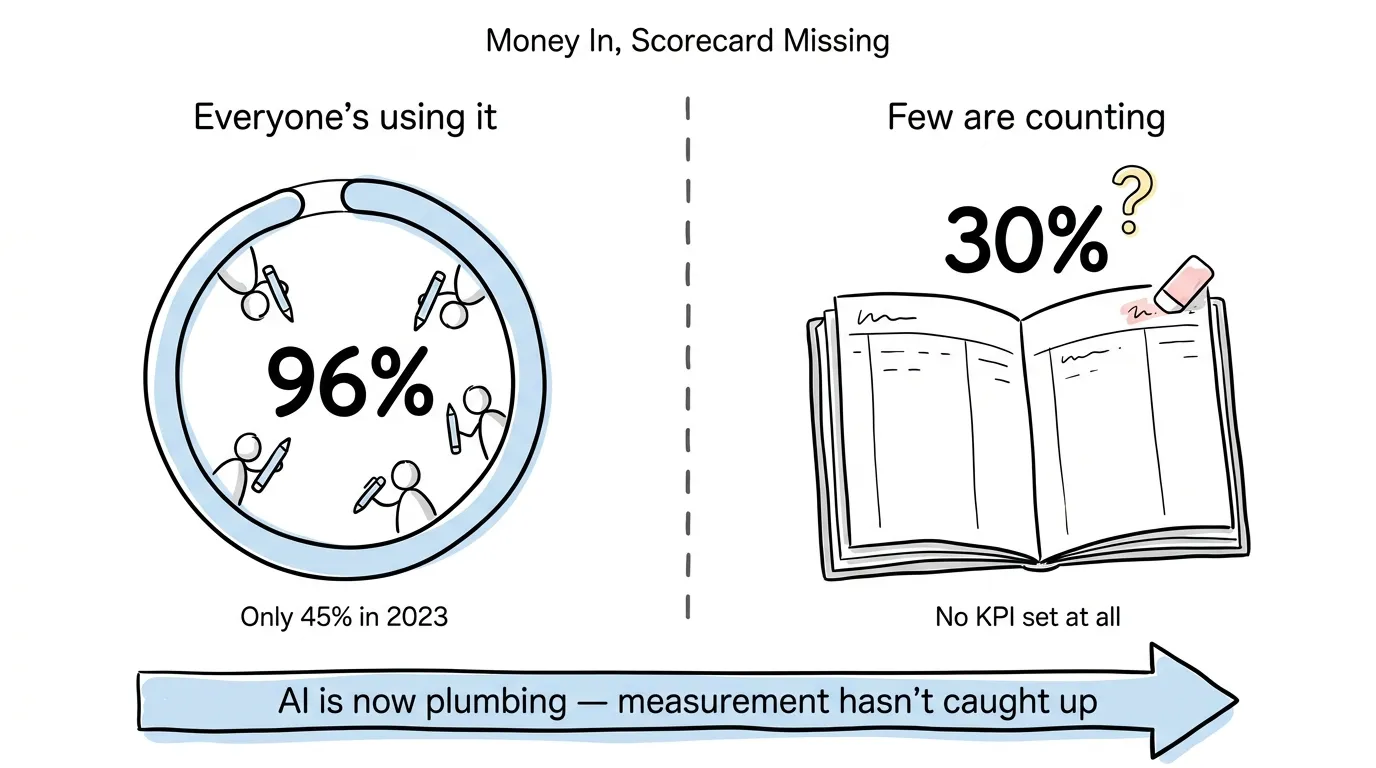
Today's throughline is measurement. WFA's annual survey confirms that 96% of marketers are already using AI — yet in that same report, 30% of teams haven't set a single KPI. HubSpot updated five AEO (Answer Engine Optimization) practitioner guides in a single day as a tools market visibly takes shape; Meta and TikTok rolled out concentrated batches of new AI ad-delivery capabilities during Advertising Week. The money is flowing into AI, but nobody has learned to count it yet. Fifteen intel items, starting with the numbers in the headline.
🎯 Today's Headline
96% of Marketers Are Already Using AI: The Numbers — and the Gaps — in WFA's Annual Survey
The World Federation of Advertisers (WFA) has published its annual survey, interviewing 54 marketers across 46 brands. 96% of respondents said they already use agentic or generative AI in their marketing work — a figure that stood at just 45% in 2023. In three years, AI has gone from novelty to a routine capability, as ordinary as running water and electricity.
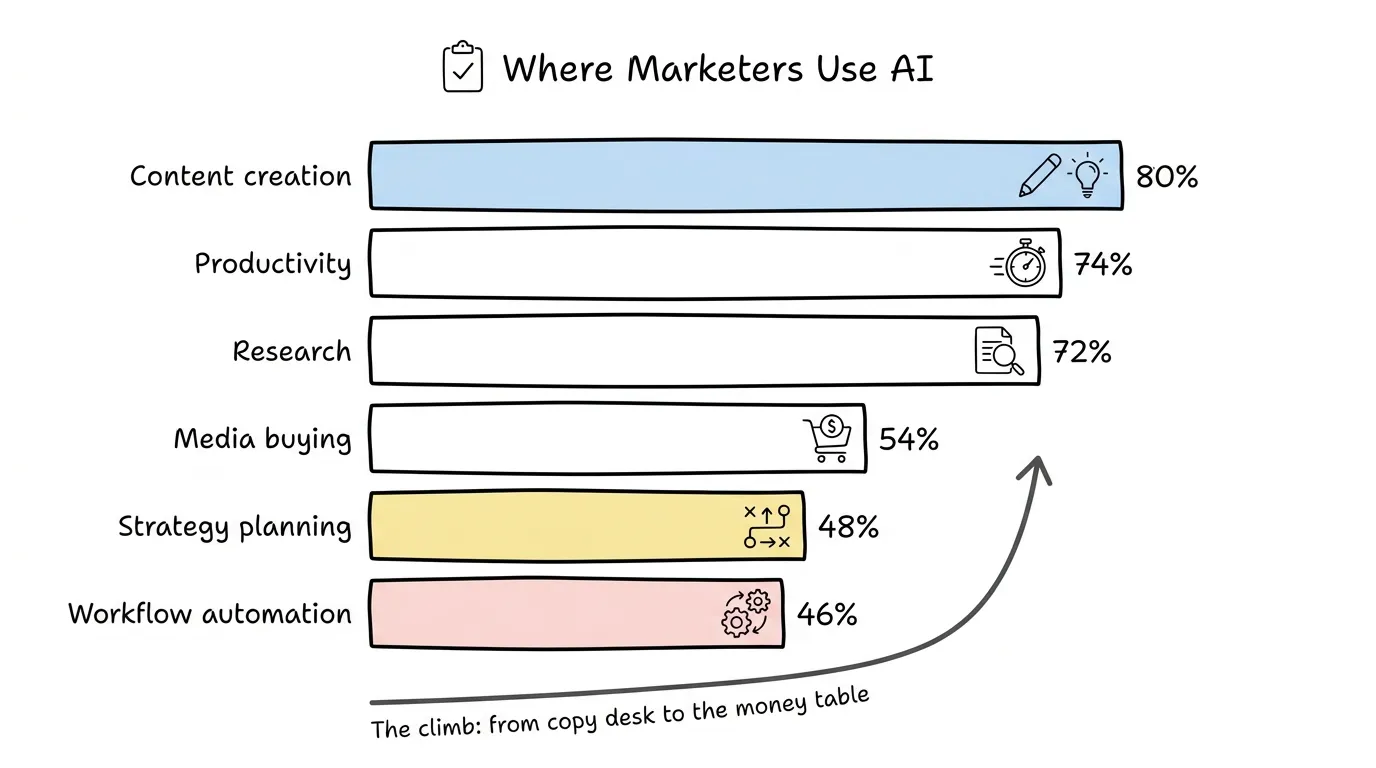
The distribution of use cases exposes the current state of play. Content creation leads at 80%, productivity gains at 74%, research at 72%, media buying and optimization at 54%, strategy planning at 48%, and workflow automation at 46%. The first two are familiar territory; the real story is how fast the later ones are climbing: AI is moving off the copywriting-and-graphics desk and onto the tables where money gets spent and strategy gets set.
The shift in team maturity says even more. In WFA's data from last October, 23% of marketing teams were still adopting AI in an ad hoc, fragmented way; that figure has now fallen to 16%. High-adoption teams jumped from 16% to 27%. Among priorities for the next 12 months, scaling adoption accounts for 63% and employee training and upskilling for 55%. Only 26% of teams believe most of their people genuinely understand AI, and 69% admit understanding is uneven — AI literacy has become the biggest skills gap.
Why this survey deserves a close read: brands' expectations of AI are shifting gears. 22% of respondents aim at efficiency gains, 22% at marketing performance, 18% at business growth — and another third want all three. The efficiency story has peaked; the performance story is just getting started. But the KPIs haven't kept up: time saved, money saved, and productivity gains each sit at 52%, 45% are chasing speed-to-market, and 30% of teams have no KPI at all. Running the most advanced tools against the most old-fashioned scorecards — that's the true portrait of most marketing teams right now.
On the implications for marketers, one set of numbers has to be pulled out on its own: agency governance. 16% of brands know almost nothing about how their agencies use AI, 29% know only partially, 36% know quite a lot, and just 13% have real command of it. The countermeasures are already taking shape: 64% of brands require agencies to proactively disclose AI use, 59% have written AI clauses into agency contracts, and another 22% plan to follow. The rules of the game for pitches, pricing, and delivery acceptance are being rewritten — anyone on the agency side needs to get ready early.
On how to act, three moves. First, attach business-side KPIs to your AI projects — pipeline, conversion, revenue — and stop checking the box with "hours saved" — and make sure you're not one of the 30%. Second, audit your agency contracts this week and add AI disclosure clauses and quality liability; 59% of brands have already moved, so it's your turn. Third, push training budget up the agenda in line with the survey's priorities — 55% of your peers are building AI literacy, and the 26% comprehension gap is your starting line.
Behind these three steps lies a shared premise: upgrade AI from a personal efficiency tool into an organizational capability. The survey's qualitative feedback backs this up — the biggest obstacles to adoption are lack of time and resources, plus not knowing where to start. Plenty of teams use AI smoothly at the individual level, but they stall when it comes to cross-functional coordination, connecting data, and reworking processes. So the training gap isn't just tool operation; it's teaching people how to accept and verify AI output, and which stages should never be handed to a model.
My take: 96% isn't the news — 30% with no KPI is. When everyone has the tools, the tools themselves stop differentiating, and the competitive watershed shifts to measurement and governance. Whoever first translates AI spend into the language of revenue takes the initiative in the next budget conversation. The most valuable warning in this survey hides in its imbalances: use-case mix skewed toward content, KPIs skewed toward efficiency, and only a quarter of the workforce that truly understands the technology. Marketing has left behind the stage where AI was a stopwatch — where it goes next depends on how you measure it.
🔗 Further reading: Read the full article
🏷 Product Launches
Meta Turns Static Images into Video with One Click, TikTok Lets AI Negotiate Your Leads: How to Handle This Wave of Advertising Week Updates
Advertising Week 2026 turned into a mass launch event for AI ad tools. On Meta's side, static-to-video conversion in Advantage+ creative is now fully generally available, and Ads Creative Studio is scaling to more advertisers, capable of producing video variants in bulk and adjusting opening hooks, audio, subtitles, and end frames. The business assistant's upgrade deserves more attention: it can read historical campaigns, seasonality, and delivery objectives, supports uploading brand guidelines, adjusts targeting and budget conversationally, and can be set to deliver reports on a schedule. Meta is also testing full rollout of its customer lifecycle strategy feature.
TikTok spread automation across three stages. Smart+ automation extends to search ads, managing keywords and creative together; Smart+ Creative Selection pulls the advertiser's own assets, AI-generated material, and creator content into a single approval flow, recommending asset combinations by campaign objective — with launch authority kept in human hands; Agentic Leads uses AI conversation to follow up on leads, and the shopping assistant connects with Buy Direct to open a path from discovery to checkout.
Reddit's moves concentrate on the leads side: Max bid campaigns now support lead-generation objectives, in-market audiences have entered beta testing (categories including enterprise services, business AI, and cybersecurity), and the attribution integration with HubSpot is in open beta — with Reddit officially citing nearly a 7% CPA improvement from early audience data.
Two more items from the same week should be read together. Search Engine Roundtable reported on October 8 that Google manual penalty reports are rising; in the cases consultants Marie Haynes and Daniel Foley Carter have seen, thin content, pure spam, and scaled content are the three main causes, and some long-established sites have been hit too. Separately, an SE Ranking analysis of 100,000 keywords shows social platform links appearing in 67.66% of Google AI Overviews, 32.39% of AI Mode answers, and 8.4% of ChatGPT answers — YouTube dominates AI Overviews citations, while Reddit and LinkedIn dominate ChatGPT's.
💬 First go into your backend and confirm which of these features are actually live in your accounts — don't follow the press-release schedule. Start testing from the stage that bottlenecks production most: static-to-video saves labor hours on batch variants, but manual review before each version goes live cannot be skipped. For leads automation, align with sales first on what counts as a qualified lead — otherwise you save effort on delivery and add overtime for sales.
🔗 Further reading: Read the full article
🏷 Marketing Tools
Which AI Prompts Should You Track? HubSpot Offers a Three-Category Set
HubSpot's AEO guide updated on October 23 answers a question no team working on AI visibility can avoid: with millions of prompts out there, which ones should you track? The answer: build a representative three-category portfolio. Brand prompts — judge them on accuracy and sentiment, not just how often you appear; non-brand prompts — measure your true share; competitor prompts — use them for comparative positioning. The three categories should cover different purchase stages, buyer personas, and priority markets. Give up the fantasy of tracking everything.
The most actionable finding is how buyers phrase their questions. Buyers ask questions in AI the way they write a requirements brief — including team size, budget range, and region — and the answers shift with that context. So your prompt list can't be drawn up on instinct; the best source is your own CRM data, reverse-engineering how buyers actually ask from real deal paths. The piece cites Responsive's 2025 research: 56% of tech buyers already use generative AI to build vendor shortlists.
The maintenance cadence is set too: review the prompt set quarterly, retire prompts that no longer work, add new categories and new competitors. Visibility data must ultimately land as page-level content fixes and regular reporting — watching the aggregate curve alone is meaningless.
💬 Don't rush to buy a monitoring tool and spread across every prompt. Pull the questions asked by your last 50 closed customers from your CRM, rewrite them as prompts, and run them for two weeks — far more accurate than brainstorming a word list. Put that quarterly maintenance on the calendar now; stale prompts left in place only pollute your baseline.
🔗 Further reading: Read the full article
Ranked #1 on Google but ChatGPT Doesn't Mention You: Three Types of AI Visibility Gaps and a Four-Step Fix
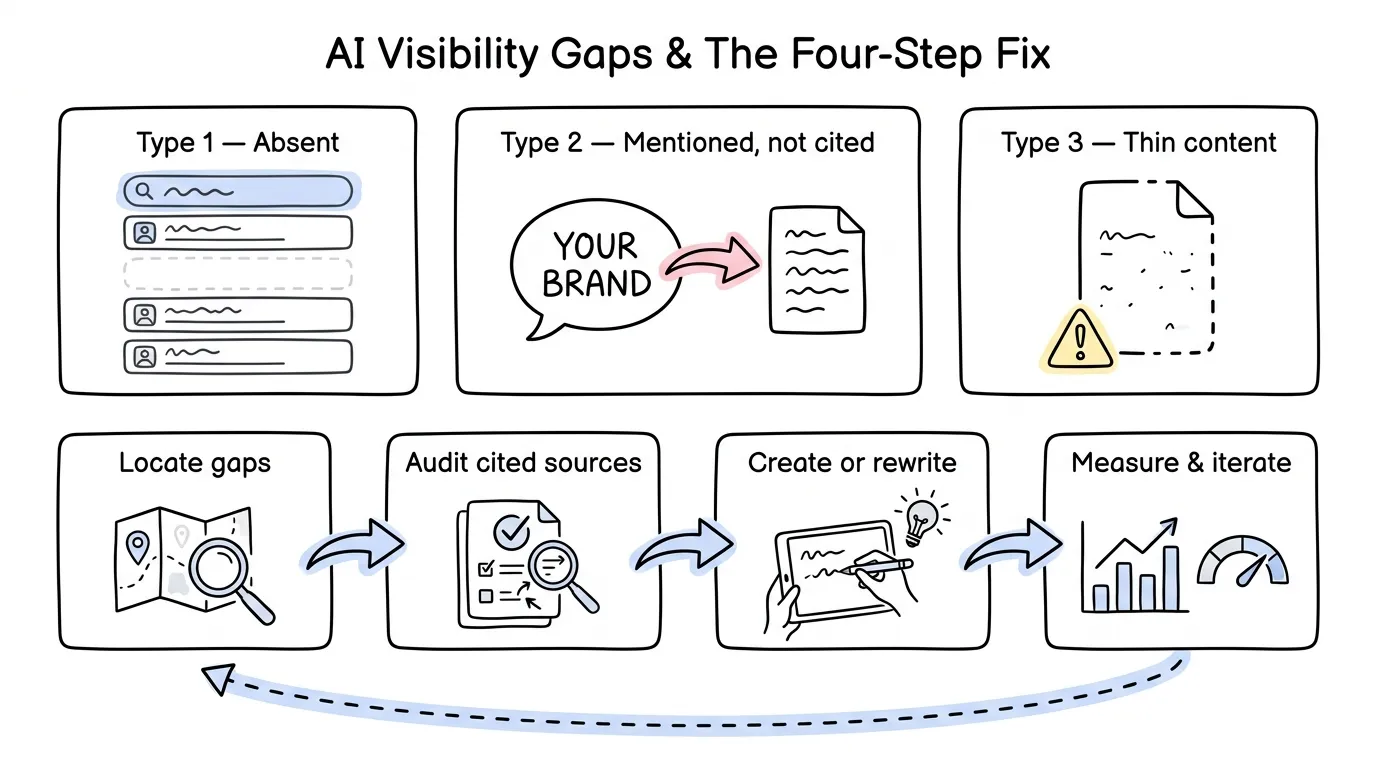
Another HubSpot guide updated the same day breaks AI visibility content gaps into three types. Type one, brand absence: under relevant prompt clusters, you simply don't appear in AI-generated answers at all. Type two, mentioned but not cited: the AI assistant mentions your brand, but the supporting evidence cites third-party websites. Type three, content insufficient to support the answer: even when you're cited, your page gives an incomplete answer.
It punctures a common illusion: traditional SEO gap analysis and AI visibility gaps are two separate systems. However well your pages rank on Google, they may never be cited by ChatGPT, Gemini, or Perplexity, because the indexing logic and citation preferences are entirely different. The second type of gap is especially sneaky: being mentioned means the AI knows you; citations flowing to someone else means trust hasn't been established.
The fix is a four-step process: use prompt-tracking data to locate the gaps, audit the sources competitors get cited for in AI answers, create or rewrite the corresponding content, then measure and iterate. The guide specifically warns against blindly mass-producing content — first judge whether the gap is worth closing.
💬 Something you can do today: pick 10 buying-intent questions from your industry, ask them of the major AIs, and record who gets mentioned and who the citations go to — you'll map the gap within an hour. The cheapest place to start fixing is type two: your page is already being mentioned; all that's missing is the citation.
🔗 Further reading: Read the full article
Profound vs. Bluefish: How to Choose an AEO Platform — Eight Dimensions to Clear First
HubSpot's platform comparison published on October 23 takes on the two biggest names in the AEO space. The comparison dimensions are comprehensive: engine and model coverage, sampling frequency, prompt-control granularity, cross-region and language support, citation fidelity, data collection method (user panels vs. server logs and the like), reporting and ROI integration, and security governance — plus onboarding cost and team fit.
One precondition buyers easily overlook: the same prompt produces different mentions and citations across engines, markets, and points in time, so any AEO platform's measurement requires repeated sampling before patterns emerge. During a demo, anyone making claims off a single screenshot should be marked down instantly.
Methodologically this comparison is honest: the author states outright that it's based on verification of product documentation and public materials, with no independent hands-on testing, and takes care to separate AEO from AI SEO — the latter means AI-assisted traditional SEO workflows, the former measures how brands show up in AI answers. A 30-minute platform-demo checklist is attached at the end; run your questions against it and a batch of vendors will filter themselves out.
💬 Before procurement, work through that checklist and press hardest on how citation fidelity is actually calculated. Picking the wrong tool wastes more than the subscription fee — it wastes three months of baseline data, and redoing the baseline later costs even more.
🔗 Further reading: Read the full article
Eight LLM Visibility Tools Compared: From Free Diagnostics to Enterprise Platforms
Still HubSpot — a tools roundup updated on October 23, covering eight tools that track brand mentions, citations, and share of voice across answer engines, priced from free diagnostics to enterprise platforms. It opens by adding two concepts: a mention comes without a link, a citation comes with a clickable source — two different visibility assets, and only the latter directly drives traffic.
The roundup stresses that one-off spot checks are meaningless. Results for the same prompt are inherently unstable across runs, so only periodic repeated sampling reveals real patterns — which makes sampling frequency and engine coverage hard criteria in vendor selection. Background data cites Digitaloft's research: 80% of users spend at least 40% of their time on zero-click results, on-site clicks and scroll signals shrink accordingly, and a brand's presence in AI answers becomes the new upstream metric.
The piece closes with a 30-day starter process: define your prompt set first, run a two-week baseline, then choose and connect a tool using the comparison table, and finally turn findings into content actions.
💬 Teams on tight budgets should run their baseline on free tiers first — track two curves, mentions and citations, for two weeks, and only talk paid platforms if a gap shows. In the zero-click era, being mentioned is itself worth money; don't measure the new thing with the old traffic ruler.
🔗 Further reading: Read the full article
Bolt AEO onto Your SEO Suite or Buy a Dedicated Platform? The Fork in the Road Between Ahrefs and Profound
HubSpot's third same-day comparison answers the most common fork in procurement: should AI visibility capability live inside your existing SEO suite, or should you buy a dedicated AEO platform? This time the contenders are Ahrefs Brand Radar and Profound.
Brand Radar's selling point is working with what you already have: AI visibility data sits in the same interface as keyword, backlink, and rank tracking — zero switching cost for SEO-native teams, switched on within your existing subscription. Profound goes deep: unique capabilities include consumer-panel prompt search volume, ChatGPT Shopping analytics, server-log crawler tracking, and a no-code Agent, but it has moved to demo-based enterprise sales, raising the budget bar. The piece lists HubSpot's own AEO as a third option, built around a tracking-plus-content-action loop, from $50/month. A three-way feature comparison table and buyer-fit advice are appended at the end.
💬 There's one test that matters: your team's SEO infrastructure maturity. If you already subscribe to Ahrefs, use Brand Radar to add the AI view before adding budget; move to a deep platform like Profound only when AI visibility needs its own reporting line and you need to show management the trends.
🔗 Further reading: Read the full article
🏷 Industry Data
Acquisition Costs Up 60% in Three Years: The Research Pushing Marketing Toward Revenue Accountability
CMO Alliance has summarized Alexander Group's "2026 Revenue-Ready Marketing Organization" study, based on a sample of 300+ marketing organizations across 11 industries. Two numbers set the stage first: customer acquisition costs have risen 60% to 100% since 2022, and buyers complete roughly 70% of their evaluation process before ever contacting sales. Both sides of the transaction have changed their behavior — the way marketing is organized hasn't. That's the mismatch this study aims to poke at.
The study scores seven industries on a marketing maturity index, benchmarking six capabilities against a 4.0 standard. Tech scores highest at 3.1, financial services 2.7, media 2.6, healthcare 2.3, manufacturing 2.1. The weak spots differ: tech and finance stall on channel management and demand generation — only 30% of tech companies run advanced demand-gen programs; media stalls on data and attribution; healthcare and manufacturing stall on customer segmentation.
The AI-related findings contain a glaring contrast: 92% of surveyed companies believe AI can deliver ROI and 80% are increasing 2026 budgets, yet only a minority of organizations have mature AI governance and attribution capabilities. The money is pouring in while the dashboard is missing. The study lands on organizational design: marketing must align with sales and customer success on revenue accountability, replacing campaign reports with the language of pipeline.
💬 The move for CMOs: rewrite the 2026 budget request from a campaign list into pipeline and revenue language, use the maturity index to find your industry's weak capability, and fix attribution before asking for more budget — get the order backwards and the money is wasted.
🔗 Further reading: Read the full article
88% Are Using AI, Only 6% Are Profiting: An ROI Data Pack for the CFO
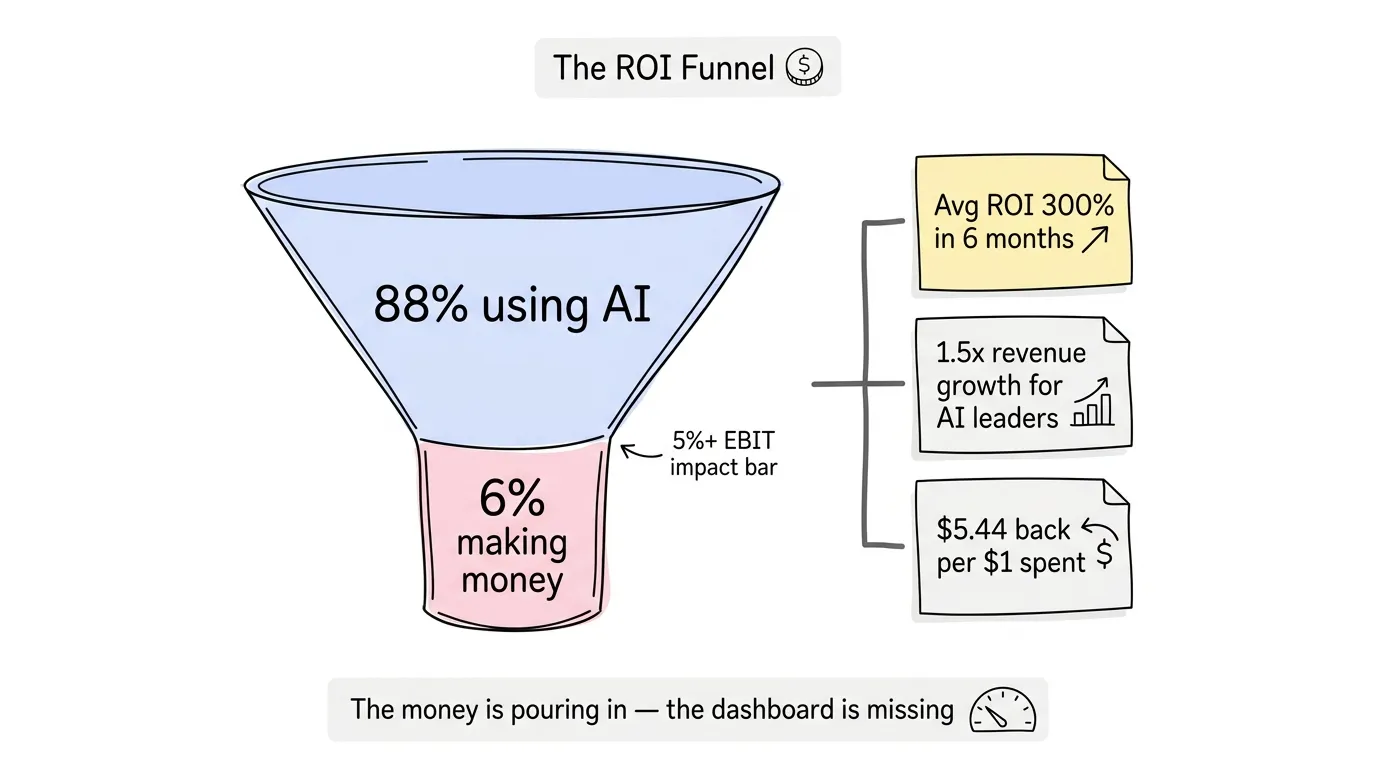
Zigment.ai has compiled 50+ sourced data points on AI marketing ROI, aimed squarely at one scenario: proving to the CFO that the money was well spent. A few of the harder numbers: organizations that deployed AI marketing in 2025 reported an average ROI of 300% within six months; marketing automation returned $5.44 for every $1 invested over three years; companies using AI across functions post ROI 22% higher than traditional peers; 74% of executives saw positive returns from AI agents in the first year.
McKinsey's 2025 State of AI gets cited repeatedly: AI leader companies grew revenue 1.5x faster than peers over three years; 88% of organizations use AI routinely in at least one function, yet only about 6% clear the high-performance bar of 5%+ EBIT impact. Gartner's forecast adds the time dimension: by the end of 2026, 40% of enterprise applications will integrate task-specific AI agents, up from under 5% in 2025. Meanwhile 72% of CMOs plan to increase budgets relative to sales in 2026 — while facing tougher ROI scrutiny.
One caution: this is a vendor's secondhand compilation of third-party research with product promotion baked in — check the original reports' methodologies before citing. Its landing point, though, is right: the difference lies in implementation quality, not spend size. Start from high-impact, low-risk use cases, pair them with finance-grade measurement, and deliver results within 60 to 90 days.
💬 Usable at tomorrow's budget meeting: pick three numbers for the deck — 300% average ROI, 1.5x growth, the 6% high-performance line — and land on a request for a small pilot with financial measurement, promising results in 60 days. The data is secondhand, but the argument structure holds.
🔗 Further reading: Read the full article
Behind the $47 Billion AI Marketing Market: 85% Are Using It, 21% Have Made It Work
The New Zealand Digital Marketing Institute's annual overview on Medium, for scale: the AI marketing market was roughly $47 billion in 2025, with a 36.6% compound annual growth rate through 2028. More than 85% of enterprises have integrated AI, but the maturity stratification is stark — only 21% have reached the integration stage and 42% the transformation stage, while the bulk of the rest are still circling the experimentation stage.
The tool-side adoption figures are useful reference: among AI video platforms, Synthesia leads enterprise adoption at 62%, Sora at 47%, Runway at 42%, HeyGen at 38%; text platforms like Jasper and Copy.ai report content production hours cut by 20% to 40%, with output up to doubled. Investment patterns are shifting from buying point tools to platform strategies — data infrastructure, models, orchestration, and governance procured as a package.
Worth flagging: the sourcing here is loose, a few figures diverge from mainstream research, and the piece was published in late December 2025 — treat it as background context, not a basis for decisions.
💬 Use its maturity layers as a mirror: 85% using, 21% making it work — most teams are stuck between piling up tools and reworking processes. Figuring out which layer you're on is far more useful than memorizing the market size.
🔗 Further reading: Read the full article
🏷 Methodology & Trends
European AI Shopping Agents Won't Recommend You? The Problem May Be the Tracking Number
Perform.AI (formerly Parcel Perform) has coined a new concept: Carrier Localism. US brands are being systematically overlooked by AI shopping agents like ChatGPT and Gemini in Europe — and the root cause isn't marketing, it's logistics data. Europe's carrier landscape is highly fragmented: the same carrier that excels in Germany may be mediocre in Spain and have no presence at all in Poland. Delivery-performance data is siloed, so AI agents can't read a consistent, trustworthy fulfillment signal — and stop recommending your products.
The supporting data comes from three sources: Salesforce says 39% of consumers — and more than half of Gen Z — already use AI for product discovery; Ahrefs says AI search visitors convert 23 times better than traditional organic search; McKinsey says inconsistent delivery experiences across regions can cut customer lifetime value by 15%. Two cart-abandonment numbers add pressure: 49% of European cross-border shoppers abandon orders over high shipping fees, and 38% over long delivery times. The fix comes in three steps: unify the delivery data layer (the piece claims data from 1,100+ carriers can be standardized into 155 event types), make delivery promises precise, and eliminate logistics handoff breakpoints — turning fulfillment performance into an AI-readable trust signal.
Note that this is vendor thought-leadership content with product promotion in the back half; the framework is thought-provoking, but verify the numbers before citing them.
💬 Cross-border brands should plug fulfillment data into their AI visibility checklist: letting the AI read your on-time delivery record beats another round of ad spend. Get marketing, logistics, and data teams in one room — this topic deserves an agenda slot.
🔗 Further reading: Read the full article
Five Marketing Predictions for 2026: Search Everywhere Rises, and So Does AI Authority
WSI has published five predictions for marketing and AI in 2026. First, search optimization heads toward Search Everywhere plus GEO (Generative Engine Optimization), as discovery disperses across TikTok, Amazon, YouTube, Reddit, and ChatGPT, and single-engine Google optimization stops working. Second, clicks fall but conversion quality rises — visitors arrive with sharper intent, and in the zero-click era brand mentions and authority matter more than rank numbers. Third, AI systems tend to cite brands that are mentioned by credible sources; review sites, forums, podcasts, and social channels form a new "AI authority" that is becoming a ranking factor. Fourth, omnichannel experience becomes table stakes — B2B and B2C buyers flow back and forth between digital and human touchpoints, and brands with disconnected systems lose deals outright. Fifth, the demise of cookies plus tightening regulation means first-party and zero-party data, combined with teams high in AI literacy, decide who wins.
The piece closes with a scorecard review of last year's predictions — which is rarer than the predictions themselves. One caution: this is agency content marketing, with its own services and books promoted; stay a little skeptical when adopting its judgments.
💬 Treat AI authority as a new metric for your Q4 review: check how often your brand is mentioned across review sites, forums, and podcasts — that's the entry ticket to being cited by AI in 2026, and there's still time to build it.
🔗 Further reading: Read the full article
AEO, GEO, LMO — What Exactly Is the Difference? A Team Onboarding Primer
The first piece in John Vargo's series on Medium (published December 2025) systematically lays out three concepts in AI search optimization. The background thesis: search is shifting from a list of links to direct AI-generated answers — a structural change. Each of the three disciplines covers a different stretch: AEO governs influencing how AI tools generate answers; GEO governs raising your content's visibility and citation rate inside generative systems; LMO governs making content retrievable, summarizable, and trusted by LLMs.
Two points are worth keeping. First, a strange phenomenon many people are seeing now has an explanation: organic traffic is falling while keyword rankings stay unchanged, because traffic is being intercepted by AI answers — the ranking metrics have gone stale. Second, AI recommendations depend more on entity coherence — whether a brand's name, descriptions, and product information match up across platforms — than on keyword stuffing. B2B and services businesses take the hardest hit from answers replacing clicks.
To be fair, this piece carries the flavor of a marketing agency's service promotion, has no new data, and stays at the level of framework exposition.
💬 Use it as a team primer: one page that explains the division of labor among the three acronyms, sparing you the re-explanations every time. Don't take the tactical advice at face value — the framework holds, the details don't survive scrutiny.
🔗 Further reading: Read the full article
🏷 Policy & Risk
172 Countries Have Privacy Laws on the Books: A Data-Compliance Baseline Checklist for Marketers
CDP.com's data-privacy regulation glossary page, updated October 11. One headline number: 172 countries worldwide now have privacy laws in force — per Privacy Laws & Business statistics as of March 2025. The three major regimes each cover a patch: GDPR protects EU personal data, requiring lawful and transparent processing, purpose limitation, minimized collection, and controlled retention periods — with cookie data also inside the protective perimeter; CCPA governs California consumers' data rights; PIPEDA governs commercial data handling in Canada. Penalties for violations range from warnings and bans on processing personal data to fines in the millions or even billions of dollars.
The message for marketing teams is buried in the details: privacy compliance is a precondition for CDP and personalization infrastructure. Customer data — whatever AI process you feed it into, whether analytics, prompting, or training — sits within the reach of these laws. And the count of laws keeps rising; the compliance checklist only gets longer.
💬 Add a compliance gate to your AI marketing pipeline: for every step that feeds customer data into an AI tool, log the data type, processing purpose, and retention period. 172 countries legislating says this is a universal requirement — run your own audit before someone else does.
🔗 Further reading: Read the full article
The More AI Writes, the More Brands Look Alike? Practitioners Flag Four Overlooked Risks
A Quora Q&A thread on the most overlooked risks when enterprises use AI for digital marketing, with answers from multiple practitioners. The highest-value answer builds a four-layer progression: LLMs are mathematically inclined to generate statistically average text, so brand voices homogenize and distinctiveness keeps eroding; after the 2025 algorithm updates, search engines visibly tightened penalties on mass-produced AI content, and articles lacking firsthand experience and fresh insight saw traffic plummet; the closed-loop feedback layer is subtler — AI generates the creative, AI analyzes the clicks, and the optimization objective gets pushed toward clickbait, with long-term customer value as the sacrifice; the fourth layer is the oldest advice but the most frequent real-world failure — over-reliance on AI without human review.
The other answers are mostly common-sense reminders of average value. The source is UGC Q&A with no authoritative provenance, answers of mixed age, and this crawl didn't capture full text either — organized here as a Q&A summary. Treat the views as raw material for a risk checklist, not as citable conclusions.
💬 Use it as a team risk self-check: sample the content from the past month that AI helped produce and probe three things — is the tone converging with everyone else's, has search traffic dipped abnormally, and do the optimization metrics all point to the short term. Of the four risk layers, the closed-loop feedback one most deserves its own working session.
🔗 Further reading: Read the full article
💡 Daily Synthesis
Put today's 15 items side by side and the through-line emerges: the adoption race is over; the measurement-capability race has just begun. Three sets of data say the same thing. WFA's 96% using AI coexists with 30% having no KPI; Alexander Group's 80% raising budgets coexists with only a minority holding attribution capability; on McKinsey's numbers, 88% are using AI while 6% are actually making money from it. AI is no longer scarce — what's scarce is the dashboard that can prove what it's worth. That's the deciding factor in the 2026 budget conversation.
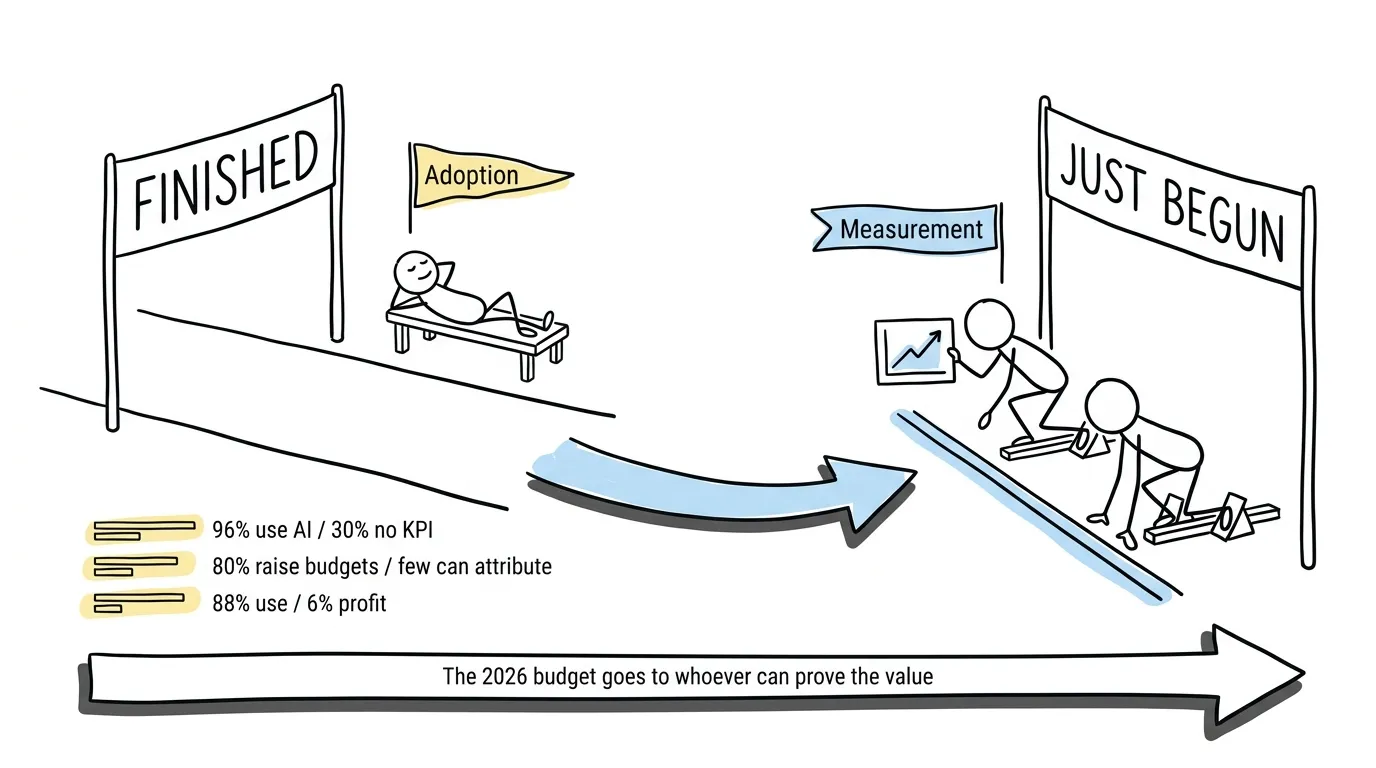
The second signal is that AEO's identity has changed. HubSpot updating five practical pieces in one day — tool roundups, platform comparisons, a 30-day starter process all present — signals a category moving from concept discussion to day-job routine. A tools market maturing usually means two things: the early-adopter window is narrowing, and Late movers will pay more to play catch-up. In the 2026 budget, AI visibility deserves its own line item.
The third signal is easy to miss: the inputs to AI visibility are widening. SE Ranking's data shows social content flooding into AI answers, and Carrier Localism turns logistics data into a shopping agent's recommendation basis. AI optimization stopped being a copy-editing exercise long ago — it's the sum of content, fulfillment, and data governance, and the bigger the market it touches, the more departments it drags in.
The risk side is equally clear-eyed. Search engines are tightening penalties on mass-produced AI content, privacy laws now cover 172 countries, and closed-loop feedback is quietly pushing content toward short-termism. Everyone who's entering has now shown up; few have made it work. What's missing is measurement, governance — and a little restraint for the long-term brand.
Continue reading
Related articles
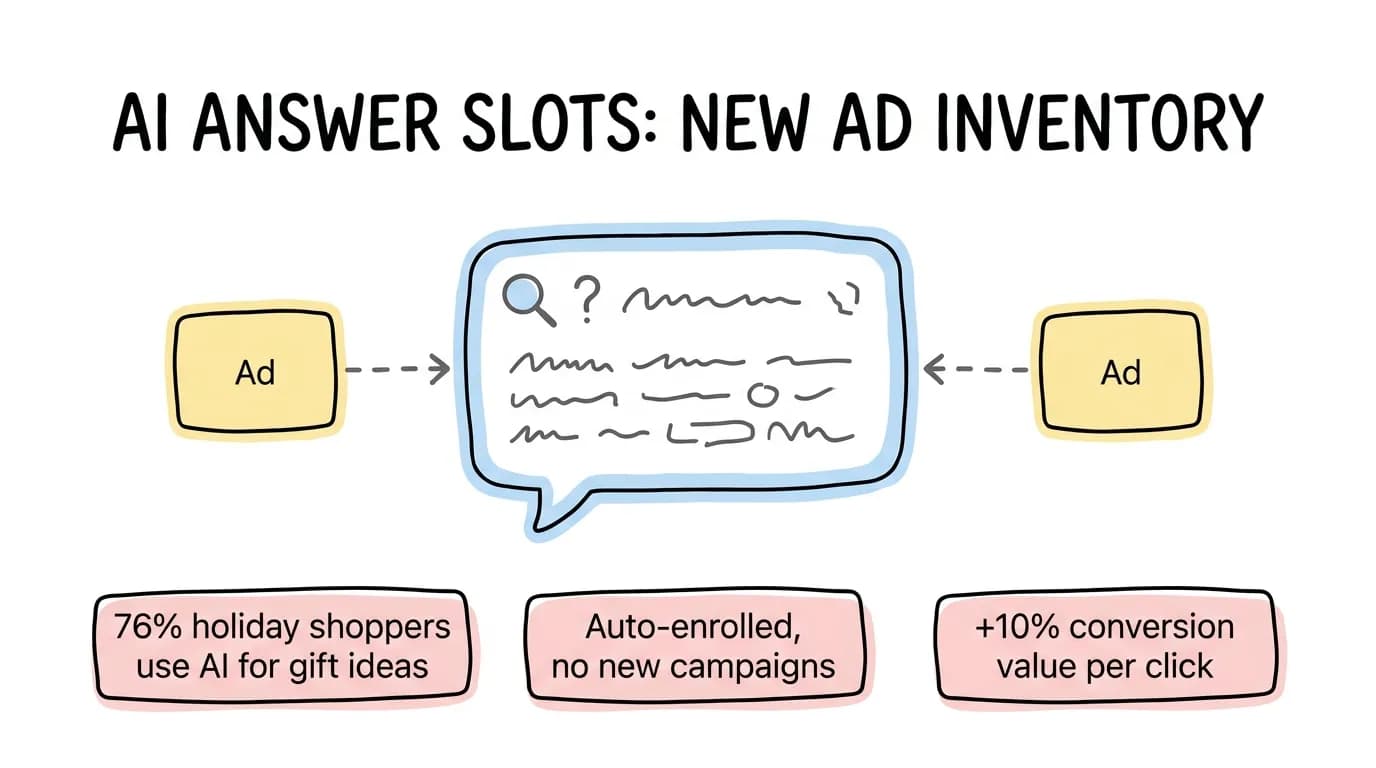
AI Marketing Daily · 2026-11-22
AI Marketing Daily for 2026-11-22 rounds up 20 items led by Microsoft opening Bing AI Overviews to ads and Google expanding AI Mode ads to ten countries, plus GEO guides, ad automation delegation guidance, AI Overviews CTR data, and a legal-risk checklist for AI-generated creative.
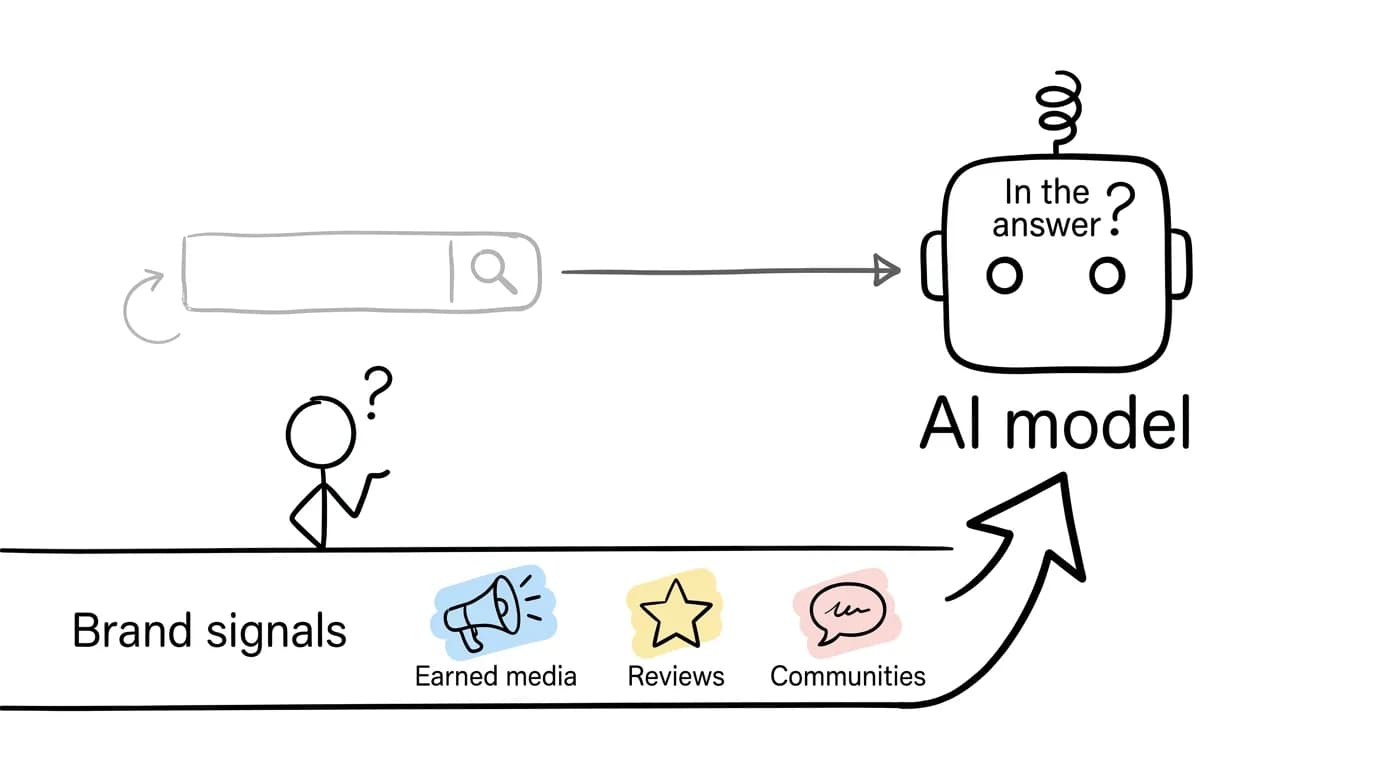
AI Marketing Daily · 2026-11-21
A November 21, 2026 AI-marketing daily covering AI search visibility, GEO methods, Google AI Mode ads expanding to ten countries, Meta's pre-Black Friday changes, agentic shopping, and industry adoption and ROI data.
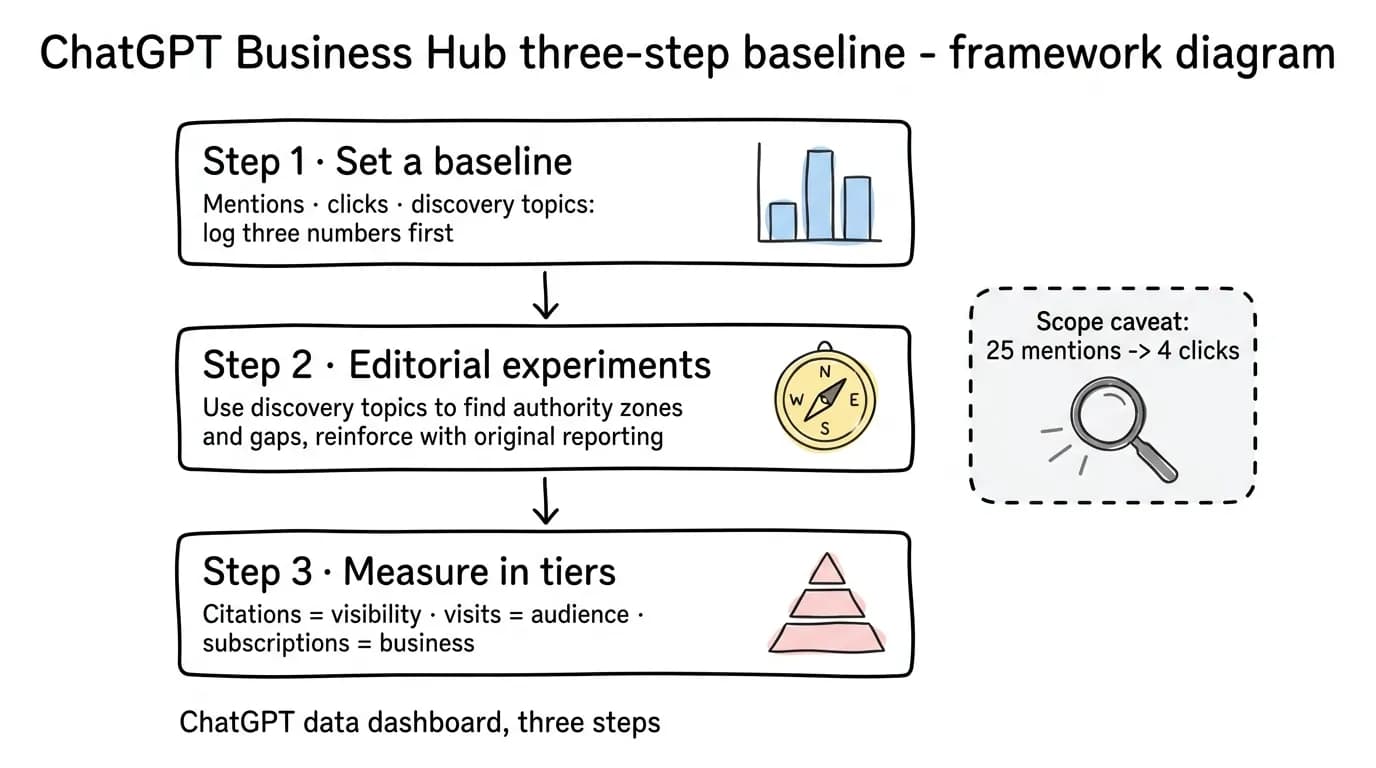
AI Marketing Daily · 2026-11-20
AI Marketing Daily for 2026-11-20 rounds up 19 items centered on measurement: OpenAI's ChatGPT Business Hub dashboard, EU rules for agent-mediated purchasing, Meta pausing four AI terms, and B2B data on shortlists and the dark funnel, each with action advice.