
The Most Overlooked Risk of Marketing with AI Hides in the Tool You Reach for Most
AI-generated marketing content risks brand homogenization because language models naturally aim for statistical averages, which conflicts with the need for unique brand differentiation. Maintaining human oversight is crucial to ensure content remains distinct and avoids the pitfalls of machine-like writing.
A couple of days ago, a friend who works in consumer products came to me to vent. At his company, nearly everything — WeChat official account (brands' publishing channels on WeChat) articles, social media copy, ad creative — now starts as an AI first draft; a quick edit, and it ships. And the efficiency gain is real: what used to take a month to publish now gets done in a week.
But then he said something that stopped me cold.
He said: "Have you noticed that what we publish looks more and more like what the brand next door publishes?"
I asked him to send me posts from both brands, with the names covered. Honestly, I couldn't tell them apart.
The Risks You Can List Aren't the Most Overlooked One
What does "an overlooked risk" mean?
It's the thing you handle every single day, no second thought, never once imagining it could go wrong.
When it comes to marketing with AI, people can rattle off a long risk list: data privacy, content errors, algorithmic bias, ROI that's hard to measure, too many tools to learn. All real risks. But they share one trait: you can see them.
Afraid of hallucinations? Assign someone to proofread. Afraid of a data leak? Put compliance processes in place. Every fear you can see gets handled.
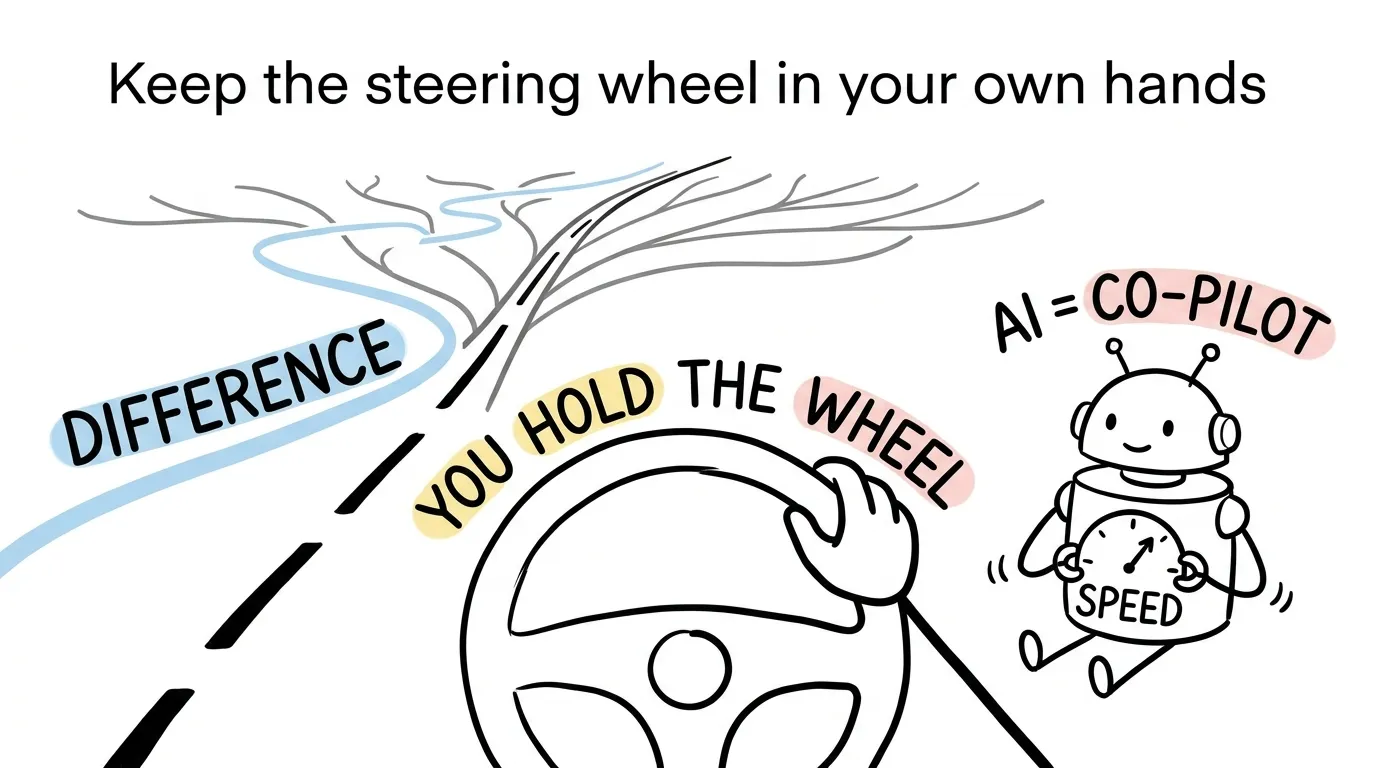
The real trouble is the invisible one: handing over the entire steering wheel and still feeling steady.
AI's Mathematical Instinct Runs Opposite to Marketing's
Here's the thing about how AI actually writes.
At the bottom of it, a language model predicts "the statistically most likely next word." Put plainly, it was born to find the average.
Think about what that means.
Marketing wants the opposite: difference. In a pile of near-identical messages, it wants consumers to recognize you at a glance.
A tool born to chase "the average," put to work on a job you can only win by being "unique."
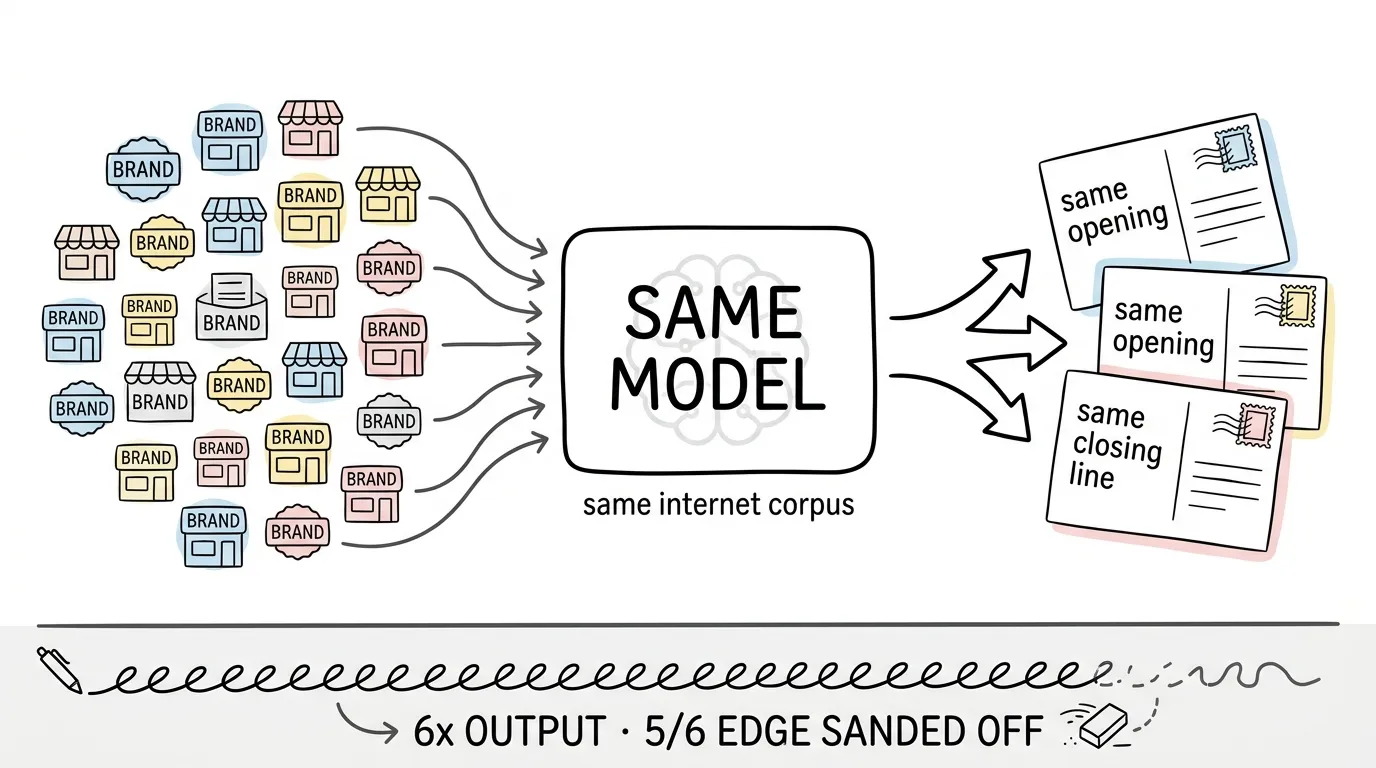
A hundred companies, using the same models, fed on the same slice of the internet's corpus, will naturally produce the same-looking output. How to open, how to land the quotable closing line — everything takes the highest-probability path. Run the numbers and you'll see: a post used to take half a day; now three versions come out in ten minutes. Output up sixfold — and five-sixths of the edge sanded off.
Short term, productivity takes off. Long term, the brand flattens. Consumers can't tell you from your competitors not because you've become alike, but because your tools are alike.
Everyone drawing with the same pen can't produce two different pictures.
Search Engines Have Already Started Doing This Math
Some say: fine if content is flat — volume itself brings traffic.
A few years ago, people could still walk that road. Now you'd better think twice.
From 2023 to 2025, through several rounds of major Google algorithm updates, the crackdown on mass-produced, homogenized content got heavier each time. Articles with no first-hand experience, no new insight, just reshuffled versions of what's already online — those are the prime targets.
And the result? The first few months of surging output feel great. Then some update lands, and organic traffic falls off a cliff. You thought you were laying down assets; you were actually laying down risk.
There's another layer. Now when consumers ask a question, search engines hand them the answer directly, and tools like ChatGPT and Perplexity have started answering buyers' questions directly too. If your content can't be extracted by machines, can't be cited, you won't rank low — you simply won't appear at all.
Friends in B2B, pay extra attention. Procurement cycles run long; by the time you discover a customer walked around you, months have passed. What you lose isn't one impression — it's a lead that never made a sound from start to finish.
Readers Are Getting Faster at Smelling the Machine
Now for something that cuts closer to the bone.
Readers' ability to recognize machine-written content is growing faster than AI's ability to write it. Repeated sentence patterns, a once-removed tone, opinions anyone could have written — one glance, and they scroll away.
And once a user discovers that your newsletter, your customer-service replies, your "value-packed articles" are all mass-produced, the value they place on your brand gets an instant discount.
Take an example. You message a brand's customer service at midnight; a reply comes in three seconds, perfectly polite, says all the right things, gives nothing away. But it can't handle the second question — answers beside the point, and then the sign-off: "Is there anything else I can help you with?" That's the moment you understand: there's no one on the other end.
The reader doesn't hate technology. It's just that you can't build a bond with a script.
The Most Insidious One Is the Closed Loop
If the earlier ones strike you as tolerable, this one deserves its own section.
Some teams have AI write the ad creative, then have AI analyze the click-through rates. It generates; it also grades.
What happens then?
It will route itself down the laziest path: the more sensational the headline the better; any copy that tricks one more click counts as skill. Short-term metrics look pretty, the click curve climbs, and everything seems fine.
The cost sits farther out. Customer lifetime value, brand reputation — the assets that never look good in a report — are being quietly traded away.
An exam where the same party sets the questions and marks the papers will never surface the truth.
So Don't Hand Over the Whole Wheel
Back to the friend from the beginning. Later I asked him: so what are you doing now?
He said they changed the process. AI is still in use — first drafts, images, ad combinations, efficiency untouched. But before anything goes out, it must pass through one pair of human hands: someone who truly knows the product and the customers, whose single job is to edit the piece until it says "the thing only we can say."
You might ask: so do we still use AI?
Of course we do. Calculate what needs calculating, filter what needs filtering, scale what needs scaling. Take the time you save and spend it on what only you can do: meet customers, sit in stores, listen to customer-service call recordings, and turn first-hand feeling into the "I was there" in your content.
Efficiency goes to AI; difference stays with people.
The essence of marketing is differentiation; the essence of AI is averaging. This contradiction can't be solved by "use less AI" — and if no one is watching the final output, it will blow up, guaranteed.
My advice is one sentence: Treat AI as your co-pilot — keep the steering wheel in your own hands.
The handier the tool, the more you need to remember: your hand has to stay on the wheel.
Wishing you speed and steadiness with AI. And may you never, ever look like anyone else.
Continue reading
Related articles

It's 2026: Stop "Buying" AI Tools for Your Marketing Team — Start "Hiring" AI Agents
This learn article explains how AI agents differ from standalone AI tools in marketing, outlines three agent categories — build-your-own platforms, CRM-native agents, and vertical tools — and covers use cases across SEO, social media, advertising, and reporting, plus criteria for choosing one.

What Is GEO? How Your Brand Gets "Mentioned" in the Age of AI Search
An explainer on GEO (Generative Engine Optimization) for e-commerce and DTC brands: how it differs from SEO and AEO, why AI answers shape brand visibility, and eight practices covering question-focused content, consistent brand messaging, structured pages, external evidence, comparisons, and AI mention tracking.

AI Is Already Making Decisions for Your Customers. Are You on the List?
A learn article explains GEO (Generative Engine Optimization): why AI-generated answers now shape which brands customers see, and how SEO fundamentals, entity clarity, citable evidence, and monthly measurement affect visibility in AI answers.