
AI Marketing Is No Longer a Shiny Toy — It's the Utility Bill
A learn article reviewing the state of AI marketing in 2025, covering market size, adoption gaps, text and video generation tools, platform-native AI, zero-click search, and skills and governance challenges.
A while back, an old friend of mine who runs an e-commerce business invited me to dinner.
The moment we sat down, before even asking how I'd been, he sighed: "This year, half my marketing budget went into feeding AI."
Was it worth it? I asked.
His chopsticks paused mid-air. "That's a long story," he said.
Later, I came across an industry research report published in late 2025 that took a full inventory of AI in marketing. My first thought after reading it: I owe this friend another dinner, so we could finally go through the numbers, line by line.
Today, on his behalf — and yours — let's do the math.
First, How Big Is the Pie
What exactly is AI marketing?
Put simply: machines take over the repetitive work of marketing — writing copy, cutting videos, predicting what you'll like, figuring out which customer is about to churn tomorrow.
How big is this business?
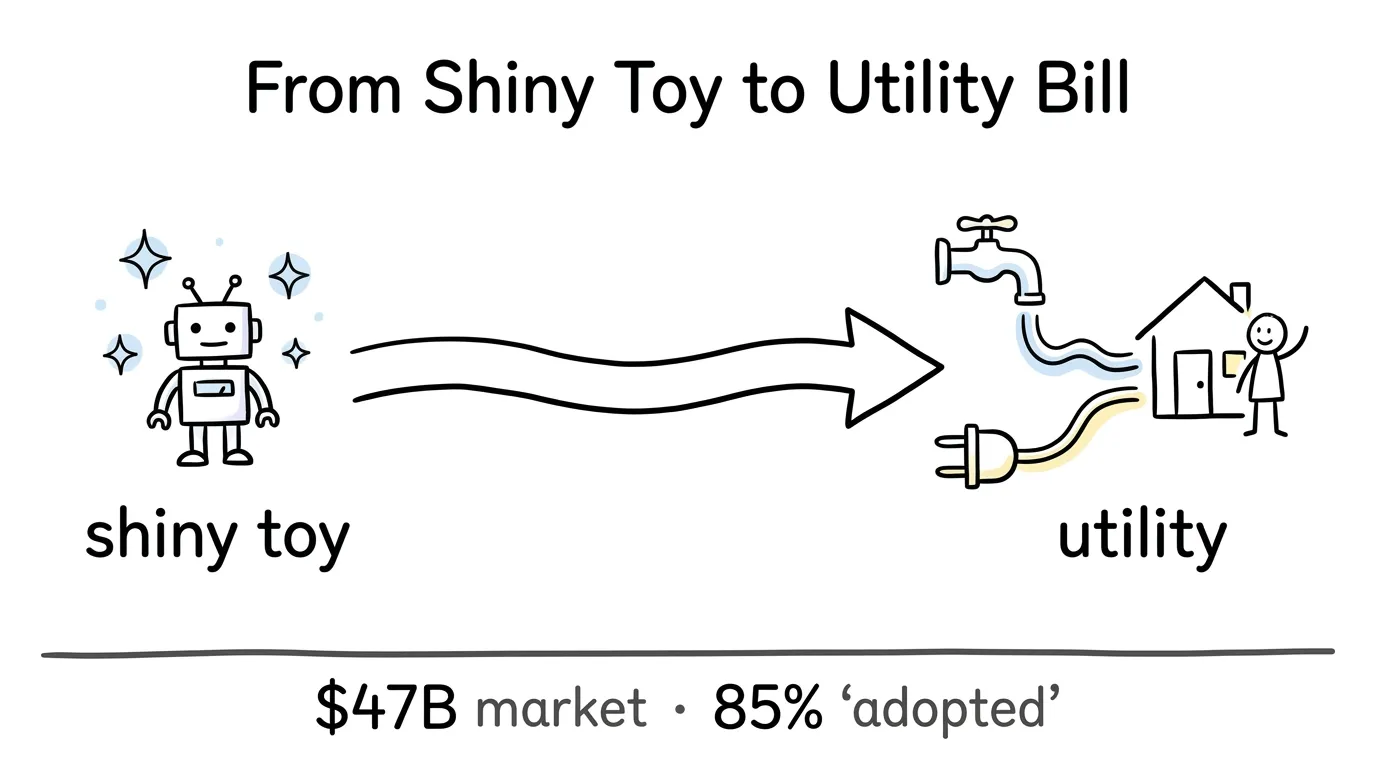
In 2025, the global AI marketing market stood at roughly $47 billion. Forecasts at the time projected a 36.6% compound annual growth rate through 2028.
Forty-seven billion dollars — over 300 billion RMB. A tool category barely a few years old has grown into a giant.
Adoption runs even hotter. Surveys show that more than 85% of businesses are already using AI in their marketing.
Eighty-five percent. Eight and a half companies out of every ten.
But hold on. That 85% is heavily inflated.
85% Bought the Gym Membership. Almost Nobody Actually Works Out.
Think about a gym.
Plenty of people sign up over the course of a year. How many actually end up with abs?
AI marketing is the same. 85% of companies have "adopted" it, but most are still in the shallow end: they have AI write a couple of tweets, generate a few images, then turn around and declare they've "embraced AI."
Companies that have truly woven AI into the entire marketing pipeline — data as the foundation, models as the bridge, orchestrated workflows, governance as the safety net, each piece interlocking — are vanishingly rare. Most are still fumbling for the doorknob.
So of that $47 billion, how much bought real results, and how much bought peace of mind? Park that question; we'll settle it at the end.
First, let's see where everyone's money is going.
The Money Mostly Goes to Three Things
The first: writing.
Text generation platforms like Jasper and Copy.ai are mature businesses now. By the vendors' own numbers: used well, they cut content production time by 20–40% and can double output.
The second: video. This was the biggest wildcard of 2025.
OpenAI's Sora can generate cinematic-quality footage from a text prompt. Runway Gen-4 leads on fine-grained control. Synthesia specializes in corporate video — its AI avatars deliver a script in dozens of languages in one take, with a 62% enterprise adoption rate, the highest in its category. HeyGen handles talking-head videos, while Pictory and Lumen5 cut long-form content into short clips.
A decent brand video used to mean hiring a crew, renting a studio, and sitting through post-production. Now it's one person, one evening. The cost structure of video production has been flipped upside down.
The third: the "native AI" of the big platforms.
Salesforce launched Agentforce, letting AI agents handle customer conversations, deal follow-ups, and service on their own. HubSpot spread AI across the entire chain — content, email, lead scoring. Adobe tucked Firefly into both its Creative Cloud and Experience Cloud; a designer clicks once, gets a whole row of variants.
See the pattern?
AI is no longer a bolt-on plugin. It's becoming the bedrock of the platforms themselves. Like water and electricity — you never notice it's there, but it's everywhere.
Four Things Happening Right Now
The report lays out four trends worth pausing over.
First: personalization has been pushed to its extreme — "a segment of one" (marketing tuned to a single individual, not a demographic).
71% of consumers now expect personalization, and 76% get frustrated when they don't get it.
How far can AI take this now? It can read your mood in the moment from your behavioral trail, time its approach for when you're easiest to sway, and even adjust its tone to match.
Second: search is going "zero-click."
Google's AI Overviews now sit on top of most search results. For 60% of searches, users read the summary and leave — without a single click.
What does that mean? The search rankings you fought so hard for may just be feeding users to the AI summary. The battle ahead isn't for the first screen of results — it's for the one sentence inside the AI's answer.
Third: short-form video keeps eating everything.
TikTok, Instagram Reels, YouTube Shorts — short video holds attention 2.5 times better than long-form content. Where attention goes, budgets follow.
Fourth: social traffic is turning straight into money.
Global social commerce hit $1.3 trillion, up 52% year over year. People watch, people buy — mid-scroll. The wall between browsing and buying has been torn down.
One counterintuitive number, by the way: blended content — user-generated material mixed with AI-tool-made assets — converts at 4.5 times the rate of pure brand content. Machines handle the volume, real people provide the authenticity. Two legs beat one.
Industry Progress Bars Are Miles Apart
AI marketing doesn't rain on every industry equally.
Retail and e-commerce run fastest — 92% of businesses there use AI. The logic is simple: closest to the money, richest in data, and results you can count on the spot.
B2B software: 78%. Finance: 65%, dancing in regulatory shackles. Healthcare: 52%, still warming up with long procurement cycles and high compliance hurdles.
A pattern emerges: the more data you have and the closer you stand to the transaction, the more money AI can make you.
Now, a Bucket of Cold Water
At this point, you might expect me to shout "get on board before it's too late."
Quite the opposite.
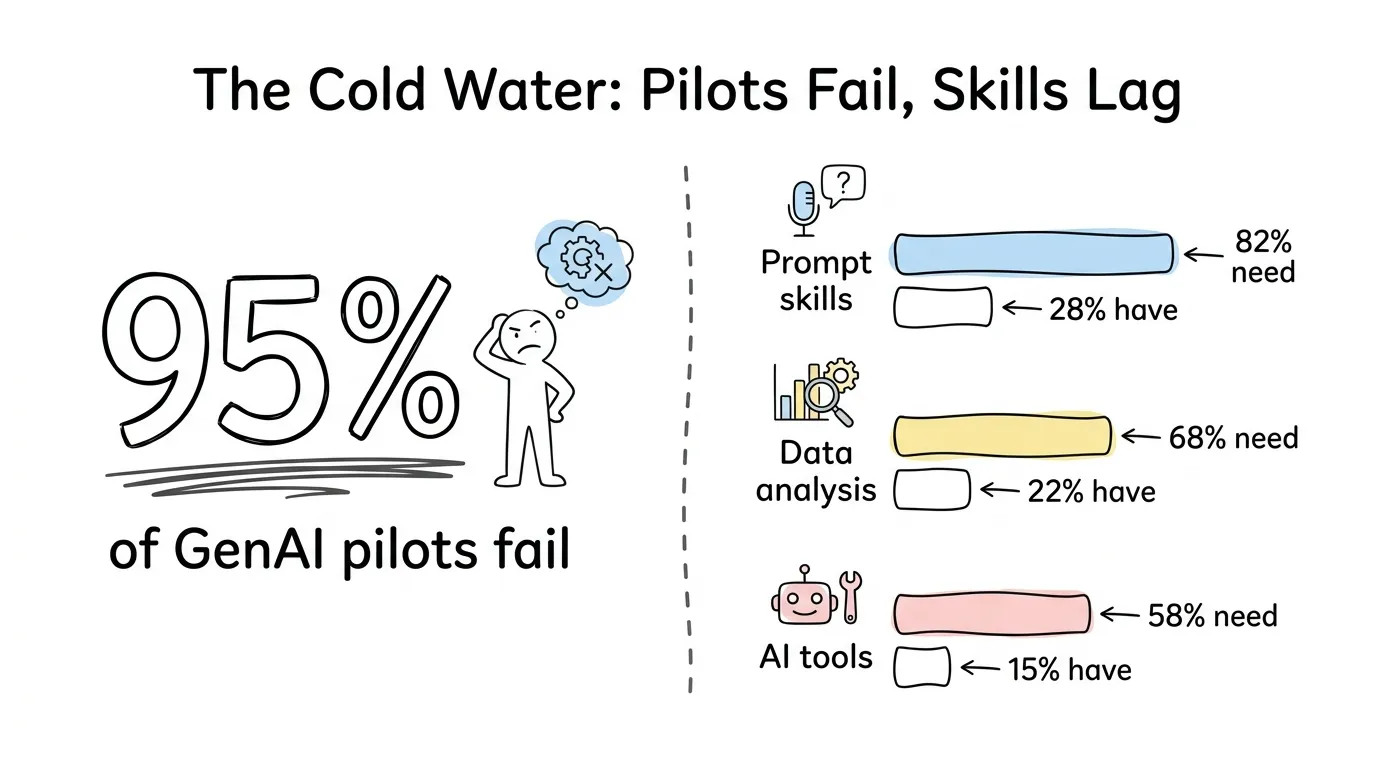
MIT ran a study with a chilling conclusion: roughly 95% of corporate generative AI pilots fail to produce measurable business value.
Ninety-five percent. The stores are packed with people buying hoes; fewer than one in twenty actually grows a decent crop.
Now we can answer that earlier question: spending money is not the same as getting results. Where does it go wrong? Not the models — the organization: leadership never truly bought in, the data foundation is rotten, nobody decided what to measure before launch, and employees still don't know how to use the tools.
The skills-gap ledger sent a chill down my spine.
Prompt engineering: required by 82% of roles, possessed by 28% of people. Data analysis: 68% versus 22%. AI tool proficiency: 58% versus 15%. 75.8% of marketers admit that AI skills are their biggest weakness; only 5% actually use AI to its full extent.
Flip that gap around and it's an opportunity. Anyone who starts catching up now is already ahead of everyone still watching from the sidelines.
The impact on jobs is real too. In the first seven months of 2025, more than 10,000 US jobs disappeared to AI automation, with entry-level roles hit first. New hires used to break in by doing the grunt work; the grunt work is gone. The bottom rungs of the ladder have been sawed off.
Regulation has arrived as well. The EU's AI Act tiers applications by risk: the more an application can sway major consumer decisions — finance, hiring — the tighter the reins.
And one more, the sting sharpest of all: 38% of marketers believe AI-written content simply isn't as good as human-written. Especially where a human touch matters — brand storytelling, crisis communication — the machine's mediocrity is spotted at a glance.
So What About 2026?
The report forecasts that the autonomous AI agent market will reach about $8.5 billion in 2026 and surge to $35 billion by 2030, a compound annual growth rate of roughly 55%. An age when agents are everywhere, doing the work, is on its way.
The report offers six recommendations. Here they are, translated into plain English:
- When picking a platform, look first at orchestration. AI agents will keep multiplying; the platform worth buying is the one that can coordinate a swarm of agents on complex work — without losing control.
- Set up governance early. Don't wait for the regulator to knock before doing your homework.
- Build your people's core skills. The skills gap is a risk — and a chance to buy low.
- Get the accounting straight. How much revenue is AI actually contributing? If you can't measure it, you're just funding your own faith.
- Don't take the human-machine ratio to extremes. Give machines the efficiency; keep judgment and taste for people.
- Double down on your first-party data. Third-party cookies are dead; the data users willingly hand you is the real fuel for AI personalization.
All six boil down to one sentence: treat AI as a colleague you train, not a deity you worship.
Back to That Dinner
Later, I told my friend: your problem isn't that you bought AI. It's that after buying it, your organization never changed.
Everyone has the tools. The gap lives in how you use them.
In 2025, AI kicked marketing's door open. In 2026, the contest is over who runs steadiest once inside.
May you run steady once you're in — and run far.
Continue reading
Related articles

When AI Does the Creative, Mistakes Come in Batches Too
A learn article on the risks of using generative AI for marketing creative across brand, legal, compliance, and operational layers, with case examples and seven practices for review, rights clearance, documentation, and vendor governance.
Which AI Should Your Startup Actually Use for Marketing?
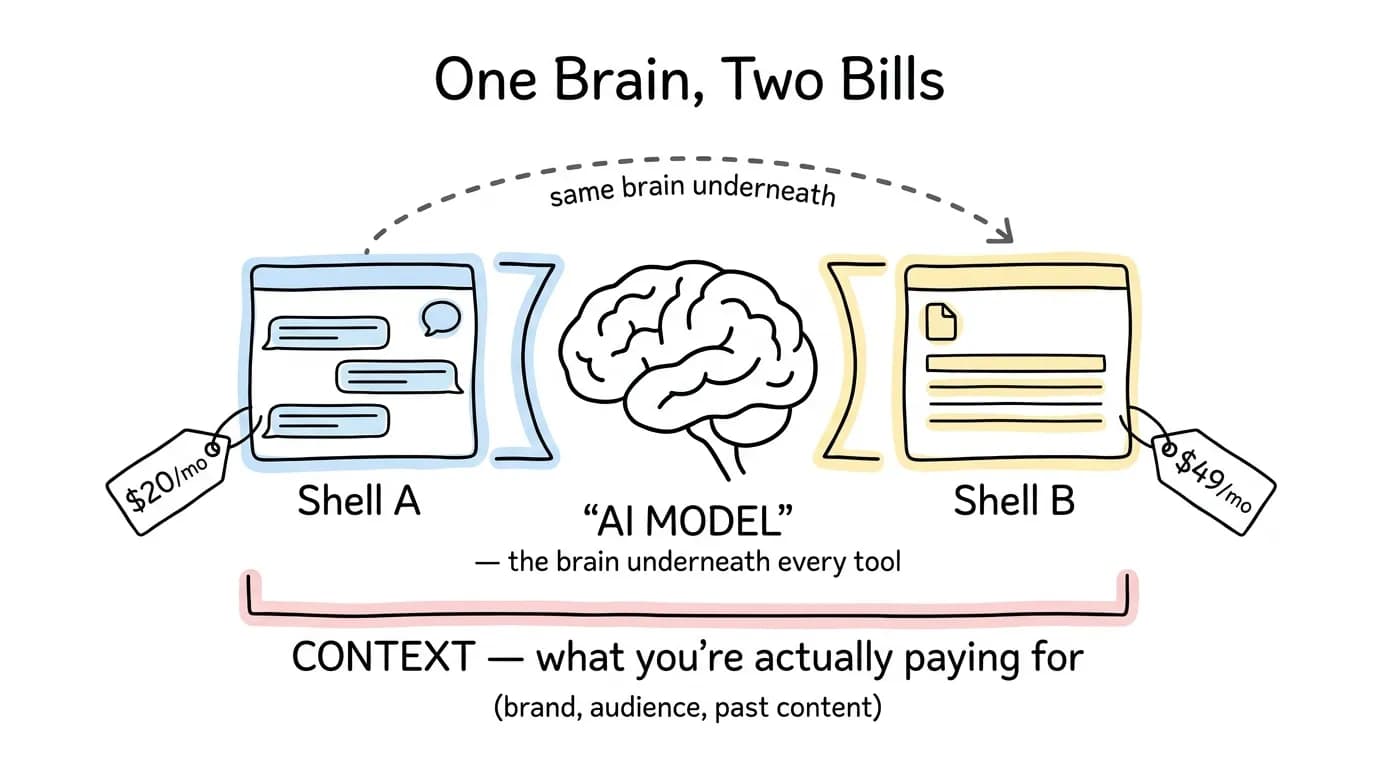
A startup marketing guide explaining the difference between AI models and tools, sorting tools by job (writing, research, design, leads, email, video ads), and outlining a 30-day test plan for choosing them. It also covers generative engine optimization and budget trade-offs.
31 AI Marketing Tools, Reviewed One by One: How Exactly Should You Spend the Money?
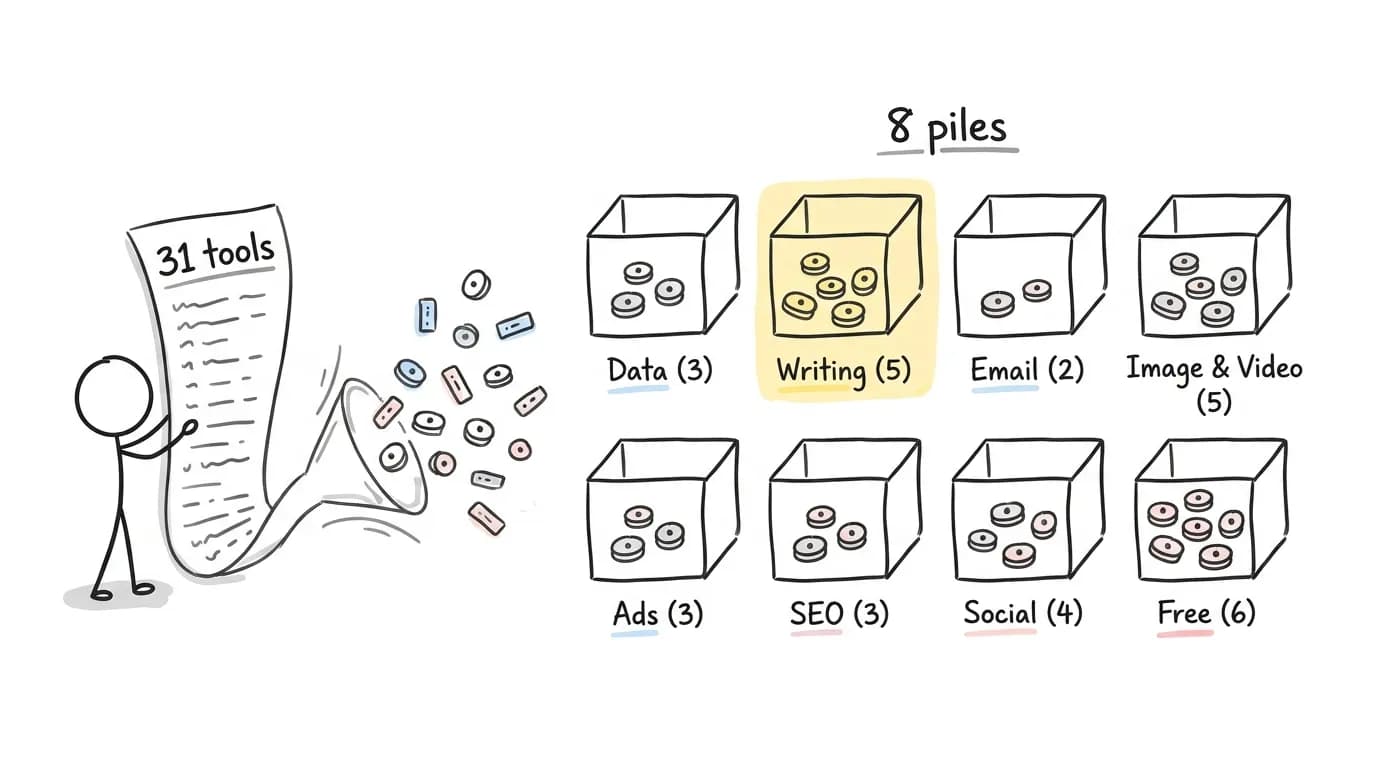
A review of 31 AI marketing tools grouped into eight categories, covering data, content, email, video, ads, SEO, social, and free options, with guidance on choosing one strong tool for your most frequent task and testing free tiers first.