
Whose Data Is It, Anyway?
An explainer on data privacy laws for cross-border marketing teams: how regimes like GDPR, CCPA, and PIPL apply based on where users are, what California's 2026 rules change, and four common pitfalls around consent records, deletion, vendor management, and pseudonymization.
Over tea the other day, a friend who runs a cross-border e-commerce business asked me: "My company is in Hangzhou, but I sell to customers in California. Do California's privacy laws apply to me?"
They do.
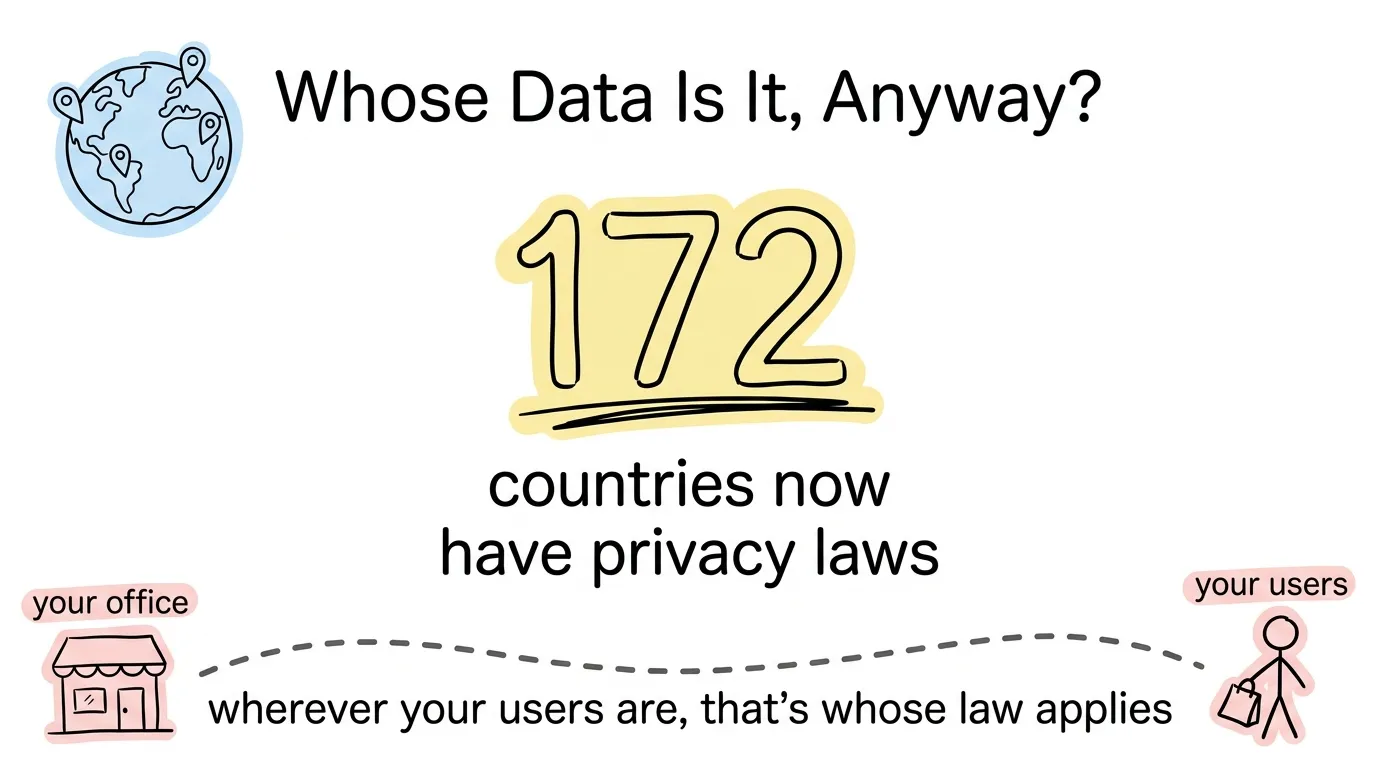
He froze for a second. Here's what I told him: you may not have realized it, but 172 countries around the world now have privacy laws on the books. That's the count as of March 2025, and it will only keep climbing. Wherever your users are, that's whose law applies. It has nothing to do with where your office sits.
Most people find this out the hard way — when a lawyer's letter lands on their desk. Let's get it straight now, before that happens.
What Is a Data Privacy Law?
Strip away the legalese and it comes down to one sentence: your users' data belongs to your users.
If you collect it, you need their consent. If you store it, you need a retention limit. If you use it, only for the purpose you originally stated. If they want to see it, you show it. If they want it deleted, you delete it.
Sounds like common sense, right? Now go open up your own company's systems: how many tools is user data scattered across? Did every single one of them get consent? When a user asks you to delete, can you actually delete — cleanly?
That's the territory privacy law governs.
What data does it cover, specifically? It varies by law. Name, email, home address are the basics. Go further down the list and you'll find race, browsing history, geolocation, fingerprints — even DNA. How far the protection extends, how long you can keep the data, what you're allowed to do with it: each law makes its own call.
How Brutal Are the Fines?
Let's do the math.
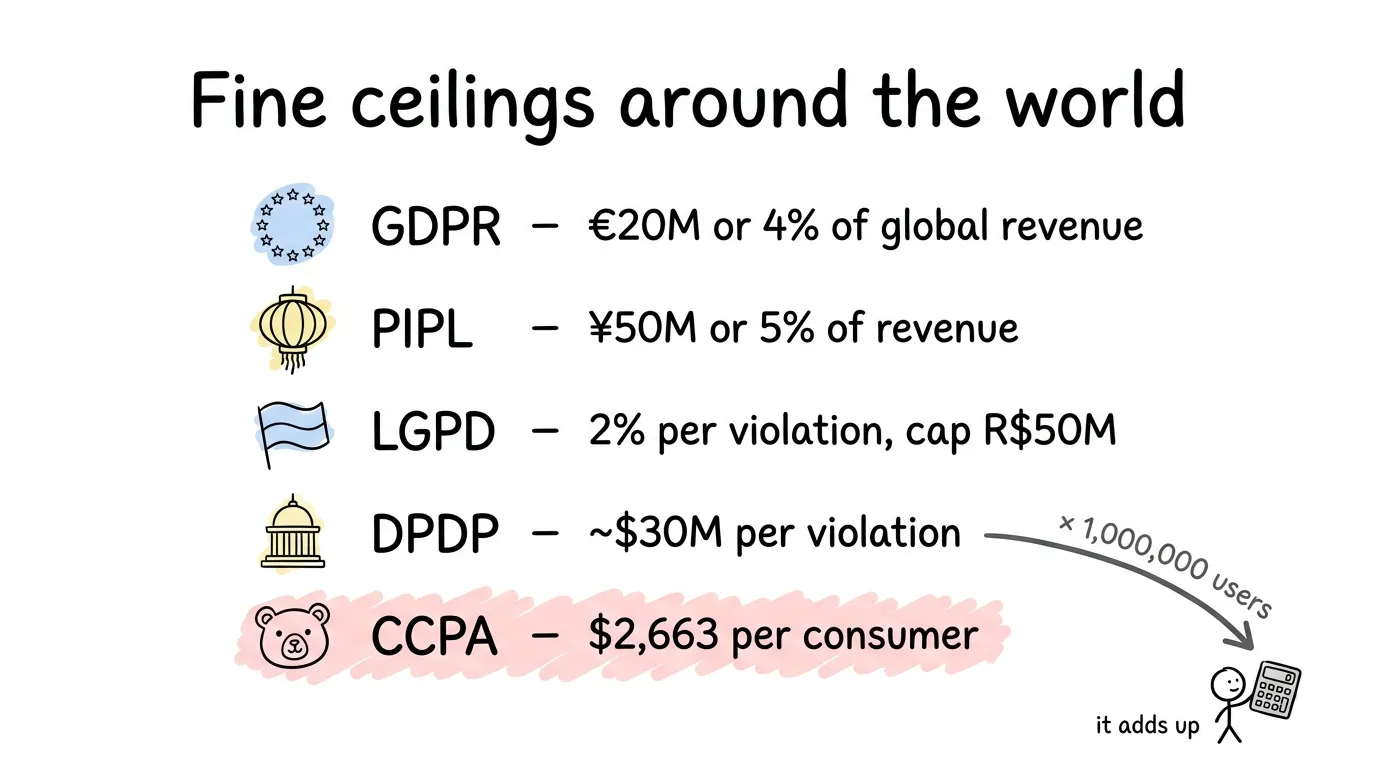
The EU's GDPR took effect in May 2018, with a ceiling of €20 million or 4% of global annual revenue — whichever is higher. China's PIPL caps out at ¥50 million, or 5% of annual revenue.
Four percent, five percent — what does that mean in practice? If you do 10 billion a year, your fine ceiling is 400 million.
Brazil's LGPD fines per violation: up to 2% of revenue, capped at R$50 million each time. India's DPDP Act tops out at about 25 billion rupees per violation — roughly $30 million. Canada's PIPEDA is the gentlest of the bunch: up to C$100,000 per knowing violation, but it covers private businesses across all of Canada.
And then there's the sneakiest one: California. CCPA fines are counted per consumer — $2,663 per violation, or $7,988 if it's intentional or involves users under 16. Note the phrasing: per consumer. If a million users fall into the same trap, grab a calculator and run the numbers yourself.
The fines are only the visible bill, by the way. Regulators can issue injunctions that bar you from processing personal data outright. They can force audits. Users can sue. Reputational damage, customer churn — there's no line item for those.
GDPR Is the Strictest — Strict How?
Take the strictest of the lot as an example. GDPR lays down a pile of rules for how you may handle data.
Processing must be lawful, fair, and transparent. State your purpose at the moment of collection, and don't collect what you won't use. Keep stored data accurate, and delete it when you're done with it. Put security measures in place, and nail down who inside the company can touch the data and who certifies compliance.
Sounds like a lot of red tape. But nearly every privacy law passed since, around the world, has cribbed from this playbook.
The US Is the Most Interesting Case: No Federal Law
A lot of people assume the US has one big federal law covering the whole country. It doesn't.
At the federal level, there are only specialists: health data answers to HIPAA, financial data to GLBA. Ordinary consumer privacy? The feds stay out of it — the states handle that themselves.
As of July 2026, 24 states have comprehensive privacy laws, 20 of which are already in effect. The four newest — Alabama, Louisiana, Oklahoma, and Vermont — take effect between 2027 and 2028.
How do state laws apply to you? Not by where your company is incorporated, but by how many of their residents you're dealing with. Most states draw the line at: process the personal data of 100,000 or more state residents, and you're in. If you make money selling data, 25,000 is enough.
So we're back to the line we started with: wherever your users are, that's whose law applies.
Among the states, California is the heavyweight. CCPA (plus the later CPRA amendments) is the only state law that also covers employee data and B2B data, and the only one with a dedicated regulator. Most other states follow the Virginia template: rights to access, correct, delete, and opt out of data sales and targeted ads are all there — but the GDPR-style "lawful basis" and Data Protection Officer (DPO) requirements never made it in.
California in 2026: The Rules of the Game Have Changed
Here's the part that really matters.
On January 1, 2026, California rolled out a whole package of new rules. My one-line reaction after reading them: they mean business now.
A lot of compliance work used to be writing policy statements. Not anymore — the new rules turn every requirement into an action.
Want to sell or share personal data? Run a risk assessment first.
A user opts out of the sale of their data? You have to give them a confirmation credential proving you've honored it. And note: an opt-out sent via the browser's built-in Global Privacy Control (GPC) signal counts too.
A user asks to access their data? You no longer get to stop at the most recent 12 months — everything collected since January 1, 2022 has to be on file.
A user asks you to correct their data? Making the fix isn't the end. If a source system pushes the old value back in, your correction has to survive it — it can't be overwritten.
Two more waves are coming: the automated decision-making provisions — advance notice, plus a user right to review and opt out — take effect in January 2027; and starting April 2028, cybersecurity audits roll out in tiers by revenue.
One detail that's easy to trip over: these thresholds float with inflation and reset every two years. The old revenue threshold everyone quotes is $25 million; as of 2025 it's already $26,625,000. Don't copy old numbers — check the latest figures the regulator has published.
For Marketing Teams, It Boils Down to Three Things
However many laws there are, what lands on marketing and data teams is three things.
First, consent isn't something you log once. A user consents today and changes their mind next month — your email system, your ad system, your analytics system all need to know. Consent status has to travel with the person, not stay frozen at the moment of collection.
Second, deletion has to actually delete. When a user exercises their right to deletion, every copy has to go. If their data is scattered across twenty tools, that's a whole-house deep clean — and it's easy to miss a corner or two.
Third — and this is the fix: pull your first-party data into one place. With a unified customer view, consent management, deletion execution, and audit trails become workable. Platforms on the market today — Salesforce Data Cloud, Adobe Real-Time CDP, Treasure AI — natively support consent enforcement and deletion propagation.
By the way, the regulators' reach has already extended into AI. Colorado signed SB 26-189 in May 2026, targeting the use of automated systems to make consequential decisions about consumers, effective January 2027. If you use AI to decide who gets a loan or what price someone pays, AI governance belongs in your compliance program, managed alongside consent management.
The Four Most Common Pitfalls
Most compliance failures don't come from not knowing the law. They come from a handful of assumptions people never thought to question. Here are four — all of them time bombs that only go off when an audit, a deletion request, or a regulator's questionnaire shows up.
Pitfall one: treating the strictest law as a superset.
A lot of teams figure that building one GDPR compliance program lets them travel everywhere on a single visa. No. CCPA gives users the right to opt out of sale and sharing — GDPR has no direct equivalent. CCPA covers employee and B2B data — GDPR doesn't. CCPA requires you to honor GPC signals — GDPR has no such requirement. Flip it around: PIPL requires cross-border transfers that cross the threshold to clear a government security assessment first, whereas GDPR's Standard Contractual Clauses (SCCs) are self-executing between the signing parties — no pre-approval step.
The right move: based on where your users are, enumerate your obligations jurisdiction by jurisdiction, and build to the union of them.
Pitfall two: logging consent, but not the evidence.
A checkbox flips a boolean to true in some marketing tool. When a user comes after you, what do you produce to prove what they consented to?
GDPR Article 7 puts the burden of proof squarely on you: the purpose they consented to, the timestamp, the channel, and which version of the notice they were shown at the time — all of it has to survive on your side.
The right move: store every consent as an immutable event record, with scope and version attached. Don't keep an editable field on the user profile.
Pitfall three: leaving vendors and ad platforms out of the picture.
Responsibility doesn't travel with the data. The data leaves your hands; the liability stays on you. Under GDPR, you answer for every processor you use. Under CCPA, if you pass an audience list to an ad platform for cross-context behavioral advertising, that constitutes a "share" — and users have the right to opt out. No matter how well the platform's terms shield the platform, they don't shield you.
The right move: keep a vendor inventory — who receives the data, under what contract, for which permitted purposes — logged item by item.
Pitfall four: mistaking pseudonymization for anonymization.
Hash the email address and figure you're out of scope? You're not. GDPR Article 4 defines pseudonymization precisely: if additional information could still re-link the data to a specific person, it's still personal data. Those hashed identifiers you send to ad platforms during data integrations are almost exactly in that state — unless your hashing scheme genuinely rules out re-identification on both ends.
The right move: classify every identifier. Can it be re-linked to an individual? If no, it's anonymized. If yes, treat it as personal data — and collect as little of it as you can get away with.
One Last Word
Back to my friend. He went and looked up how many users he has in California — then quietly bumped up his compliance budget.
With privacy, doing it early is a cost. Doing it late is damages.
Here's wishing that your users' data is only ever used where they consented.
Continue reading
Related articles

What Is an AI Marketing Agent? From "Using AI" to "Delegating to AI"
A learn article explaining what an AI marketing agent is, how it differs from rule-based automation, and which repetitive tasks such as lead qualification, reporting, and campaign monitoring can be delegated while humans keep key decisions.

Marketing Automation Is Shifting from "You Do It" to "You Say It"
This article explains how marketing automation is shifting from rule-based platforms that merely execute toward AI agents that plan, create, publish, and review campaigns, covering delegable tasks, underlying technologies, tool categories, adoption steps, and risks such as privacy and automating without strategy.

When AI Does the Creative, Mistakes Come in Batches Too
A learn article on the risks of using generative AI for marketing creative across brand, legal, compliance, and operational layers, with case examples and seven practices for review, rights clearance, documentation, and vendor governance.