
What Does Your Brand Look Like Inside AI's Answers? Profound and Bluefish AI Measure It in Completely Different Ways
A learn article introducing AEO and comparing how Profound and Bluefish AI measure brand visibility in AI answers, covering engine coverage, prompt management, citation tracing, data collection methods, attribution, security, and onboarding, plus a six-question demo checklist.
A few days ago, a friend who runs a consumer brand invited me to dinner. Before he'd even sat down, the questions came flying: We used to fight for search rankings; now customers just ask AI. So where do we actually rank inside ChatGPT's answers? Are we mentioned at all? Which page does it cite?
I asked him: do you know what the answers to those questions are worth?
He paused.
I said, let's talk about this today. There's a name for it: AEO. What is AEO? Answer Engine Optimization — the practice of studying how your brand shows up in AI-generated answers: how completely it appears, how accurately it's described. And Profound and Bluefish AI are the two players in this space whose approaches differ the most. Perfect timing — let me break them down for you.
First, Let's Fix a Misconception: A Visibility Score Is Not an Answer
Many people assume AEO measurement just means checking whether AI mentioned you. Far too shallow.
Think about it: the same prompt — ask it today and ask it next week, the answers may differ; ask ChatGPT and ask Perplexity, they differ; ask in Shanghai and ask in New York, they differ again. Engine, market, timing — change any one of the three, and who gets mentioned, who gets recommended, who gets cited can all shift with it.
So a single "visibility score went up 5 points" tells you nothing.
Maybe a new piece of your content just started getting cited. Maybe AI mentioned you but gave no source. Or maybe your competitor just disappeared from a batch of answers.
Same 5 points, three different causes, three completely different actions.
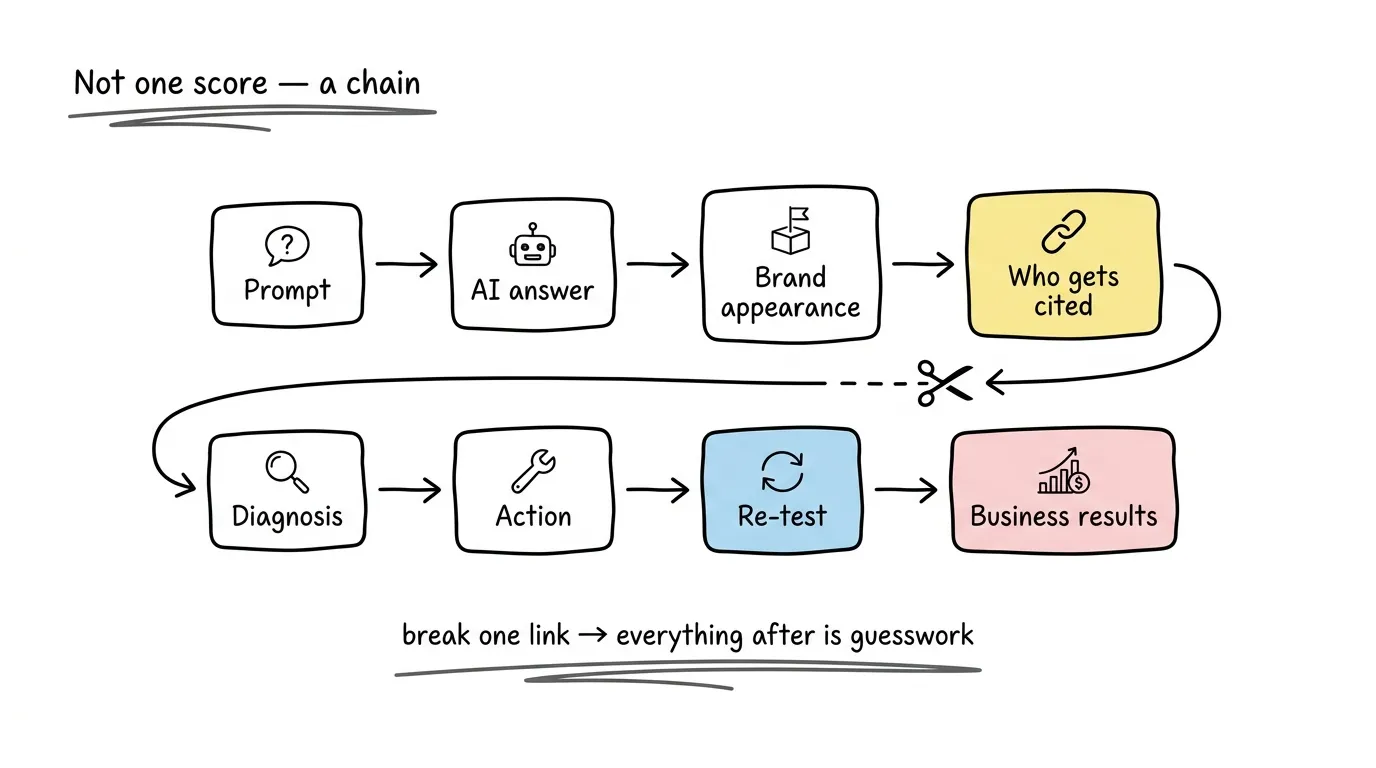
What AEO measurement really measures is this entire chain:
Prompt → AI answer → brand appearance → who gets cited → diagnosis → action → re-test → business results.
Break it at any link, and everything after it is guesswork.
And one more thing, while we're at it: a commonly confused concept worth clearing up. AEO is not AI SEO. AI SEO uses AI tools to optimize traditional search rankings; AEO studies how your brand appears inside AI answers. They overlap, but they are fundamentally not measuring the same thing.
Round 1: How Complete Is the Coverage?
Both companies run data collection every day. But their coverage strategies are worlds apart.
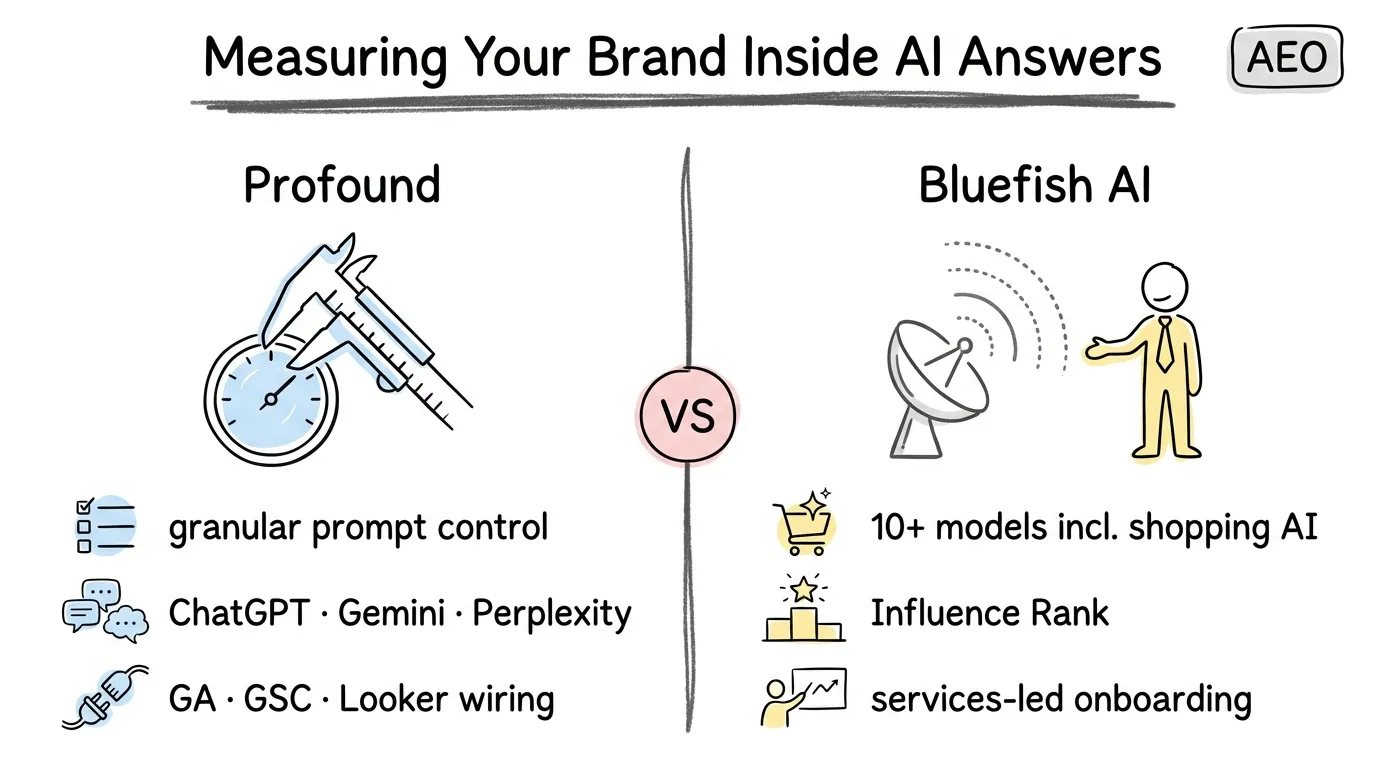
Profound spells this out in fine detail in its public documentation: answer engines like ChatGPT, Gemini, and Perplexity are all covered, with platforms, regions, and languages all configurable. It also has a separate Prompt Volumes dataset covering ChatGPT, Gemini, Claude, and Perplexity, with regional variations on top.
Bluefish AI goes in the opposite direction: its public materials say it monitors more than 10 models, including shopping-scenario AI such as Amazon Rufus and Alexa for Shopping. That's territory Profound doesn't emphasize.
But there's a trap here, and you should watch for it. Profound's regional configuration follows the dataset. Prompt Volumes has its own set of available regions and platforms, which is not the same thing as its Answer Engine Insights. So don't fixate on numbers like "how many engines are covered" — check whether the specific dataset you'll actually use has data on the engines, regions, and languages you care about.
And there's a more basic question: who gives you finer control over prompts?
Profound supports three ways to add prompts — manual entry, bulk upload, and auto-generation — and lets you organize them by topic, tag, platform, region, and language. Bluefish uses a static prompt set paired with model drift control, which keeps the baseline from warping as models get upgraded, so comparisons across time actually hold up.
One gives you freedom. One gives you stability. Pick whichever you're more starved of.
Round 2: Can Citations Be Traced All the Way Down?
Being told "you were cited" is useless. You need to trace it to the exact URL.
Both companies can trace AI answers back to specific source pages. The difference is in what they give you beyond the citation.
Inside Profound's Answer Engine Insights there's a FactCheck feature: it takes what AI says about you, checks it against a knowledge base you define yourself, and when something is wrong, it links to the source URL — then you can dispatch work directly. Fix the content, write new content, or go handle communications.
Bluefish's AI Monitoring Suite also verifies brand claims, checking them against a vetted "source of truth". But it goes one step further: Impact Score and Influence Rank estimate how much weight a given source had in shaping that AI answer.
Now you have three lenses for reading citations: how often you're cited is frequency; which page is cited is precision; how much weight that page carried is influence.
But one warning here: Bluefish's influence scores are model-generated, not directly observed. Before you use them, find out exactly how they're calculated. Otherwise you'll be ranking your work priorities by a black-box score — and you won't even know when it ranks them wrong.
Bluefish published a case study of its own: it noticed a brand's owned pages had a low citation rate, investigated, and found it was a crawler-access problem; after fixing the site configuration, it tracked how citation frequency changed. Diagnosis, action, re-test — the loop closes. Just know this: it's a story the vendor tells about itself, not third-party verification.
Round 3: How Is the Data Actually Collected?
This is the link I most want you to watch. Because the collection method determines what your data actually represents.
A platform can collect AI answers through the consumer interface — measuring exactly what real users see — or it can go through the official API, and what comes back may be a different story. Same prompt, same engine, and the two routes can still produce results that don't match.
Profound is explicit on this point: Answer Engine Insights collects responses from consumer answer-engine interfaces, not API outputs. The reasoning is direct — that interface is what customers see when they use the product.
Bluefish mentions daily monitoring, a static prompt set, drift control, and a "precisely controlled environment", and it also notes drawing on Google signals, brand-owned data, and panel data. But how it actually collects each individual AI answer — through the interface or through the API — its public materials don't say.
Oh, and don't be fooled by "we offer an API". Whether there's an API for you to pull data, and how the vendor collected that data in the first place, are two different things.
So at the demo, throw these questions across the table: Where do the answers come from? Which variables are controlled? How are repeated runs handled? What happens when an engine gets overhauled?
When two platforms test the same prompt and report different numbers, the answer usually hides right here.
Round 4: Can the Reports Connect to Money?
Good-looking data is not the same as a better business. This round is all about attribution.
Profound supports CSV export, offers an enterprise-grade API, and connects to Google Analytics, Google Search Console, Adobe Analytics, and Looker. The GA line matters most: pipe conversion and revenue data into its Agent Analytics, and you can follow AI-driven traffic all the way through to signups and closed deals.
Bluefish's AI Data Suite uses Collections to group URLs, products, and topics, build baselines, then log your marketing actions alongside them and watch how each dimension changes. It also mentions "conversion contribution" and closed-loop attribution, but its public materials give little detail on how it connects to a CRM or analytics tools. What's that worth? Exactly one pointed question at the demo.
Whichever vendor you pick, attribution means climbing a ladder:
AI visibility → identifiable referral traffic → conversions → known leads → pipeline.
Every rung up demands another layer of evidence. If visibility rose and leads rose in the same period, it's worth investigating the relationship; but to say with a straight face "these leads came from AEO", you need the evidence chain that connects visibility, the customer journey, and the final outcome.
ROI without an evidence chain is voodoo.
Don't Forget to Ask About Security
In enterprise procurement, how data is handled is a question you can't dodge.
Both companies have SOC 2 Type II, single sign-on (SSO), and multi-factor authentication (MFA). Dig one level deeper and the gap opens up. Profound publishes fine-grained role permissions, audit logs, encryption and backup policies; enterprise customers can request HIPAA-related documentation, and daily backups are retained for one week. In Bluefish's public materials, permissions and retention get less detail, and the compliance wording reads "HIPAA Ready".
And one outdated impression worth correcting: some older comparison articles still say Bluefish's certification was in progress — it now lists SOC 2 Type 2. Before you buy, let the latest documentation do the talking.
A few questions to memorize and ask outright: Who can see the AEO data? What information flows through integrations? How are permissions managed? How long is data retained?
How You Onboard Decides the Long Game
This is the easiest link to overlook, yet it determines the quality of your data for the next two years.
Profound's documentation recommends starting with 5 to 10 strategic topics. Prompts can be generated or uploaded, managed with topics and tags, and there's a Profound University for training. But one warning deserves your highlighter: changing tracked prompts affects period-over-period comparisons. Your prompt library is measurement infrastructure — change one prompt today, and the same-period curve next year stops lining up.
Bluefish plays a services game: onboarding training, custom data and workflow integrations, followed by AEO program support, strategic consulting, executive reporting, and change management. Its stated goal is to get your team running in week one.
When judging onboarding, don't look at speed — look at two milestones: how long until you get usable signals, and how long until you've accumulated a credible trend. The former is a matter of days. The latter needs repeated measurements underneath it, and no amount of rushing gets you there.
So, Who Fits Whom?
Here's my read, laid out on the table.
For data teams building their own AEO operations in-house, who want granular prompt management and region-and-language control, Profound is the better fit. For agencies that need independent workspaces to isolate client data, look at its Agency Mode — brands, clients, and pitch environments kept separate.
For brands with a heavy PR tilt, who care about audience analysis and source influence, Bluefish's AI Accuracy, audience-level visibility, and influence metrics are a better fit; and if you'd rather have the vendor carry the strategy for you, that's its home turf too.
If you're already living in the HubSpot ecosystem, look at AEO in Marketing Hub Professional or Enterprise, which suggests prompts from CRM context and connects to content workflows; standalone HubSpot AEO tracks daily visibility, competitors, and citations across ChatGPT, Gemini, and Perplexity, with prioritization suggestions on top. If your engine-coverage needs are unusual, mixing and matching works too. Just keep one thing clear in your head: different tools have different prompt sets, collection methods, and counting conventions — you'll have to reconcile the numbers yourself.
Before the Demo, Bring This 30-Minute Exam
Whoever you end up buying, don't sit through the slide deck — put it to the test. Six questions:
- Run 3 to 5 of your real business prompts, and confirm the controls: engines, models, regions, languages.
- Don't stop at the visibility score — open the raw answers and see how your brand and known competitors actually look inside them.
- Chase the citations: open a few source URLs and check whether the pages can actually support the claim.
- Look at history: in repeated measurements, how does it tell a one-off blip from a real trend?
- Pick one real finding, follow it from detection to the recommended action, then ask one more thing: after that action, how do we re-test?
- Walk through an export or the API, and see how the data flows into the systems you use today.
The most ruthless move: bring a visibility problem you already know about into the exam room. Say a competitor keeps showing up for one of your prompts, or AI once said something wrong about you. Hand the same problem to each vendor, and whose methodology is solid gets settled on the spot.
A Few Closing Words
Profound and Bluefish AI: one built measurement into a precision instrument, the other built it into brand intelligence plus hands-on service. Neither crushes the other — there's only which one matches the problem in your hands.
That friend of mine later came back and asked me: which one should I actually pick?
I said, don't start with which one — start with this question: What do you want this data for?
Diagnosing citation problems? Comparing across markets? Or wiring AEO into your CRM to do the accounting? Different answers, different tools.
Tools always follow the question. Get the question straight, hand out the 30-minute exam, and the answer will surface on its own.
Continue reading
Related articles

What Is GEO? How Your Brand Gets "Mentioned" in the Age of AI Search
An explainer on GEO (Generative Engine Optimization) for e-commerce and DTC brands: how it differs from SEO and AEO, why AI answers shape brand visibility, and eight practices covering question-focused content, consistent brand messaging, structured pages, external evidence, comparisons, and AI mention tracking.

AI Is Already Making Decisions for Your Customers. Are You on the List?
A learn article explains GEO (Generative Engine Optimization): why AI-generated answers now shape which brands customers see, and how SEO fundamentals, entity clarity, citable evidence, and monthly measurement affect visibility in AI answers.

Google Is Stuffing Ads Into AI Search: These Recent Stories Are Really One Story
A news roundup linking recent AI marketing stories—Google adding ads to AI Mode, Amazon's Ads Agent, ChatGPT image updates, a UK startup tracking brand mentions in AI answers, and an AI ransomware warning—arguing that control over ad data and visibility is shifting toward platforms.