
The Sky Above Search Has Truly Changed: AEO, GEO, and LMO in the AI Era
AI assistants are transforming search by providing direct answers instead of just links. To succeed, businesses must adopt AEO, GEO, and LMO strategies to ensure their content is understood and cited by large language models.
A few days ago, an old friend of mine who runs an enterprise services business invited me out for tea. He sat down, and his first words were: "Something's gone haywire."
I said, take your time — tell me the whole thing.
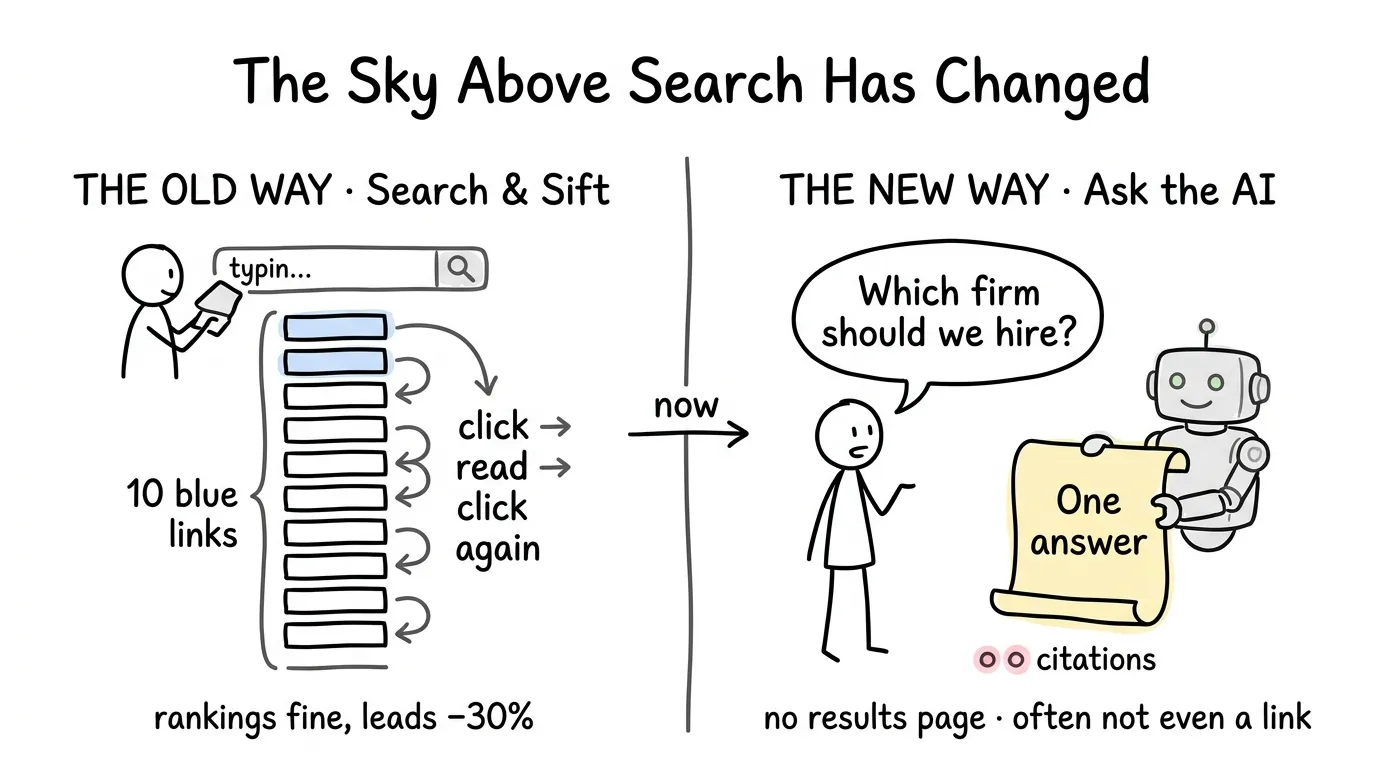
He said his company's website keyword rankings hadn't dropped at all — several had even climbed two spots. Yet inbound inquiries had fallen by nearly thirty percent. His marketing team combed through every piece of data: rankings fine, content untouched, backlinks intact. So what about the traffic? Where did the traffic go?
I told him: the traffic isn't lost. It just no longer passes by your front door.
Why do I say that? Think about it: in the past, when you looked for answers, you searched first, then sifted through the results, then clicked in and read for yourself. And now? You just ask the AI. Ask it which supplier to recommend, how to choose between two options, what a concept actually means. The AI doesn't hand you ten blue links. It hands you an answer.
You finish reading, and the problem is solved. And you haven't clicked a single link.
That is exactly what my friend ran into. The rankings held steady because the old exam hall is still standing; the leads dried up because the exam-takers have all moved to a new one.
This Is No Minor Shake-Up — the Foundation Itself Is Changing
Some people consoled him: isn't this just another minor algorithm update? Ride it out and it will pass.
My judgment: it won't. This is a structural change.
Search used to be "here's a map — find your own way." Google ran that game for over twenty years, and everyone got good at it: polishing keywords, stacking up backlinks, fighting for rankings. Search now is "you name the destination, and the driver delivers you there." AI assistants like ChatGPT, Gemini, and Perplexity — plus Google's AI Overviews and the AI Microsoft has tucked into Bing and Copilot — are all doing the same thing: digesting the information scattered across the web, synthesizing it into a single answer, and serving it straight to you.
What does that mean? It means "search" is no longer a place — it is an ecosystem. Several engines, several ways of asking and answering, each answering in its own way.
Users have changed along with it. Doing your homework used to mean hopping across multiple web pages; now people go straight to the AI for recommendations, for side-by-side comparisons, for action lists. When the AI answers, it isn't reading your keyword density; it's judging how clearly, how credibly, and how professionally your organization shows up across the web.
Put bluntly: you used to optimize for the ranking algorithm; now you have to be legible to an AI that actually reads.
Who does this hit hardest? Two groups I especially want to flag: consulting firms and B2B companies. Because your customers are precisely the people who use AI tools most intensively. Early-stage research, shortlisting vendors — they are already asking the AI first.
So What Do You Do? Remember Three Words
This thing already has a name: AI Search Optimization. Under it sit three levers, and I'll take them one at a time.
What Is AEO?
AEO stands for Answer Engine Optimization.
What is an answer engine? Tools like ChatGPT and Perplexity — you ask one question, and they hand you the answer directly.
What AEO pursues is getting your content cited when the AI generates its answers.
Here's an example. A user asks the AI: "Recommend a few firms that do supply chain consulting." The AI draws on the web information it has already digested, picks out the few firms it considers most trustworthy, and weaves them into one recommendation. Whoever gets picked wins that exposure. And note: this exposure has no results page, no position bidding — often not even a link.
So whom does the AI pick? What kind of content does it like? Crisp concept definitions, step-by-step frameworks, consistent terminology, and hard-edged professional insight. These are the things the AI can parse, remember, and dare to cite.
So AEO is not about gaming the system. Quite the opposite: you have to cultivate yourself into the canonical answer the AI is willing to cite.
What Is GEO?
GEO stands for Generative Engine Optimization.
If AEO governs whether you make it into the answer, GEO governs whether the AI introduces you correctly.
Google's AI Overviews, Microsoft's Copilot — tools like these automatically generate summaries, recommendations, comparisons. In effect, they introduce you on your behalf. The question is: how accurate is the introduction?
For instance: when it summarizes your business, does it mix up who did what? When it describes your methodology, can it capture your signature approach? Has it pasted someone else's content onto you?
Accuracy here doesn't come from one brilliantly written article. It comes from your entire digital footprint being consistent. Website, official content channels, case studies, white papers — all telling the same story, in the same language. The AI works like a jigsaw puzzle. If the pieces you provide don't fit together, it fills in the gaps itself — and the "you" it imagines is often not you.
What Is LMO?
LMO stands for Language Model Optimization.
This is the deepest layer. AEO and GEO govern how the AI uses your content; LMO governs how the AI ingests it.
Large language models don't crawl page by page the way traditional crawlers do. Their knowledge comes from training corpora, plus whatever gets retrieved later. LMO's job is to make sure that what goes in is conceptually clear, well-structured, terminologically consistent, and systematically organized.
Here's an analogy. LMO is like writing a textbook for a student who is extremely diligent but has no intuition of his own. Write the textbook well, and when he answers questions, he speaks on your behalf. Write it a mess, and he'll make up his own version — and answer with total confidence.
So what LMO cares about has never been keywords. It is meaning. How the concepts relate to one another, whether your methodology forms a coherent system, whether the context across the web can assemble into a complete and credible you. Companies whose content is scattered all over the place are dismantling their own foundation with their own hands.
Three Jobs — Miss One and the Whole Thing Leaks
Let me string them together for you.
AEO gets you into the AI's answers. GEO makes sure the AI gets you right. LMO makes you stand firm in the AI's eyes.
One handles getting in the door, one handles your image, one handles the foundation.
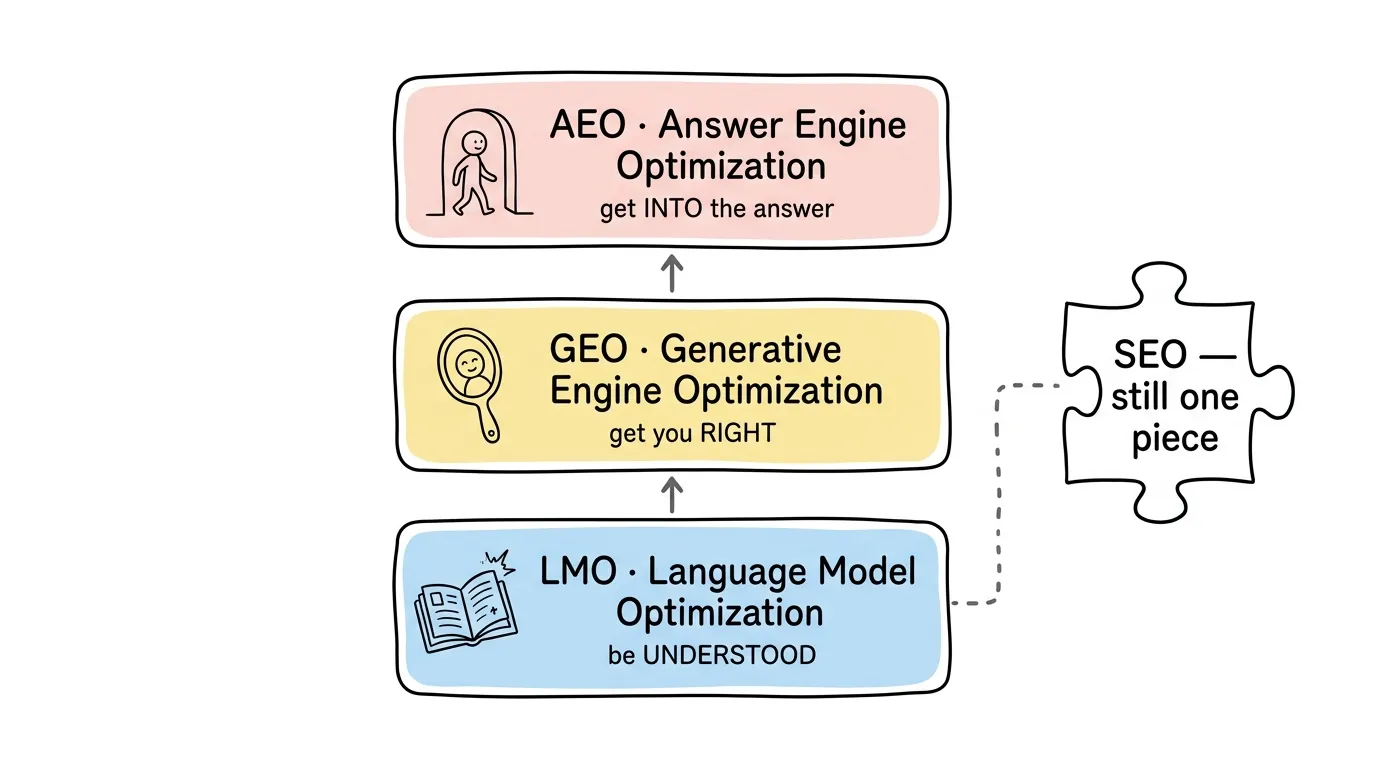
What about SEO, then? Is SEO dead? No. It is still an important puzzle piece. But be clear about this: it is now only one piece. Today's customers ask questions in many places, so you have to answer in many places. Wait for them where they look for answers now — not where they looked ten years ago.
Why Would the AI Pick You, and Not the Competitor Next Door?
This is the question I most want to get straight with you.
When an AI engine picks companies, the logic is nothing like traditional rankings. It is not scoring and sorting web pages; it is judging after understanding. It looks at an entire web of signals: Is your content clear? Does your expertise hold up? Is your story consistent across the web?
So can piling up traffic, dumping money into ads, and aggressively stacking backlinks get you into the AI's answers? That's getting harder all the time. Because the AI is judging something else: whether your expertise is clear, consistent, and systematic across the web.
Now flip it around: the companies the AI keeps mentioning are not necessarily the ones with the biggest traffic — they are the ones with the cleanest digital footprint: stable in what they say, unified in how they say it, verifiable in what they know. The AI understands at a glance, trusts once it understands, and cites once it trusts.
Back to My Friend
Later I asked him: what are you planning to do?
He said: first, cut the self-congratulatory product pages from the website and rewrite them as the questions customers actually ask, with answers. Then, organize our methodology into a framework we can explain clearly, and publish it.
I said: now you're heading in the right direction.
The endgame of search is not a single entry point — it is a web of answering engines made of every kind of AI. Whoever first organizes their expertise into a form the AI can read, remember, and is willing to cite will hold the new map before the old one stops working.
It sounds abstract, but taken apart it comes down to one sentence:
Optimization used to be about making machines find you. Now it is about making machines understand you — and dare to speak for you.
Here's wishing you an early start on writing your own "textbook."
Continue reading
Related articles

It's 2026: Stop "Buying" AI Tools for Your Marketing Team — Start "Hiring" AI Agents
This learn article explains how AI agents differ from standalone AI tools in marketing, outlines three agent categories — build-your-own platforms, CRM-native agents, and vertical tools — and covers use cases across SEO, social media, advertising, and reporting, plus criteria for choosing one.

What Is GEO? How Your Brand Gets "Mentioned" in the Age of AI Search
An explainer on GEO (Generative Engine Optimization) for e-commerce and DTC brands: how it differs from SEO and AEO, why AI answers shape brand visibility, and eight practices covering question-focused content, consistent brand messaging, structured pages, external evidence, comparisons, and AI mention tracking.

AI Is Already Making Decisions for Your Customers. Are You on the List?
A learn article explains GEO (Generative Engine Optimization): why AI-generated answers now shape which brands customers see, and how SEO fundamentals, entity clarity, citable evidence, and monthly measurement affect visibility in AI answers.