
In 2026, Stop Building Your Business Around Google Alone
A 2026 marketing outlook arguing that search has fragmented across AI assistants and platforms, covering generative engine optimization (GEO), first-party and zero-party data, consistent cross-channel experience, and human-led content amid AI-generated volume, with notes on WSI's self-graded predictions.
A few days ago at dinner, a friend who runs an e-commerce business was complaining to me: he'd put a decent chunk of budget into SEO, his rankings looked fine, but traffic kept falling. He asked me if he'd done something wrong.
I asked him one question back: when you look something up these days, do you still open a search engine?
He froze for a second, thought about it, and said: actually... I just ask ChatGPT.
And there's your problem. He didn't do anything wrong. The act of "searching" itself has changed.
Search Has Shattered
Search, as we understood it, meant opening Google, typing in keywords, and staring at the top ten blue links.
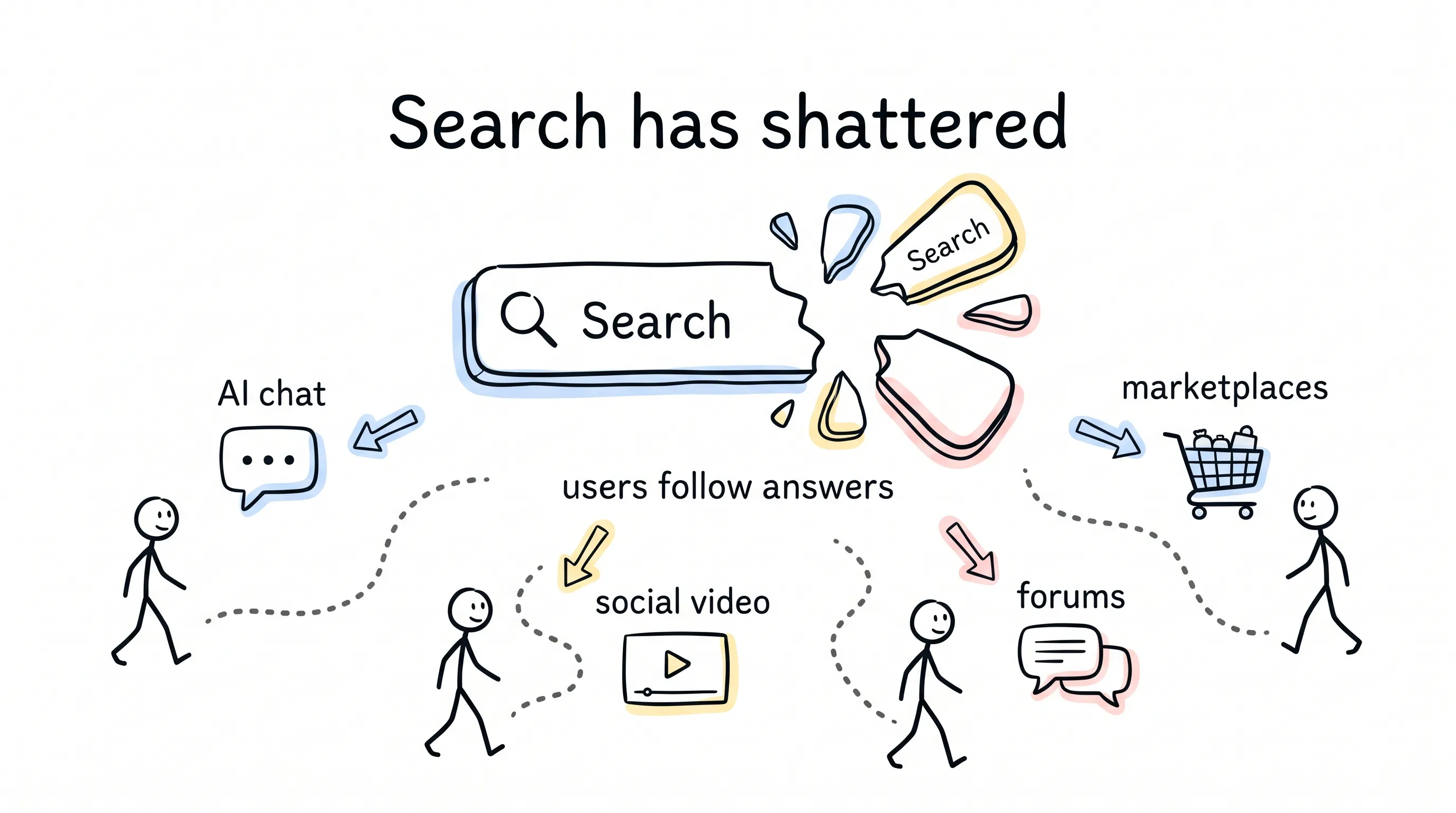
Now? You ask a question in ChatGPT, pull up a comparison in Perplexity, punch a keyword into TikTok, search products directly on Amazon, dig through real users' gripes on Reddit.
Search hasn't disappeared. Search has shattered.
Users follow answers, not platforms. Wherever the answer is, that's where the people are.
So the first job of this year's marketing is to settle one question: wherever your target audience asks their questions, that's where you need to show up.
There's a name for this: Search Everywhere Optimization. It's the upgrade of traditional SEO. And its most critical piece is called GEO — Generative Engine Optimization.
What is GEO? Put simply, it's making AI willing to cite you and mention you when it generates answers.
But notice — something fundamental has changed here.
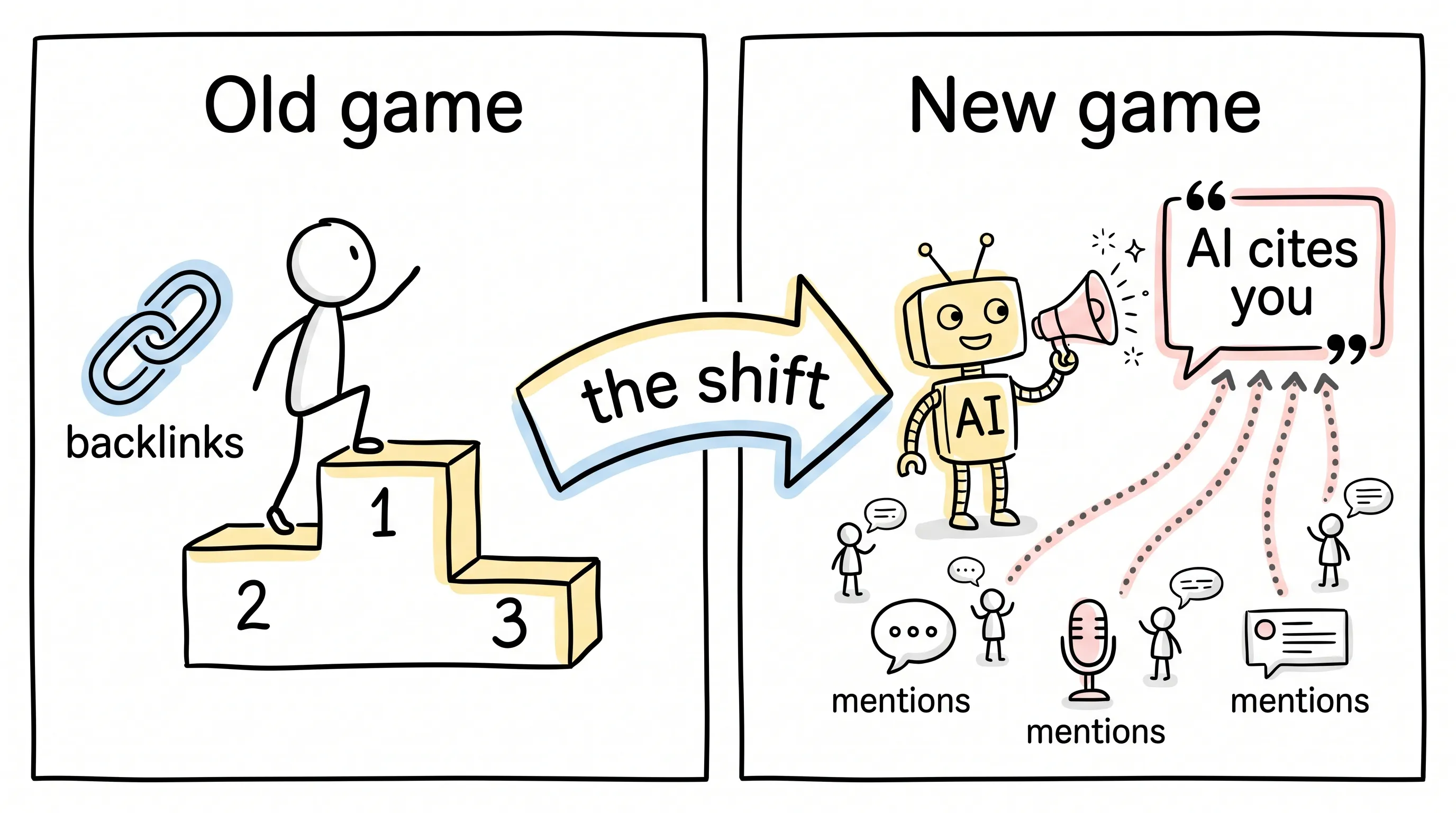
SEO used to be a contest of rankings. If you rank third and I rank second, I beat you.
AI doesn't rank. AI cites.
It won't tell you who came in first. It will say: according to some sources, this brand has a good reputation. So who does it cite? The brands that get talked about again and again in comment sections, forums, podcasts, and social media.
In other words, the old game was backlinks; the new game is mentions. How many credible places talk about you determines whether AI thinks you're trustworthy.
And here's something a lot of people haven't caught up with: clicks are no longer the core metric.
AI hands you the answer directly, so for many questions you never click through at all. This is called zero-click search, and its share keeps climbing.
Fewer clicks — bad news? Not necessarily.
Think about it: when someone clicks your link out of an AI answer, they mostly arrive already carrying a question, a comparison, a decision. Fewer people, but each one is far more qualified.
Traffic volume is falling. Traffic quality is rising.
How to do that math is a lesson every marketer has to relearn this year.
Data: You Really Can't Keep Renting It Anymore
On the other end of the search shift, the foundation of data is shifting too.
The "cookieless future" has been announced for years — this time it's actually here. Third-party cookies are bowing out across mainstream platforms, and data regulations around the world keep tightening. In 2025 alone, 17 countries added or expanded data-related laws.
Consulting firm Deloitte ran a survey: more than 75% of marketing leaders expect this shift to disrupt how their business currently operates.
Not "might have an impact." "Disrupt."
So what now? The options for buying or renting data are narrowing fast. What you can genuinely rely on is the data you've accumulated yourself.
It comes in two kinds.
One is first-party data: the behavior users leave behind on your own website, app, or store. What they browsed, what they bought, which emails they opened.
The other is more interesting: zero-party data — what users tell you proactively. The preferences they tick in a survey, the answers they pick in a quiz, the interests they share in your preference center.
Why is zero-party data especially valuable? Think about it: when someone volunteers to tell you what they want, that alone is the signal closest to a purchase.
The essence of the data question has changed — from "I'll take it from you" to "you give it to me."
And "you give it to me" has a precondition: you have to be worth trusting.
That's why privacy is turning from a compliance cost into a competitive advantage. Whoever's data is collected cleanly and openly ends up with sharper profiles and longer-lasting customer relationships.
Data obtained without trust loses value every time you use it. Data earned through trust grows more valuable the more you use it.
Someone Found You. Then What?
OK, so now your brand gets mentioned across platforms and your data is squeaky clean. Next question: when users actually show up, is your experience ready for them?
You got cited in a ChatGPT answer, and the user followed the thread to your website. The next day he gets your email, and it's singing a different tune. The day after, he contacts your support, and your support agent draws a complete blank.
That deal is probably dead.
The customer doesn't care what you call this channel internally. He only cares about one thing: is your company the same "person"?
People shopping today bounce between touchpoints — one day it's short video, the next your website, the day after that maybe an AI chat — assuming you remember them the whole way.
If you can't remember, the experience is broken. And once it's broken, there's no "next."
There's a dead-simple self-test: pick three random touchpoints where you come into contact with customers and put them side by side. If they don't look like they were made by the same company, that's the hole you most need to patch.
At bottom, connecting all this is back-office work: CRM, email, website, analytics — these systems need to recognize each other first, so the customer never has to "start from scratch" again.
Interestingly, what AI helps with here isn't some advanced marketing magic but the plainest thing possible: helping you remember what customers said and did, then reminding you it's time to follow up.
Complex growth often hides in plain places like this.
After the Flood of AI Content, What's Scarce?
This is a question you have to answer head-on this year.
Generative AI has spread into every content workflow. The Interactive Advertising Bureau (IAB) predicts that AI will transform every stage of media campaigns: how you think, how you produce, how you measure.
Speed and output are no longer the problem. And here's the new problem: when everyone can publish a hundred articles a day, content turns into white noise.
Screens full of correct-but-useless articles. Readers glance once and swipe away. What's more troubling, AI itself can tell. When generative engines choose sources to cite, they prioritize content with real traces of expertise.
This is the so-called "crisis of sameness": everyone sounds more and more alike, and customers and AI alike can't tell who actually knows their stuff.
The way through is actually clear: AI handles efficiency, humans handle point of view.
Research, data analysis, first drafts — hand those to the machines, fast and steady. But judgment, lived experience, the pits you personally fell into, the details only you can tell — those must come from people.
I read this as an "authenticity premium": when output is no longer scarce, being real becomes the scarcity.
Readers don't trust platforms; they trust people. A hundred words written by someone who actually fell into the pit are worth more than ten thousand words written by a machine.
So don't hide your experience. Write out "how we figured this out" and "what traps we stepped into." Those are exactly the things AI can't fabricate.
AI Is the Engine. Leadership Is the Driver.
And there's one more topic we can't avoid.
In 2026, AI no longer counts as an advantage. It's the baseline. Just like no company today says "we have electricity, so we're strong."
Everyone has it. So what's the competition?
Who uses it well. More precisely: whose organization uses it well.
AI can do the work, but AI can't set the direction. It can calculate which channel has the best ROI, but deciding whether to kill off a product line is still a human call. It can simulate your customers, but weighing trade-offs, making the final decision, and owning the responsibility — still humans.
So this year's dividing line is leadership.
I see some fast-moving companies already doing these things: assigning dedicated people to monitor AI output quality, setting rules that draw the line between what AI may and may not do, training everyone to build basic AI literacy, and switching performance metrics from "how much got done" to "how much actually worked."
In one sentence: don't ask what AI can do for you; first get clear on what you want your organization to do with it.
Tools can be bought anywhere. An organization that knows how to use them can't be.
Five More Signals Still on the Way
The five points above are already happening. A few more forces are just surfacing — no rush to go all in, but worth keeping on your radar.
AI agents. AI goes from "assistant" to "employee": planning, executing, and optimizing an entire campaign on its own. Whoever can manage it responsibly gains an extra pair of hands.
Conversational customer service. Large language models have brought support bots back to life: they can follow context now, and carry emotion. For small and mid-sized companies, this is the textbook case of getting big results on a small budget.
AI accountability. The more AI participates in decisions, the more regulators and customers will ask: how did your AI make that call? Set up a governance framework early and save yourself big trouble later.
Decision intelligence. Let AI simulate "what happens if we do this" before you spend the money. Turn reports into rehearsals, and turn the rearview mirror into a windshield.
Micro-influencers. Instead of celebrity endorsements, people increasingly trust real humans: employees, longtime customers, niche creators who genuinely know their stuff. Trust is shifting from "who shouts loudest" to "who tells it true."
None of these may explode overnight, but the direction is already visible.
By the Way: What's It Like to Grade Your Own Predictions?
WSI, a veteran digital marketing agency, has a fun tradition: publish predictions at the start of every year, then grade itself at year's end. Points for hits, deductions for misses — no dodging, ever.
For their five 2025 predictions, their self-assessment was +3.
Which one was most accurate? Generative search exploding — self-scored +2, direct hit. One number speaks volumes: in July 2025, Adobe ran a survey of a thousand people, and 770 of them said they were already using ChatGPT as a search engine.
Seven hundred seventy out of a thousand. When I saw that number, I honestly paused for a second. Adoption at that pace would be startling in any industry.
Which one was the worst? Voice search and voice commerce — self-scored -2, called wrong for years running. Everyone uses voice assistants: set an alarm, ask the weather. But actually getting people to place orders by voice never took off. What truly turned "talking" into the mainstream, instead, was conversational AI search.
The remaining three were all right in direction: AI-driven decisions spreading, social commerce growing, personalization becoming more common (89% of marketing decision-makers consider it essential within three years) — but all stuck halfway, tripped up by trust, regulation, and user habits, each in its own way.
Right direction, wrong pace — that's just the nature of predicting. Three +1s, one +2, one -2: adds up to +3. Not perfect, but honest.
I think the habit itself is worth more than the score: only those who dare to lay last year's judgments out in the sunlight deserve to make this year's judgments.
Finally
Back to that friend at the beginning. Later he told me he stopped asking "how are the rankings" and started asking "when AI mentions us, what does it say?"
Change the question, and every action changes.
In 2026: search has shattered, data has gotten expensive, content is brutally crowded, and organizations have to keep up.
Plenty of change. But in the end it comes down to one line: the stronger the tools, the more valuable the person.
Here's to a brand that AI thinks of — and that human hearts remember even more.
Continue reading
Related articles

It's 2026: Stop "Buying" AI Tools for Your Marketing Team — Start "Hiring" AI Agents
This learn article explains how AI agents differ from standalone AI tools in marketing, outlines three agent categories — build-your-own platforms, CRM-native agents, and vertical tools — and covers use cases across SEO, social media, advertising, and reporting, plus criteria for choosing one.

What Is GEO? How Your Brand Gets "Mentioned" in the Age of AI Search
An explainer on GEO (Generative Engine Optimization) for e-commerce and DTC brands: how it differs from SEO and AEO, why AI answers shape brand visibility, and eight practices covering question-focused content, consistent brand messaging, structured pages, external evidence, comparisons, and AI mention tracking.

AI Is Already Making Decisions for Your Customers. Are You on the List?
A learn article explains GEO (Generative Engine Optimization): why AI-generated answers now shape which brands customers see, and how SEO fundamentals, entity clarity, citable evidence, and monthly measurement affect visibility in AI answers.