
Does Your Brand Show Up in AI Answers? Three Tools, Settled in One Read
This article compares three tools—Ahref's Brand Radar, Profound, and HubSpot AEO—to help marketers understand Answer Engine Optimization (AEO). It details the strengths and weaknesses of each platform for tracking brand visibility in AI search results.
A while back, an old friend of mine who works in marketing took me out to dinner. Halfway through the meal, he sighed: he'd barely gotten his head around SEO, and now a new acronym had popped up — AEO. He'd lined up the candidates: Ahrefs' Brand Radar, Profound, HubSpot's AEO. Which one should he pick?
I told him: don't rush into comparing features. This is really a multiple-choice question — if you haven't understood the question itself, no answer option, however pretty, will save you.
That night I went home and dug through all three. Today, I'll lay it all out for you — once and for all.
What Exactly Is AEO?
So what is AEO, exactly?
AEO stands for Answer Engine Optimization. Put simply: in the search-engine era, you got a page of links and did the clicking yourself. Now people ask ChatGPT, Gemini, or Perplexity directly and walk away with a ready-made answer.
That gives us two new terms.
When your brand gets named in an answer, that's a mention. When the answer cites your page as a source, that's a citation.
Why did these two words suddenly become so valuable?
In 2025, Pew Research Center ran an analysis tracking the real browsing behavior of 900 U.S. adults. The finding: when a Google AI summary appeared on the page, only 8% of users clicked a traditional search result; without the AI summary, it was 15%.
What does that mean? Once users see an answer, they stop clicking links.
So the old playbook of rank monitoring breaks down when it comes to AI answers. Nobody can see what position you rank; whether you get named at all is what matters. Tools built specifically to measure AI visibility exist to fill exactly this gap.
Right now, three lead the pack: Brand Radar, which lives inside Ahrefs; Profound, built for this one job; and HubSpot AEO, which bundles tracking and recommendations together.
Let's take them one at a time.
Brand Radar: The One That Lives Inside Ahrefs
First, Brand Radar.
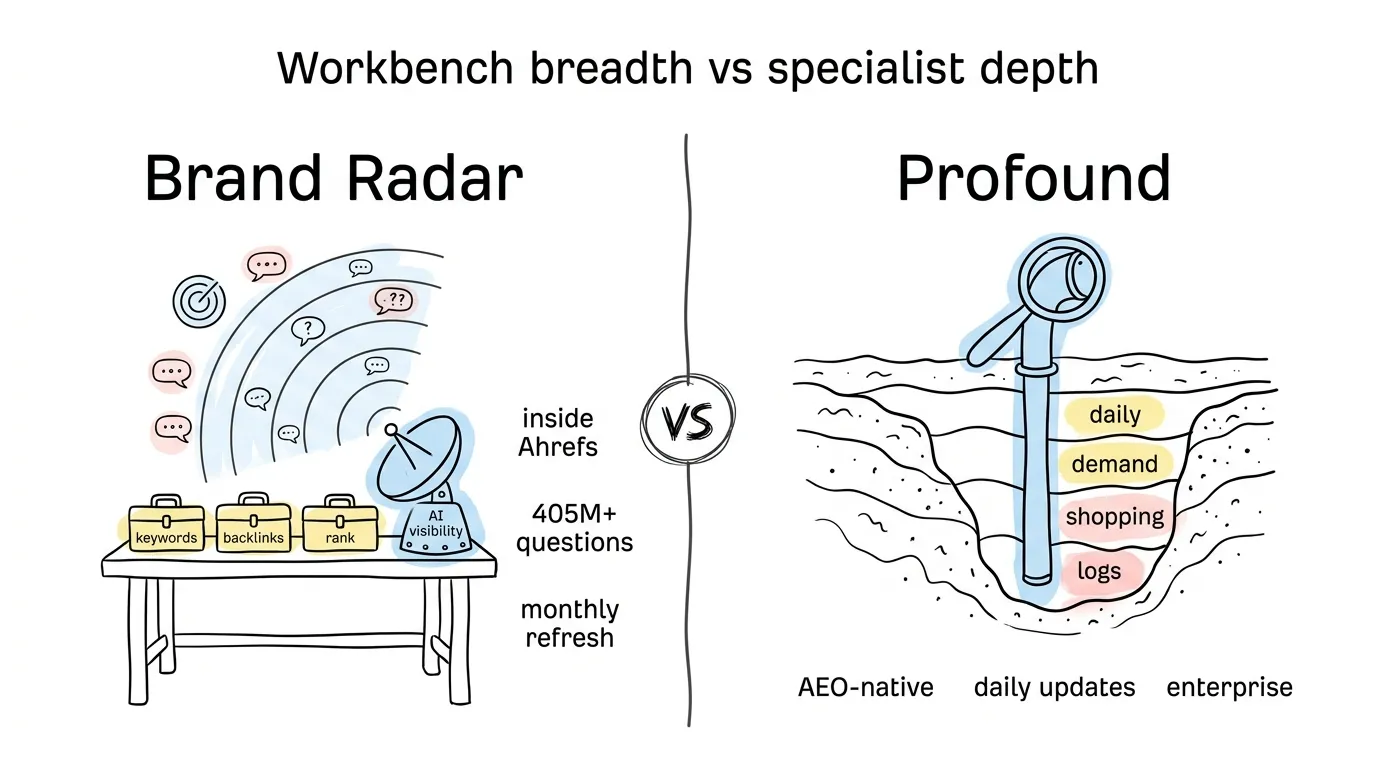
Its ace is data. Ahrefs starts from its own keyword database, expands search terms into natural-language questions (using People Also Ask and semantic expansion), and then runs them against the major AI platforms. Its official help docs say the question bank exceeds 405 million entries; the product page says 448 million and up. The two numbers still contradict each other, so before you quote either one, check the official page for the latest figure.
The upsides are tangible.
First, you don't have to move anything. Your team already does keywords, backlinks, rank tracking, and site audits inside Ahrefs — now the AI visibility data sits right next door, and you don't even need a second login.
Second, broad engine coverage. The index covers AI Overviews, AI Mode, ChatGPT, Perplexity, Gemini, and Copilot, and adding custom prompts brings Claude in as well. Grok is listed in the docs, but collection of new data is paused for now.
Third, visibility off the field too. It also tracks how visible you are on YouTube, Reddit, and TikTok — still in testing, and free.
Fourth, it works out of the box. If your brand is in the index, results appear with one search — no configuration. Data goes back to 2025.
But there's always a flip side.
ChatGPT data in the main index refreshes only once a month. Custom prompts can run daily, but every run burns one check credit per prompt, per platform, per region. The Lite plan comes with 5 custom prompts and 150 checks a month; Standard is 10 prompts and 300 checks; Advanced is 20 prompts and 600 checks. Not enough? Add-ons run $50 to $250 a month. If all you want is its AI visibility index: $199 a month for a single platform, $699 for all platforms. Ahrefs plans themselves start at $129 a month and include those 5 prompts.
There's also a catch for small brands. Ahrefs itself admits the index works best for brands with search volume; if nobody's searching for you, coverage will suffer.
As for sentiment analysis, it isn't a core Brand Radar metric — Ahrefs has parked it in Letaido, another product in the family, as a standalone capability.
Profound: The Power User's Professional Choice
Profound has taken a different road: built for AEO from the very first line of code.
Its strength is depth.
First, daily updates. Brand mentions, share of voice, citing domains, sentiment (positive, neutral, negative) — all run once a day.
Second, it goes where nobody else has gone: the demand volume behind prompts. Profound says this data comes from a double-confirmed consumer panel, and can be sorted by intent (informational, commercial, conversational, generational) and broken down by age, income, and platform. Note: this is the vendor's own claim. Before you pay, make them lay the methodology out for you to see.
Third, e-commerce players should perk up: it can look at ChatGPT Shopping. Product recommendations, how accurate the attributes are, shopper sentiment — down to every single SKU. This one, the pricing page says, sits in the enterprise tier.
Fourth, Agent Analytics. From your server logs, you can see when AI crawlers came and which pages they crawled, and it can also sort out attribution for real human traffic. Akamai, AWS, Cloudflare, Vercel, WordPress — all connect.
Fifth, there's also a no-code agents workflow, and with Profound Sheets you can run tasks in batches. The enterprise tier can watch up to 9 engines at once.
Sounds powerful. But there are three traps you need to know about.
Trap one: pricing. As of October 2026, Profound's pricing page has only two tiers left: a free trial — 50 prompts for 7 days, only ChatGPT, Gemini, and AI Overviews, no export, no history — and above that, a custom enterprise version. The $99 and $399 monthly tiers that were once public have disappeared from the page. Export, API, SSO, full history — all locked inside enterprise.
Trap two: it doesn't live in your house. Profound exists independently, outside your SEO toolbox and your CRM. Its agents can push content to your CMS, but the visibility data won't land next to your customer records and campaign data.
Trap three: you pay twice. Agents burn credits, and buying more credits requires an enterprise-level plan. When you budget, besides seats, remember to set aside a line for usage.
HubSpot AEO: From Seeing to Doing
The third contender has a different idea again.
HubSpot AEO's logic: seeing the problem alone is useless; someone has to follow through and do the work. It positions itself along a single line: visibility, then recommendations, then actions on content and campaigns.
$50 a month, $45 a month if billed annually, with 25 prompts included. No separate HubSpot subscription needed, and no requirement that you use HubSpot's CMS. It tracks brand visibility scores, competitor share, citations, and sentiment, covering ChatGPT, Gemini, and Perplexity, then turns the gaps into prioritized recommendations: build a new page, update that old article, go pitch a certain outlet.
If you're on Marketing Hub Pro or the enterprise tier, it can go one step further. It takes the data in your CRM and recommends which prompts to watch; recommendations connect directly into the content and social tools, drafting on-brand blog posts in one click. AEO data and campaign metrics under the same roof — that's where its value is highest.
Of course, the shortcomings are on full display: only three engines. To watch AI Overviews, Copilot, or Claude, you still need to call in Brand Radar or Profound. Server log analysis and a shopping module — it doesn't have those either.
So How Do You Choose?
That's all three. How to choose? Let me ask you three questions.
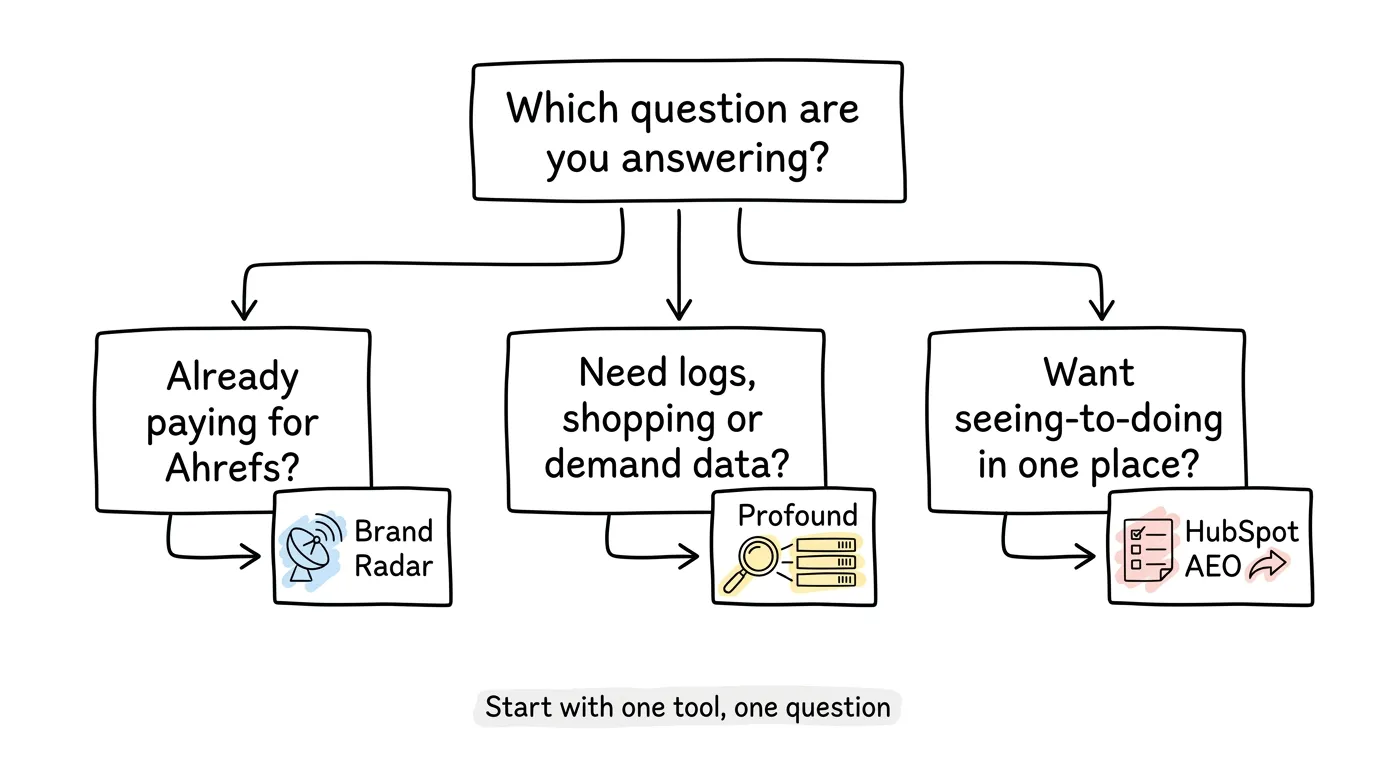
One: are you already paying for Ahrefs? If yes, start with the custom prompts Brand Radar already includes — it's the path of least resistance.
Two: do you need server logs, shopping analysis, or consumer-level prompt demand? If yes, go book a Profound demo.
Three: do the engines you need to watch go beyond ChatGPT, Gemini, and Perplexity? If yes, look at Brand Radar, or Profound's enterprise version.
If your answers to these questions aren't decisive, run through a few common scenarios. Deep Ahrefs users, choose Brand Radar. A project starting from zero — HubSpot AEO has the lowest barrier, and if the budget allows, go straight to Profound. Agencies managing a pile of clients: Profound has agency plans and per-client workspaces, while Brand Radar puts no limit on the number of brands. Marketing teams managing multiple brands: Profound scales to enterprise; HubSpot is one $50 instance per brand. E-commerce retailers: Profound's SKU-level analysis is hard to get around. And as for teams already running marketing inside HubSpot — what exactly is there to agonize over?
One more thing: most teams don't need to buy both at the start. Use one tool first, with one clearly defined question. If it can't answer, then add the second.
Think Before You Spend: The Seven-Step Test
Whichever you choose, run every tool through the same routine — only then are the results comparable.
- Pick 20 to 25 questions your buyers would genuinely ask, covering awareness, comparison, and purchase.
- Put 3 to 5 competitors on the list. Fewer than three, and the share numbers mean nothing.
- Choose engines based on where your buyers actually spend their time.
- Record a baseline. Before you start, log visibility, mentions, citations, and sentiment.
- Look at citation quality: in your category, which domains and which kinds of pages do the AIs trust?
- List the gaps. Flag every prompt where a competitor appears and you don't.
- Define success metrics: how often you show up in AI answers, share of citations, quality product interactions. One reminder: visibility doesn't guarantee traffic, let alone revenue.
Then take that same routine to each tool. Ahrefs offers no free trial — if you have a plan, test custom prompts right inside the plan; Profound's trial can run 50 prompts for 7 days; HubSpot AEO tracks 25 prompts for free from the start.
Oh, and if you're still on the fence, go run the free AI Search Grader first. It takes a snapshot of how ChatGPT, Perplexity, and Gemini describe your brand — no account registration needed. Use it as a starting point, then move up to continuous tracking.
Finally, Back to That Dinner
At the end of that dinner, I told my friend: none of these three tools is lying to anyone. They're just answering three different questions.
Brand Radar answers: inside the SEO workbench I already know, can I see AI while I'm there? Profound answers: I want to go deep on this, and I'm willing to pay specialist-tool prices. HubSpot AEO answers: after seeing the problem, who walks me through the work?
In the world of AI, if you're not named, you don't exist.
Tools will come and go, prices will move, and the engine list changes every month. But this one, in the short term, won't change.
Here's hoping you always show up in the answers.
Continue reading
Related articles

It's 2026: Stop "Buying" AI Tools for Your Marketing Team — Start "Hiring" AI Agents
This learn article explains how AI agents differ from standalone AI tools in marketing, outlines three agent categories — build-your-own platforms, CRM-native agents, and vertical tools — and covers use cases across SEO, social media, advertising, and reporting, plus criteria for choosing one.

What Is GEO? How Your Brand Gets "Mentioned" in the Age of AI Search
An explainer on GEO (Generative Engine Optimization) for e-commerce and DTC brands: how it differs from SEO and AEO, why AI answers shape brand visibility, and eight practices covering question-focused content, consistent brand messaging, structured pages, external evidence, comparisons, and AI mention tracking.

AI Is Already Making Decisions for Your Customers. Are You on the List?
A learn article explains GEO (Generative Engine Optimization): why AI-generated answers now shape which brands customers see, and how SEO fundamentals, entity clarity, citable evidence, and monthly measurement affect visibility in AI answers.