
The Second Half of Marketing: Making the Numbers Add Up to Revenue
A learn article arguing that marketing must account for its spend in revenue terms as AI adoption, buyer self-research, and acquisition costs shift. It reviews an Alexander Group maturity study across industries and outlines five structural moves for tying marketing to pipeline and revenue.
A while back, an old friend of mine who has spent over a decade in marketing invited me to dinner. He'd been promoted to CMO two years ago, running marketing at a software company. By all rights, life should have been getting easier.
Halfway through the meal, he sighed.
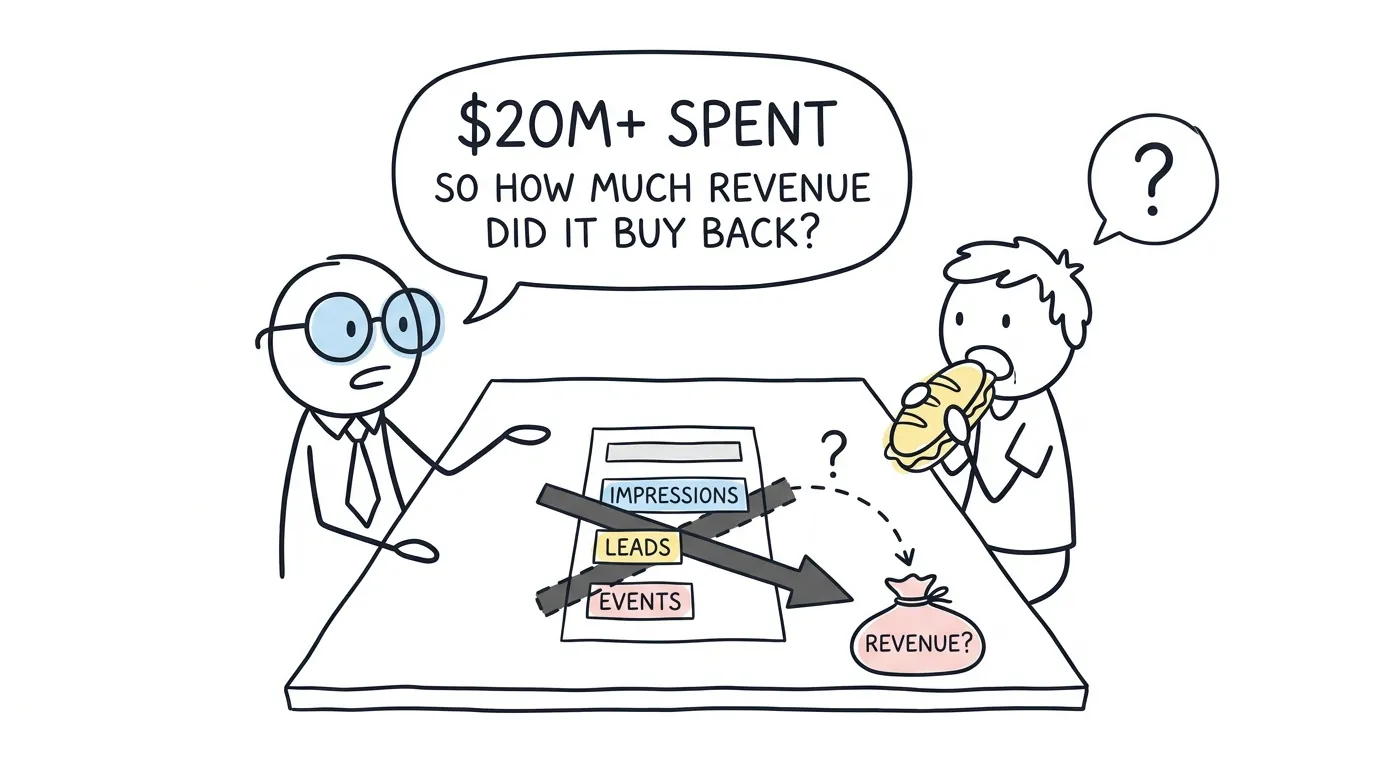
He told me that at this quarter's budget meeting, the CFO had asked him one question: marketing had spent more than 20 million yuan this year — so tell me, how much revenue did it buy back?
He opened his mouth and couldn't answer.
I told him that wasn't his fault. For the past twenty years, almost nobody asked that question. Marketing reported impressions, leads, event counts; the boss nodded, and the page turned.
Now, the page won't turn.
The Game Has Changed, So the Accounting Has to Change
So what exactly is marketing's awkward spot?
It's this: the more work marketing does, the harder its books become to reconcile.
Think about it. Over the past two years, three things about marketing's world have changed.
First, AI. Used to be, adopting AI was a multiple-choice question. Now it's like air — everyone is breathing it. You use it, your competitors use it, and nobody gains an edge.
Second, buyers. Today an enterprise customer won't meet a salesperson until roughly seventy percent of the evaluation is done. They search on their own, compare on their own, lurk in communities on their own. By the time you meet them, the battle is already half over.
Third, cost. Since 2022, customer acquisition costs have risen 60% to 100%. Spend the same money, and you get less than half the customers.
Add these three together, and what do they mean?
They mean marketing can no longer report only "here's how much work we did." It has to answer "here's how much business we brought back."
Marketing's value is being redefined — from "we did a lot of work" to "we earned a lot of money."
The Report Card from 300 Companies
As it happens, the consulting firm Alexander Group published a dedicated study this year called the Revenue-Ready Marketing Organization Research. They interviewed executives from more than 300 marketing organizations across 11 industries, trying to answer one question: what does a marketing organization that is truly accountable for revenue look like?
What does revenue-ready mean?
Plainly put: a marketing organization that no longer just generates buzz, but takes responsibility for pipeline and revenue.
The study includes a scoring tool, the Marketing Maturity Index, which measures six capabilities against a benchmark of 4.0. Let me walk you through a few industries' scores.
The most mature is technology, at 3.1. Sounds decent, right? Look closer: only 30% of companies are actually running advanced demand generation programs. 80% are adding budget, and 56% say returns have doubled — yet demand generation, as a craft, is one most of them still haven't mastered.
Number two is business & financial services, at 2.7. This industry's numbers are even more tangled: 83% are adding budget for 2026, 92% believe AI will pay off, and 35% have seen returns genuinely double. Yet only 16% of companies can run advanced demand generation.
The money is pouring in; the people who know how to spend it are few.
Media ranks third, at 2.6. Its strength is winning audiences and producing content; its weakness is the math: what viewers watched, and how that connects to the business — it can't trace. 32% of companies have marketing contributing more than 40% of pipeline, and 44% put AI in their top three priorities for 2026. But the bridge in the middle — attribution — is still unbuilt.
Healthcare ranks fourth, at 2.3. The score isn't high, but its revenue accountability is actually among the best of the industries surveyed: 35% of companies have marketing contributing more than 40% of pipeline, 34% are running advanced demand generation, and 54% have built credible AI governance frameworks. The weak spot is segmentation. Think about it: when a hospital makes a purchasing decision, seated at the table are the administrator, the physicians, procurement, compliance — one table, many agendas. Segment poorly, and nothing you say lands where it should.
The next two sting more.
Manufacturing & distribution, at 2.1 and 2.0. 70% are adding budget, 80% believe AI will pay off — yet only 8% can run advanced demand generation, and only 20% can get marketing contributing more than 40% of pipeline.
At the bottom is life sciences, at 2.0. This one spends the most freely: 100% of surveyed companies are adding budget, 87% believe in AI, and 29% have even started running advanced demand generation. But at only 5% of companies does marketing contribute more than 40% of pipeline.
100% adding budget, 5% seeing revenue. In between stretches a 95-percentage-point execution gap.
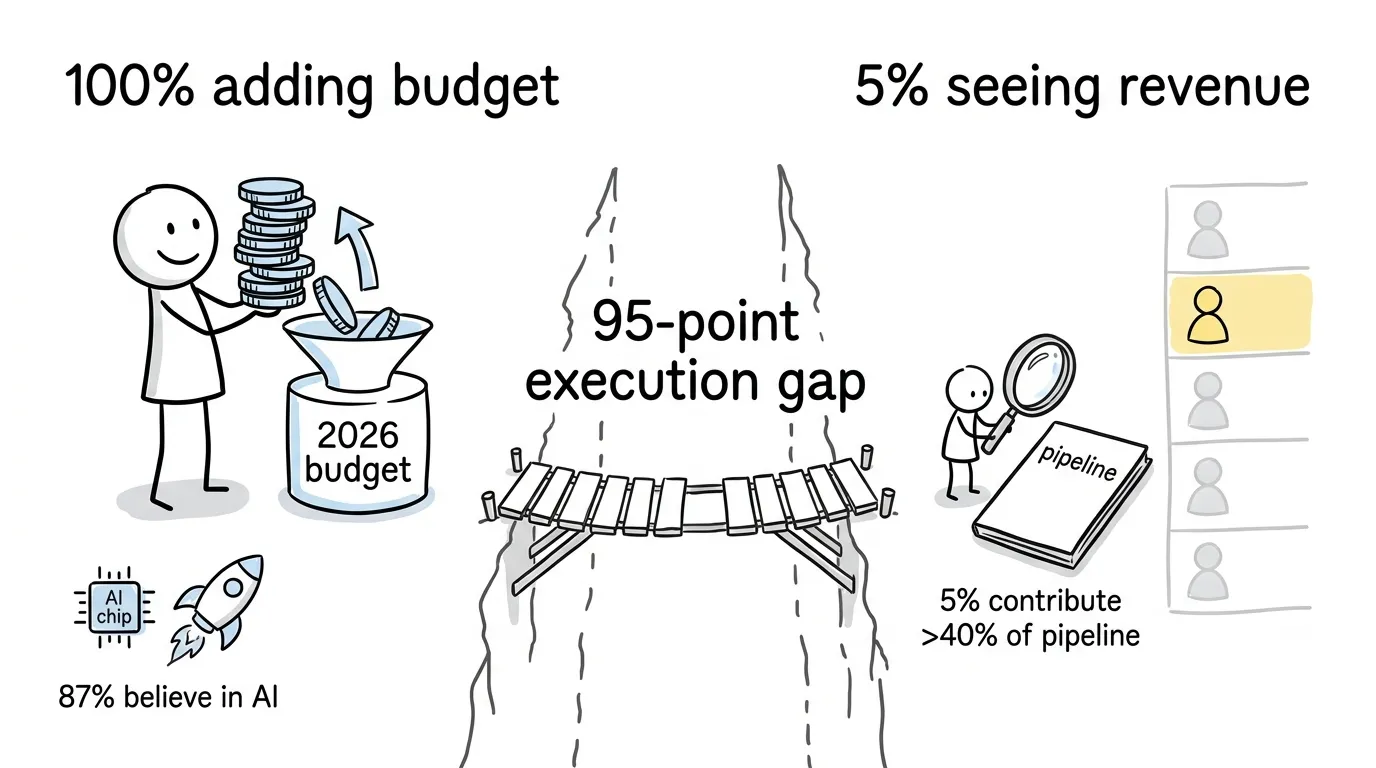
Notice something? Across seven industries, the weak spots differ: technology and finance are stuck on demand generation, media on attribution, healthcare, manufacturing, and life sciences on segmentation. But the disease is the same: budgets go up gladly, capabilities grow slowly.
CMOs and CROs: Where Should the Five Cuts Fall?
So what do you do?
Squeeze another 5% of optimization out of last year's plan? Useless. A situation like this calls for structural surgery. I've boiled it down to five moves.
The first cut: chop up the org chart drawn by channel. Stop organizing by paid media, events, and website. Redraw around customers and revenue outcomes. Demand generation, customer marketing, digital experience, operations & analytics — these teams need one set of goals and the same yardstick.
The second cut: manage AI like an investment portfolio. AI isn't done the moment you buy software. Every use case needs an owner, an expected outcome, governance standards, and a measurement plan. An AI project that can't answer for those four things isn't an investment — it's a fad.
The third cut: sit down with sales and customer success and draft one shared business scorecard. Count pipeline contribution, yes — but also conversion rates, customer acquisition costs, sales cycle length, retention, expansion, and marketing productivity. One card, everyone looking at the same numbers, arguing about the same thing.
The fourth cut: fill the gaps — but fill the right ones. What's missing is governance, lifecycle management, revenue analytics, operational discipline. Hiring ten more channel specialists at a moment like this is buying nicer oars for a leaking boat.
The fifth cut, the harshest: put a price on not being able to do the math. What happens to companies that can't articulate the link between marketing spend and business results? Confidence in the budget slides steadily, the customer experience gets owned in disconnected pieces, technology gets over-bought and then bought all over again, and decisions get slower and slower.
Which cut hurts the most?
The fifth. The first four are choices; the fifth is a matter of time.
From Here On, the Winners Are Those Who Dare to Pin Numbers on AI
The competition ahead comes down to who dares to nail AI's output to revenue. Who adopted AI first matters far less.
A few directions worth betting on: push AI from "we've adopted it" to "we can account for it"; use sharper segmentation and sales–marketing alignment to forge demand generation into a real craft; use shared measurement standards to make the attribution ledger solid; and let marketing's reach extend across the full lifecycle — acquisition, retention, growth, all of it.
When the dust settles, the organizations that win are the ones that can trace marketing spend, cleanly and clearly, to pipeline, revenue, and customer value.
At the end of that dinner, I told my friend: the CFO's question is actually a gift. He isn't giving you a hard time — he's telling you, ahead of schedule, what the price of admission for marketing will be at the next table.
Whether you can answer "how much revenue did it buy back" — that is the ticket.
Go home and do the math.
Here's to being the first to get the books right.
Continue reading
Related articles

It's 2026: Stop "Buying" AI Tools for Your Marketing Team — Start "Hiring" AI Agents
This learn article explains how AI agents differ from standalone AI tools in marketing, outlines three agent categories — build-your-own platforms, CRM-native agents, and vertical tools — and covers use cases across SEO, social media, advertising, and reporting, plus criteria for choosing one.

Did the Money You Spent on AI Marketing Ever Come Back?
A guide to measuring AI marketing ROI across three layers: ad reports, sales pipeline, and the financial ledger. Covers metrics such as ROAS and CPA, eight dashboard metrics, industry benchmarks, and common measurement mistakes.

How to Pick a Creative Automation Platform: First, Figure Out What These Eleven Actually Do
A learn article sorts eleven creative automation platforms — including Bannerflow, Celtra, Smartly.io, and Storyteq — into four functional groups and proposes five evaluation questions covering publishing reach, automation depth, ease of adoption, team fit, and verifiable evidence.