
Why AI Shopping Assistants Can't See Your Brand in Europe
Explains why AI shopping assistants may overlook cross-border brands in Europe, attributing it to fragmented carrier networks and inconsistent fulfillment data rather than marketing. Argues that consolidating carrier data into standardized, machine-readable fulfillment records is what makes a brand visible in AI-driven
Not long ago, a friend of mine who runs a cross-border e-commerce business asked me out to dinner. The dishes had just arrived when he started venting about something strange.
His brand was doing fine in the US. His paid acquisition had a method to it, his repeat customers were loyal, he ran his own warehousing and fulfillment — everything ran smoothly. But the moment he crossed into Europe, strange things started happening: when users in America searched with AI, his products often got recommended. Yet when users in Germany, France, and Spain asked the exact same questions, ChatGPT and Gemini wouldn't mention him at all.
"Liu Run, do you think the platforms are discriminating against me?"
I told him: actually, no. Your problem, most likely, sits in a place you'd never guess: logistics.
It's not that AI can't see your marketing. It's that it doesn't trust your fulfillment.
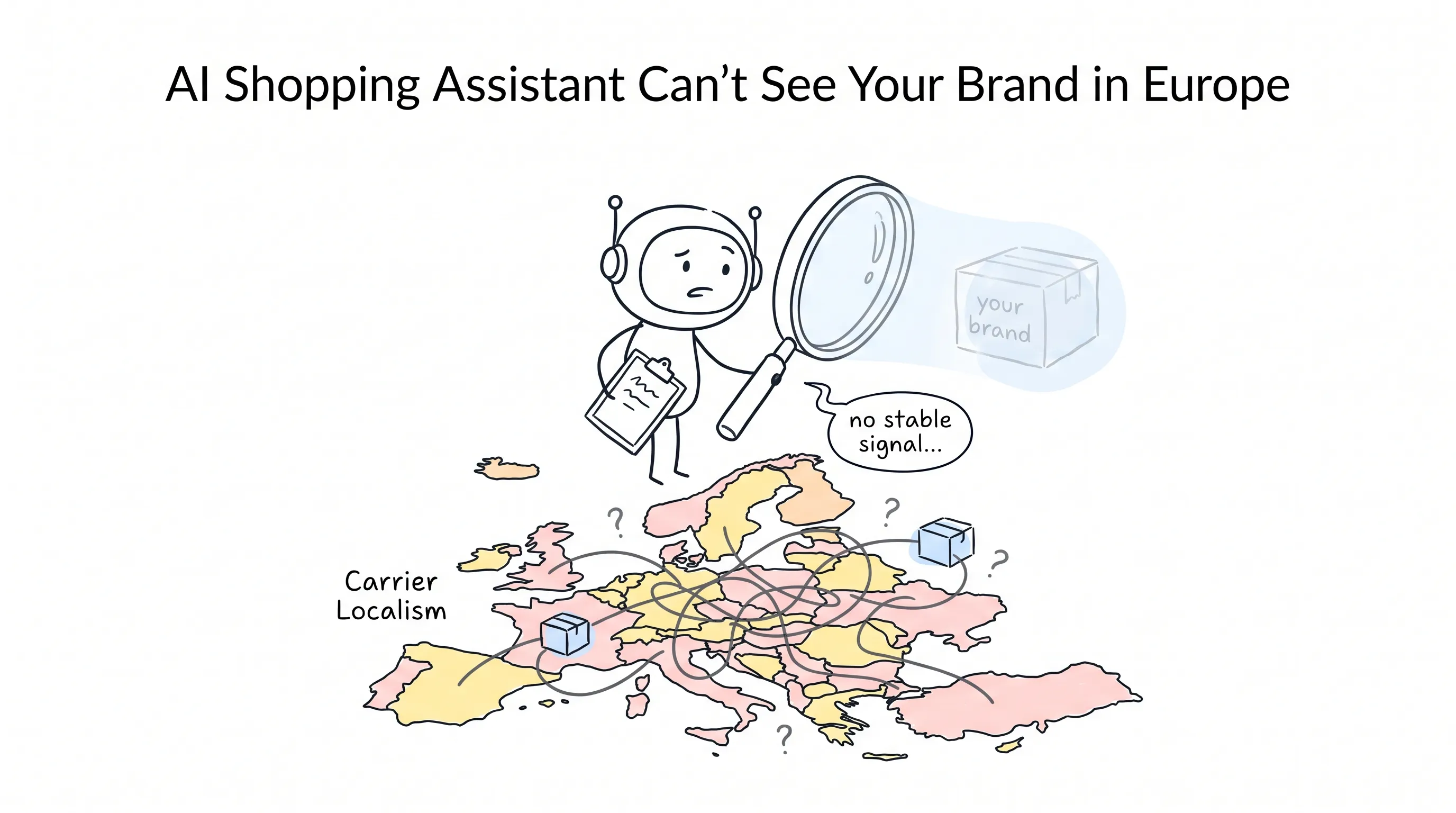
What is "Carrier Localism"?
Some background first.
The US parcel market is highly concentrated. A handful of big companies, one national network, broadly consistent service levels. When you manage logistics in the US, you're managing a single network.
Europe is not. Europe is a patchwork of countries. National postal services, regional couriers, last-mile specialists — each handles its own stretch. The same carrier can perform brilliantly in Germany, turn mediocre in Spain, and may have no presence at all in Poland.
The industry has a name for this: Carrier Localism — the same carrier network, once it crosses a border, sees wildly volatile delivery times, quality, and costs.
Many European retailers admit it themselves: serving this many carriers at once is one of the most painful jobs in cross-border operations. For an American brand, it usually lands as a messy stack of service agreements and a report you can never finish piecing together.
You look at this and call it operational complexity — grin and bear it.
AI looks at this and calls it unreliable fulfillment — and won't put you in front of users.
Same facts, two readings. The second one decides whether you do any business at all.
How does AI "see" a brand?
What is an AI shopping assistant? Picture a particularly cautious purchasing assistant. Its greatest fear is recommending the wrong thing. A few bad calls, and users stop trusting it.
So it only recommends brands it trusts. And whether it trusts you comes down to data.
Your European logistics data is scattered across dozens of carriers, each with different formats and different tracking standards. In AI's eyes, this isn't richness. It's chaos. From chaos you can't extract a stable signal that proves "this brand does what it says."
From there, the trouble compounds, link by link.
Vague promises. Your checkout page says "5–10 days, Europe-wide," which looks solid enough. But your competitor tells German users "2 days, on the dot." When the AI assistant makes the trade-off for the user, it will most likely pick the one bold enough to promise a precise date.
Abandoned orders leave a trail. A survey of European cross-border shoppers found that 49% of abandoned orders were because shipping cost too much, and 38% because delivery was too slow. AI can read all this behavioral data. Read enough of it, and it sticks a "poor buying experience" label on your brand.
Radio silence before delivery. Packages get handed between carriers, and the tracking trail keeps cutting out mid-route. Users get anxious, "where exactly is my package" tickets climb, and bad reviews follow. And emotion is a signal AI reads just as well.
A tangled mess of data, in AI's eyes, is roughly equal to a brand not worth recommending.
The bill is bigger than you think
Some will say: if it can't see me, fine, I still have other channels.
Let's run the numbers.
Some research says visitors arriving from AI search convert at 23 times the rate of traditional search visitors. Re-verify the multiple if you like; the direction won't change: people willing to let AI help them decide arrive with clear purchase intent. This is the highest-intent traffic there is.
And that crowd is growing. 39% of consumers already routinely use AI to find products; among Gen Z, more than half. Losing them means handing your most eager buyers, on a silver platter, to the competitor who got their logistics data cleaned up.
There's more. McKinsey's research ran another calculation: when a brand's delivery experience swings good and bad across regions, customer lifetime value (CLV) in those markets can shrink by as much as 15%.
So here's the picture: AI not recommending you is the short-term loss; a user getting served once by your competitor, with a bad experience, is the long-term loss.
Debts owed on logistics always get collected in the end — principal plus interest — on the brand's ledger.
What to do?
There's really only one direction: upgrade from "managing carriers" to "managing fulfillment data."
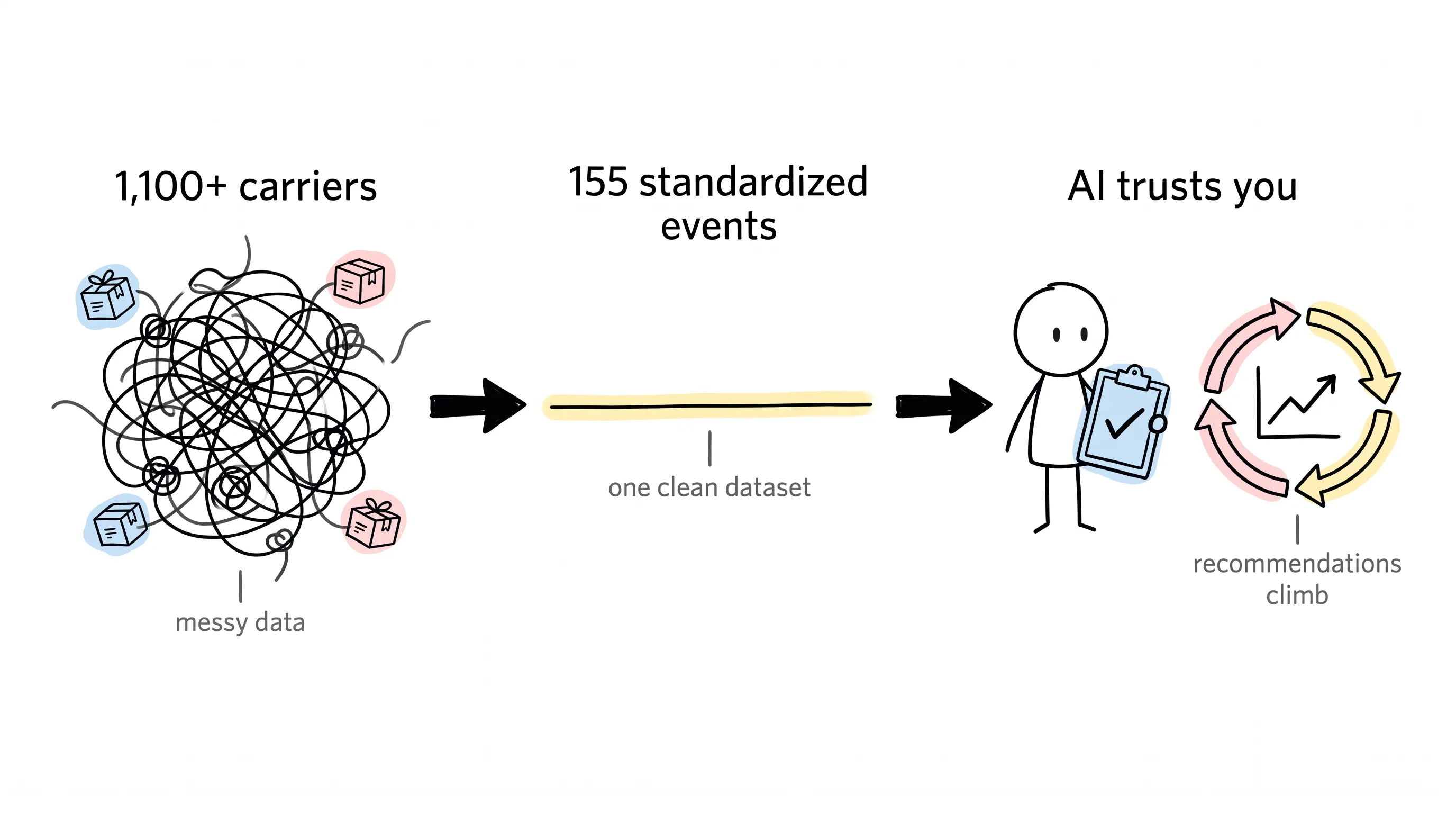
From the moment an order is placed to the moment it's signed for, it doesn't matter how many carriers the parcel passes through. What matters is that every event flows into the same dataset, so AI reads one clean, standardized, machine-readable fulfillment record.
That's exactly what Perform.AI is doing. Its AI Decision Intelligence cleans the messy data of 1,100+ carriers into 155 types of standardized logistics events, processing billions of parcel data points every year. The tangled mess twisted into a single thread — and suddenly AI can read you, and your fulfillment capability becomes "visible" for the first time.
With that foundation laid, there's a next step. Its other product, AI Commerce Visibility, tracks where your brand shows up in AI recommendations, connecting real fulfillment performance with AI rankings. Run the operations solidly, the data turns clean, trust signals accumulate bit by bit — and recommendations start climbing.
Just like that, a flywheel starts turning.
What's really worth pondering comes later
Today's AI assistant punishes you by not recommending you — by making you invisible.
The next generation may take your fulfillment record and proactively tell users: this brand is often late, buy with caution.
Think about what that means. Every promise your marketing team makes, from now on, has a system that never forgets reconciling it against operational data.
Epilogue
Before that dinner broke up, I told my friend: don't rush to add ad budget for Europe; first straighten out your fulfillment data.
The day it's straightened out is not the day AI starts recommending you.
It's the day you finally qualify to be recommended.
May you and your brand get seen by AI — sooner rather than later.
Continue reading
Related articles

What Is GEO? How Your Brand Gets "Mentioned" in the Age of AI Search
An explainer on GEO (Generative Engine Optimization) for e-commerce and DTC brands: how it differs from SEO and AEO, why AI answers shape brand visibility, and eight practices covering question-focused content, consistent brand messaging, structured pages, external evidence, comparisons, and AI mention tracking.

AI Is Already Making Decisions for Your Customers. Are You on the List?
A learn article explains GEO (Generative Engine Optimization): why AI-generated answers now shape which brands customers see, and how SEO fundamentals, entity clarity, citable evidence, and monthly measurement affect visibility in AI answers.

Google Is Stuffing Ads Into AI Search: These Recent Stories Are Really One Story
A news roundup linking recent AI marketing stories—Google adding ads to AI Mode, Amazon's Ads Agent, ChatGPT image updates, a UK startup tracking brand mentions in AI answers, and an AI ransomware warning—arguing that control over ad data and visibility is shifting toward platforms.