
AI's Answers Never Mention You? Don't Rush to Write New Articles
Explains how to diagnose why a brand is missing from AI answers, covering coverage, extraction, and citation-support gaps and the difference between mentions and citations. Outlines a four-step workflow—pulling prompt data, keeping records, auditing content, and prioritizing—plus fixes, metrics, and common traps.
A couple of days ago, a friend who runs a SaaS business invited me to dinner. The first thing he said when we sat down: "I'm going to write 50 articles in one go."
I asked: why?
He said he had taken a batch of questions his customers often ask and fed them to ChatGPT — and found that his product never showed up in the answers. His competitors, on the other hand, were there every single time. He panicked and concluded: not enough content, so the answer was more volume.
I asked him only one question: are you sure what you lack is "articles"?
He froze. He thought about it for a long while, and then said: no, not sure.
That's what I want to talk about today. In the AI era, "content gaps" don't look the way they did in the SEO era. If you look at them through old eyes, you'll write 49 articles for nothing.
What Is a Content Gap for AI Visibility?
Simply put: among the questions users ask AI, there is a spot that should belong to you — and you're not in it.
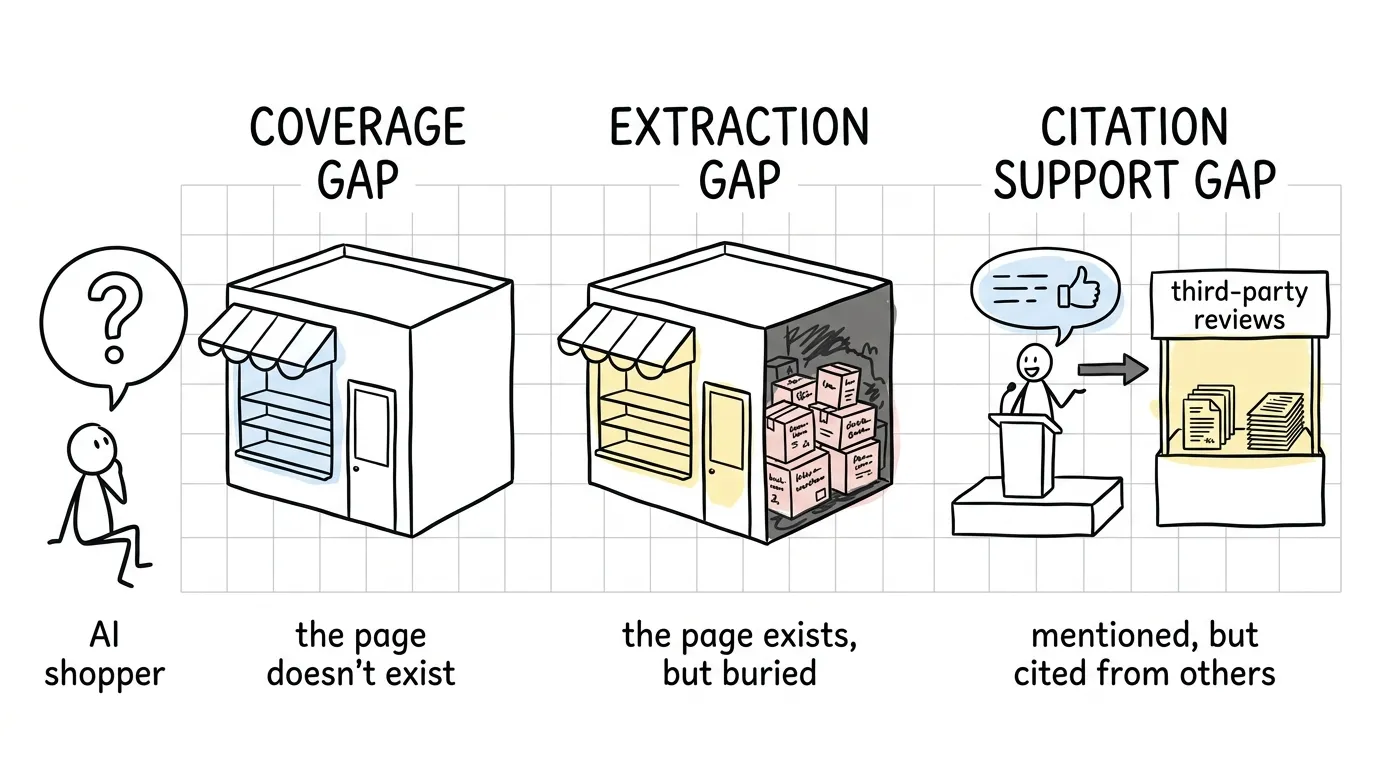
And there are three ways to be missing. Here's an analogy: think of your content as a store.
The first is a coverage gap. Someone comes asking a question, and your store simply doesn't stock anything that answers it. Say you sell furniture and a customer asks "how do I make my office quieter" — you have no soundproof-window product line. What's missing is the page itself.
The second is an extraction gap. You have the goods, but they're piled in the warehouse, never shelved, and the labels are written in scrawl. The page exists, but the useful information is buried in sales copy, and AI can't find it, can't understand it, can't take it away.
The third is a citation support gap. AI mentions you, but the evidence backing the answer gets cited entirely from other people. It's like a host praising you on stage, then turning around and saying "for detailed specs, see the third-party reviews." You got the face time, but you didn't earn the trust.
These three often overlap. A single page may have the right topic, but an answer that isn't direct enough, and evidence that falls short. So don't rush to classify and call it done — what you're diagnosing is: within the ecosystem of this answer, which piece is actually missing?
Here's the spot where beginners trip most often.
Being mentioned and being cited are two different things.
Being mentioned means your name appears in the answer. Being cited means the answer links to your page as its supporting source. Sound similar? They're miles apart.
Example: someone asks AI "which project management tool is best for agencies," and AI recommends a certain platform — but for details like pricing and integrations, it cites a review site. The brand got its face shown; not one word of its own content was used.
The reverse doesn't hold either: being cited isn't the same as being recommended. AI linking your page as a reference doesn't mean it recommends you to readers, still less that anyone clicked the link, still less that the deal was won.
So when you keep records, these two columns must be kept separate. Merge them into one number called "visibility," and you'll never know where the medicine should go: did you fail to make the list, or did you make the list but fail to become the source? These are two diseases, and they need two different prescriptions.
Four Steps to Find the Gaps
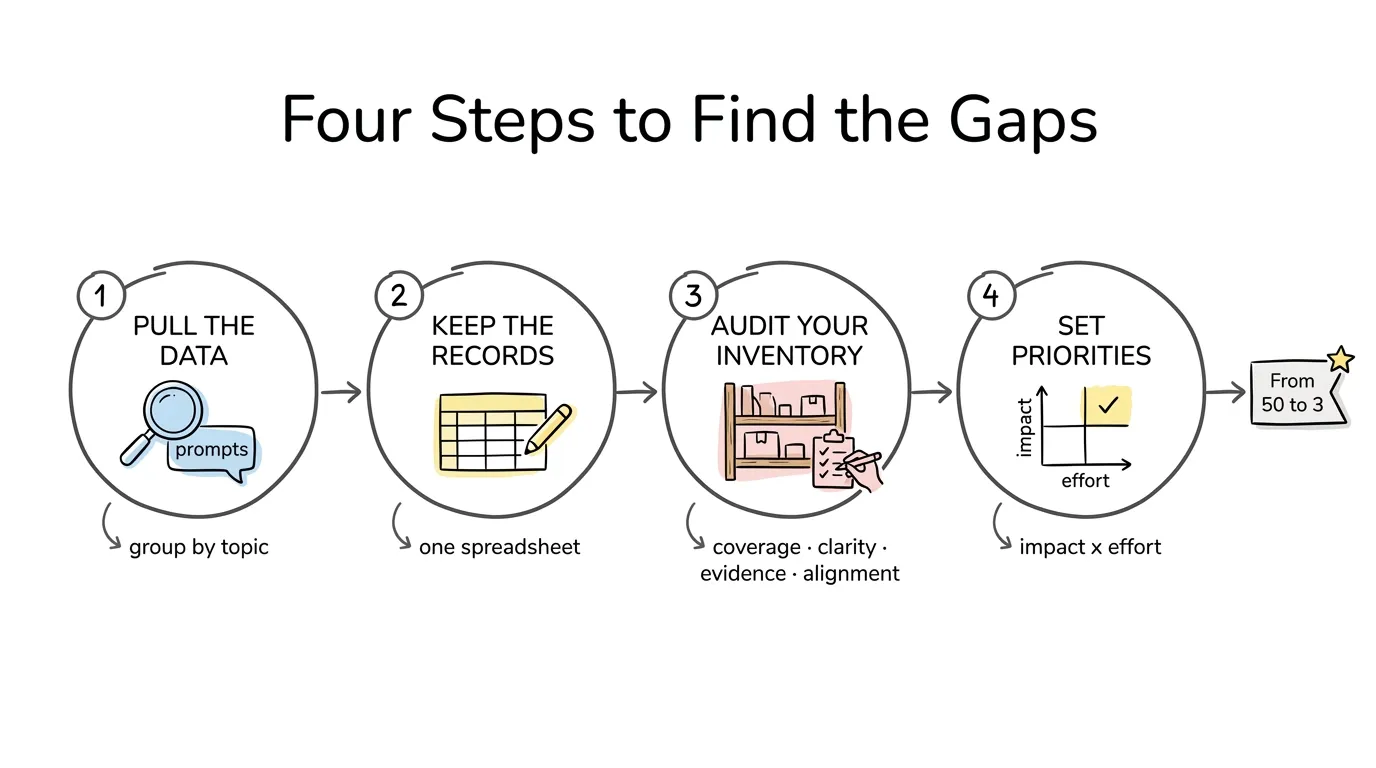
Where to begin? The whole exercise has four steps: pull the data, keep the records, audit your inventory, set priorities. Don't shuffle the order.
Step 1: See How AI Currently Talks About You — and Where It Leaves You Out
First, pull a set of prompt monitoring data. Prompts are the questions users throw at AI. Pick a batch of questions that genuinely represent your customers — the ones people ask while learning, comparing, and getting ready to pay — and see where you appear in the answers and where you're absent.
On the tooling side, HubSpot's AEO (Answer Engine Optimization) tool can track your brand's performance across ChatGPT, Gemini, and Perplexity: mentions, citations, and competitors, all on one dashboard. Google's AI Overviews are worth bringing into scope too.
One caution: once you have the questions, don't treat them as scattered points — group them by topic and intent. The same need gets asked in a hundred different ways. Take AEO consulting services: the questions might fall into three groups — which firms to compare, how a CMO should choose, what a large content team needs. Three questions, one need, three angles. Don't turn each phrasing into its own content topic, or your content calendar will drown in the permutations of phrasing.
And one iron rule: look at each platform separately. For the same question, ChatGPT and Perplexity may give entirely different answers and cite entirely different sources. Blend them together and you've calculated nothing.
Step 2: Grab a Spreadsheet and Keep Honest Records
Run each prompt group through the AI and note: which platform, which day, which brands the answer mentioned, which sites it cited. One spreadsheet is enough. It's a crude method, but it works.
I know a consultant who does AI search visibility advisory. She tested one prompt: "Which AI search visibility audit service is right for a fast-growing B2B SaaS startup?" ChatGPT recommended Profound, Otterly, Scrunch, and Peec AI — all monitoring software. Not a single firm doing consulting-driven audits made the list. She recorded the row in her sheet: prompt, platform, date, brands mentioned, sources cited.
Once the records are in, your observations will fall into roughly five buckets:
- You're absent; competitors are present. What to check: do you have relevant content at all? Is the answer weighted toward capabilities or evidence you haven't covered?
- You're mentioned, but not cited. What to check: what is it citing as its source? Can your pages produce information just as solid and just as verifiable?
- You're cited, but not recommended. What to check: is the cited page purely informational, never taking on the decision question of "who should you pick"?
- Mentioned and cited. What to check: did the answer get you right? Is this performance stable — still there when you rephrase the question?
- You're absent, and no one is clearly recommended. What to check: does this question even relate to your business? Does the answer need to name brands at all?
The output of this step is a small handful of prompt groups you can see clearly — not a pile of vague anxiety. With the classification in hand, you won't reflexively write another article just because a citation didn't land.
For instance, if your brand keeps getting mentioned but all the feature details come from third-party directories, the thing to do right now is go back and fill in your product documentation. Ten more thought-leadership masterpieces won't help.
Step 3: Match the Questions Against Your Own Content
Watching what AI says isn't enough; you have to go back and take inventory. For each priority prompt group, search your own website and content library: product pages, docs, comparison pages, case studies, research, blog posts — is there a page already answering this question?
For every page you find, measure it with four yardsticks:
- Coverage. Does the page truly answer this question, including the small forks hidden inside it?
- Clarity. Can a reader quickly find the answer, and the facts supporting it?
- Evidence. Where data, cases, or first-hand experience are due — are they given?
- Alignment. Are the audience, scenario, and decision criteria this page serves the same crowd as the people asking?
Back to that consultant, and here's where it gets interesting. Her audit service page itself was written clearly: who it serves, what's included, all there. But AI understood "audit services" as "audit software" — it recommended all tools and cited all tool reviews. The prompt plainly asked about services; AI heard software.
So what's the real gap? Another page singing the praises of her own services? No. It's a piece that clearly explains "how monitoring platforms and consultant-led audits actually differ, when to use which, and why a scaling B2B SaaS might need both." That's filling an information need, not making a self-introduction.
When AI doesn't mention you, it isn't necessarily that you lack content — it may be that AI never understood the question as the question you thought it was.
One more humbling check before you act: does the company actually offer this product or service? A missing mention could hide a content gap — or a capability gap, a positioning problem, or a question that simply isn't yours. Don't build shelf space for goods that don't exist.
Step 4: Set Priorities — Don't Spread Effort Evenly
A pile of gaps found. Which one first? Two dimensions: business impact and effort cost.
Big impact, small change: do it now. Focus on refreshing existing pages and adding the missing evidence. Big impact, big change: make it a project. You may need to pull in product and engineering. Small impact, small change: fold it into work already under way. Small impact, big change: shelve it. Note why you shelved it, and pull it back out when the business changes.
For that consultant, the "audit services for B2B SaaS" prompt hits the bullseye: it aligns exactly with her target customers and her services, and the AI answer genuinely drops the "consultant-led audit" half of the question. Worth a project.
By the way, the third-party sources being cited are worth a look too. Since all the citations are software reviews, pitching a consultant's-perspective piece to an industry publication might be another route in. It's a different move from fixing your own site, but it plugs the same gap.
Understand the Answers Before You Fill the Gaps
For each priority prompt group, do three things: read the AI's answer closely, open the pages it cites, and compare against the results from traditional search.
Note: this step is not about copying your competitors' articles. It's about figuring out: what kind of information does this answer "feed on"? Do the cited pages define things more directly? Do they have product docs, fresher data, worked examples you can follow? Are they serving a different audience, a different scenario?
Once you've compared, the most common flaw is poor extractability. What is extractability? In a page of content, can the useful information be easily found, understood, and taken away — by humans, and by AI too? The fixes boil down to a few moves:
- State the answer up front, then unfold the benefits and background.
- Write subheadings that say what each section answers — skip the generic headers that could sit in any article.
- Keep every claim next to its explanation and evidence; don't make readers hunt across the page.
- Use tables where tables fit, numbered steps where steps fit, and save prose for where nuance is truly needed.
- Drop the internal jargon; use the words users use.
- Don't stash key information inside images only.
- Align product descriptions, specs, and terminology across pages wherever they should match.
But remember: good structure is good for readers. It doesn't guarantee that AI will cite you.
What truly gives a page its ballast is original information: first-hand experience, research you ran yourself, expert analysis, customer stories, product details only you could write. And the originality has to solve someone's problem. An "exclusive dataset" with no methodology disclosed is worth less than one real case a reader can act on.
When you do research, disclose sources, dates, sample sizes, and methods. When you publish customer stories, get permission first and scrub the confidential bits. When you quote experts, don't stretch their meaning into what you wanted to say.
Filling Gaps Comes Down to Five Moves
Diagnosis done. What do you do?
- The page exists but is stale or broken → Refresh it: update the answer, the examples, the product details, the supporting data.
- The page exists but says it badly → Rewrite: fix the vague passages and move the answer up front.
- The messaging exists but can't hold up → Add evidence: docs, cases, research, expert voices.
- No page matches at all → Build one. But first ask whether it should be folded into an existing resource. Five articles shredding one topic into pieces lose to one article that nails it.
- The question is too peripheral, the capability irrelevant, the evidence too thin → Note why, and shelve. Bring it back when circumstances change.
For anything new, write the brief properly: who it's for, which question it must answer, what evidence it needs, how it differs from what you already have. For anything old, don't tear it down and start over — keep the parts that already work and make focused improvements.
After publishing, write one more line: which page, which gap, what date, which prompt group you're watching. Skip this ledger and two months from now you won't be able to explain why anything rose or fell.
How Do You Know It's Working
Four metrics, all computable by hand:
Brand mention rate = answers mentioning you ÷ total tracked answers × 100 Citation rate = answers citing at least one of your URLs ÷ total tracked answers × 100. Note: if one answer cites three of your pages, it still counts once — you're counting answers, not links. AI share of voice = your appearances ÷ total appearances of all tracked brands × 100. You can also compute it on the citation basis, but the two bases measure different things — pick one and stick with it; don't switch back and forth. AI-driven visitors and follow-on actions. HubSpot's traffic analytics tag visits from AI assistants separately as AI Referrals, and contact records carry that source, so you can trace it all the way to leads and closed deals.
But first, three splashes of cold water.
First, AI answers differ from one run to the next. You're absent this time; present next time. So record a baseline first, then keep observing with the same method, the same prompts, the same platforms — gather several rounds of observations before you read anything into it. Don't treat a single fluctuation as a signal.
Second, competitors move, and platforms move too. Mentions rising doesn't necessarily mean your articles did the work. Keep a change log: when content changed, when the product shipped anything major, whether the tracking method was adjusted.
Third, traffic data captures only half the story. Someone learns of you from AI, then searches for you elsewhere — that visit never gets credited back to AI. So read mentions, citations, and traffic as three ledgers side by side, to understand trends — not to attribute any single article's precise contribution.
By the way, you can start with no analytics tools at all. Fix a set of prompts and record the answers manually. Just be clear that this measures visibility within your tracked sample — not how many people saw it, or how many made it to your site.
The Three Most Common Traps
- Chasing every gap as it appears. AI answers are jittery by nature; if you open a new project every time a mention goes missing, your editorial calendar becomes a reflex to noise. Group, watch trends, and act only when the evidence accumulates.
- Spreading effort evenly. A brand may be absent from the big, popular questions yet show up constantly in the specific ones its customers actually ask. The latter is your home turf. Watch the prompts tied to your services, your audience, and the purchase decision.
- Writing pages like dictionary cards. Pages full of short definitions, repeated subheadings, and standard-issue answers — AI extracts them beautifully, and humans find nothing to read. Format exists to organize information, not to replace it. AI can help you draft and structure, but whether the facts are checked, the sources hold up, and the piece answers what people really ask — a human has to be the gatekeeper.
The Tools Matter Less Than the Ledger
The tooling barrier here is actually low.
One spreadsheet, two tabs. One records raw observations: prompt, platform, date, answer summary, mention status, citation status, competitors' cited sources, your corresponding page, gap type, impact and cost, next step, owner and review date. The other summarizes by prompt group. Never delete the raw observations — otherwise the changes between runs are lost.
One brief. The template isn't complicated, but the most important field is "why this piece must be written." A prompt list only tells the writer what people are asking; it can't say what your existing content lacks, or why the new piece is the one to fill it.
If you want a running start, HubSpot has two free entry points. AI Search Grader is like a check-up clinic: it scores your brand's recognizability, sentiment, share of voice, and market position in AI answers — good for a first read on where you stand. HubSpot AEO is continuous monitoring, watching mentions, citations, and competitors across ChatGPT, Gemini, and Perplexity; users on Marketing Hub Professional and Enterprise can even let CRM data suggest which prompts to track. After the check-up, you still come back to the fine craft above: group, keep records, audit your inventory.
What Happened Next
Back to the friend who wanted to write 50 articles.
He ended up writing 3. He pulled the prompt data first, grouped it, kept his records — and found only three things actually worth doing: refresh one old page, add one set of product evidence, and write one piece on "monitoring platforms vs. human-led audits."
From 50 to 3.
Fill the gaps that affect the business — not every instant of your absence from AI's answers.
AI generates answers tens of millions of times a day. Your absence from one of them doesn't make each one worth rescuing. First find out whether what's missing is a page, clarity, or evidence — then decide whether to act.
So here's my wish for you: a permanent seat in AI's answers — one you can explain, and one that holds.
Continue reading
Related articles

What Is GEO? How Your Brand Gets "Mentioned" in the Age of AI Search
An explainer on GEO (Generative Engine Optimization) for e-commerce and DTC brands: how it differs from SEO and AEO, why AI answers shape brand visibility, and eight practices covering question-focused content, consistent brand messaging, structured pages, external evidence, comparisons, and AI mention tracking.

AI Is Already Making Decisions for Your Customers. Are You on the List?
A learn article explains GEO (Generative Engine Optimization): why AI-generated answers now shape which brands customers see, and how SEO fundamentals, entity clarity, citable evidence, and monthly measurement affect visibility in AI answers.

Google Is Stuffing Ads Into AI Search: These Recent Stories Are Really One Story
A news roundup linking recent AI marketing stories—Google adding ads to AI Mode, Amazon's Ads Agent, ChatGPT image updates, a UK startup tracking brand mentions in AI answers, and an AI ransomware warning—arguing that control over ad data and visibility is shifting toward platforms.