
96% of Marketers Are Using AI. So Why Isn't Marketing Getting Any Better?
A learn article reviewing a WFA survey on AI adoption among brand marketers: usage has spread from content and efficiency tasks into strategy and workflow automation, while teams say they want effectiveness but mostly measure efficiency, and agency AI use remains unclear without contract disclosure.
I recently came across a survey from the World Federation of Advertisers (WFA). The WFA is the global trade association for brand owners — think of it as something like a homeowners' association for advertisers.
They asked 54 marketing leaders from 46 brands one question: do you use AI?
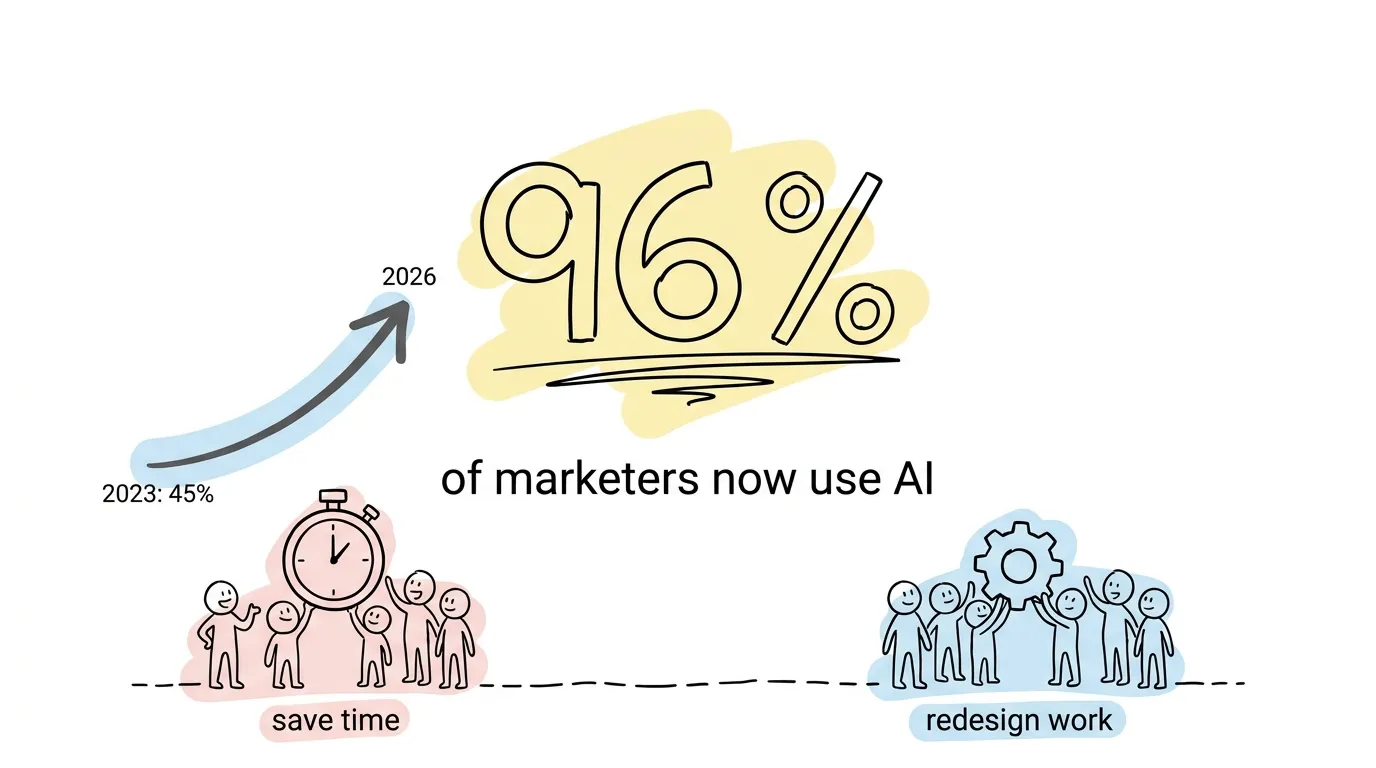
96% said yes.
That stopped me for a second. In 2023, the figure was still 45%.
Three years, and it has more than doubled.
The "use" here means generative AI — or, a step further, agentic AI. What's agentic AI? You hand it a task, and it breaks the task into steps on its own, runs them on its own, and hands the results back when it's done.
In other words, AI in marketing circles is no longer some "emerging capability." It's just routine — no different from using Excel.
But don't rush to conclusions. The most valuable part of this survey isn't the 96% — it's the numbers that come after it.
1. Everyone Is Using It — but the Depth of Use Varies Hugely
In October 2025, the WFA ran the same survey. Back then, 23% of marketing teams used AI "sporadically" — trying it when they remembered, dropping it when they forgot.
Now, that number has fallen to 16%.
The moderate users have barely moved, holding at around 57%.
So where did the rest go?
Into deep use. A year ago, only 16% of teams dared to claim they were using AI in depth. Now, 27%.
Think about what that tells you. AI in marketing is shifting from a novelty into daily life. A few years ago everyone scrambled to try it for fear of falling behind; now what actually separates teams is who has embedded it into their workflow — into every single move of the working day.
2. The Use Cases Are Moving into Deep Waters
So what are people actually using AI for?
Content creation, 80%. Efficiency, 74%. Research, 72%. Media buying and campaign optimization, 54%.
None of that is surprising. What's surprising are the next two numbers: strategy and planning, 48%; workflow automation, 46%.
Strategy used to be the marketing person's private plot of land — the part they were least willing to hand over to machines. Now, nearly half of teams have let AI in.
That's a signal. Tools always take root first in execution-oriented, agency-style territory — the kind of work that's easiest to deliver. Once AI seeps into strategy and process, it means brand owners have started treating it as a "colleague," no longer just a "magic wand."
3. They Talk Effectiveness — and Measure Efficiency
The old math was easy. Write a piece with AI: two hours before, twenty minutes now, an hour and forty minutes saved. That's efficiency — visible and tangible.
Now, brand owners have started working out a different equation: can AI make my marketing actually sell better?
In the survey, those naming efficiency and those naming effectiveness as AI's primary goal each came in at 22% — a dead heat. Another 18% are eyeing business growth, and a third of teams say: we want all three.
That's a good sign. Efficiency has a ceiling — you can only squeeze so much out of an hour and forty minutes before there's nothing left to save. Effectiveness is different: it's another growth curve entirely.
But here's where it gets interesting.
Ask them about their goals, and they say effectiveness. Then look at what they actually measure:
Time saved, 52%. Money saved, 52%. Output gained, 52%. Faster to market, 45%.
All efficiency metrics.
What they say is effectiveness. What they measure is still efficiency.
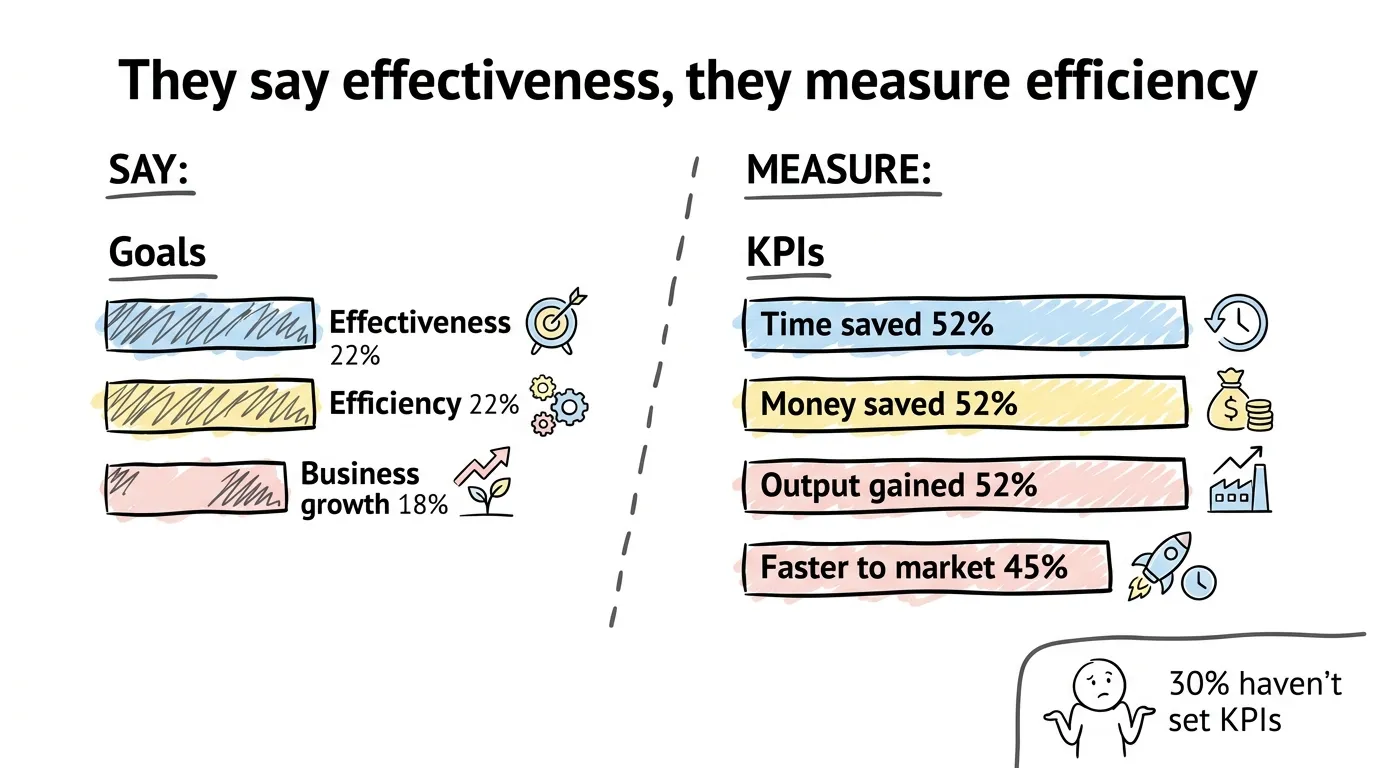
What's even more unsettling: 30% of teams haven't even set KPIs yet.
4. Agencies Are a Black Box
There's one more thing brand owners feel unsure about: are their agencies actually using AI? How much? And what share of the delivered work is AI's?
16% of brands admit they have "almost no understanding" of their agencies' AI use. 29% know only a little. Those who genuinely know where things stand number just 13%.
These are the people you pay serious money to do the work — and you don't even know how the work gets done.
The fix? Write it into the contract.
59% of brands have already added AI clauses to their agency contracts, and another 22% are on their way. 64% have issued one hard requirement: if AI was used, you have to disclose it.
Put simply: contracts used to govern "how much this work costs." Now they govern "how this work gets done."
5. The Biggest Gap Is Not Tools, but People
Finally, the number I think matters most.
Over the next 12 months, what are brand owners' priorities? 63% say, spread AI use wider; 55% say, train employees and close the skills gap.
And how many teams believe most of their employees truly understand AI?
Only 26%.
69% of teams admit that AI literacy varies hugely from person to person. In the same department, some people use AI to do the work of three, while others are still stuck at having it write weekly reports.
Tools can be bought overnight; literacy can't. It gets built one training session and one project at a time.
Final Words
Back to that survey at the start. 96% — it sounds like a party.
But behind the noise, the real dividing line has already appeared: everyone is using AI, yet some use it to save time, and some use it to redesign how they work.
Saving time earns you the margin. Redesigning the work earns you the future.
What this survey never says out loud is probably exactly this.
Wishing you an AI you don't just put to use — but see all the way through.
Continue reading
Related articles

It's 2026: Stop "Buying" AI Tools for Your Marketing Team — Start "Hiring" AI Agents
This learn article explains how AI agents differ from standalone AI tools in marketing, outlines three agent categories — build-your-own platforms, CRM-native agents, and vertical tools — and covers use cases across SEO, social media, advertising, and reporting, plus criteria for choosing one.

Did the Money You Spent on AI Marketing Ever Come Back?
A guide to measuring AI marketing ROI across three layers: ad reports, sales pipeline, and the financial ledger. Covers metrics such as ROAS and CPA, eight dashboard metrics, industry benchmarks, and common measurement mistakes.

How to Pick a Creative Automation Platform: First, Figure Out What These Eleven Actually Do
A learn article sorts eleven creative automation platforms — including Bannerflow, Celtra, Smartly.io, and Storyteq — into four functional groups and proposes five evaluation questions covering publishing reach, automation depth, ease of adoption, team fit, and verifiable evidence.