
88% of Companies Use AI. So Why Do Only 6% Make Money?
This article examines why most AI-marketing adopters struggle to show returns: citing figures that 88% of organizations use AI while only about 6% are high performers, it outlines what profitable teams do differently, from executive involvement and finance-grade metrics to governance guardrails and agentic AI.
A while back, an old friend of mine who works in brand marketing invited me to dinner. Halfway through the meal, he started sighing.
Last year, he overrode the skeptics and pushed AI marketing through his company. He won a healthy budget and rolled out a stack of tools. Early this year, his boss called him into the office and asked exactly one question: the money has been spent — has it come back?
He said: I use AI every day — writing copy, making visuals, running ads. It's not that it's useless. But if you ask me to spell out exactly how much we've made, I can't get the words out.
I told him: the spot you're in is not yours alone. I've recently gone through a mountain of data and found a pattern that stings:
Enthusiasm is the majority. Profit is the minority.
First, the enthusiasm. The enthusiasm is real.
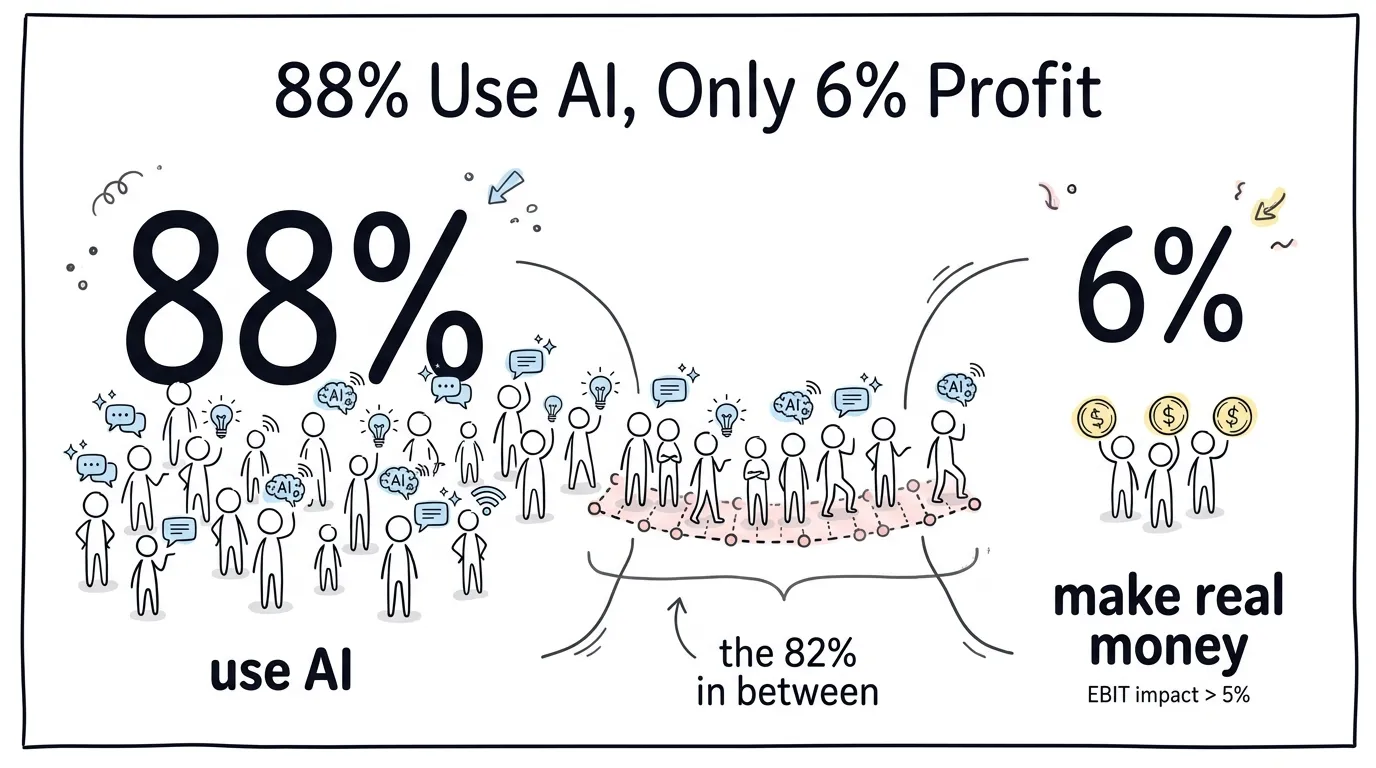
McKinsey ran a global survey in 2025 — 1,993 respondents across 105 countries. The finding: 88% of organizations now use AI regularly in at least one business function. Just one year earlier, that figure was 78%.
Ten points in a single year. That's not slow creep anymore. That's everyone getting on board.
The market tells the story even more bluntly. The AI marketing market was just $12.05 billion in 2020; by 2025 it had grown to $47.32 billion. Five years, up 293%. Analysts project it will top $215 billion by 2027.
The user numbers are staggering too. In 2025, personal AI users worldwide reached 378 million, a net gain of 64 million in one year — the largest annual increase on record. Generative AI adoption hit 54.6% by August 2025. The personal computer took years to reach that level of adoption; so did the internet.
Strong numbers. Genuinely impressive.
But everything has a flip side.
Only 6% are making money
In that same body of research, only about 6% of organizations genuinely qualify as "high performers."
What counts as high performance? Not how many tools you've installed, or how many AI strategy meetings you've held. There is exactly one yardstick, and it's a hard one: AI's contribution to EBIT (earnings before interest and taxes) must exceed 5%. Only 6% get there.
Another data point stuck with me. In 2025, McKinsey interviewed 50 senior marketing leaders at Fortune 500 companies and asked them all the same question: what's the ROI of your marketing tech stack?
Not one of the 50 could answer.
Think about that. The marketing chiefs of the world's richest companies can't do the math on their own AI. No wonder ordinary companies can't either.
88% are using it; 6% are profiting from it. What separates the 82% in between?
Let's run the numbers — and see how ruthless the winners are
First, let's be clear: the winners aren't winning by a little.
Industry statistics from 2025 show that companies that deployed AI marketing solutions earned an average 300% return within six months. This isn't a consultant's theoretical model — it's measured in financial terms.
Take marketing automation, hardly a new race track: for every dollar spent, companies recoup an average of $5.44 over three years, and most break even in under six months. Salesforce says its customers see marketing ROI rise 25% on average after adopting automation.
Now look at the gap. Companies using AI see ROI 22% higher than peers sticking to traditional playbooks. Those deploying AI across three or more functions saw ROI grow another 32% year over year. In 2025 research, AISofto ran the numbers for organizations with AI marketing deployed: revenue up 41% on average, acquisition costs down 32%.
McKinsey tracked companies for three years and found that AI leaders grow revenue 1.5 times faster than their peers, with returns on invested capital 1.4 times higher.
What does 1.5x mean? A one-step lead may not sound like much — what's scary is moving one step faster every single year. Run like that for three years, and the people behind you can no longer see you.
That gap is no longer luck. It's a moat.
Same AI. So where does the difference come from?
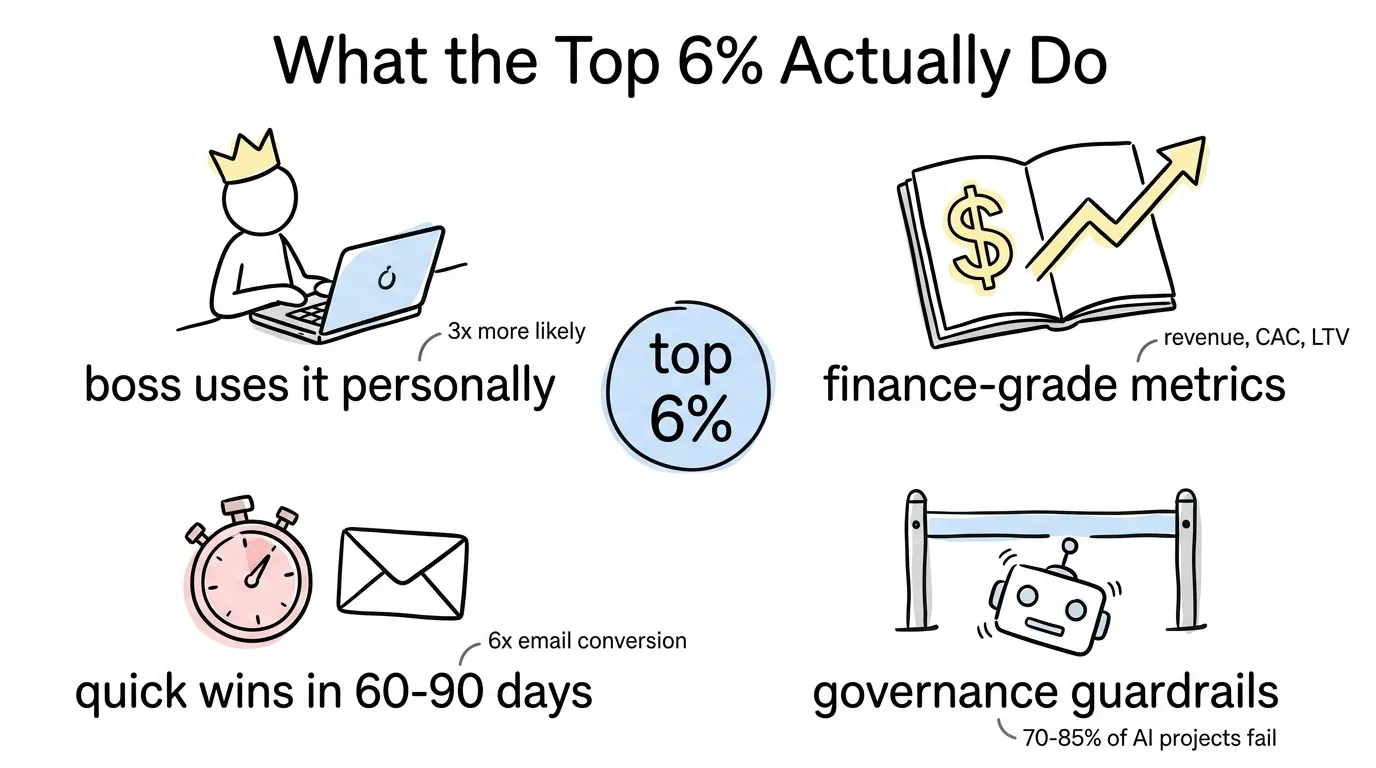
I dug through what the top 6% actually do, and none of it is mystical once you say it out loud.
First: the boss gets in the game personally. In high-performing organizations, executives personally champion AI and lead by example at three times the rate of everyone else. Note this: approving budgets alone does nothing — you have to use it yourself. A boss who doesn't use AI has no idea where things get stuck, and no way to tell whose reports to believe.
Second: they keep the books clear. Plenty of companies adopt AI and their measurement stays stuck at "our efficiency improved." Improved by how much? What's that in revenue? High performers go straight to finance-grade metrics: incremental revenue, lower acquisition costs, higher conversion rates, customer lifetime value.
Third: they don't overreach. They start with high-impact, low-risk use cases and demand returns within 60 to 90 days. Email marketing, for one: AI-optimized personalized emails transact at six times the rate of generic ones. Content, for another: a 1,500-word blog post that used to take 8 to 10 hours to write had, by the end of 2025, been compressed to 2 hours by many teams. 93% of marketers say AI has genuinely accelerated content production, and 65% of companies say AI content improved their SEO.
Fourth: they build governance guardrails. This is the step nearly everyone skips, and the numbers are ugly: in 2025, 70% to 85% of AI projects failed. 77% of enterprises worry about AI hallucinations, and 47% of enterprise users admit they've made major decisions based on content the AI simply made up. Gartner even predicts that by the end of 2027, more than 40% of agentic AI projects will be scrapped over poor risk controls.
The three biggest roadblocks for AI projects in 2025 were data privacy (40.44%), lack of technical skills (37.98%), and implementation cost (33.17%). Notice what's not on the list: "the models aren't good enough." IBM put it even more bluntly in its 2025 analysis: most organizations aren't ready for agents — they're stuck on architecture, not on models.
AI projects die of mismanagement, not of technology.
And here are a few examples involving real money.
Starbucks built an AI called Deep Brew to personalize recommendations for its members — member spending rose 34%. Amazon's recommendation engine drives 35% of its sales every year. An e-commerce company that adopted SuperAGI's agent platform cut acquisition costs by 30% and lifted conversion by 25%. The investment platform Scripbox grew paid subscriptions 33% in three months while cutting customer-support workload by 80%. A real estate firm called Savvy Group turned 1.4 times more leads into customers, with 65% less manual follow-up.
Each of these cases shows off a different kind of technology, but they share exactly one thing in common: every single one ties directly to money.
2026: the lead role has changed
If the last two years were about whether you use AI at all, the contest changes this year.
Because the lead role has changed. So what is Agentic AI?
Here's a way to picture it. Old-school marketing automation is like a cooking machine that follows the recipe: you hard-code the steps, and it executes them one by one, unable to deviate. An agent is a chef who reads the recipe himself: you tell him the goal is to bring this month's acquisition costs down, and he analyzes the data, sets his own plan, adjusts the targeting himself — and reports back to you when it's done.
From tool to colleague. That's a qualitative shift.
The numbers back this up. Organizations expect an average 171% return from AI agents; US enterprises forecast as much as 192%. 74% of executives saw positive returns from AI agents within the first year. Gartner predicts that by the end of 2026, 40% of enterprise applications will embed task-specific agents — up from under 5% in 2025. Eightfold in one year.
Among early movers who bet more than half their AI budget on agents, 88% have seen returns in at least one use case. The average across all organizations: just 74%.
But I owe you the other side of the story too.
In its 2026 B2B predictions, Forrester warns that runaway use of generative AI alone could cost B2B companies more than $10 billion. Consumers aren't at ease either: 72% believe AI will be used to create false information. Gartner even predicts that by 2027, 20% of brands will go the other way and market themselves as "AI-free."
Oh? Now that's a signal worth chewing on. The more widespread the technology, the more valuable "human" and "trust" become.
What happened to those who waited
Finally, a word about the teams that decided to "wait and see."
By 2025, 70% of consumers could already feel the experience gap between AI leaders and laggards: how fast you respond, how personal your experience feels — all of it is under a magnifying glass, compared against rivals armed to the teeth with AI.
And the gap compounds. Fast companies launch campaigns 75% faster than teams building them by hand, and they adjust spend in real time; the money and time they save goes right back in, and the snowball grows. Slow companies face rising acquisition costs and tightening budgets — they want to catch up, but every investment request gets harder to approve.
Traditional search is caving in too. Gartner predicts a 25% drop in traditional search engine usage by 2026, and by 2028 organic traffic could be cut in half as people start finding things through conversational AI assistants. The way your customers look for you has changed — but you're still waiting in the old spot.
A two-speed world. The fast get faster; the slow get slower.
The cost of waiting never shows up in your budget spreadsheet. It shows up on your competitor's growth curve.
A closing word
Back to my friend's question: the money has been spent — has it come back?
The advice I gave him is the same thing I want to leave with you.
Don't rush to buy more tools. Pick one or two high-impact, low-risk use cases first, do the math in finance-grade terms, and within 60 to 90 days produce a number you can take into the boardroom. Then build the guardrails: clean data, defenses against hallucination, metrics tied to revenue, training that keeps pace. Only after that, agents.
Here's a number worth remembering: 75% of marketing teams still don't have a proper AI roadmap. That's both a crisis and an opportunity. It means that if you start now, there's still time to join the few out front.
With AI, enthusiasm has never been the problem — 88% have it.
The real dividing line is whether you can become the 6%: turn enthusiasm into profit.
Here's hoping you get the books in order soon.
Continue reading
Related articles

It's 2026: Stop "Buying" AI Tools for Your Marketing Team — Start "Hiring" AI Agents
This learn article explains how AI agents differ from standalone AI tools in marketing, outlines three agent categories — build-your-own platforms, CRM-native agents, and vertical tools — and covers use cases across SEO, social media, advertising, and reporting, plus criteria for choosing one.

What Is GEO? How Your Brand Gets "Mentioned" in the Age of AI Search
An explainer on GEO (Generative Engine Optimization) for e-commerce and DTC brands: how it differs from SEO and AEO, why AI answers shape brand visibility, and eight practices covering question-focused content, consistent brand messaging, structured pages, external evidence, comparisons, and AI mention tracking.

AI Is Already Making Decisions for Your Customers. Are You on the List?
A learn article explains GEO (Generative Engine Optimization): why AI-generated answers now shape which brands customers see, and how SEO fundamentals, entity clarity, citable evidence, and monthly measurement affect visibility in AI answers.