
AI Marketing Daily · 2026-10-20
AI Marketing Daily for 2026-10-20 rounds up 14 items under the theme that AI's speed dividend is being repriced. It covers HubSpot's one-year AI-first blog retrospective, four GEO pieces on AI search visibility, workflow design over tools, AI agent ROI, cross-border Google Ads, and marketing research.
Today runs on a single theme: the speed dividend of AI is being repriced. The HubSpot blog team opens the books on a year of its AI-first experiment, the GEO camp puts out four substantive pieces in a single day, and MarTech takes aim at workflows rather than tools. Read all 14 items and you'll understand why production capacity is no longer a barrier.
🎯 Today's Headline
The HubSpot blog team opens the books: one year into AI-first, drafting is faster but content isn't
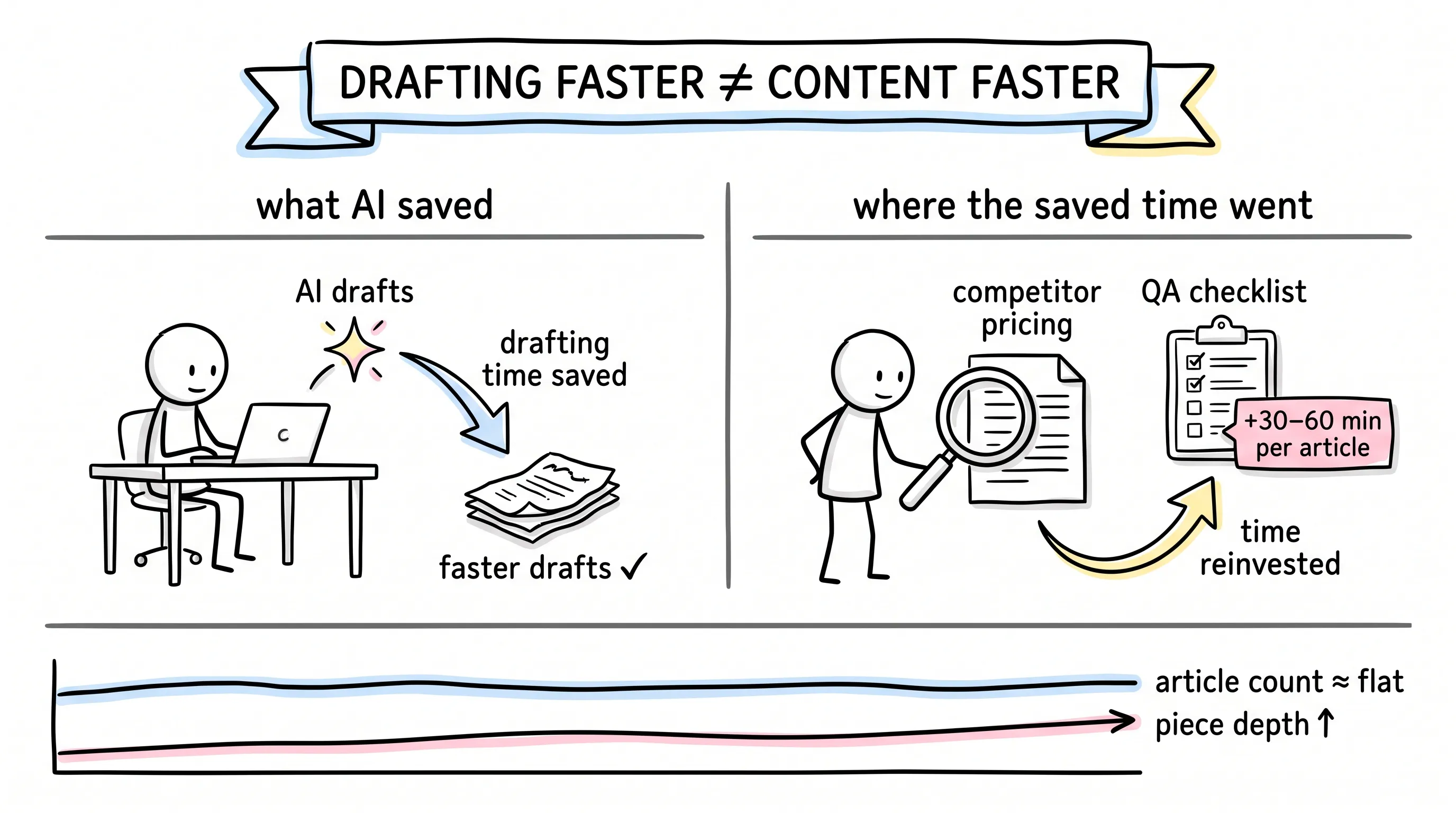
What happened. Jamie Juviler, who manages the HubSpot blog's writing team, published a first-hand retrospective on October 19, 2026, laying out the full ledger of the team's first year on an AI-first writing model. The switch became official in June 2025, and the approach was deliberately hands-off: no prescribed process — writers were simply given access to Claude, ChatGPT, and NotebookLM, told to explore on their own, and the team then codified whatever worked. The early signals looked great; writers were clearly turning drafts around faster. But two months in, the time-tracking data told a messier story. Article count barely moved, yet each piece ran longer and deeper. The drafting time AI saved got eaten up elsewhere: competitor research, expert quotes, in-depth tool reviews — the work no competitive post can skip.
The problems the retrospective surfaced cut deeper. The first crash came on a competitor-comparison post: a writer discovered that the pricing information AI supplied was completely outdated — and the AI never flagged its own uncertainty. Training data has a cutoff date, product pages are hard to parse, and even with live web search switched on, results can sound authoritative yet trail reality by months. Then came the hallucinations: invented statistics, misattributed quotes, wrong terminology — all delivered in the same confident tone. The team responded by upgrading fact-checking from a light final step to a standalone process stage, adding 30 to 60 minutes per ordinary article, and longer for research-heavy pieces. QA time is climbing too, and the issue list is specific: AI clichés, hedging language, redundant sentences, inadvertent plagiarism, broken links, missing alt text, broken heading hierarchy, and no LLM chunkability optimization. Juviler built a QA checker of his own in Google Docs; it is now a mandatory pre-publication step.
Why it matters. What makes this retrospective valuable is that it is a candid ledger from a front-line manager at a major company, not vendor puffery. It directly corrects the popular AI-efficiency narrative: faster drafting is not faster content, and efficiency gains don't automatically become output gains unless you reinvest the saved time in the deep work competitive content demands. The corroborating data is just as hard. In 2026, SEO expert Lily Ray tracked more than 220 sites identifying themselves as customers of AI content platforms, and the pattern held: organic traffic climbs fast, then falls off a cliff, with many sites handing back every point of the gain. More than half saw peak traffic fall by 30% or more; nearly a quarter dropped more than 75%. HubSpot's 2026 State of Marketing report adds the other side of the coin: 52% of marketers believe AI has made content creation so easy that it has largely stopped working in aggregate, while 83% of marketers are expected to produce more content than ever. Put those two numbers together and you have the full price list for slop at scale.
What it means for marketers. Content managers need to change their process. Fact-checking must become its own stage; competitor pricing and product-feature claims get verified by humans, every time; AI research output is treated as leads, never as conclusions. QA can't rely on eyeballs either — hedging language, broken links, and structural issues all need tooling as the safety net. Managing writers calls for a new frame: Juviler splits the team into results-driven writers and craft-loving writers — the former welcome the speed AI brings, while the latter treat writing as a craft, and AI-first leaves them feeling something has been taken away. Neither reaction is a performance problem; managers have to handle the two differently. At the organizational level the principle is: mandate experimentation, not method — require everyone to try AI, but never prescribe how. E-E-A-T requirements, editorial judgment, and strategic thinking haven't moved an inch in this shift. In Juviler's words, the layer of work that makes content worth reading — human perspective, original insight, rigorous sourcing — still lands on the writer, and it matters more than before, because it's the only layer that separates you from everyone else's AI output.
How to act on it. Three steps can start this week. First, add an explicit fact-checking stage to your content process with a 30-to-60-minute budget; anything touching competitor pricing, statistics, or quote attribution gets verified against the original source, item by item — whatever fails gets cut and rewritten. Second, harden your QA list into tooling, even if that starts as a checklist in a doc: hedging language, redundant sentences, inadvertent plagiarism, broken links, alt text, heading hierarchy, and whether paragraphs are built to be chunked and cited by AI — run every item. Third, allocate the time AI saves explicitly, and write it into the process: reinvest the saved drafting hours, proportionally, into original data, expert quotes, and hands-on testing — the three content types AI can't produce and that both search algorithms and readers reward. Managers should add one more move: hold an honest feedback session and ask writers specifically where the friction is. HubSpot's experience: the people who pushed back most honestly produced the clearest improvement roadmap.
My take. The most valuable line in this retrospective is that AI doesn't know what it doesn't know. In 2026, a content team's moat has shifted from model choice to the rigor of its verification process. Lily Ray's 220-site dataset shows the win-by-volume window has closed; HubSpot's time-distribution charts show the speed dividend pays out only through process design. Whoever turns fact-checking and QA into standalone stages first can use the same tools to earn credibility no one else can match.
🔗 Further reading: Read the full article
🏷 AI Search & GEO
GEO done right: the Princeton definition, a six-dimension comparison, and 23× conversion data
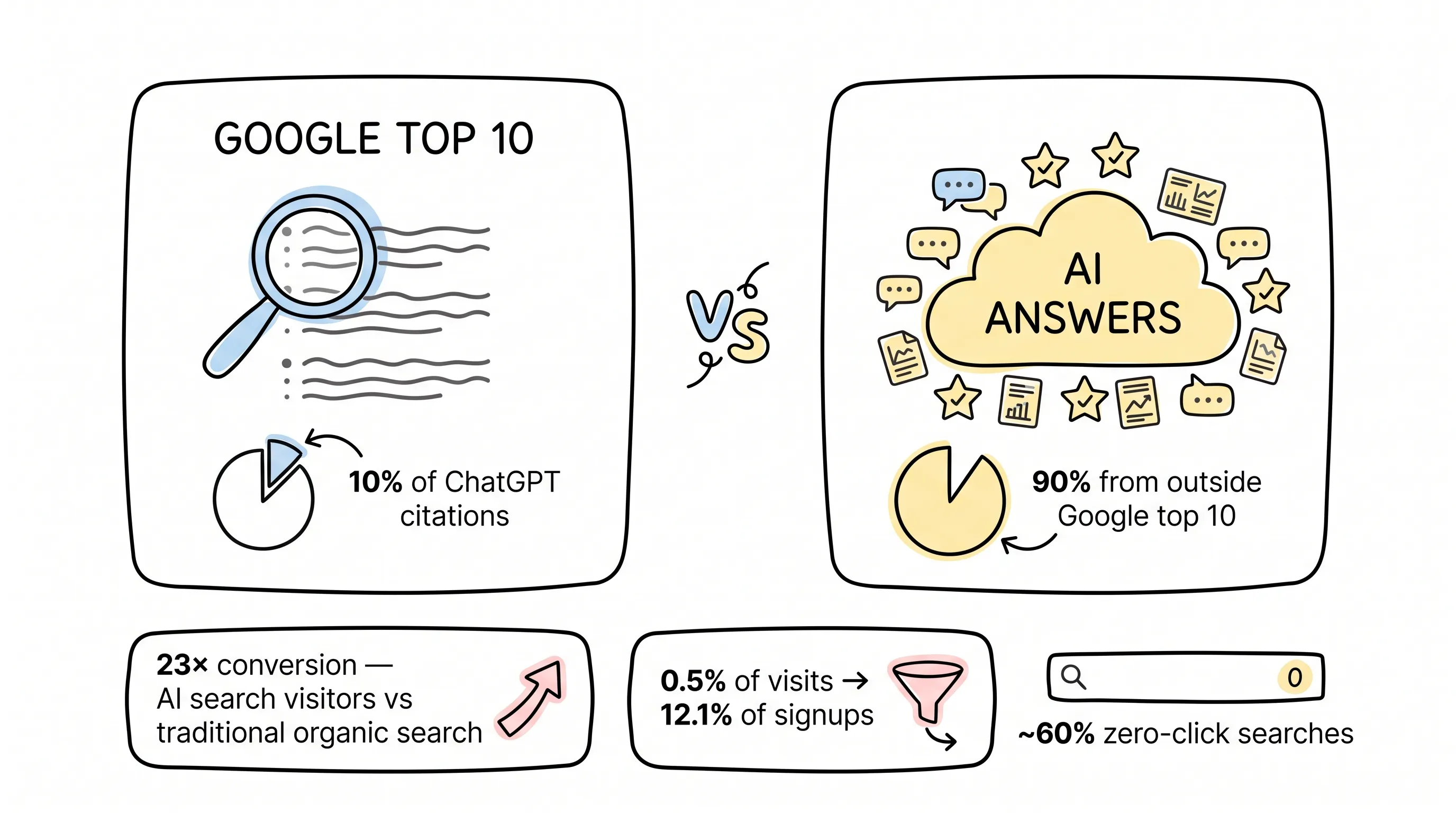
Discovered Labs' long-form piece is the clearest treatment of GEO (Generative Engine Optimization) at the definitional level. The academic starting point is the Princeton team's November 2023 paper, in which a six-person group introduced the GEO concept and its experimental method. The article draws a clean boundary between GEO and AEO (Answer Engine Optimization): AEO fights for featured-snippet positions in traditional search, while GEO's battleground extends to the entire ecosystem of AI-generated answers. A six-dimension comparison table breaks GEO and SEO apart across goals, platforms, success metrics, content structure, authority signals, and optimization focus — success metrics shifting from keyword rankings to citation rate and share of voice. The data is where this article hits hardest. a16z's analysis shows only 10% of ChatGPT citations come from Google's top ten; the other 90% of AI citations come from outside Google's rankings. SparkToro finds nearly 60% of US Google searches end with zero clicks. Ahrefs' figure is the most striking: AI search visitors convert at 23× the rate of traditional organic search — AI traffic is just 0.5% of site visits yet drives 12.1% of signups. Microsoft Clarity's numbers run in the same direction: AI referral conversion at 1.66% versus 0.15% for traditional organic search. On the B2B side, DemandGen research shows 47% of buyers use AI for supplier research, and in technology categories 80% of buyers use AI at least as much as search — 21 percentage points above other industries.
💬 How marketers can use it: put a16z's 10% straight into your project proposal. If your site ranks in Google's top ten but doesn't get cited by ChatGPT, the gap is in authoritative entity signals, not rankings — don't aim at the wrong target. This week, manually audit how your brand shows up across the major AI engines to establish a baseline, then decide how much GEO budget to commit.
🔗 Further reading: Read the full article
A panoramic look at 15 GEO tools: the dual-gate model and Source Stack are the keys to vendor selection
Yotpo's blog updated this roundup on October 8 — a 27-minute read — and breaks the GEO tool stack into six categories: enterprise intelligence, competitive intelligence and attribution, hybrid SEO-and-GEO suites, technical agility optimization, reputation management and content execution, and go-to-market monitoring. More analytically valuable than the tool list are three concepts. First, the dual-gate model: your brand must first clear the RAG retrieval gate (RAG, retrieval-augmented generation), which is technical; then the synthesis gate — entity authority — which is about trust. Miss either gate and you never make it into AI answers. Second is Source Stack: which forums, review platforms, and verified data sources an LLM treats as its factual grounding — occupying those positions matters more than SEO rankings. Third is volatility: AI citation data swings 40% to 60% month to month, which means one-off optimization is pointless and continuous monitoring is required. The piece cites SparkToro for backdrop: more than 60% of searches end without a single external click. Yotpo's own Discover product gets an embedded plug in the article, so read with a grain of salt — but the overall framework holds.
💬 This week: before shortlisting, ask every tool two questions — can it track month-over-month swings in AI citation rate, and can it show you the gaps in your Source Stack. Before paying, run two weeks of free, manual, per-engine spot checks to establish your baseline; only then talk budget. That alone saves you from wasted spend.
🔗 Further reading: Read the full article
The CoreMedia enterprise view: visibility redefined as being cited by AI
CoreMedia's strategic readout, aimed at enterprise CMOs and CIOs, frames LLM search as structural change rather than an incremental patch on existing SEO plays. It arms decision-makers with a three-stat set: McKinsey counts 78% of organizations using AI in at least one business function by the end of 2024, up steadily from 72% earlier that year and 55% a year before; Adobe data shows referral traffic to US retail sites from generative AI sources exploded 1,200% in a year; and Google AI Overviews now appear in 13% of search queries. User behavior is shifting too — AI-referred visitors stay 8% longer, view 12% more pages, and bounce 23% less — while 66% of users complain there are too many ads in Google search. The enterprise adoption picture offers three scenarios: customer-service chatbots handling routine inquiries in insurance, utilities, and telecom, with complex cases escalated to humans; omnichannel content orchestration resolving the tension between localization at scale and brand consistency; and AI content plus personalization covering conversational commerce. The article's conclusion: the question is no longer how to rank, but how to become a source AI trusts. Written in 2025, it reads as one of the more conservative takes in the GEO space, but the enterprise framing is complete.
💬 Action: use the three-stat set to pitch the initiative to leadership — it's persuasive enough. On sequencing, start with the customer-service chatbot: you can evaluate it against an existing script library and see satisfaction data within six weeks, then take on bigger, org-wide efforts like omnichannel orchestration.
🔗 Further reading: Read the full article
GEO vs SEO: the funnel re-ordered for the zero-click era — start banking referencing capital
Infinity Marketing's general guide, published in February 2026, wins on clear structure and sourced data. It cites SparkToro's 2024 zero-click research: 58.5% of US Google searches end without a click, and 59.7% in the EU; of every 1,000 US searches, only 360 clicks flow to the open web — 374 in the EU. GEO re-orders the marketing funnel in three ways: discovery happens earlier, with users short-listing brands inside AI answers; decisions come faster, with citation and verification settled in the same conversation; and visibility compounds over time, because brands cited repeatedly show up more often in later answers. The article coins referencing capital — the authority assets that make AI systems want to cite you, including original data, third-party-validated methodologies, and definitions of industry terms. The six-step implementation path, in order: build topical authority, design content for answers, structure the context, expand your measurement frame, align SEO, content, and brand, then stay consistent for the long haul. Against comparable pieces, its incremental insight is moderate, but the six-step path is ready to use as-is.
💬 How to get started: referencing capital belongs in your annual content strategy — shift part of the budget from chasing rankings to citable assets, such as an original industry data report or definition pages for a few key terms. Of the six steps, the last one — long-term consistency — is the easiest win: don't change plays every quarter; AI's memory of a stable publishing source takes time to build.
🔗 Further reading: Read the full article
🏷 Workflow & Organizational Capability
MarTech: in the AI era, the marketing leader's new job is designing workflows
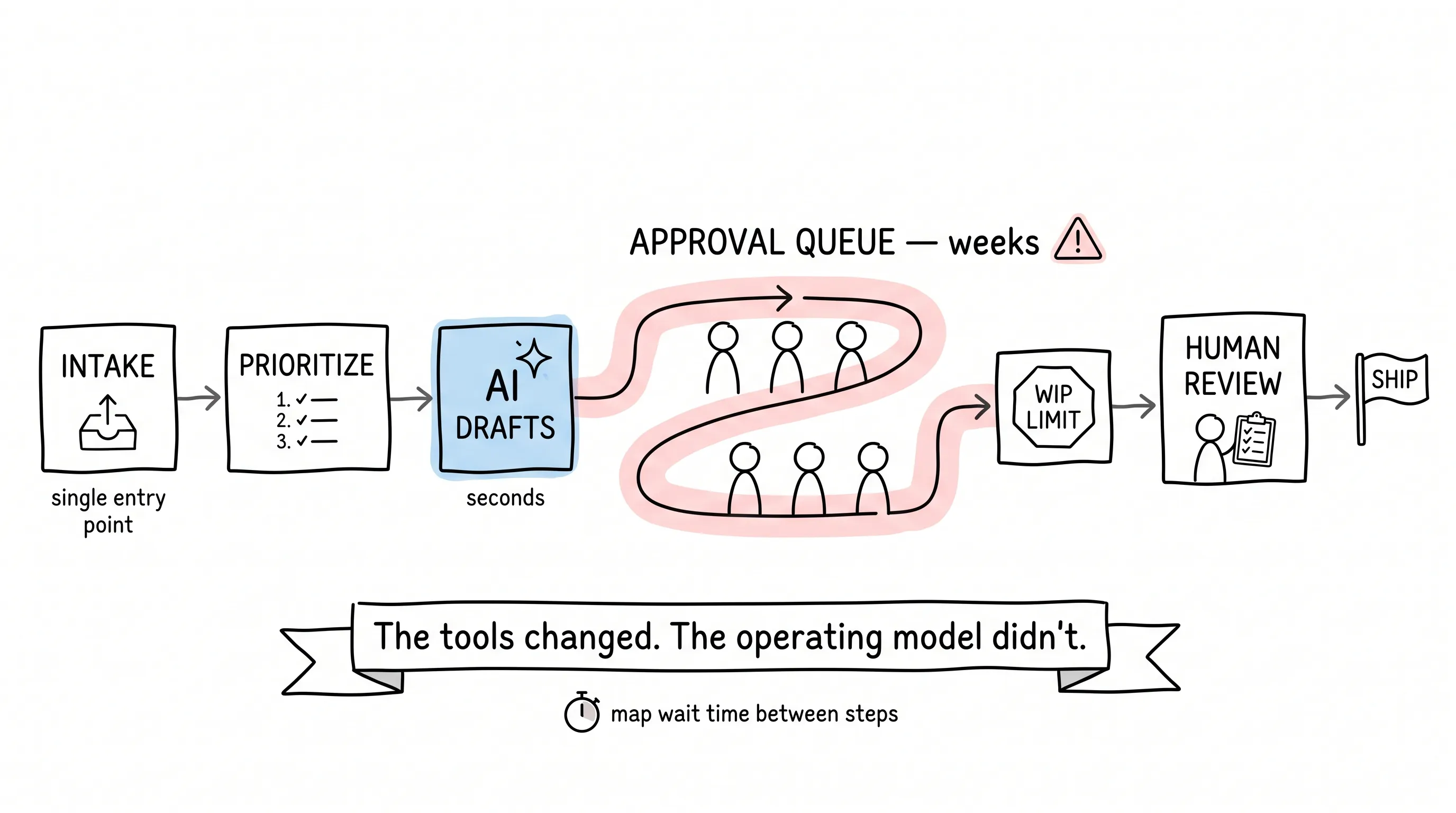
MarTech published independent consultant Stacey Ackerman's piece on October 19 — just one day earlier, about as timely as it gets. Her argument is blunt: once AI commoditized marketing production, the bottleneck moved upstream from production to workflow. Across consulting engagements she keeps seeing the same pattern: the best stack is bought — Claude drafts copy in seconds, Canva AI turns out video in minutes — yet deadlines still slip three weeks, because briefs sit stuck in approval queues, two teams run conflicting priorities, and nobody can say who holds final sign-off. Cramming new tools into an old operating model only accelerates the dysfunction; six months later usage is patchy, workarounds are everywhere, and leadership asks what went wrong. The answer: the tools changed, the operating model didn't — the roles, habits, incentives, and approval paths are all old. She prescribes four levers. One: intake and prioritization — all requests come through a single entry point screened by explicit admission criteria; otherwise the loudest stakeholder sets the agenda. Two: limit work-in-progress (WIP) — watch where work waits, not where people are busy. Three: role design for humans and AI — decide which steps AI owns, which get human review, and which judgments can never be delegated; that is workflow design, not tool selection. Four: short-cycle feedback loops so teams learn while they ship. The quickest way to see results: map one high-traffic process end to end and measure the wait time between steps.
💬 How marketers can use it: pick one campaign process this week and map it end to end, marking wait time at every step. Most teams will find 70% of the time goes to approvals and handoffs; saving a week there is worth more than having AI write ten extra drafts.
🔗 Further reading: Read the full article
A HubSpot evangelist: "good enough" is killing your brand — how to put taste-gating into practice
HubSpot Academy senior evangelist Crystal King's podcast dropped September 15 — 18 minutes, and the thesis is blunt: AI made content fast and cheap, and the price is industry-wide sameness. She cites detection data from Pangram Labs: more than 40% of long-form LinkedIn posts are flagged as fully AI-generated. The research backup comes from a joint finding by UCL, MIT, and London Business School: AI raises individual output quality while narrowing the overall distribution of creativity — those who can do it do it better, and those who can't still can't. She also explains model collapse, a.k.a. "Habsburg AI": the generational degradation that sets in when models are retrained on their own output, amplifying mediocrity every generation. Her answer to all this is business taste — editorial judgment at the brand level, one of the last differentiators left in the AI era — plus a taste-gating framework you can apply immediately: put a human-taste checkpoint inside the AI workflow and let people with judgment hold the exit. Yes, this is official HubSpot evangelism with its own AEO traffic play attached, but the arguments carry research backing; it isn't pure advertising.
💬 Action: taste-gating needs exactly one move to start — add a human-taste checkpoint to your publishing process; whoever signs off owns it. Give the team three non-negotiables, such as: original data required, real customer language required, brand-voice sample check required. AI drafts that fail get sent back for a rewrite.
🔗 Further reading: Read the full article
The Neil Patel two-host podcast: ten ways AI is actually changing marketing
Marketing School, hosted by Neil Patel and Eric Siu, uploaded this episode on January 26 — 18 minutes, full transcript, 1,120 plays. The most substantive of the ten directions: AI fluency is now a non-negotiable skill for marketing roles — Single Grain requires everyone to be able to use Claude Code within six months, not just ChatGPT; revenue per employee is becoming the new north-star metric of the AI era; and the distinction between AI Theater and real revenue — separating performative AI from AI applications that genuinely drive revenue. The episode also covers AI data and analytics, PLG (product-led growth), personalization at scale, strategy over execution, services and AI, shipping faster with AI, and the future of marketers. A fun detail: the hosts say the topic of this episode itself came out of Claude Code. The content mostly restates industry common sense with little original research data, but the two hosts' industry credibility and the concrete requirement (everyone on Claude Code within six months) give it practical bite.
💬 How marketers can use it: revenue per employee is the one to copy into your performance reviews: shift team KPIs from output volume to per-head revenue contribution, and the AI-fluency requirement follows naturally. Add an AI Theater self-audit: list every AI use at your company, tag each one as either actually driving revenue or just presentation-deck fodder — then cut the latter.
🔗 Further reading: Read the full article
🏷 Tools & Media-Buying Practice
An honest ROI accounting for AI-agent marketing automation: a realistic 3-to-5× in 12 months for SMBs
The best thing about jservo's ROI guide is its honesty. It opens by admitting that the 5-to-10× ROI figures floating around the market are mostly marketing talk that ignores hidden costs, then offers a realistic 3-to-5× range over 12 months for small and mid-size businesses — with a transparent worked example: roughly 3.6× on $18,000 of annual investment, every cost and benefit item checkable. Methodologically, the piece points out that task frequency is the best predictor of automation ROI: high-frequency, repetitive tasks pay back fastest, and it recommends ranking tasks by frequency before deciding what to automate first. The fastest payback scenario is lead-qualification automation, typically recouping its cost in 60 to 90 days, because it directly shortens sales response time and has a clean data loop. The article also carefully separates modeled numbers from cited case studies, so simulated values never masquerade as evidence — a transparency rare in agency blogs. For marketing teams weighing whether to adopt AI agents, this is decision material you can recompute yourself.
💬 How marketers can use it: take its worked example as your estimating template — first list the full annual cost of investment, tools, training, and operations included, nothing left out; then rank your automation backlog by task frequency. The 60-to-90-day payback on lead-qualification automation is the most credible number here — start there. Win the first battle, and the budget for everything after will follow.
🔗 Further reading: Read the full article
HubSpot's CMO demos Loop Marketing live: the Fresha case, all four stages
In this HubSpot Live video from December 2025, CMO Kipp Bodnar personally demonstrates all four stages of Loop Marketing using Fresha. Fresha is a beauty-industry SaaS that tackles no-show booking losses for salons and spas. The four stages unfold in sequence. In the Express stage, you define your ICP (ideal customer profile) and brand voice — the standout use here is treating AI as a feedback thought partner in place of expensive focus groups; in Bodnar's own words, having run surveys and focus groups, a well-trained AI agent returns remarkably similar feedback. In the Tailor stage, messaging is customized by segment: Fresha's play targets salon owners with one to three locations for a no-show-reduction campaign. The Amplify stage amplifies content, and the Evolve stage iterates on real-time insights. The video runs 14 minutes with a full transcript and shows how AI embeds into the marketing loop rather than replacing it. As promotion for HubSpot's own methodology, the slant is self-serving, but the framework is complete and the case is real; the four-stage breakdown transfers across industries.
💬 This week: the AI-replaces-focus-groups move alone saves five-figure research spend. Small and mid-size teams can feed historical customer interviews to an agent, have it simulate how three typical customer types would react to the next proposal, get a first-cut insight in half an hour, then calibrate the drift by hand — a month faster than waiting on a research firm's schedule.
🔗 Further reading: Read the full article
Cross-border Google Ads in practice: why ads that win in the US fall flat in Japan
This hands-on guide from Deebo, a Japan-based cross-border consultancy, maps each of Google Ads' built-in AI capabilities onto cross-border scenarios instead of hand-waving that "AI helps." It opens with the root causes of failure: differences across four dimensions — language, culture, search behavior, and customer expectations — make ad creative and bidding strategies validated in the US fall flat in Japan, Germany, and the Middle East. It then walks systematically through Google Ads' AI capability list: Smart Bidding, Performance Max, Responsive Search Ads, automated audience targeting, dynamic shopping ads, conversion forecasts, and ML-based budget allocation. The bidding section goes deepest: automated bidding optimizes separately across four dimensions — country, device, currency, and audience — and the AI will decide on its own that a high-conversion market like Singapore deserves more aggressive bids, shifting budget over from underperforming markets. The piece covers practical usage and applicability conditions for four automated bid strategies: Maximize Conversions, Target CPA, Target ROAS, and Enhanced CPC. Its conclusion: in cross-border advertising, AI has moved from nice-to-have to competitive necessity. Written in November 2025, the Google Ads interface may have changed since, but the strategic framework hasn't aged.
💬 Action: cross-border teams shouldn't rush into PMAX — each market needs at least 30 accumulated conversions before Smart Bidding has anything to learn from. On division of labor: hand the bidding layers to AI, but culturally adapted creative and landing pages must be human-made. Get those two backwards and the money just burns.
🔗 Further reading: Read the full article
🏷 Content & Social Operations
Canada's BDC social-media AI guide for SMBs: beware AI slop
This guide, published August 17 by Canada's Business Development Bank (BDC), is a public institution's walkthrough of social-media AI for small and mid-size businesses. Five core uses span content generation, audience targeting, posting-time optimization, social listening, and paid-media optimization, with three more uses for AI agents: managing engagement at scale, cross-platform content execution, and performance gains driven by engagement data. The attention-saturation data chain is the most valuable part of the piece: in the pre-digital era, people saw 500 to 1,500 ads a day; in the social-media era of 2010–2020, that rose to 4,000–10,000 daily interactions; in the AI era, it's past 10,000 a day. On that basis it defines AI slop: scaled AI content that trades on exaggeration, outrage, and fear for engagement — to social media what spam is to the inbox — eroding trust and brand differentiation. Senior business advisor Louis-Daniel Bernier's judgment: the competitive barrier is shifting from production capacity to an authentic, distinctive brand voice; AI can refine execution, but it cannot replace strategic judgment or market intuition. Three countermeasures are highly actionable: protect authenticity, insist on human review, and anchor content in real customer and employee stories.
💬 How marketers can use it: hold your own social accounts up against this. Scroll your last 30 posts and count how many come from real customer stories — if it's under three in ten, treat that as a warning sign. Capture quick clips and photos of everyday employee moments, customer complaints, and offline scenes, and start building a library of raw material; that's the one thing mass-produced AI drafts will never give you.
🔗 Further reading: Read the full article
🏷 Research & Data
A top-journal editorial: the top three applications of generative AI in marketing, and a research agenda
Four scholars — including Kshetri, Dwivedi, and Davenport — published a management editorial in the International Journal of Information Management (Elsevier, April 2024, Vol. 75), giving generative-AI marketing its academic coordinate system. The article focuses on the top three GAI marketing applications identified in BCG's April 2023 survey — personalization, insight generation, and content creation — and notes that the three are interlinked. Data density is its strength: as of March 2023, 73% of US organizations were already using GAI tools in marketing activities; Conference Board research shows 82% of respondents expect GAI to raise productivity, against only 4% expecting a decline; and the AI-marketing market, worth $15.84 billion in 2021, is projected to reach $107.5 billion by 2028. On barriers, cost is the biggest hurdle for SMEs — M365 Copilot adds $30 per user per month and GPT-4 Plus runs $20 a month, and it adds up for small teams. The article also advances a thesis framework: GAI-generated content carries more personal relevance than the previous generation of digital technologies. One caveat: the full text sits behind a paywall — this read covers only the abstract and select sections; it was written across 2023–2024, so its timeliness is middling, and its anchoring value as an academic reference outweighs its practical guidance.
💬 How marketers can use it: the way to use an academic item is to take its data, not its conclusions. When you write annual plans or background decks for leadership, the 82%-versus-4% expectation gap and the $107.5 billion 2028 market projection are hard numbers you can cite. When citing, always flag the data window as 2023–2024 so nobody mistakes it for a fresh survey.
🔗 Further reading: Read the full article
Research glimpse: a cross-border precision-marketing framework built on knowledge graphs plus federated learning
In a paper in Advanced Electromagnetics, Vol. 15, No. 3 (published August 13, 2026), S. Z. Liu of Zhejiang Industry Polytechnic College proposes an AI-driven precision-marketing system framework for cross-border e-commerce. What's rare in marketing contexts is this combination of methods: a knowledge graph maps product–user relationships, Transformer-based behavioral modeling captures purchase intent, deep reinforcement learning handles real-time ad optimization, and federated learning takes on privacy-preserving conversion attribution. The claimed experimental results: CTR up about 60%, conversion rate up 50%, customer lifetime value up 40%, ROI up 50%. All four numbers come from the author's self-built simulation environment; the journal's impact factor and the reproducibility of the experiments are both questionable, and the full PDF is only reachable via an external download link. Its value is directional: federated learning for conversion attribution is a technical route that matches the EU market's privacy-compliance trajectory and deserves a close watch from cross-border teams. Keep it filed as a research glimpse; treat it with caution in practice.
💬 How to use it: treat this strictly as a research glimpse — don't put those four improvement numbers into any proposal; a self-built simulation has no third-party validation. What's genuinely worth remembering is the direction: federated learning for privacy-preserving attribution. If you're advertising in EU markets, this is a route that solves compliance and attribution at once — hand it to your technical team for a maturity assessment.
🔗 Further reading: Read the full article
💡 Today's Big Picture
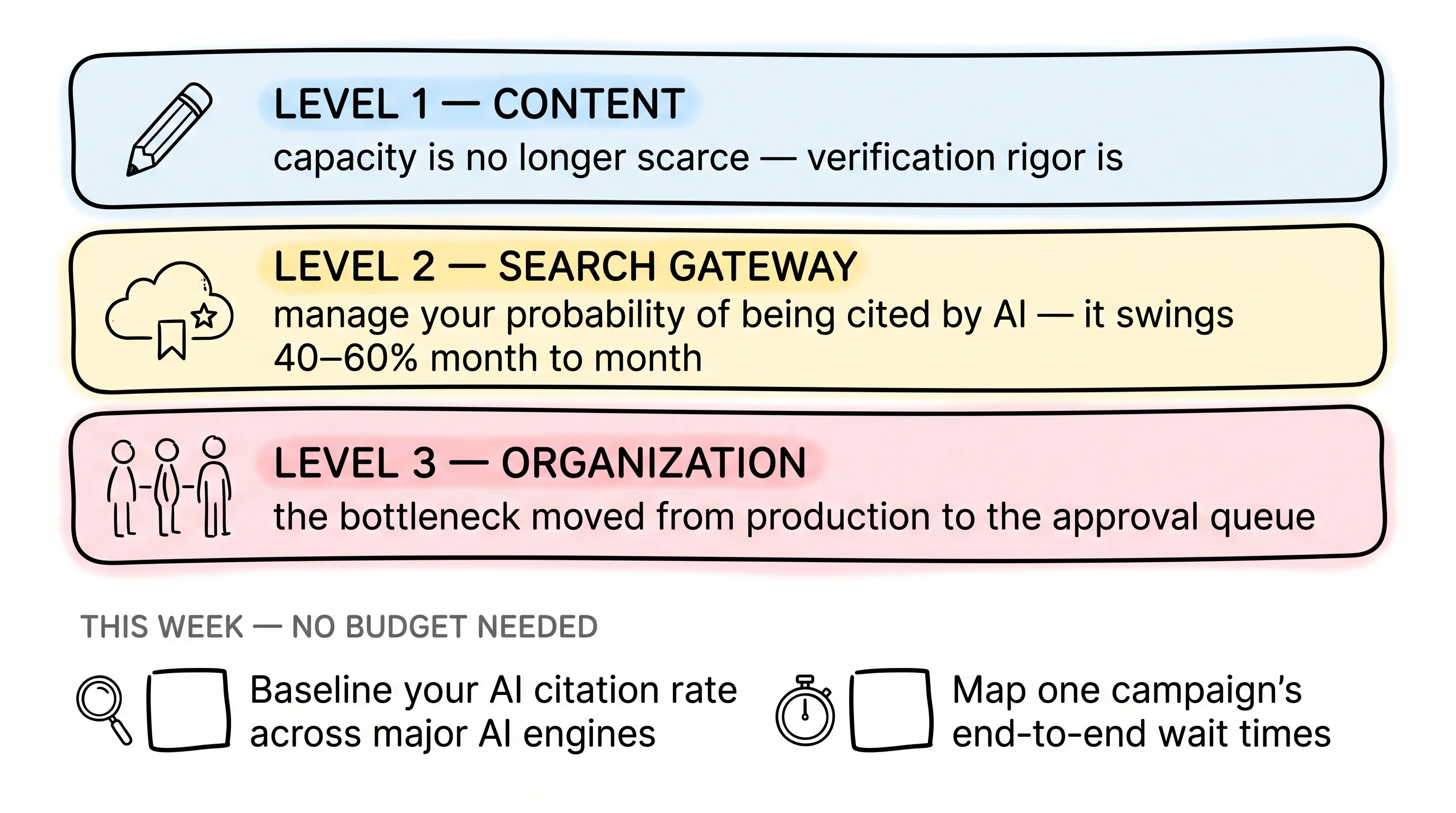
Read today's 14 items together and one judgment is worth keeping: the speed dividend of AI is being eaten away by repricing across three levels. The first level is content itself — the HubSpot retrospective, the taste-gating piece, and BDC's AI-slop guide all tell the same story: capacity is no longer scarce; what's scarce is verification rigor and an authentic brand voice, and Lily Ray's 220-site decline data is the bill for chasing speed alone. The second level is the search gateway, where the four GEO pieces form a single signal: the era of deterministic search is over, and what brands must now manage is their probability of being cited by AI — a probability that swings 40% to 60% month to month and has to be run like a continuously managed asset; one-off optimization won't save you. The third level is inside the organization, where the MarTech piece says it plainly: the tools changed and the process didn't, six months later only workarounds remain, and the bottleneck has moved from production to the approval queue. This week's action list for marketers has just two items: run a baseline of your brand's citation rate across the major AI engines, and map the end-to-end wait times of one campaign process. One aims at external visibility, the other at internal flow; neither needs budget approval, and both can start this week.
Continue reading
Related articles
AI Marketing Daily · 2026-11-22
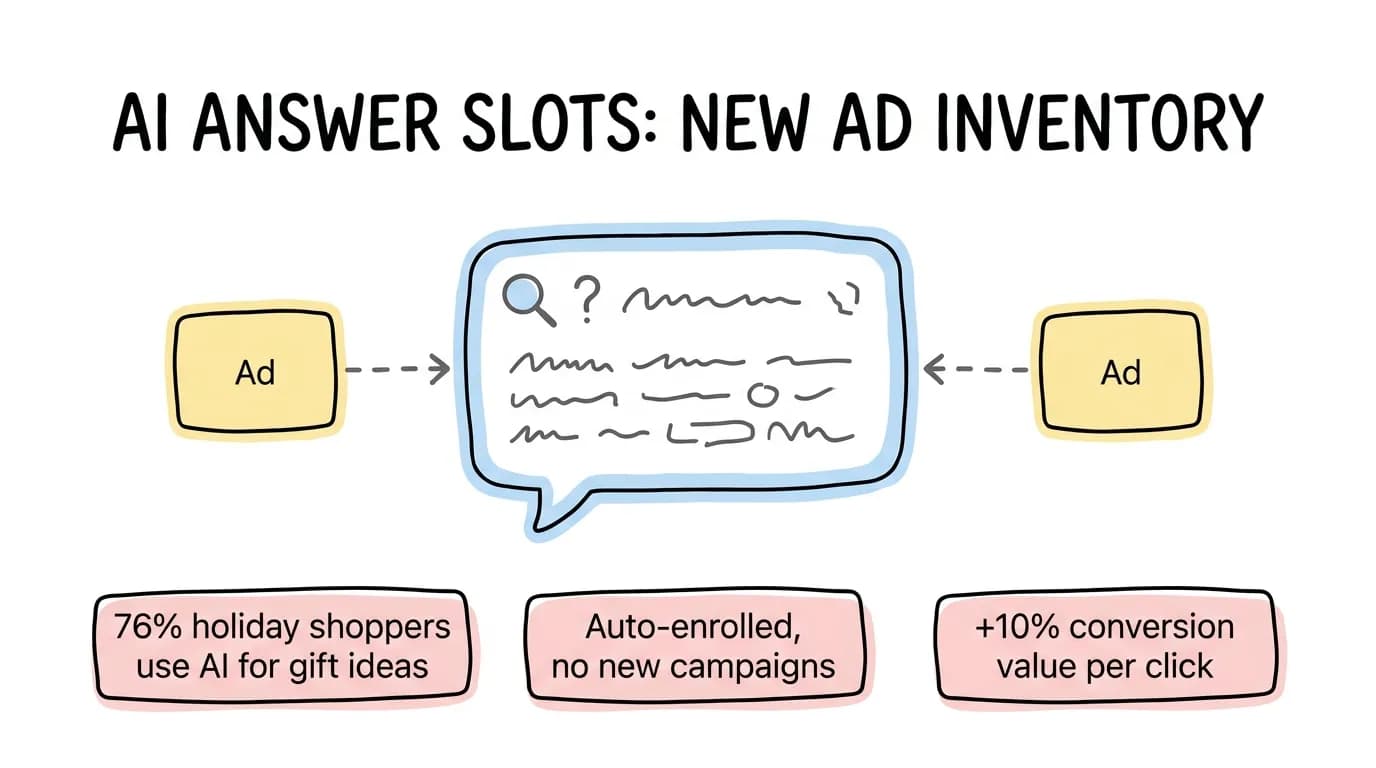
AI Marketing Daily for 2026-11-22 rounds up 20 items led by Microsoft opening Bing AI Overviews to ads and Google expanding AI Mode ads to ten countries, plus GEO guides, ad automation delegation guidance, AI Overviews CTR data, and a legal-risk checklist for AI-generated creative.
AI Marketing Daily · 2026-11-21
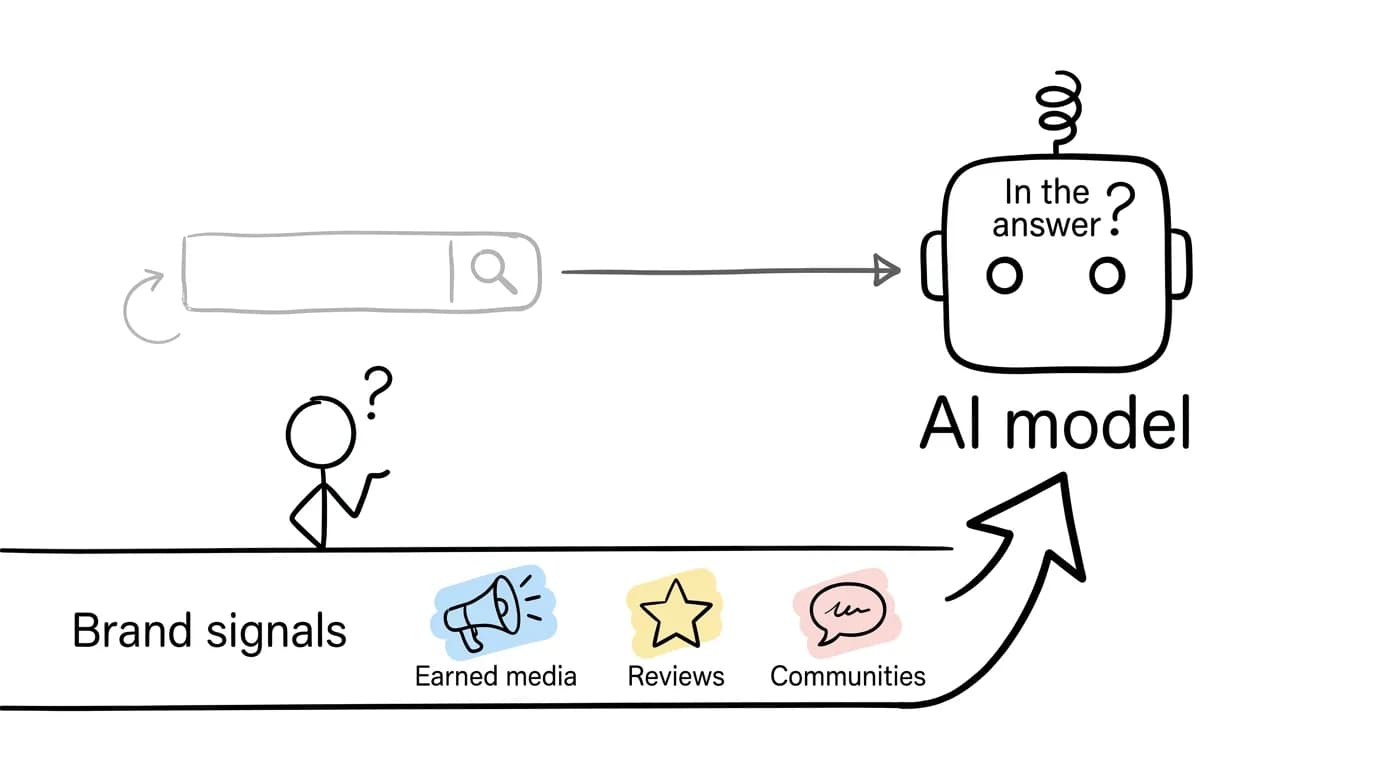
A November 21, 2026 AI-marketing daily covering AI search visibility, GEO methods, Google AI Mode ads expanding to ten countries, Meta's pre-Black Friday changes, agentic shopping, and industry adoption and ROI data.
AI Marketing Daily · 2026-11-20
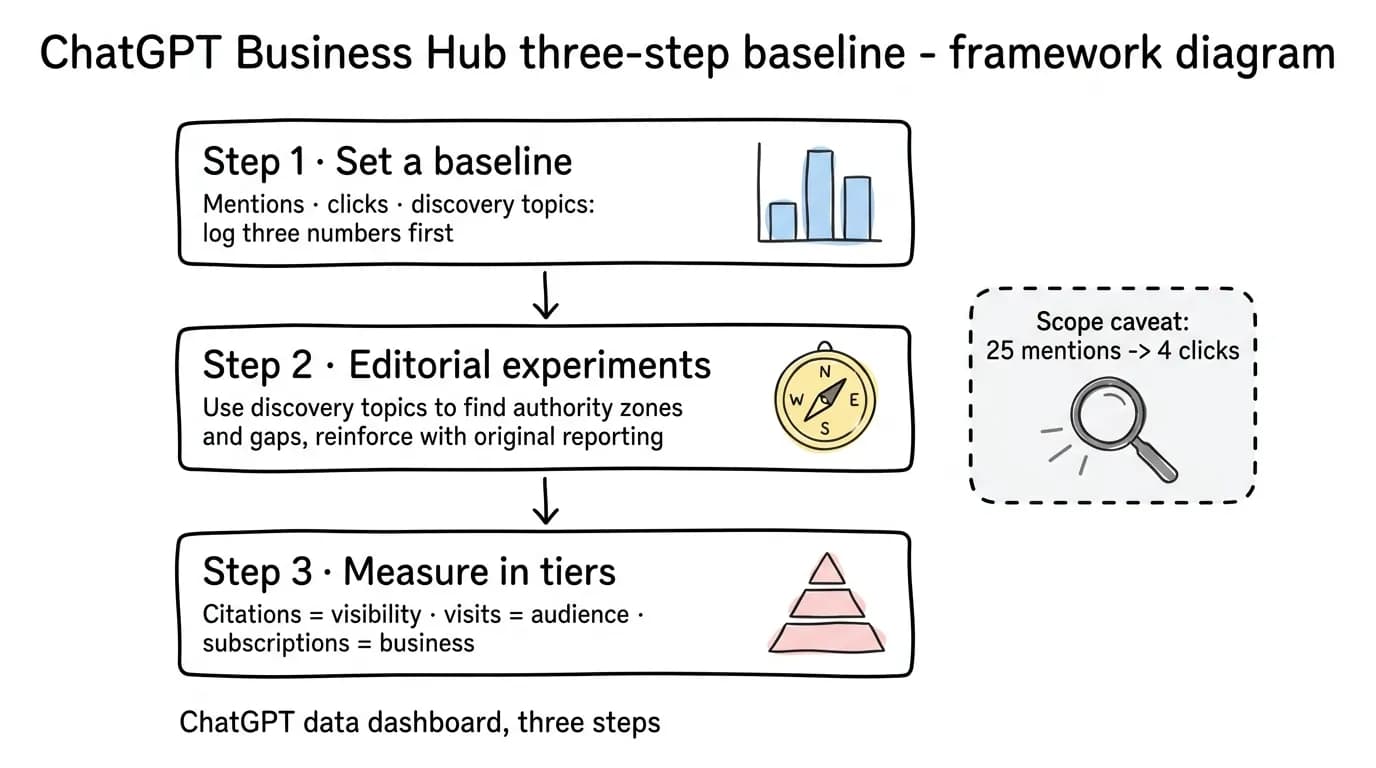
AI Marketing Daily for 2026-11-20 rounds up 19 items centered on measurement: OpenAI's ChatGPT Business Hub dashboard, EU rules for agent-mediated purchasing, Meta pausing four AI terms, and B2B data on shortlists and the dark funnel, each with action advice.