
How AI Is Actually Changing Marketing — Let Me Do the Math
A first-hand breakdown of how AI is actually changing marketing: one marketer shipped 600 programmatic pages in a weekend without writing code, then maps ten shifts that are really happening — AI fluency as table stakes, getting the money math right in Google Ads, rising revenue per head, real personalization, and the分
Last weekend, I did something I never would have dared to do before.
There was a batch of programmatic pages I'd wanted to build for a long time, targeting a set of long-tail keywords. It had been queued for almost a year and never bubbled up. A while back I asked the colleague in charge, and he said: next Friday.
Next Friday? I couldn't wait that long.
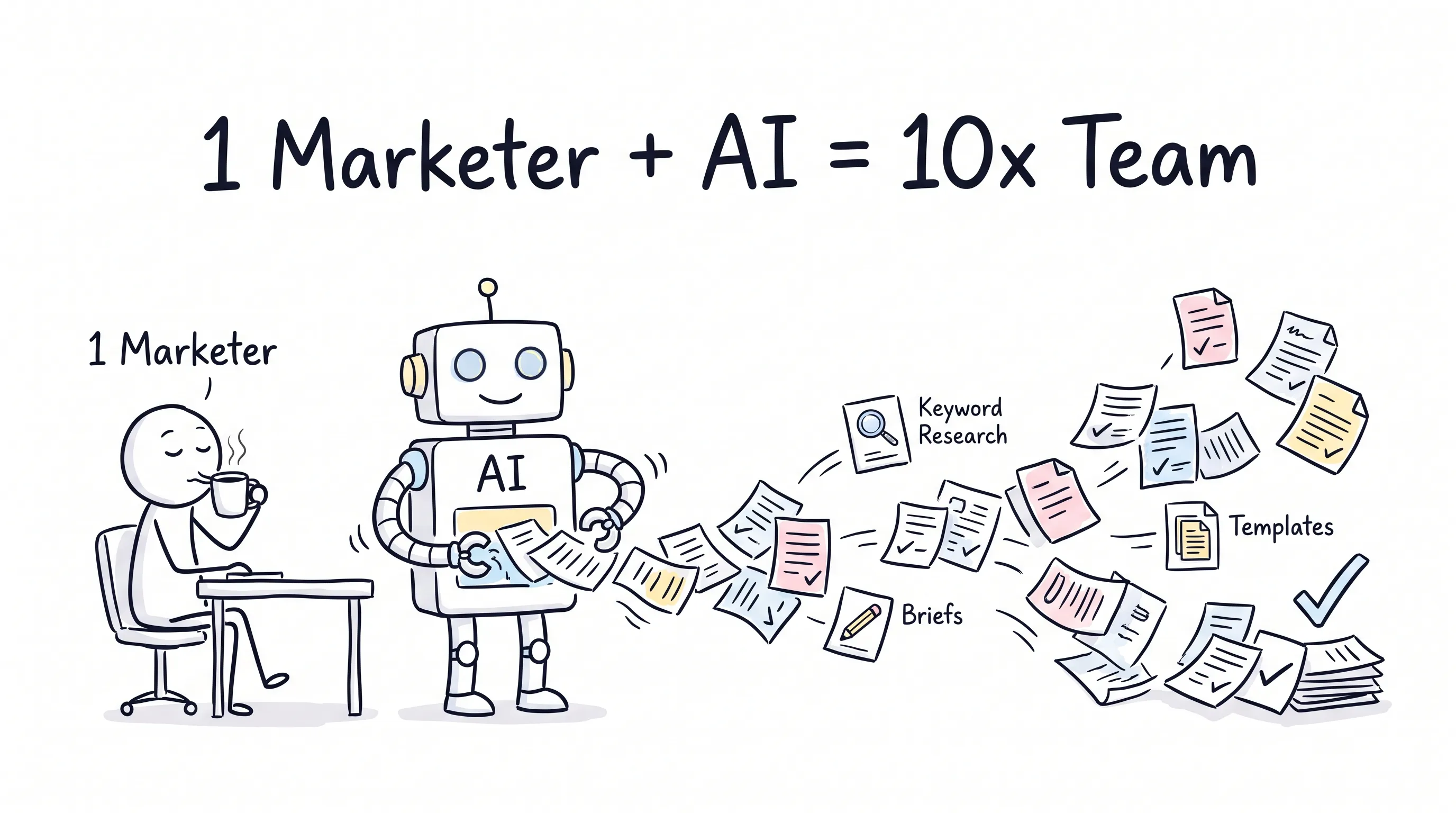
I opened an AI agent tool, Manus. In under an hour, it finished the keyword research, wrote the content briefs, applied our existing page templates, and showed me two samples first. I said, good — go with this. And it handled the rest.
150 pages shipped that Friday, then 450 more over the weekend. 600 in total. If you priced that work at agency rates, it would be worth roughly $45,000.
To be fair, my colleague isn't incompetent — he's just stretched too thin. What really struck me was something else: a marketer who can't write code can now, alone, do the work of an entire team.
So today I want to have a serious conversation about how AI is actually changing marketing. No concepts — only what's genuinely happening. I've mapped it out, and there are ten things.
1. Knowing How to Use AI Is Now Table Stakes, Not a Bonus
What does "knowing how to use AI" actually mean?
Does chatting with ChatGPT and having it write a couple of copy lines count? Not anymore.
At our company, the expectation for every teammate is: within six months, not just fluent use of ChatGPT, but competence with coding-style tools like Claude Code. Six months. And honestly, we think even that's generous.
Why the urgency? Because these tools let you build things. I'm a living example: I can't write code at all, but an idea popped into my head one weekend and I went and built it — and the thing actually works.
Now think about it. If one person is like this, a team is like this, and everyone in an entire company is like this — imagine the firepower.
2. The Most Urgent Thing: Get the Money Math Right
I could go on for days about what AI can do. But the one thing I care about most: can it be converted into dollars?
First, the data situation. In today's environment, Google is unlikely to go acquire social platforms, and Facebook is in the same position. Companies like Perplexity and Anthropic are already at a scale where regulators would never approve a monopoly. The result: data is scattered across platforms, and no single player can swallow it all.
The good news is that AI can pull together the data you're allowed to access, analyze it in real time, and show you where your money is being wasted.
Take an example. In Google Ads, many companies bid on their own branded terms (brand keywords). When should you spend? When a competitor is bidding on your brand terms — if you don't, your traffic gets poached. When should you not? Let AI sweep every region and every city, and if it finds nobody competing with you, that money doesn't need to be spent; users will click your ad anyway.
Hand this judgment to AI to monitor and adjust in real time. This one tactic alone saves anywhere from a few thousand to over a million dollars a year.
Everyone loves talking about how cool AI is; almost nobody talks about how much money it saved them or made them. That's a lesson the industry still needs to learn.
3. Revenue per Head: This Metric Deserves a Comeback
The third change is called revenue per employee.
A while back we worked with a client, one of the fastest-growing nutrition supplement brands in the world. They wanted to scale their ad budget from several hundred thousand dollars up by two or three times. What was blocking them? Creative capacity. They needed massive volumes of AI creative, plus licensed use of influencer likenesses.
The result: one strategist on their team, using AI, single-handedly ran an entire creative production line.
In the past, an agency hitting $200,000 in revenue per employee was considered very healthy. Going forward, that number is likely to keep climbing. Think about what that means — every business owner out there should be weighing it.
4. Not Writing Code Is No Longer an Excuse
Marketers historically stayed away from product-led growth (PLG) for a simple reason: they couldn't design, and they couldn't code.
What is product-led growth? You use a free product to bring users in the door, then sell them something else on top — consulting services, for example. In the past, only companies that could afford engineers could walk this path.
That's changed. AI can produce design mockups, build prototypes, set up collaboration — you can push a product live without knowing how to code.
To be honest, products built by AI today still aren't as good as what three or four excellent engineers could build with AI. But I'd bet that within two or three years at most, they'll catch up. A friend says it won't even take that long — we made a bet over a fancy dinner on it. I hope I win.
5. Personalization Needs to Go from "Crude" to "Real"
For the past few years, let's be honest: the personalization that marketing talked about was crude.
Website de-anonymization and data enrichment tools barely scratched the surface.
Going forward, it will be different, because two prerequisites are maturing: tokens are getting cheaper, and data sources can finally be pulled together in one pass. When that happens, the moment a user sees your retargeting ad, email and SMS follow on cue, all part of the same playbook. Personalization is no longer just calling out someone's name — it's choreographing an entire sequence of touchpoints around that one person.
For the past two years, this was constrained by raw materials. From here on, it comes down to whose imagination is bigger.
6. Companies Aren't Laying People Off — They Just Want More
In the news, the AI narrative is grand: AGI is around the corner, and in ten or fifteen years nobody will have to work.
The reality we're seeing is something else entirely: almost no company is cutting marketing investment because of AI. Inside enterprises, AI has moved past the experimental stage — it's now standard equipment.
So what are companies actually asking for?
For everyone to produce more, faster.
Start with strategy. AI will absorb more and more of the execution-level work. So strategic capability is becoming the hard currency of marketing. A marketer who doesn't understand strategy is going to have a rough time ahead.
Then services. Some people are bearish on the services business; my read is the opposite: services will become more valuable. What enterprises want is smart people to execute for them. That business won't disappear — the bar will just rise very high.
Finally, speed. It used to be one major release per quarter; now the boss asks: why not every month, or even every week? Barriers to entry are dropping, and everyone is being pushed to run faster. The interesting part is that companies aren't saving money because of this — they're spending more, buying speed. The real money that Amazon, Microsoft, and Google are pouring into data centers is the other side of that same logic.
7. AI Theater and AI Profit
This is the one I most want to talk about.
Large companies are mandating AI adoption. But a substantial share of it is performance.
A joke has been making the rounds online. A CEO says: the company set AI targets, so I bought an AI tool for the entire staff — 4,000 seats. At the board meeting, usage was up, and everyone applauded. And then? Nobody could say what those 4,000 people actually produced with it.
Why does the joke sting? Because it's too real. We've run live polls at industry events: who has actually calculated ROI from AI? Only a handful of hands went up.
The capital markets are being honest too. Companies like Adobe and Salesforce, which are genuinely serious about AI, haven't seen their stock prices deliver what the outside world imagined. What has actually gone up? Chips, data centers, energy — and the large model makers themselves.
Meanwhile, AI-native companies starting from zero are running at full speed. In Stockholm there's a company called Lovable that lets you build an application in a few minutes; within a year it has already reached several hundred million dollars in recurring revenue.
CFOs have already started asking CIOs: with this much invested, where's the profit?
Over the next 12 months, more and more companies will start accounting for "AI theater" and "AI profit" separately. The former will get punctured; the latter will get more investment.
8. What Junior and Mid-Level Marketers Should Do
If you're a junior or mid-level marketer, my advice comes down to two sentences: keep one deeply specialized craft, but stop using "this is the only thing I know" as an excuse.
Because the cost of learning something new has collapsed: no courses to buy, no two-hour videos to grind through, no dozens of blog posts to dig through. Just ask AI — the answer is right there.
The marketers who can go deep on one thing and use AI to pick up everything around it will become more and more valuable. Those who have neither are in danger.
Back to Those 600 Pages
What that one hour really shook me with wasn't the $45,000 saved.
It was the first time I felt it viscerally: the gap between tools is turning into a gap between people.
Those 600 pages weren't made by AI, and they weren't made by me. They were made by the version of me that knows how to use AI.
How much is that "knows how" worth? Starting today, that's something every marketer should calculate for themselves.
And I wish you the same: may you never become that CEO sitting in the boardroom, watching usage rates climb, unable to explain what actually happened.
Continue reading
Related articles

It's 2026: Stop "Buying" AI Tools for Your Marketing Team — Start "Hiring" AI Agents
This learn article explains how AI agents differ from standalone AI tools in marketing, outlines three agent categories — build-your-own platforms, CRM-native agents, and vertical tools — and covers use cases across SEO, social media, advertising, and reporting, plus criteria for choosing one.

What Is GEO? How Your Brand Gets "Mentioned" in the Age of AI Search
An explainer on GEO (Generative Engine Optimization) for e-commerce and DTC brands: how it differs from SEO and AEO, why AI answers shape brand visibility, and eight practices covering question-focused content, consistent brand messaging, structured pages, external evidence, comparisons, and AI mention tracking.

AI Is Already Making Decisions for Your Customers. Are You on the List?
A learn article explains GEO (Generative Engine Optimization): why AI-generated answers now shape which brands customers see, and how SEO fundamentals, entity clarity, citable evidence, and monthly measurement affect visibility in AI answers.