
Going Global in Cross-Border E-Commerce: An AI System Is Rewriting the Math of Conversion
An explainer on an AI-driven precision marketing system for cross-border e-commerce, combining knowledge graphs, Transformers, deep reinforcement learning, and federated learning, with a discussion of study results and practical caveats.
Last month, a friend of mine who runs a cross-border e-commerce business took me out to dinner.
He sells the same insulated tumbler on two storefronts. The European store was doing decently; the Latin American store was a disaster. Identical product pages, identical ad creatives, identical ad schedules — and nobody was buying.
He asked me: where do you think the problem is?
I told him the problem was right there in that one word: "identical."
What is precision marketing, really? Put simply, it means saying different things to different people, at different times, in different ways. If you run a corner store in your own neighborhood, you know exactly what the regulars like to eat. That's not hard.
What's hard is doing business across an ocean.
Your customers live on the other side of the planet, speaking a language you don't understand, living lives you never see. When they buy an insulated tumbler, it may not be for the commute — it might be for weekend hikes. Different culture, different habits, even different hours for scrolling their phones.
This was always hard. And in recent years, it has gotten harder.
Why? Because people's attention is increasingly fragmented. Someone might scroll past you in a short-video feed in the morning, look you up on a search engine at noon, get tagged by a friend on a social platform in the evening, and only remember to place an order on day three. That journey is scattered across five or six places, and from any single one of them, you can't see the whole picture.
On top of that, markets move fast. The selling point behind today's hit product might be old news by next month.
So overseas conversion has become the sorest spot for many sellers going global.
Is there a way out?
A study published this August tackled exactly this question. The researchers built an AI-driven precision marketing system that bolts four technologies together. My gut after reading it: this line of thinking deserves a serious look from anyone doing business overseas.
Here it is, translated into plain English.
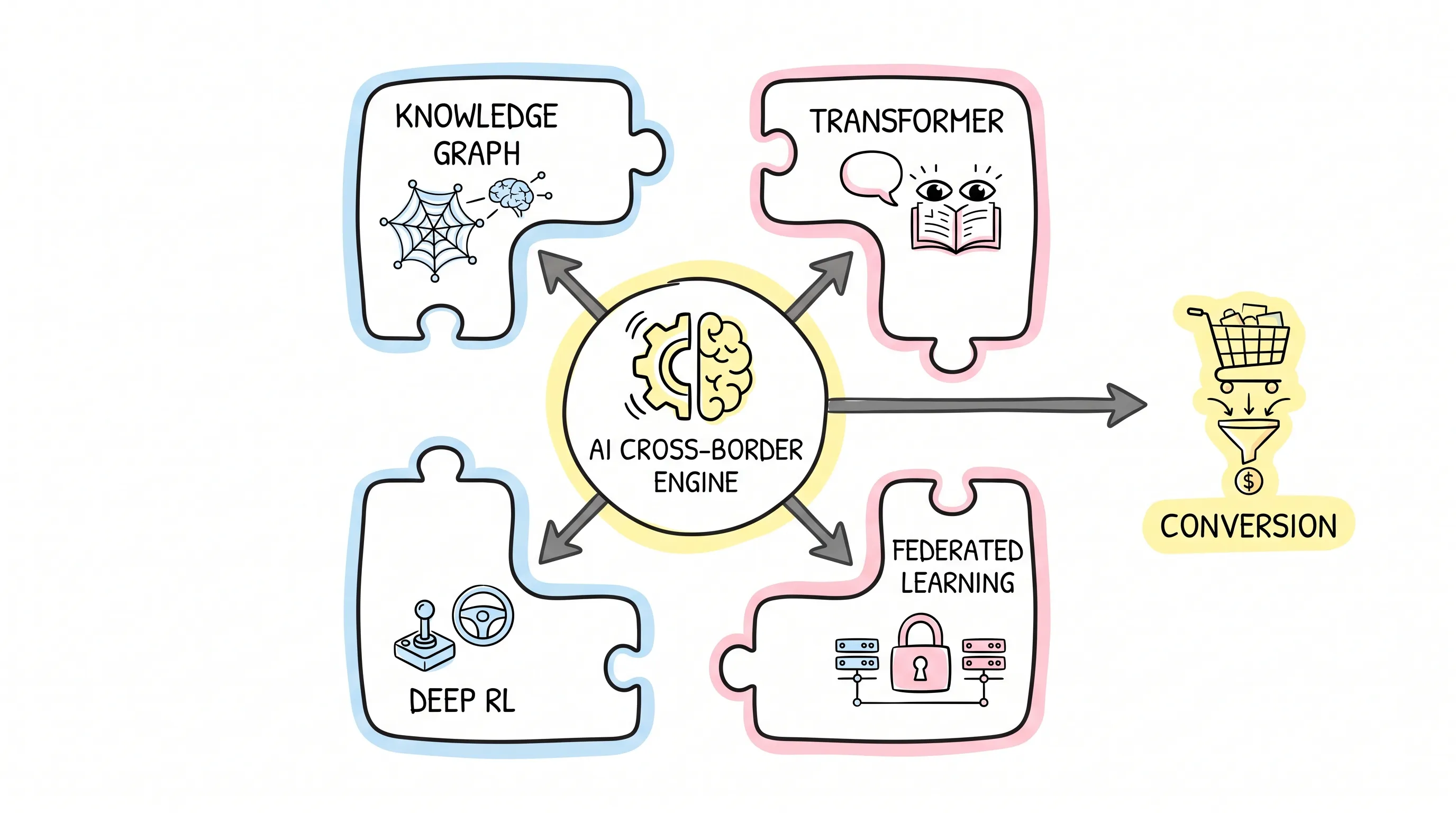
Piece One: The Knowledge Graph
What's a knowledge graph?
Picture it as the brain of a world-class salesperson.
A store manager who has done business in Tokyo for ten years carries a web in his head: this tumbler connects to "office" in Japan, to "camping" in Europe, to "iced Americano" in Southeast Asia. Which holidays mean gifts, which seasons mean stocking up, which ad slogans are landmines in which local market — all of it lives on that web.
A knowledge graph is that mental web, drawn out as a graph a machine can read.
With it, the system knows: copy written for a user in Germany and copy written for a user in Brazil can't follow the same logic. That's what gives "localized content generation" its teeth. Translating English into Portuguese isn't localization — it's translation. Real localization swaps out the selling points, the scenarios, and the emotional register all at once.
Piece Two: The Transformer
You've probably heard the word Transformer. The models behind ChatGPT are built on exactly this technology.
Its job in this system is "mind-reading" — in other words, behavior prediction.
A shopper who swipes away after 3 seconds and one who lingers for 3 minutes comparing prices back and forth have completely different intents. In the past, systems could only see surface numbers like "time on page." Now, the model can read from a stream of behaviors "what he'll want to do next" — in real time, while he's still browsing.
Put simply: don't wait for the user to leave before running the post-mortem. Hand him the right thing while he's still there.
Piece Three: Deep Reinforcement Learning
Deep reinforcement learning (DRL) sounds intimidating, but the idea is plain: try something, look at the result, adjust, try again.
Doesn't that sound like a veteran driver? A feel for the road isn't memorized from the rulebook; it's fine-tuned mile by mile. Which lane jams up, which light stays red forever — the body knows before the brain does.
Applied to ad placement: this creative performs well in Germany at 3 p.m.; that one performs well in Brazil at 9 p.m. Where should the budget shift? The system learns while it spends, adjusting in real time. No more Monday meetings where you manually comb through the dashboard.
Piece Four: Federated Learning
The fourth piece is the one I find most interesting.
Everyone in cross-border commerce knows user data is the lifeblood. And yet data rules keep tightening around the world. The EU has GDPR, and getting data across borders means a mountain of headaches.
Federated learning's answer: the data stays home; the model does the traveling.
What does that mean? Your data stays on your servers, my data stays on mine, and nobody hands over raw records to anyone. Everyone shares only what their models have learned — comparing answers, so to speak — and together the models get sharper.
It's like a group of peers who never trade customer lists but can sit down and compare notes on "what kinds of customers close more easily." The lists are private; the experience is not.
In this system, federated learning handles conversion attribution: as a user moves from seeing an ad to pulling out a wallet, the credit along that path can be split with full transparency — accounted precisely, without ever touching the compliance red line.
Then, Let's Do the Math
Four pieces snapped together — how well does it work?
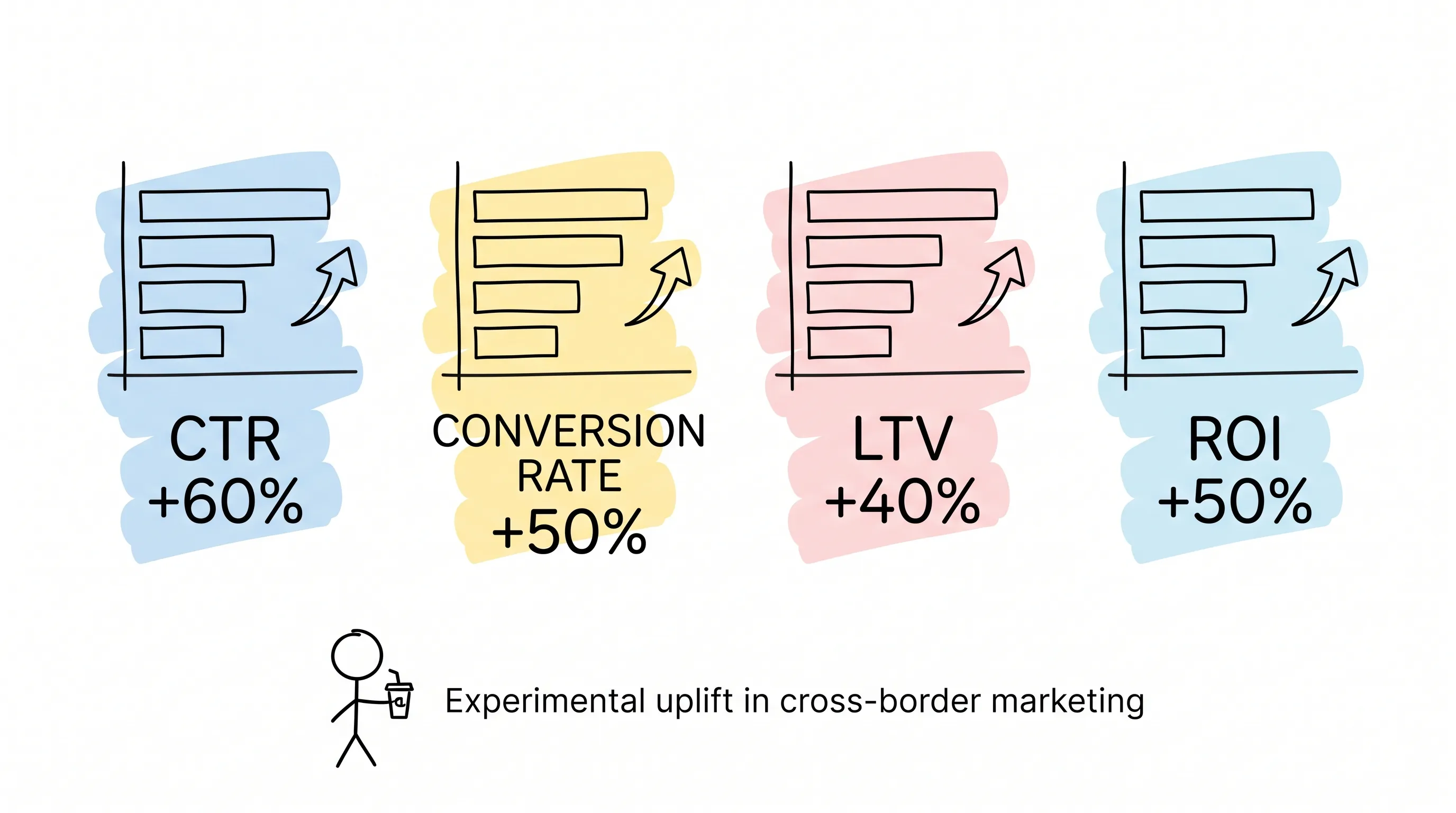
The study's experimental numbers: click-through rate (CTR) up about 60%, conversion rate up 50%, customer lifetime value (LTV) up 40%, return on investment (ROI) up 50%.
Numbers look abstract, so let me translate.
What does a 60% CTR lift mean? Say 100 people originally saw your ad and 10 clicked in. Now it's 16. Those extra 6 are all potential buyers who would otherwise have scrolled away.
And a 50% conversion lift? Of 100 people who walked into your store, 2 used to buy; now 3 do. Don't underestimate that one extra buyer. Same traffic, one-and-a-half times the sales — nearly free money.
A 40% lift in lifetime value is about how many times a first-time buyer comes back. This is the real dividing line for going global. One-off sales and repeat customers are two entirely different businesses.
Of course, these numbers come from the study's experimental setting. How much of it you can actually realize in your own store depends on execution.
But I Want to Pour Some Cold Water
The numbers are beautiful. Still, honesty compels me: there's a long distance between the numbers in a paper and the numbers you'll actually see on your own dashboard.
The first trap: this system needs to be fed. Someone has to build the knowledge graph — the cultures, the scenarios, the taboos of each market have to be poured in, one entry at a time. Buy the software and coast to victory? No such thing.
The second trap: compliance is its own course of study. Federated learning solves "how to share data," but the regulations of every market and the rules of every platform still have to be chewed through on your own.
There's one more trap that's easy to overlook: the organization has to keep up. The system adjusts ads in real time — if your team still holds a Monday planning meeting and waits for the Friday report, you've hobbled the system from the start.
A sharper knife cuts deeper. Until you can handle it, it isn't yours.
Back to That Dinner
I saw that friend again a while later.
I told him: your Latin American store's problem probably isn't the product. It's that you're still running Latin America with a European store's brain.
He was quiet for a moment, then said: then I'll start with the copy — rewrite the selling points around the scenarios locals actually live in.
I said, exactly. That one step is already doing what the system does — just done by hand.
By the way, the framework this study lays out is equally relevant to information recommendation, behavior prediction, intelligent decision networks, and other fields. It's not just for cross-border e-commerce.
Technology keeps evolving, but the essence of business hasn't changed: whoever understands users best, takes the market.
It's just that now, "understanding users" is something machines are learning to do rather well.
Wishing you smooth sailing overseas. May your goods actually sell, and your money actually come home.
Continue reading
Related articles

It's 2026: Stop "Buying" AI Tools for Your Marketing Team — Start "Hiring" AI Agents
This learn article explains how AI agents differ from standalone AI tools in marketing, outlines three agent categories — build-your-own platforms, CRM-native agents, and vertical tools — and covers use cases across SEO, social media, advertising, and reporting, plus criteria for choosing one.

Did the Money You Spent on AI Marketing Ever Come Back?
A guide to measuring AI marketing ROI across three layers: ad reports, sales pipeline, and the financial ledger. Covers metrics such as ROAS and CPA, eight dashboard metrics, industry benchmarks, and common measurement mistakes.

How to Pick a Creative Automation Platform: First, Figure Out What These Eleven Actually Do
A learn article sorts eleven creative automation platforms — including Bannerflow, Celtra, Smartly.io, and Storyteq — into four functional groups and proposes five evaluation questions covering publishing reach, automation depth, ease of adoption, team fit, and verifiable evidence.