
Ranked #1 on Google, and ChatGPT Still Doesn't Know You Exist: What Is GEO?
This article explains GEO (Generative Engine Optimization), why a top Google ranking does not guarantee visibility in AI answers, and outlines seven practices for making content easier for AI engines to cite, along with metrics such as citation rate and share of voice for tracking AI referrals.
A couple of days ago, I had dinner with a friend who runs a B2B software company. Halfway through the meal, he vented about something.
His company holds a rock-solid #1 Google ranking on the main keyword in its niche. Organic traffic is healthy. The content team churns out 10 articles a month, rain or shine. By the old playbook, this is straight-A student territory.
So what happened? A prospective customer recently talked to him about vendor selection. The customer said, "I had ChatGPT draw up the shortlist for me — five companies in all."
He wasn't on it.
He asked me: isn't that infuriating? We're clearly the best in the industry — how does the AI not know who I am?
I said: perfect timing, let me walk you through a term — GEO.
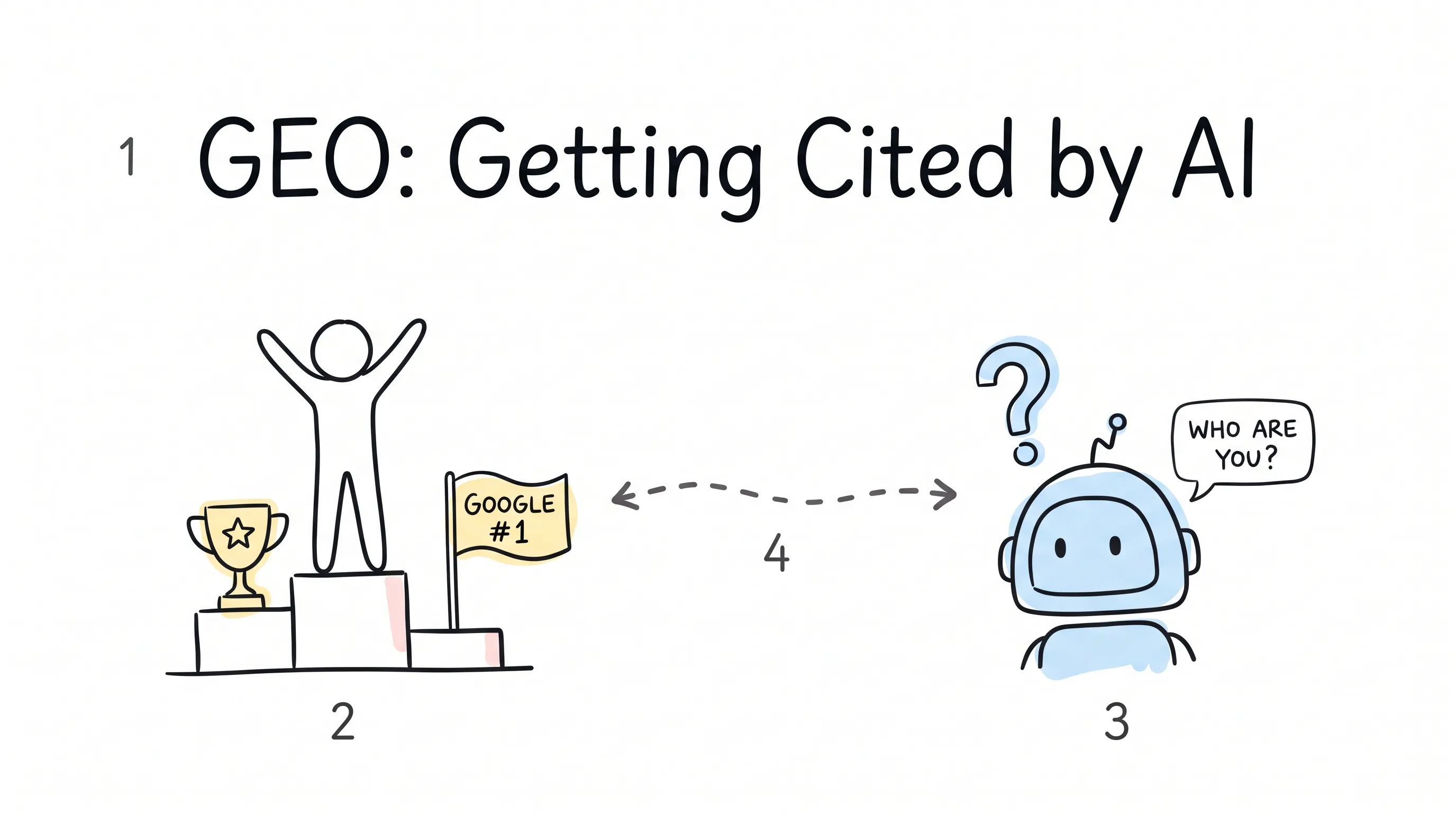
What Is GEO?
GEO stands for Generative Engine Optimization. Simply put, it's about making your company's content easier for AI like ChatGPT, Perplexity, and Claude to cite.
Note: cite, not rank.
The term wasn't invented by a marketer on a whim. In November 2023, a group of researchers led by Princeton University published the first academic paper to define GEO. The term only caught on later, as people gradually realized the whole traditional search-optimization toolkit no longer worked in front of these AIs.
You may have also heard of another term: AEO, Answer Engine Optimization. The two get mixed up all the time. What's the difference?
AEO governs the systems that "serve up answers" — think Google's AI Overviews, think Siri. GEO reaches one level deeper: the platforms that use large language models to formulate answers in their own words.
One contrast is all you need to remember: in the search era, the core unit is the link; in the answer era, the core unit is the citation.
Why Ranking #1 on Google No Longer Works
Someone has studied a telling number: of all the sources ChatGPT cites when answering questions, only 10% appear in Google's top 10.
Flip it around, and 90% of citations come from beyond Google's first page.
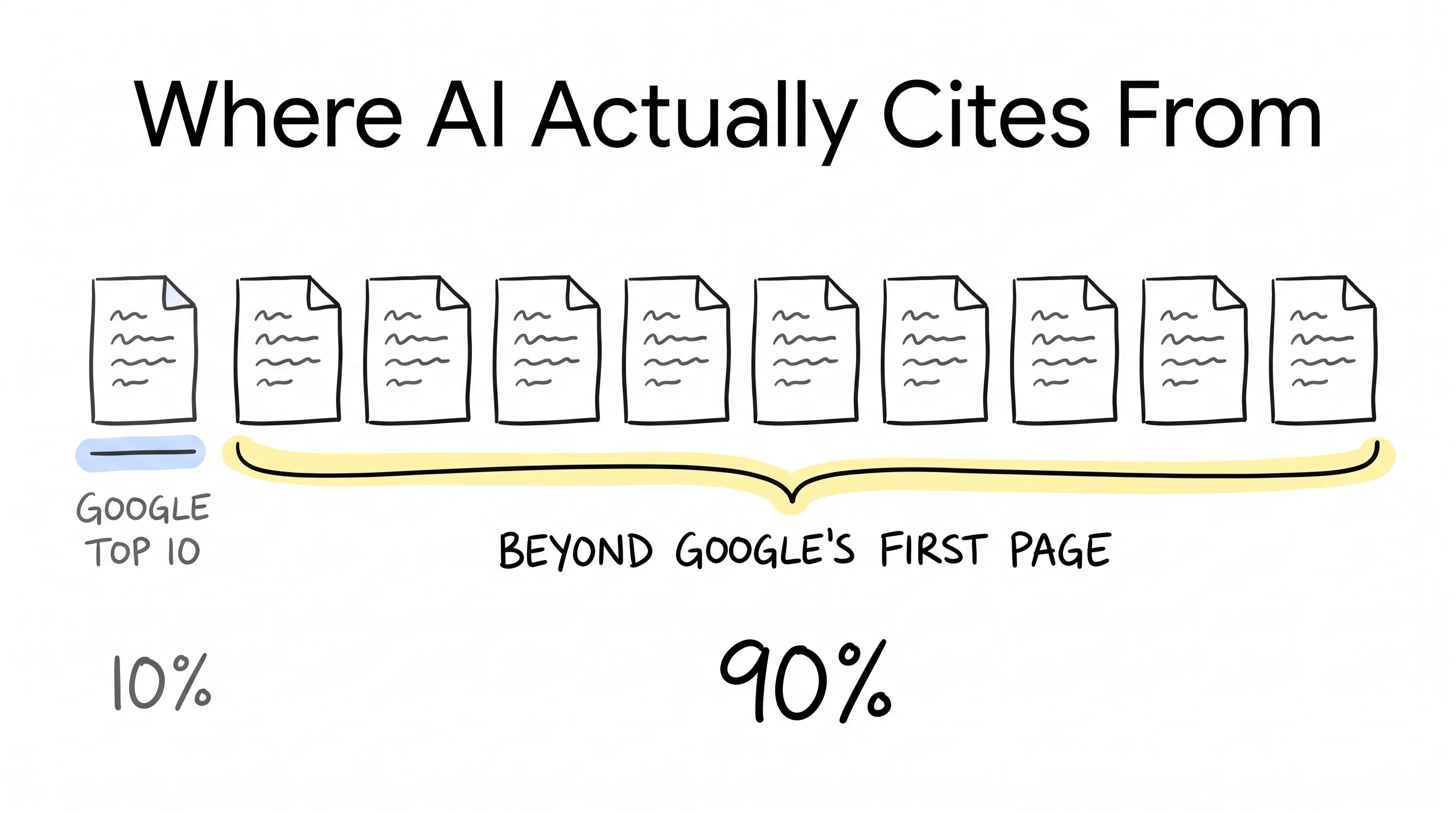
Think about what that means. That position you fought tooth and nail for in the search results barely matters to the AI.
Why? Because the underlying logic of the two is different.
What does Google do? It maintains a giant index of web pages, then ranks them using signals like authority, keyword relevance, and user behavior. Your job is to climb to the top and wait for people to click.
What does an AI answer engine do? It uses a technology called RAG, retrieval-augmented generation: first it pulls, from a sea of content, the passages most semantically relevant to your question; then it organizes those passages into an answer; finally, it attaches the sources it deems credible.
In one sentence: Google hands you a reading list; AI reads the books for you, then tells you whose advice to take. Getting cited is getting AI's recommendation.
What stings even more: in the US, roughly 60% of Google searches now end in zero clicks. Users read the answer right on the results page and never enter any website. Pile on AI Overviews and the assorted chatbots, and the "click into your site" step is getting skipped entirely.
How Valuable Is AI Traffic, Really?
So how much is the traffic from AI worth? Let me run a few numbers for you.
Ahrefs has published its own data: visitors from AI search convert at 23 times the rate of traditional organic search. AI traffic makes up just 0.5% of total visits, yet contributes 12.1% of all sign-ups. Half a percent of the traffic, more than a tenth of the sign-ups. That math works out in your favor any way you run it.
The numbers from Microsoft Clarity tell a similar story: traffic referred by AI converts to sign-ups at 1.66%; traditional search, 0.15%. An 11-fold difference.
Why are AI-referred visitors so valuable?
Picture the process of a buyer using AI for vendor selection. They tell the AI everything up front — their tech stack, budget range, team size, specific pain points. The AI takes that information, searches, compares, and returns targeted recommendations. By the time that buyer follows a citation to your website, they've already been told: you're a great fit for them.
In other words, the AI has done your pre-screening for you, and everyone who shows up is a high-intent customer.
47% of B2B buyers are already using AI for vendor research. Tech is even more aggressive: 80% of tech-industry buyers use generative AI for vendor research at least as often as search — 21 percentage points above other industries.
Gartner has even predicted that by 2026, traditional search engine usage will drop by 25%. Chatbots are becoming the next generation's answer gateway.
Here's one case I've come across. A B2B SaaS company ranked top three on Google for its main keyword, yet ask ChatGPT or Perplexity and it was never mentioned at all. The company then did GEO systematically, and in about seven weeks, AI-referred trial sign-ups grew from 500 per month to more than 3,500.
What to Actually Do: Seven Things That Make AI Dare to Cite You
The old SEO moves — keyword stuffing, meta descriptions, backlink hoarding — get no traction here. An agency called Discovered Labs, after analyzing thousands of AI citations, distilled "what kind of content gets cited" into seven factors. I'll walk through them one by one, in plain English.
-
State clearly who you are. Before the AI can cite you, it has to know you. At the start of every piece of content, use two or three sentences to say who you are, what category you belong to, and where you're positioned. "We help businesses grow" says nothing; "we're a service provider that helps B2B software companies break into AI citations" — that's information.
-
Structure your content around the buyer's follow-up questions. After the main question, a buyer will always ask the next one. Your content should answer that chain of questions in one go. The AI favors sources that deliver a complete answer within a single paragraph.
-
Let third parties speak for you. The AI trusts what others say about you far more than your own self-praise. Wikipedia entries, a stack of genuine reviews on G2, discussions on Reddit, citations in industry reports — all dramatically raise your chances of being cited. Tooting your own horn won't do it; when the whole neighborhood vouches for you, that counts.
-
Make every fact verifiable. Write down the dates, the sources, the specific numbers. The AI loves precision and hates vagueness. Vague claims, it won't dare cite.
-
Cut your content into easy-to-lift chunks. What the AI retrieves is passage by passage, not the whole page. Break your content into semantic chunks of 200 to 400 words, each one able to stand alone as an answer, paired with clear subheadings, comparison tables, and process lists.
-
Stay fresh, stay consistent. The AI favors new information, and it penalizes sources whose numbers don't match across the board. Your company information on your website, your G2 profile, Wikipedia, and your LinkedIn page must be identical, word for word.
-
Spell out the relationships. Who you integrate with, which industries you serve, whose alternative you are — name names, and add structured markup like Organization, Product, and FAQPage. The AI understands the world by linking entities into a knowledge graph, so you have to proactively tell it where you fit.
Do the Math: Stop Watching Rankings
The old keyword-ranking scoreboard doesn't work here. Watch four things instead.
Citation rate: the share of high-intent buyer questions in which your brand gets mentioned by the AI. Done properly, one round of testing covers 50 to 100 buyer questions, spanning ChatGPT, Claude, Perplexity, Google AI Overviews, and Microsoft Copilot.
Share of voice: for the same question, an AI answer typically recommends three to five companies — what percentage of the time do you appear among them?
AI-sourced pipeline: tag traffic arriving from AI citations with dedicated UTM tags, pipe it into your CRM, and track it all the way through — visitor to opportunity to closed deal.
Conversion rate comparison: how much better do AI-sourced leads convert than search-sourced leads? Don't forget that 23x. Even at small volume, the business is anything but small.
Shopping for a GEO Vendor? How to Tell the Real Ones
If you'd rather outsource than build a team in-house, let me flag a few tells.
A genuine GEO practitioner can clearly explain how AI optimization differs from traditional optimization, and has a methodology explicitly built around entities, third-party validation, and content chunking. If what you hear is "we just make great content" or "we follow the EAT principles," chances are that's old methods with a new label slapped on.
A genuine GEO practitioner systematically tracks citations across multiple AI platforms and is willing to show you the monitoring dashboard. By the way, on average ChatGPT alone accounts for 87.4% of AI-referred traffic — but that doesn't mean you test that one platform only.
A genuine GEO practitioner will talk with you about building third-party endorsements on Wikipedia, Reddit, and review sites, not just about backlinks.
And the most down-to-earth tell of all: look at the contract. If they push for a one-year or even two-year commitment right out of the gate, it means they have no confidence in their own results. The ones who dare to bill monthly are the ones planning to keep you through results.
Back to That Dinner
Here's what I told my friend: you're panicking now, but you still have time.
Those three to five slots in AI recommendations haven't been filled yet. Whoever first gets their content into a shape the AI can read and dares to cite claims the position first. And this thing compounds: the more customers citations bring you, the thicker your case studies and reputation grow, the stronger your third-party validation becomes, and the harder you are to push out later.
The other way around: keep staring only at Google, and that road isn't narrowing — it's disappearing.
At the end of the day, in the search era, traffic was seized; in the answer era, business is referred. The AI doesn't recommend the loudest companies. It only cites the ones that state things most clearly and stand up best to verification.
Here's hoping the AI gets to know your company — soon.
Continue reading
Related articles

It's 2026: Stop "Buying" AI Tools for Your Marketing Team — Start "Hiring" AI Agents
This learn article explains how AI agents differ from standalone AI tools in marketing, outlines three agent categories — build-your-own platforms, CRM-native agents, and vertical tools — and covers use cases across SEO, social media, advertising, and reporting, plus criteria for choosing one.

What Is GEO? How Your Brand Gets "Mentioned" in the Age of AI Search
An explainer on GEO (Generative Engine Optimization) for e-commerce and DTC brands: how it differs from SEO and AEO, why AI answers shape brand visibility, and eight practices covering question-focused content, consistent brand messaging, structured pages, external evidence, comparisons, and AI mention tracking.

AI Is Already Making Decisions for Your Customers. Are You on the List?
A learn article explains GEO (Generative Engine Optimization): why AI-generated answers now shape which brands customers see, and how SEO fundamentals, entity clarity, citable evidence, and monthly measurement affect visibility in AI answers.