
"Good Enough" Is Killing Your Brand
A learn article arguing that AI-generated marketing content is becoming homogenized, citing studies on content similarity, model collapse, and consumer sentiment, and proposing a three-step workflow that pairs AI drafting with human brand judgment.
It's 8 a.m. You open LinkedIn.
Ten long posts. One about "empowerment," one about "customer-centricity," one about "redefining growth." The rhythm of the sentences sounds like one person wrote them, the adjectives like one person picked them, and even the hooks collide: in an era of such-and-such, such-and-such is becoming more important than ever.
You think you just scrolled past ten authors. In reality, you scrolled past one model.
Why is this happening? Because AI has made content production fast and cheap. Fast — everyone is fast. Cheap — everyone can afford it. And everyone is using the same few models, trained on heavily overlapping data.
Think about it: one hundred chefs, given the same cookbook and the same batch of ingredients — can they cook one hundred distinct meals?
Unlikely. What everyone serves up is that same "pretty decent" dish.
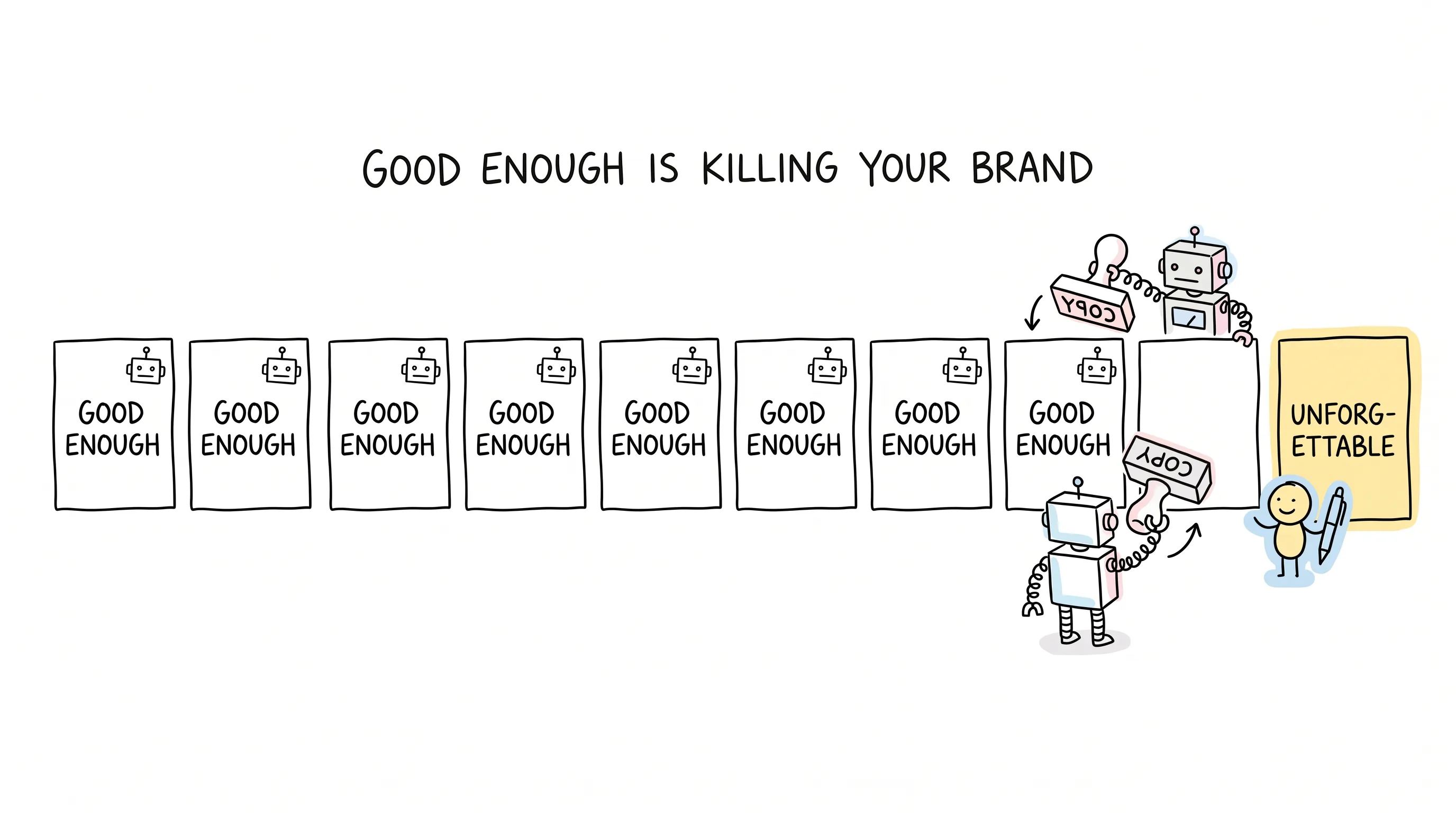
This is the most hidden crisis in today's content industry: read one piece at a time, and every piece passes. Read them together, and it's all the same voice.
Good enough is where mediocrity begins.
First, Some Uncomfortable Numbers
This sameness isn't just an illusion. One company has actually put numbers to it.
An AI detection company called Pangram Labs used a browser extension this year to scan more than 1 million social media posts. The result?
Across the web, one in four long posts was judged to be "entirely AI-generated." On LinkedIn, that figure exceeds 40%.
40%. Of the long posts you scroll on LinkedIn, more than four in ten were written by machines.
More interesting is a comparison: LinkedIn posts made up one-third of the total scanned, yet accounted for nearly two-thirds of the AI content. The most professionalized platform is precisely where homogenization is heaviest.
One caveat here: Pangram sells AI detection tools, so the numbers inevitably carry an agenda — take the magnitude as the takeaway.
But the magnitude alone makes the point. We have very likely already crossed the line: on some platforms, the majority of what you read isn't written by humans.
Every Piece Got Better, and Together They Got Worse
Some will ask: the individual quality of AI writing isn't bad — who does it hurt?
It hurts precisely the "individual piece" perspective.
Researchers at University College London and the University of Exeter ran an experiment: people wrote short stories, some with AI assistance and some without. The AI-assisted stories scored higher on quality and were easier to read.
But. They were also significantly more similar to one another.
AI raised the floor of every piece while narrowing the distribution of all pieces. Everyone moved a step forward — and then everyone crowded into the same corridor.
MIT's economists added another twist. 444 professionals did writing tasks, half using ChatGPT and half without. AI did speed things up and raise quality — and the lower someone's starting point, the bigger the gain.
Sounds like all good news, right?
Put the two experiments side by side and the trouble appears: everyone got better, and everyone became the same.
The most compelling evidence comes from Italy. In 2023, Italy briefly banned ChatGPT. Researchers at London Business School seized the window to observe local restaurants' marketing content: during the ban, content similarity dropped and average like-based engagement rose by about 3.5%; once the ban lifted, homogenization followed right back.
Same restaurant, same platform, same audience. The only variable was whether AI was in the workflow.
AI's spread brings homogenization — and homogenization carries a price.
The Market Has Started Voting with Its Feet
The market is already putting a price tag on it.
In its 2026 consumer survey, Gartner found that 49% of U.S. consumers believe AI has made content quality worse; nearly half say they would prefer brands that use no AI in their marketing at all.
The agency side is reflecting too. In June 2026, Forrester and the 4A's jointly released a report: 90% of U.S. marketing agencies are already using generative AI, mainly to cut costs and boost efficiency. Yet the report's own conclusion stings: the entire industry's obsession with efficiency is eroding marketing effectiveness and brands' long-term growth.
Even the companies themselves have grown uneasy. In October 2025, The Conference Board analyzed S&P 500 annual reports: 72% of companies list AI as a material business risk. In 2023, that number was just 12%. The most cited concern is reputational risk.
Remember, these are SEC filings written for investors. Companies are effectively telling shareholders in black and white: the content and communications risk from AI is big enough that it must be disclosed.
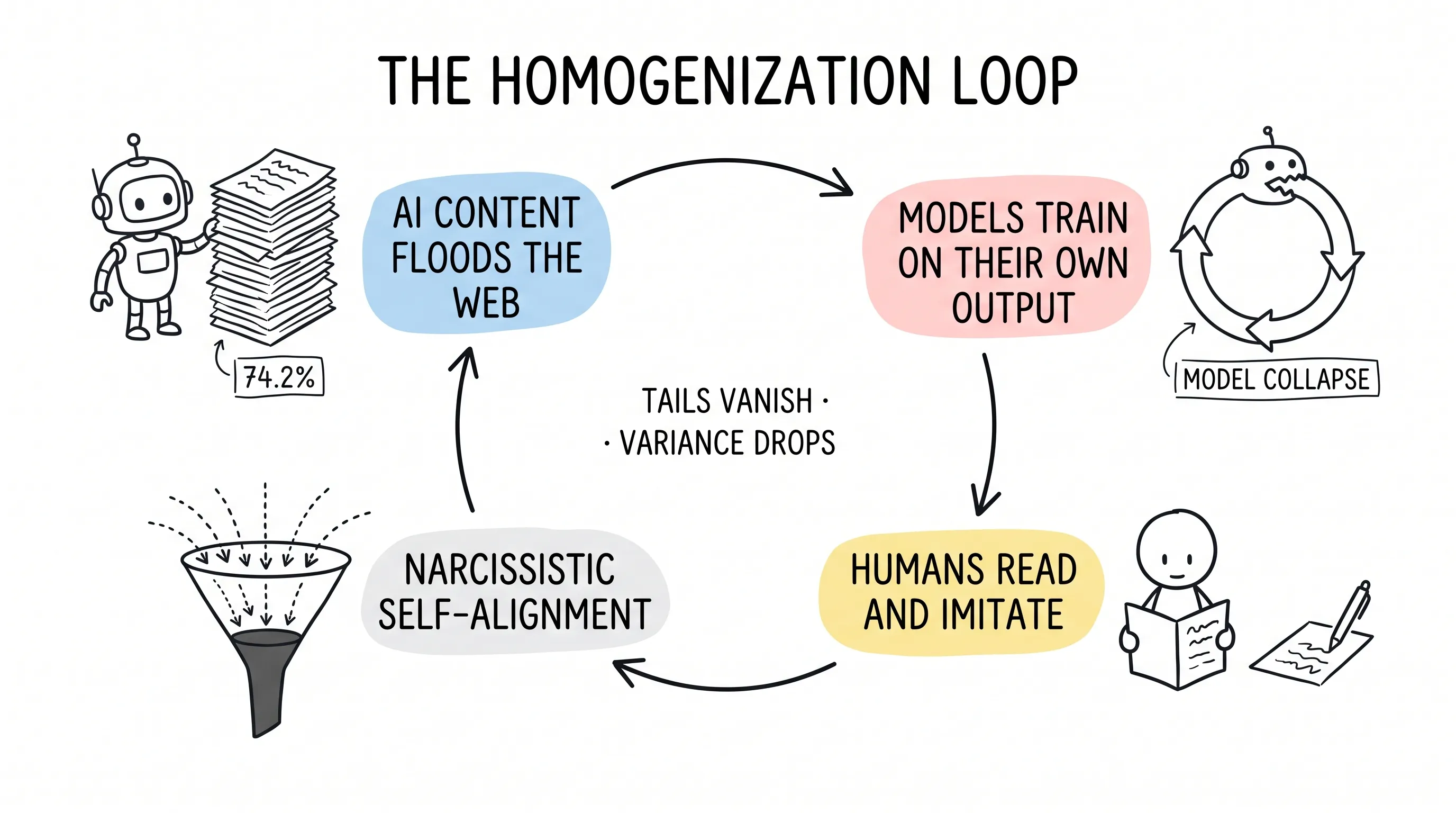
The flood on the content side is rising too. Ahrefs analyzed 1 million new web pages published in April 2025; 74.2% contained detectable AI content. Broader estimates suggest 30–40% of all active text on the web is AI-generated or AI-edited.
The Truly Terrifying Part Is the Loop
If it were just "content looking a bit alike right now," that wouldn't be a big deal. What's terrifying is the loop.
In 2024, researchers from Oxford, Cambridge, and Google DeepMind published a study in Nature describing a phenomenon called "model collapse": when models start training on their own generated data, two things happen. First, the tails of the distribution vanish — rare, unique, and odd content gets quietly wiped away. Then the whole distribution narrows into a band of extremely low variance.
The researchers gave it a stinging nickname: Habsburg AI. Like the European dynasty that survived centuries on inbreeding — the gene pool kept shrinking until each generation was weaker than the last. Models trained repeatedly on their own output end up exactly the same.
A team at Rice University ran a more extreme experiment: in a fully synthetic training loop, within five generations, a model's quality and diversity both collapse.
But the loop doesn't just happen to models. It happens to you and me.
In a framework proposed in 2024, researchers at KAUST and the University of Macau observed: as AI content floods the internet and people read enough of it, they internalize its patterns and start writing more "average," more AI-flavored content themselves.
The model contracts toward the center, and people drift toward it too. The researchers named this endpoint "narcissistic self-alignment": humans and AI, eventually flowing into the same narrow center.
God. At this point the problem is no longer technology. An entire content ecosystem is flattening together.
What Is Business Taste?
So here's the question: production has been commoditized, methods homogenized, and the data is feeding back on itself. What is left that can truly distinguish you from the company next door?
One word: taste. To put it more fully: business taste.
What is business taste?
It's the ability to make judgments at the brand level. What should exist and what shouldn't; what gets published and what gets killed; what sounds like your brand and what sounds like any brand using the same models.
When your AI output is "good enough," taste's job is to say that one word: no.
A June 2026 article in Fast Company defines taste as the combination of three things: sensitivity, intuition, and learned judgment. Two lines in it are worth quoting to you.
Taste is half about saying yes, and the other half about saying no.
And a warning: beware "taste slop" — content that looks tasteful but is actually empty. Even "anti-homogenization" itself can be manufactured into a new homogenization.
Taste isn't mysticism either — it can do the accounting. System1 and WARC analyzed ad performance: ads with high creative scores earn more than three times the marketing ROI of low-creative ads.
The more commoditized production becomes, the more valuable judgment is. And right now, almost no one is investing in it systematically.
That is the window of opportunity.
Putting Taste Into the Workflow
So what do you actually do? Here are three steps.
Step one: re-order the workflow. Let AI lay the foundation and generate options; let people do the filtering and make the final call. AI suits research, generating variants, running tests, and drafting; for work that builds brand recognition, the judgment must come from a human. Six months ago many treated "writing a good prompt" as the finish line — in hindsight, the prompt is just the starting point; judgment is the destination.
Step two: feed it your own material. Don't start from a blank page. Load your brand assets, voice documentation, past marketing campaigns, customer evidence, even competitor intelligence into your project. Constrain the model with your own memory instead of letting it riff freely on public training data. The output changes immediately.
Step three: before publishing, run it through a "taste gate." Ask four questions: Is this content unique? Does it have real cases, data, or lived experience? Would anyone want to save it or share it? Is it building long-term brand recognition, or is it just a one-off output?
We've run legal review on our documents for years. Perhaps it's time to add a new review: one that judges specifically whether content is unique enough.
Coca-Cola has demonstrated both the upside and the downside for you.
Their Create Real Magic project turned their own brand archives and assets into AI tools for digital artists, and they ran a creation academy to select creators. The work that came out was distinctive and culturally resonant. Later they cut out that layer of human judgment and published an AI-generated holiday ad directly — the public backlash was immediate. The most stinging comment: soulless.
Same company. With human judgment, a stroke of genius; without it, a disaster.
Three Companies "In No Hurry"
Here are three reference points.
Hermès uses AI heavily — but only for supply chain optimization and demand analysis. Creative direction is entirely human, and the boundary is drawn firmly.
Duolingo turned itself into a meme: absurd, theatrical, personified to the extreme. That brand personality could never grow out of a model trained on the "average internet." It can only come from human judgment about "what's funny and when to hold back."
Patagonia spends less than 1% of revenue on paid media, and most of what it tells are other people's stories. It remains one of the most recognizable brands on the planet.
When everyone is producing more, faster, deliberate restraint is itself a signal.
Back to 8 a.m.
The research is clear: AI genuinely raises per-piece output, genuinely speeds up research, genuinely cuts costs. These are real advantages. Use them — don't hold back.
The question is what you bring to pair with it.
AI can get you to a first draft faster. But deciding what the brand is, deciding what not to write, and spotting "this piece passes but no one will remember it" — that can only be human.
A few days ago I scrolled onto another post. A young woman sharing the everyday routine of playing Wordle with her mom — no grand lessons, yet the numbers were terrifyingly good. Why? Because it's alive. It's different from everything else in that corridor.
We are, of course, creatures of habit. But what we want has never been just habit.
We also want surprise, delight, to be lit up.
When everyone is "good enough," being distinctive is the greatest efficiency.
Here's to writing things people will always remember.
Continue reading
Related articles

It's 2026: Stop "Buying" AI Tools for Your Marketing Team — Start "Hiring" AI Agents
This learn article explains how AI agents differ from standalone AI tools in marketing, outlines three agent categories — build-your-own platforms, CRM-native agents, and vertical tools — and covers use cases across SEO, social media, advertising, and reporting, plus criteria for choosing one.

What Is GEO? How Your Brand Gets "Mentioned" in the Age of AI Search
An explainer on GEO (Generative Engine Optimization) for e-commerce and DTC brands: how it differs from SEO and AEO, why AI answers shape brand visibility, and eight practices covering question-focused content, consistent brand messaging, structured pages, external evidence, comparisons, and AI mention tracking.

AI Is Already Making Decisions for Your Customers. Are You on the List?
A learn article explains GEO (Generative Engine Optimization): why AI-generated answers now shape which brands customers see, and how SEO fundamentals, entity clarity, citable evidence, and monthly measurement affect visibility in AI answers.