
We Took Our Blog Team AI-First. More Than a Year Later, Here's the Honest Truth
The author, a blog team manager, recounts more than a year of running an AI-first writing workflow: faster drafting offset by deeper articles, hallucinations forcing formal fact-checking, added QA steps, and team-management lessons, plus a critique of high-volume AI publishing.
In June 2025, our blog team officially switched to an AI-first writing model.
The day the announcement came down, my feelings were mixed.
Half of it was excitement. The old inefficiencies in our process had bothered me for a long time, and AI might actually cure a few of them.
The other half was anxiety.
Strangely enough, my anxiety wasn't aimed at the technology. Could these tools actually write? Could you trust what they produced? I worried about all of that. But what I worried about most was the people.
I've managed the writing team on the HubSpot blog for more than three years. Before that, I was a writer here myself. So I know exactly what "ownership of the craft" means.
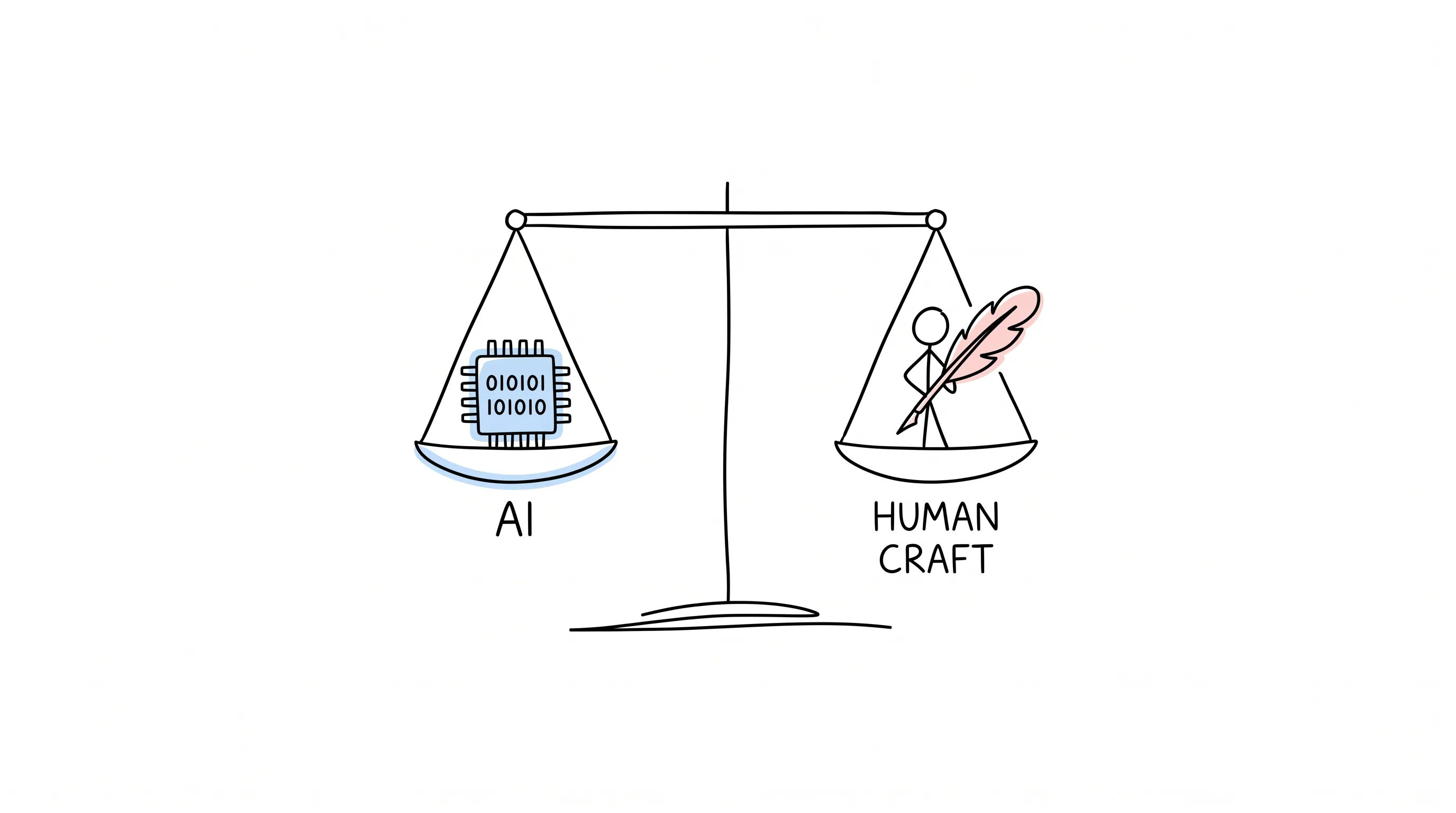
Many of the writers on this team got into the business because they love to write. Working out the right sentence, winning a reader's attention — that's the core joy of their work. Traffic and conversions come later.
Now the craft they make a living from had to change how it works within a few months.
Wouldn't you be anxious?
The Outside World Is Telling This Story Wrong
Over the past year-plus, the more public discussion about AI content I read, the more I felt most people had it wrong.
The assumption goes: AI can already produce decent-looking writing, so the hard part is over. What's left is to apply the same casual touch-up effort you'd give an AI-drafted email to a blog post, hit publish, and call it a day.
I've done this for over a year, and I'll say it responsibly: that doesn't work.
What is a blog post? It's something that has to compete with dozens, even hundreds, of other articles for readers on the same topic. In that game, mediocre writing that doesn't try doesn't win.
And that, oddly enough, is good news for content teams. The process changed; the craft hasn't lost value.
So the question becomes: how do you get craft and efficiency at the same time? What is AI actually good at, and where does it dig traps? Over the past year-plus, we've walked the whole thing with real time and money on the line. Where we saved time, where we spent more, what landmines we stepped on — I'll go through it one by one.
First, How We Used to Write Articles
Before AI, our process was just that — a writing process.
We had editorial standards and quality guardrails, but we never dictated how an article "had to be written." We hired for craft; craft is something you simply have to trust.
Why trust? Because writing isn't just a technical job. Give writers room to grow their own workflow, and they pay you back with content that has personality, with insights nobody else can copy.
When new writers join, we give them a simple time frame to plan their pace:
Outline, half an hour to an hour. Research, one to two hours, depending on how unfamiliar the topic is. First draft, five to seven hours on average. Final editing, QA, formatting, and loading into the CMS, another two hours or so.
Add it up, and a standard blog post easily eats a whole day — often more.
Where's the bulk? The writing step. Getting the words onto the page, finding the right structure, explaining one thing clearly — that's the core of this job.
We Set Exactly One Rule: Don't Prescribe Method
When we formally rolled out AI, my approach was deliberate: no one-size-fits-all mandate.
For over a decade, "let writers grow their own process" had always worked. With AI in the picture, I had even less intention of stepping in and telling a group of seasoned writers how to do their jobs.
We did exactly three things: turn on the tools, give plenty of time, then wait. The tools were Claude, ChatGPT, plus a NotebookLM.
Experiment first, rules later.
The result?
Not the clean efficiency victory I had imagined.
The First Surprise: Words Got Faster, Articles Didn't
At first, the signs were good. Words were hitting the page at a visibly faster rate.
I took it for granted: faster first drafts, faster output.
Wrong.
Two months in, I pulled the hours data and talked with people on the team one by one, and the picture that emerged was far more complicated.
Publishing volume barely moved. But every article got longer, deeper, and harder to produce. Writers were pouring the time they saved into hands-on software testing, chasing expert quotes, digging topics deeper.
The time AI saved at the writing stage was being eaten back, bite by bite, by everything else that "a competitive article" demands.
Worse, some people were being squeezed from both ends: pressure from above to write faster, while the article itself demanded they write more fully. The pressure simply doubled.
Once I saw that, I adjusted expectations quickly. Because I realized: AI hadn't reduced the workload. In many ways, it had made the workload bigger.
So my first lesson: If you measure AI's value by publishing volume, you'll mostly be disappointed. The payoff isn't speed — it's what the article itself becomes.
The Second Surprise: AI Research Is Half Angel, Half Trap
I originally assumed research was AI's home turf. What used to take an hour to get familiar with an unfamiliar topic could now be handled with one question.
Half right.
On general topics, AI is genuinely strong. In well-documented fields, it explains concepts clearly and holds up under follow-up questions — far faster than opening a dozen browser tabs.
But the traps? The writers stepped on them almost immediately.
The first alarm came from a competitor roundup. A writer came to me and said the pricing the AI gave was wrong. Not off by a little — completely outdated old prices. The AI didn't know prices had changed, and it never said "I'm not sure."
I should have seen it coming. Training data stops months back — how would it know a competitor adjusted prices last week? But honestly, if that writer hadn't pushed on it, I would never have factored this into the process at all.
From then on, we set a hard rule: for anything involving competitor pricing or product-feature accuracy, AI research doesn't count.
The logic is obvious once you think about it: training data has a cutoff date. New prices, new features, brand renames — it knows none of them. Even if you go to live search, product pages are structured so messily that models often can't read them. What you end up with is a passage that sounds completely confident but actually stopped months, even years, ago.
We produce a lot of competitor lists and product-related content. The research for that content is still entirely manual today, and takes about as long as it always did.
One-line summary: AI accelerated general research. Competitor research — not a single minute saved.
The Third Surprise: Hallucinations Forced Fact-Checking Into a Formal Step
Deeper than outdated pricing is a trap called hallucination.
Made-up statistics. Quotes attached to the wrong person. Wrong industry terminology. And all of it delivered in the same confident tone.
It doesn't know what it doesn't know.
We hold a high bar for accuracy. These hallucinations turned fact-checking from a small wrap-up step into one of the most time-consuming parts of the whole process. For some pieces, AI drafting was actually slower than writing by hand — because verifying where it went wrong sometimes took more effort than rewriting.
What touched me most was how fast the team caught errors. "Nothing unverified ever ships" — that obsession is etched into a craftsperson's bones. It kept reminding me of something I already believed: the writer will always matter more than the tool in their hands.
The countermeasure landed too: a new formal step added to the process — independent fact-checking. Before, accuracy was the writer's own responsibility, and editors scanned for obvious errors at the end. Now, verification is a standalone stage. A typical article adds 30 to 60 minutes; pieces heavy on data, quotes, or product information take longer.
You might think: skip the checking, bet on AI all being right — could that work?
It could. But do you want that to be your content's baseline? Once misinformation goes out — even unintentionally — the hole it leaves in trust is very hard to patch.
The Fourth Thing: Quality Doesn't Stand Guard on Its Own
QA time is rising too, and for reasons that don't overlap with fact-checking.
Fact-checking handles "is the information right." QA handles everything else: does this article read like a human wrote it? Does it meet the bar? Is the structure friendly to search engines and AI tools?
Without a structured quality gate, AI-drafted drafts carry in a whole batch of problems the writers themselves wouldn't notice:
AI voice — the same wash of hedging words and empty phrases, "it's worth noting that," "empower," "dive deeper"; redundant sentences saying the same thing in circles; unintentional plagiarism of competitor content (not deliberate — the model lifting passages it saw during training straight into its output); broken links; images missing alt text; messed-up heading hierarchy; and whole passages written in ways that are inconvenient for AI search to slice up and quote.
My fix was low-tech: I wrote a QA checker myself in Google Docs, built specifically to catch the problems above. Now it's a mandatory stage in the process.
A Whole Set of Things AI Never Touched
So much changed, but a few things haven't moved an inch.
The E-E-A-T requirements, kept exactly as they were: original quotes, first-hand perspective, solid sources. Editorial judgment, kept as it was. And that layer of strategic thinking — who this piece is really for and what it says to them — kept as it was.
What AI took over is execution: drafting, scoping, generating angle ideas, explaining concepts. But the layer that makes an article worth reading — the human perspective, the original insight, the rigorous sourcing — still rests on the writer.
Not only does it remain; it weighs more. Because that is the one place your content can pull away from everything AI turns out across the web.
Managing the Process Got Easier; Managing People Got Harder
A year-plus in, my role has been pulled in two directions at once.
On one side, I've turned into a process obsessive. Workflows, tool chains, how a draft gets assembled — I think about these more than I ever have.
On the other side, managing people got harder.
Not because the writers are difficult. It's that I'm asking them to change the way they work.
A process can be written down once and done. Leading a group of people through a change that completely reshapes their professional craft, while keeping morale steady — that's a problem of an entirely different magnitude. However well-built the process, if the writers don't buy in, it's all wasted effort.
Here's the key: writers got into this profession for different reasons, so AI lands on them with different weight.
Some people are naturally in it for the results. They're good at writing, and they're glad to see content move the business. For them, AI is a tailwind — a faster path to the finish line. They're happy.
Others came for the craft. The act of writing itself is what they treasure. To those people, AI-first feels like something being taken away.
Let me be clear: the second group isn't a capability problem, and it isn't resistance to change. It's an internal tension that deserves to be taken seriously.
My job is to see where each person stands on that spectrum and treat them accordingly — and to keep a place where the truth can be spoken, including hard truths about AI.
Why is that non-negotiable? If writers don't dare tell you where things are wrong, you're building your process on bad information. The people who pushed hardest on our AI workflow early on were exactly the ones who handed me the most accurate list of fixes.
If you're wading across this river too, a few words for you:
- Don't rush to prescribe method. Give tools first, give space first, and let them test out the path.
- You can mandate experimentation; don't mandate usage. Teams that nailed down usage from day one created unnecessary friction.
- Remember, you're asking people to change how they work. That takes time — and trust even more.
- Keep a door open for negative feedback. If they don't dare tell you the truth, you'll build your process on false information.
- See whether each person is results-driven or craft-driven, and treat them accordingly.
The goal never changed: make things worth reading. Only the path changed.
One-Article-Per-Minute Won't Save a Team
Okay, the team stuff is done. Now the outside world.
You might ask: if AI can generate a blog post in minutes, why not just publish more? More publishing, more ranking chances, a wider funnel for leads. What a deal.
People in this industry have actually run that math — and made plenty of noise doing it.
Back when AI content started scaling, a playbook spread through the SEO world: publish the most AI content at the fastest possible speed, and seize the traffic before competitors even react.
Claim the ground first; deal with quality later.
Turns out, later never came.
Anyone in the business recognizes what this playbook produces at a glance: articles that go around in circles; listicles that would still hold up if you swapped in any industry's name; no original data, no real opinions; run a plagiarism check and you'll even find passages lifted verbatim from competitors.
There's now a word for it: AI slop. Experienced readers can't be fooled. Search algorithms, even less so.
Marketers know this themselves. In HubSpot's 2026 State of Marketing report released this year, 52% of marketers believe AI has made content production so easy that overall effectiveness has actually gotten worse.
Not enough? This year, SEO expert Lily Ray tracked more than 220 sites that identified themselves as customers of AI content platforms, and found a strikingly consistent pattern: organic traffic spikes quickly, then falls off a cliff, with many sites dropping straight back to where they started. In her data, more than half of the sites lost over 30% of their peak traffic, and nearly a quarter lost more than 75%.
I understand why people charged in. The pressure is real: 83% of marketers say that with AI's arrival, they're being asked to produce more content than ever before.
But this is what betting on speed alone gets you. Quality, once compromised, basically can't be rescued after the fact.
The teams doing it well go in exactly the opposite direction: define what "good" means first — voice, depth, accuracy, originality. Then work backward to figure out where AI can speed things up, and where it must not touch.
That's exactly how the HubSpot blog operates: not a single E-E-A-T standard loosened, quality guardrails built into the process in advance, and an honest separation between which content types suit AI involvement and which fundamentally don't. Tutorials and original research have wildly different requirements — force both through the same mold and what comes out is mediocre output nobody reads.
Karla Hesterberg, former head of the HubSpot blog, said something I especially love: "The only process that truly takes no effort produces garbage." Keep the garbage out, put good writers in the driver's seat, and use AI as a lever, not a stand-in. The teams whose content converts all work this way.
More Than a Year Later
More than a year has passed, and looking back, I'm proud of where the team has gotten to. Of course, there are still questions I haven't figured out — I won't pretend otherwise.
What really made it work isn't the tools; it's the people. I knew that before I walked in, and this year-plus has proven it again and again: the writers who dared to tell me the truth gave me the roadmap; the writers who struggled showed me what this transformation actually demands.
What makes me happiest is a sentence the team has started saying lately: they feel like real writers again.
The balance between AI's efficiency and your own craft is starting to hold steady. Not because of some perfect prompt, and not because of some miracle tool. It holds because from day one, we never let go of what makes content good.
If you're an editorial leader crossing this river right now, remember: what carries you across is the writers who care enough to tell you the truth, and your willingness to hear it. Don't underestimate the weight of "feeling like a writer." It shows through in the work.
AI is a tool. Put writers at the center, hold the quality line, and the rest takes care of itself.
Here's to you crossing that river soon, too. And when that day comes, I hope someone on your team runs over and tells you: I feel like a writer again.
Continue reading
Related articles

It's 2026: Stop "Buying" AI Tools for Your Marketing Team — Start "Hiring" AI Agents
This learn article explains how AI agents differ from standalone AI tools in marketing, outlines three agent categories — build-your-own platforms, CRM-native agents, and vertical tools — and covers use cases across SEO, social media, advertising, and reporting, plus criteria for choosing one.

What Is GEO? How Your Brand Gets "Mentioned" in the Age of AI Search
An explainer on GEO (Generative Engine Optimization) for e-commerce and DTC brands: how it differs from SEO and AEO, why AI answers shape brand visibility, and eight practices covering question-focused content, consistent brand messaging, structured pages, external evidence, comparisons, and AI mention tracking.

AI Is Already Making Decisions for Your Customers. Are You on the List?
A learn article explains GEO (Generative Engine Optimization): why AI-generated answers now shape which brands customers see, and how SEO fundamentals, entity clarity, citable evidence, and monthly measurement affect visibility in AI answers.