
In the Age of AI Search, How Does a Brand Get "Mentioned"? A Look at GEO and 15 Handy Tools
An explainer on GEO (Generative Engine Optimization): how AI answers differ from traditional search, the retrieval and synthesis gates brands face, and a roundup of 15 tools for monitoring and improving brand visibility in AI-generated answers.
A while back, an old friend of mine who runs an e-commerce business invited me to dinner. Halfway through the meal, he started sighing.
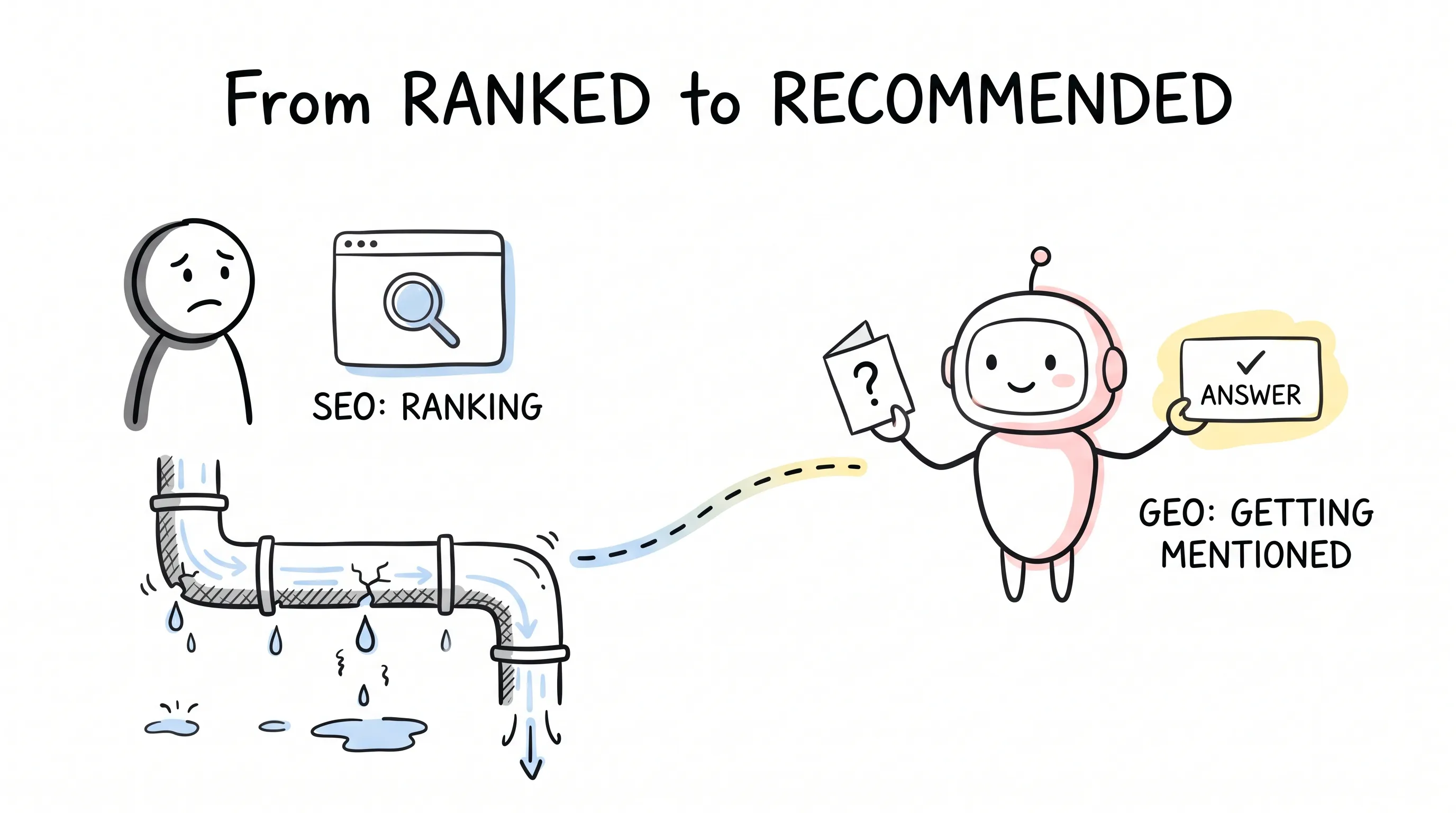
He said his website traffic used to be pretty stable. He had done everything SEO required: keywords, backlinks, internal links — none of it skipped. But recently, the traffic felt like someone was sucking it out of a pipe, draining away with a whoosh.
I asked him: when you buy things yourself these days, do you still flip through ten pages of search results?
He froze.
Not anymore. Before buying anything now, he asks AI first. He asks ChatGPT, he asks Perplexity, and before placing an order he glances at that AI Overview sitting at the top of the Google search box. AI gives the answer, and he orders right away.
I said, that's exactly it. Your SEO hasn't slipped — the game has changed how it's played.
The way customers find answers has changed: from "scrolling through a list" to "taking a recommendation." And who AI recommends — and who it doesn't — is something that can be managed. This new discipline has a name: GEO, Generative Engine Optimization.
SEO is about getting search engines to rank you at the front. GEO is about getting AI to willingly mention you when it puts its answers together.
One letter apart, worlds of difference.
1. From "Looking Up a Dictionary" to "Asking a Trusted Advisor"
To understand GEO, you first have to think through how search itself has changed.
For the past twenty years, the logic of search engines was "looking up a dictionary." You type in a word, it digs out the few most matching pages from its warehouse and hands them to you. Whether you adopt them is your call. The answers sit right there — you go find them.
Now, the logic of AI answering questions is "asking a trusted advisor." You ask it a question, it reads through a huge pile of material, digests it itself, and then states the conclusion for you. You never even see the source material.
One handles "finding." One handles "figuring it out."
How fierce is this change? Over 60% of searches today end the moment a user "glances at an answer," without even knocking on an external website's door. Gartner has even predicted that traditional search volume will decline by a quarter because of this.
It's not that users stopped searching. It's that their questions get answered by AI halfway down the road.
So what should a brand do? The answer is inside the AI's head. You have to find a way to move in.
2. Moving into the AI's Head Means Passing Two Gates
What does moving into the AI's head mean?
Think about it: before AI can mention your brand in an answer, how many gates does it have to pass?
Two.
The first is called the "retrieval gate." Before it starts writing, AI usually retrieves material first — the mechanism is called RAG (Retrieval-Augmented Generation). If your key information is buried in a hard-to-parse PDF, hidden behind layers of JavaScript, or is just a slogan with no context around it, AI can't read you. If it can't even read you, how can it mention you?
This gate is a technical matter: clean structured data, fast enough load speed, a clear information architecture. The bar isn't high. But plenty of brands collapse right at the doorway.
The second is called the "synthesis gate." The watershed between GEO and SEO sits right here.
Even if AI reads your content, it may not use it. These models have been trained over and over on one instinct: better to say less than to spout nonsense. Whoever is credible gets cited. If your brand is "unfamiliar" with a topic in the AI's knowledge — that is, it lacks what's called entity authority (Entity Authority) — the AI writes its answer and skips right past you.
Take running shoes. In the AI's mind, Nike is a finely woven net: which lineup, what technology, what foot type it suits — everything interlocks. A new brand might have only a few isolated keywords dangling on that net. Who does AI recommend? I don't need to say the answer out loud.
3. The AI's "Source List"
So you may ask: who does AI actually trust?
There's an industry term for this: the source stack (Source Stack). When AI organizes an answer, it keeps a layered trust checklist in mind.
At the bottom layer are databases like Wikidata and knowledge graphs. Cold and impersonal, but authoritative.
In the middle layer are Reddit, Quora, and verified real user reviews. This is the "folk wisdom" AI loves to dig through most.
The top layer is finally your own stuff: product documentation, help centers, the official blog.
Interesting, right? Official content comes last.
Why? Because models have a chronic worry called model collapse: when AI-generated content is fed back to train AI, quality degrades generation by generation, like inbreeding. So a model would rather trust the original words of real people than marketing-toned press releases.
AI doesn't quite trust your own mouth. It trusts other people's mouths more.
This brings two headaches.
First, you can't control what AI cites. Second, its temper is wildly changeable. Once organic rankings hold steady, they can stay stable for months; AI citations can swing 40% to 60% in a single month. On Tuesday it treats you as the top pick, and by Friday it has swapped you out: the model updated once, or it swallowed a new batch of reviews.
In 2025, Authoritas ran a dedicated study: the volatility of AI Overviews is 60% to 70% higher than traditional organic rankings. And it splits by intent. Problem-solving questions like "how do I fix dry skin" trigger an AI answer at a far higher probability than research-type questions like "skin care knowledge."
The character of the tide has changed. It used to be a water level, slowly rising, slowly falling. Now it's waves — they arrive without warning.
Fortunately, the toolbox is growing along with it. I went through the tools on the market worth using: 15 in total, grouped into four clusters by purpose. One by one, here they come.
4. Cluster One: First, "See" Yourself
What do you look like in the AI's eyes? You can't see this with the naked eye — you need tools.
Profound is the enterprise-grade player. It has amassed over 400 million real questions, and you can see what people are asking AI about your category — and whether you show up in the answers. It can also throw the same question to ChatGPT, Claude, Perplexity and several others, comparing who mentions you and who mentions your competitors.
Semrush's AI Visibility Toolkit goes the all-in-one route. The most practical bit: Google rankings and ChatGPT rankings, viewed on the same dashboard. It has also reworked its famous volatility monitor into an AI "weather forecast" — the moment a model updates or an industry's citations start shaking, the alarm goes off. It has even started estimating "prompt volume," and found a pattern: comparative questions like "A or B, which is better" carry far less volume than explainer-type questions, but much richer commercial value.
BrightEdge's Generative Parser is a scout that specializes in Google's AI Overviews. Its greatest strength is explaining the "why." For the same skin-related topic, why does "how to treat a skin allergy" trigger an AI Overview with a medical disclaimer, while "the best face cream" triggers a product carousel? It also watches visual assets: has your product image been grabbed and displayed by an AI Overview? Citations with images tend to earn higher click-through rates.
Ahrefs' Brand Radar takes its old backlink craft into new territory. In the AI era, one "mention" works like one "link." It tracks the unlinked mentions inside Reddit posts, TikTok, and YouTube descriptions, and it analyzes the small trickle of clicks AI actually drives: early data shows this group of visitors bounces less, and conversion can reach 4.4 times that of traditional search. Someone pre-briefed by AI arrives ready to buy.
Peec AI is the starter option for small and mid-size merchants. Starting at €85 a month, the interface is as clean as an "in / out" attendance sheet: under each question, whether you're in the answer. It also thinks up questions for you, automatically expanding "CRM software" into "What's the best CRM for teams under 50 people," so the questions you monitor are the kind real humans ask. It also tells you where your exposure comes from: your own blog, a review on G2, or a Reddit thread.
Morningscore turned GEO into a game. Update schema to earn XP, fix broken citations to complete quests, and a 0-to-100 health score that now counts AI readability too. Sounds like a toy? For a team lead, it's a magic weapon for persuading colleagues to get work done. After all, nobody gets fired up about "go fix the structured data" — but "let's knock out another 300-point upgrade"? That lands differently.
5. Cluster Two: Figure Out Why AI Mentions Them, Not You
Seeing yourself is only the first step. The more valuable question is your competitor.
Evertune specializes in exactly this. Its signature capability is following the vine to the melon: when AI mentions a competitor, what sources did it cite? Dig in and you might discover that the competitor gets name-dropped in ChatGPT constantly — not thanks to its official site, but to one heavily upvoted Reddit post. Find those "influence nodes" and you'll know where to aim your PR and community budget.
It can also run one very clever test: connect straight to a model's API and tell whether AI "knows you natively" — you're in its training data — or "learns about you on the spot," finding you only through real-time retrieval. The two states call for completely different business moves.
There's a classic case, too. Porsche used it for a self-check and found the AI's perception of its "performance" was crisp, while its perception of "safety" was blurry — a gap between the two perceptions. After adjusting its communications narrative, its AI visibility rose 19 points.
AthenaHQ tackles another painful question: users don't click — how do I do the math on that?
Its method is to align "how many times AI mentions you" with real money. Connect Shopify, connect Google Analytics 4, and hold AI mention frequency against the rise and fall of direct traffic and brand-term searches. Even with no clicks, you can see the correlation. It also ships with an action center: when it spots Perplexity citing your outdated price, it automatically drafts a correction and drops it into your help center.
6. Cluster Three: Help AI Read Your Website
The retrieval gate mentioned earlier — every tool in this cluster exists to get you through it.
Rankscale AI has one especially intuitive feature: for the same product page, it shows you "what humans see" and "what AI reads" side by side. The human side is gorgeous; the AI side might be a knot of unparseable gibberish. It also draws a "semantic distance map": you think you're close to "recommended by dermatologists," but in the AI's knowledge graph you may still be tied down in the "budget skincare" corner.
Authoritas is a detail obsessive. Inside AI Overviews, citations tucked behind collapsible buttons and follow-up question lists go unseen by ordinary tools. It unfolds the entire page structure and digs them out one by one.
Rankability is betting on a first-mover dividend: llms.txt. You can think of it as the AI-era robots.txt — a clean, markdown-formatted content inventory placed in your site's root directory, fed straight to AI crawlers. Right now only about 10% of domains across the web use it. The early movers claim the spot. It also checks "agent friction" for you: CAPTCHA walls and convoluted scripts — the things that block humans equally block the shopping bots that comparison-shop on a user's behalf.
7. Cluster Four: Manage the "You" in AI's Mouth
AI says wrong things too. When it does, who's responsible? You are.
Goodie AI does exactly this — think of it as the PR department for the AI era. It hunts down "data gaps": cases where AI, unable to see new information, simply made something up. Your product is clearly on sale, but AI says it's been discontinued. It also watches "association risk": if your brand keeps getting mentioned in passing inside answers to risky questions, it flags it so you can go clarify.
It also champions a particular way of writing: less marketing-speak, more question-and-answer form. What is the question, what are the facts. This kind of content is naturally more likely to be cited by AI.
Surfer SEO manages the foundation of your content. Its recommended play is called a "topical map": if you want to be treated as a running-shoe expert, writing about running shoes alone isn't enough — you must also write arch support, marathon training, and the other satellite topics thoroughly, one by one, so AI can see the depth of your expertise. Its editor checks over 500 semantic signals, and the most critical one is called "information gain": does your content add anything new to the internet? If not, why would anyone cite it?
Writesonic GEO is the volume player. It sweeps competitors' exposure across AI, finds the questions "they're answering and you aren't," and automatically drafts answer snippets to fill the gap. It can also renovate a roomful of unread old blogs into a format machines love to read. Cheap, high-volume — good for getting moving first.
8. E-Commerce Deserves Its Own Mention
Most of the above are general-purpose tools. But e-commerce has its own peculiarities: thousands of SKUs, where hero products and long-tail products call for completely different plays; product lifecycles that change three times a year; purchase intent that differs by region. The "keyword perspective" of a general tool can't cover all this.
The one built specifically for this is Yotpo Discover. It watches SKU-level, category-level exposure: in ChatGPT, Gemini, and Google's AI Overviews — is your specific product being mentioned, and why was the competitor mentioned while you weren't? And it isn't content to just produce reports; it dispatches three Agents to do the actual work: one handles on-site fixes, automatically auditing structured data and internal links on product pages; one produces content, using your store's real reviews as raw material to generate buying guides; one mobilizes, finding the Reddit threads and communities AI frequently cites and asking your real buyers and veteran members to speak up.
Its foundation is a decade-plus of accumulated SKU-level reviews and membership data. New consumer brands like David Protein and Beekman 1802 are already using it.
See — even the tools are diverging: the general ones watch the "words," the e-commerce ones watch the "goods."
9. How to Spend the Money
With the tools covered, let's talk about combining them. My advice is four words: read first, write second.
The most common mistake is rushing to publish content and jump into the conversation before you understand how AI talks about you right now.
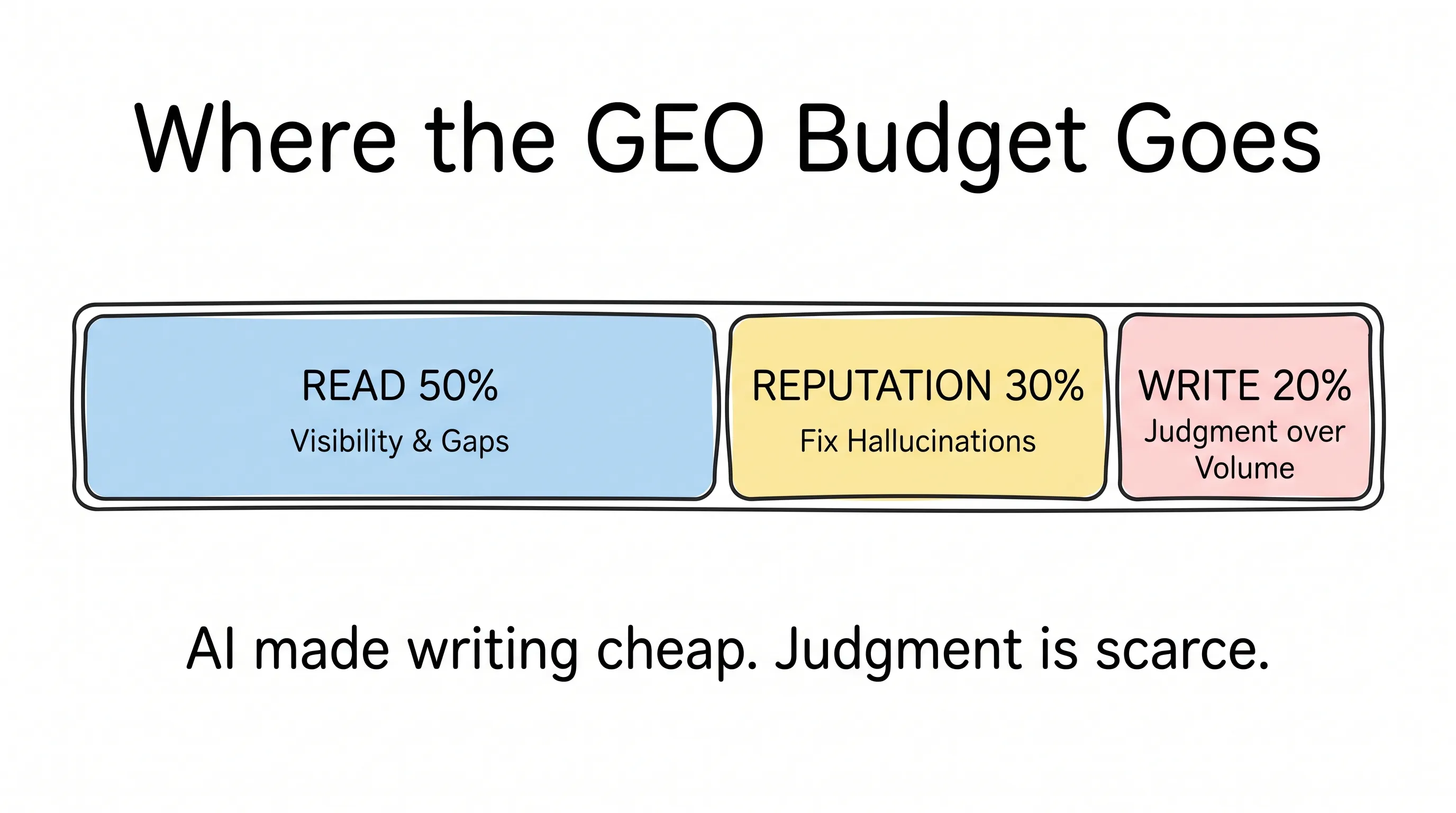
For a mid-size e-commerce brand, the budget can be split like this:
50% goes to "reading." Profound, Semrush and the like — to figure out where you're visible, where you've vanished, and why.
30% goes to "reputation." Goodie AI, Evertune and the like — keep sentiment in check, correct the hallucinations. In the AI era, reputation is visibility itself.
20% goes to "writing." Surfer, Writesonic and the like.
Why does "writing" only get twenty percent? Because AI has slammed the cost of writing to the floor, and content is no longer worth much. What's scarce is judgment: knowing what to write, and who to show it to once written.
10. One More Step Forward
The next real change is that the "person" coming to buy may not be a person at all.
A shopping bot receives its owner's instructions: under $150, rated 4.5 stars or above, organic cotton sheets — place the order. It doesn't look at your banner ads, and it's immune to your copy's emotional pull. It looks at only three things: structured data, interface openness, and a crystal-clear price list.
By 2030, an estimated 25% of e-commerce transactions will be initiated by machines. At the negotiating table, on one side sits an algorithm — and on the other side, another algorithm.
So the ultimate form of GEO isn't just "get AI to mention me." It's "get machines to be able to use me": does the page parse well, can the price list be scraped cleanly, is the inventory data real-time.
Writing this far, I thought of my friend again.
At the end of that dinner, I gave him one line — and I give it to you, reading this article now:
GEO isn't about tricking a robot. It's about building trust, engineered.
Whether it's a person scrolling a screen or a bot crawling the web, what they want is actually the same: the most credible, verified, most useful answer.
May you become that answer.
Continue reading
Related articles

It's 2026: Stop "Buying" AI Tools for Your Marketing Team — Start "Hiring" AI Agents
This learn article explains how AI agents differ from standalone AI tools in marketing, outlines three agent categories — build-your-own platforms, CRM-native agents, and vertical tools — and covers use cases across SEO, social media, advertising, and reporting, plus criteria for choosing one.

What Is GEO? How Your Brand Gets "Mentioned" in the Age of AI Search
An explainer on GEO (Generative Engine Optimization) for e-commerce and DTC brands: how it differs from SEO and AEO, why AI answers shape brand visibility, and eight practices covering question-focused content, consistent brand messaging, structured pages, external evidence, comparisons, and AI mention tracking.

AI Is Already Making Decisions for Your Customers. Are You on the List?
A learn article explains GEO (Generative Engine Optimization): why AI-generated answers now shape which brands customers see, and how SEO fundamentals, entity clarity, citable evidence, and monthly measurement affect visibility in AI answers.