
AI Marketing Automation: How Many Times Over Does It Pay Back? I Ran the Numbers, Line by Line
A learn article explaining how to calculate ROI for AI marketing automation: full-cost accounting, why quoted returns are often inflated, a worked B2B SaaS case, control-group testing, and a five-step rollout checklist.
A few days ago, a friend of mine who runs a SaaS company invited me out for coffee. He sat down and opened with: buddy, I saw a case study that says with an AI agent, returns can hit 10×. Should I get on board?
I said, don't reach for your wallet just yet.
Numbers like 10× are all over sales decks. But a deck is for closing the deal; the math is for running the numbers. So today, let's walk through this bill line by line.
When you're done, you'll see: this can make money, but it's nowhere near as magical as the legend says. And anyone who guarantees you a 10× return with a straight face — you can basically stand up and walk out.
What Is the ROI of Marketing Automation, Exactly?
What is the ROI of marketing automation, exactly?
Put simply: you let AI agents, automation workflows — machines — do the work humans used to do, and ROI is the money they bring back, divided by everything you spend on them.
Note: all of it.
A lot of owners do the math with only the software subscription. That's like judging whether a car is good by looking only at fuel prices — no maintenance, no insurance, no traffic fines.
A car's true cost goes far beyond the gas. An AI system is the same. Beyond the subscription, there's the developer labor to wire it into your existing systems, the hours spent tuning prompts, the ongoing monitoring once it's live, and the most easily forgotten line item: the cost of its mistakes.
AI does make mistakes. It will report a wrong price with total confidence, and it will sort your leads into the wrong groups. Every mistake needs a human to clean up after it.
An ROI that only counts the numerator and never the denominator is lying to you.
One Bill You Can Actually Read
Talk is cheap. Let me run the numbers for you.
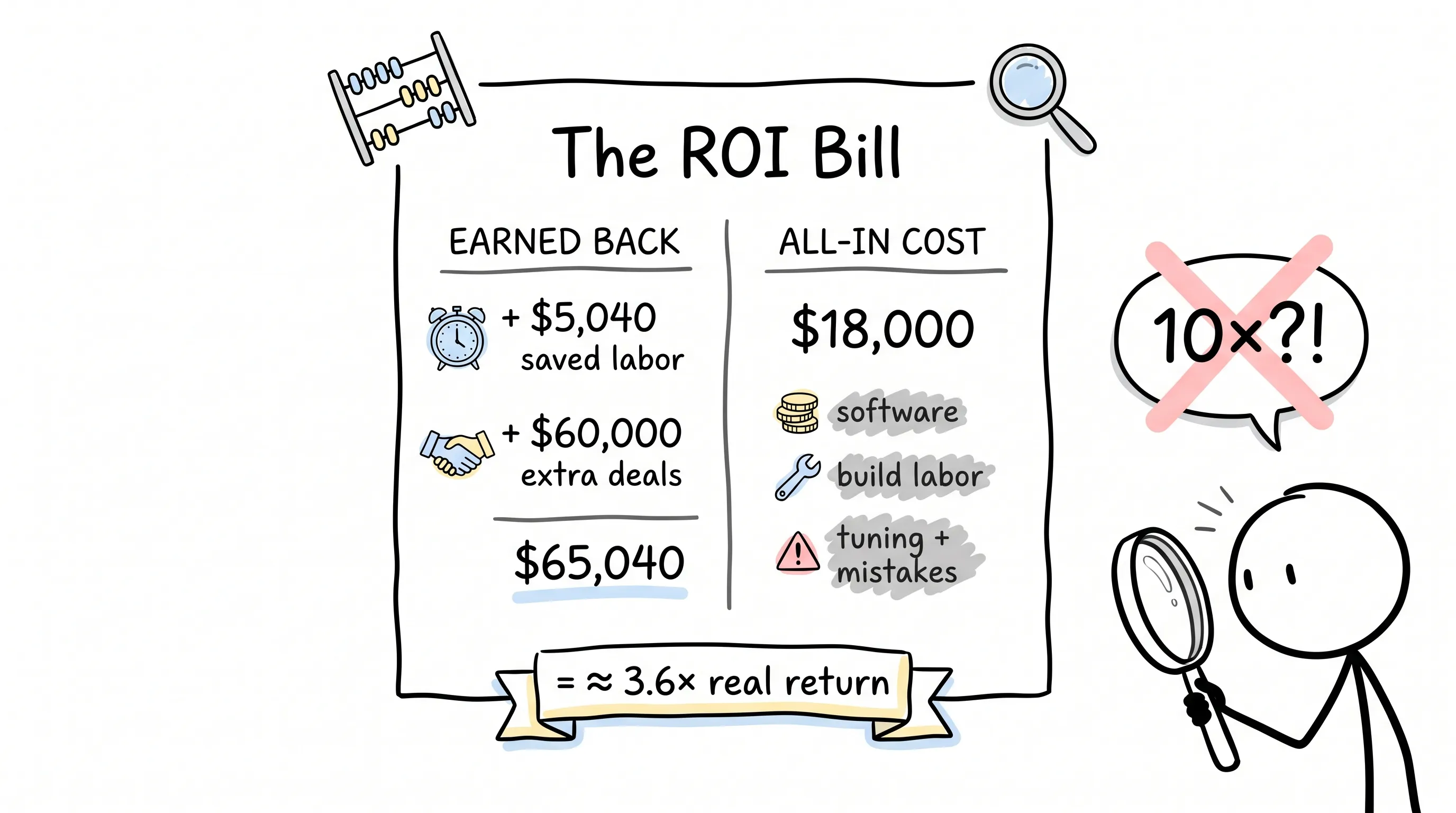
Say you're a small or mid-size business spending a total of $18,000 a year on an AI marketing agent — model calls, database, orchestration tool, plus the first-year build and debugging labor, all of it.
What does it earn back? Two things.
The first is the labor you save. Say it saves you 30 hours a month of lead qualification and follow-up emails. At a blended labor cost of $14 an hour, that's 30×12×14 — $5,040 a year.
The second is the extra business. Say you get 400 inbound leads a month, and after the agent goes live, your lead-to-demo conversion rate rises from 11% to 14% — three percentage points. 400×3% means 12 more demos a month, 144 a year. Even at a conservative one deal closed per six demos, and $2,500 gross profit per deal, that's 24 deals × $2,500 — $60,000 a year.
Add the two: $65,040 divided by $18,000 — roughly 3.6×.
You might ask: is that conversion lift really the AI's doing? Good question — we'll get to how to verify that in a moment. For now, a stress test: cut that $60,000 in half, assume half the growth has nothing to do with the AI. Even then, the return is still north of 2×.
So what does an honest number look like? With the conditions done right, 3 to 5×. Below that, something's wrong somewhere. Above that, check what's hiding in the other person's denominator first.
Why Are the Numbers You See Inflated?
So why does the market keep throwing around 10×, or even tens of times that? Three traps. Run every proposal against them before you sign.
Trap one: comparing against a broken baseline. When vendors demo their ROI, their favorite move is comparing the AI against a manual process that was garbage to begin with. The old process was a mess, so even a little automation "improves things by 70%." That's not the AI's credit — that's the credit for how bad things were before.
Trap two: the disappearing denominator. Integration, prompt tuning, monitoring, fixing errors — all of it vanishes from their decks. Look at the AI case studies from giants like Klarna or Walmart: behind the dazzling numbers are engineering teams a small company could never afford. A big company's wallet and a small company's wallet are different species.
Trap three: no control group. Conversion went up 20%? Great — but that happened to be the month you ran ads, hit peak season, and changed your pricing. Without a control group, there's no telling whose credit that 20% is.
By the way, a 2025 Google Cloud survey says 88% of companies that adopted AI agents early saw ROI gains. The excitement is real. But note — that's excitement measured in enterprise budgets. For a small business, reading that number is like admiring someone else's straight-A kid: fine to envy, fatal to copy.
What you do see, study after study, across manufacturing, finance, and logistics, is remarkably consistent: scope the work to one clearly defined process, and efficiency gains mostly land in the 40% to 70% range.
Those are the numbers that actually exist on planet Earth.
What a Real-World Bill Looks Like
Enough theory. Here's a bill from the field.
Full disclosure first: this is a representative synthetic case from the industry, anonymized in detail — not the audited report of any named client. But the method and the magnitude hold up.
In early 2025, a B2B SaaS company in Riyadh had a three-person marketing team taking in 480 leads a month. The baseline numbers: average response time to a lead, 4.2 hours; lead-to-demo conversion rate, 11%; blended customer acquisition cost, 940 Saudi riyals; the team spent 58 hours a week on triaging leads, sending follow-ups, and typing data into the CRM.
What does 4.2 hours mean? Harvard Business Review published a classic study with a title that should scare you: "The Short Life of Online Sales Leads." The conclusion in one sentence: whoever replies within an hour stands a far better chance of winning the customer. At 4.2 hours, the lead has long gone cold.
Later, they spent about 62,000 riyals. What did they build?
Three parts. First, n8n as the orchestration layer. Second, a layer of RAG — you hear that acronym and your head starts to spin, so let me translate: (retrieval-augmented generation — you feed the system your product docs and price lists first, so when the AI answers, it may only pull from that real material and is not allowed to make things up). Third, and the most critical design: a "dumb" routing engine.
What's a dumb routing engine? Rules judge first: is this question about pricing, inventory, or business hours? If yes, it goes straight to the rules library and gets answered with the standard answer — the large language model (LLM) is never even woken up.
The result? About 63% of traffic never reached the LLM at all.
Reliability never comes from how smart the model is. It comes from how many questions never reach the model at all, leaving it no room for freelancing.
Arabic and English ran down the same pipeline. A customer asking in a Gulf dialect got routed to the tuned dialect prompts. The underlying model was a general-purpose LLM — OpenAI or Google Gemini — no different from anyone else's. The difference was entirely in the two cages built around the model.
Six months later, the ledger looked like this:
Response time: 4.2 hours → 90 seconds.
Lead-to-demo conversion rate: 11% → 14.7%.
Blended acquisition cost: 940 riyals → 690.
Leads handled per month: 480 → 710.
Weekly labor: 58 hours → 19.
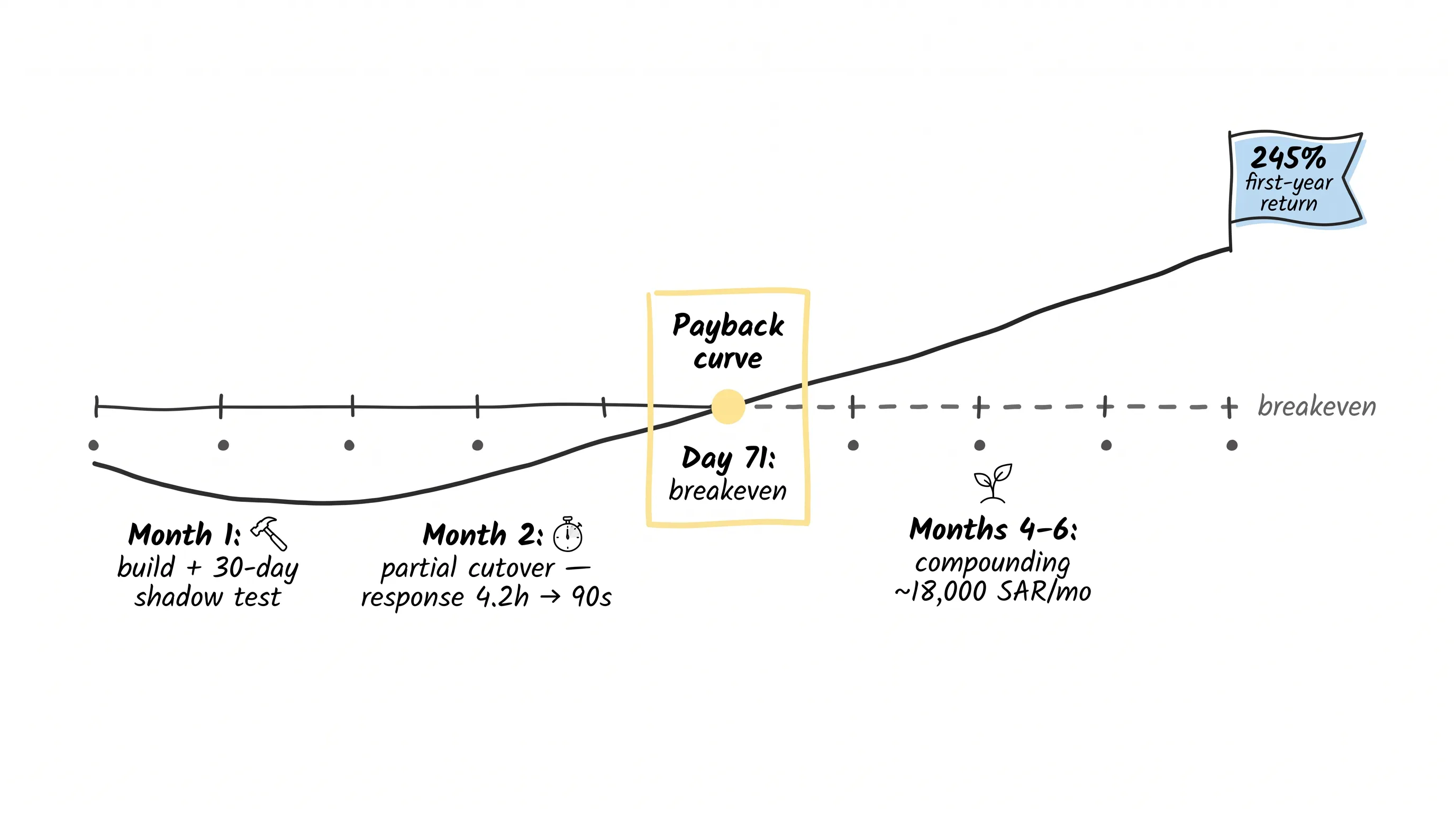
The 39 hours cut loose converted, at blended cost, into roughly 11,700 riyals a month in saved labor — all of it redeployed to high-value customer care. First-year net gain: about 214,000 riyals against an investment of 62,000 — a 245% first-year return. An impressive number, right?
Not reassured? Here's a bottom-line calculation you can take to the stingiest CFO: delete every bit of credit for business growth, count only the saved labor — that's still about 140,000 riyals a year against a 62,000 investment, a return still above 100%.
When did the money come back? Not in a straight line.
Month one: build the system, run shadow testing (the AI works alongside humans, its output logged against theirs), barely any profit — all the money went here. Month two: partial cutover — response time dropped like a stone, but conversion didn't move; leads need time to run the full cycle. Month three: on day 71, the breakeven line got crossed. Months four through six: the compounding kicked in — dialect routing got more accurate with use, and net monthly gains stabilized around 18,000 riyals.
Judge an AI project not by its first month's report, but by its fourth month's capacity. The people who can't resist killing a project in week six usually die the night before the compounding starts.
How Do You Test Without Testing in Vain?
Now for the question you should be asking: how do I know whether my setup is genuinely making money, or just caught a good season?
In one sentence: keep one group of leads walking the old road.
Here's how. Before launch, honestly record a 60-to-90-day baseline: conversion rate, cost per lead, response time, labor hours per task. After launch, keep 10% to 20% of traffic on the original manual process.
Why? The most direct example: your AI group converts at 14.7%, while the control group on the old road converts at 12.9% in the same period. The AI's real credit is the 1.8-point gap — not the full jump from the historical 11% to 14.7%. The rest could be season, ads, or your price cut.
The formula isn't complicated either: (incremental revenue + money saved − total cost) ÷ total cost. The numerator is easy to grasp; the denominator, once more: license fees, integration labor, prompt tuning, hosting, monitoring, human review — not one of them can be left out.
And there are two metrics most owners' dashboards simply don't have — yet they're the line between life and death.
One is hallucination rate: the share of AI answers containing factual errors. Even at 3%, on 700 conversations a month, that's 21 customers who received wrong information. Twenty-one — each one potentially out there telling the world how you got it wrong.
The other is human-handoff rate. One vendor claims 90% of questions get deflected by the AI; you look closely at the data, and 40% of real traffic still ends up with a human. That kind of "deflection" is a numbers game.
Watch both numbers weekly. A quietly rising hallucination rate usually means the material you're feeding it has gone stale — it has started confidently quoting from an old price list. By the time you see it in the revenue report, it's too late.
Different Departments, Different Speeds
One more thing most people overlook: AI automation doesn't pay out evenly — the return speed varies wildly by department.
Marketing is the fastest. Payback in three to five months, first-year returns roughly 150% to 300%. Why? Because every lead rescued can be traced straight to revenue — the credit is crystal clear.
Operations sits in the middle. Customer service, scheduling — five to eight months, and the winnings are mainly labor cost.
Finance is the slowest. Reconciliation, invoicing, fraud prevention — seven to nine months. What it earns is "fewer mistakes." Fewer errors, smoother compliance — the value doesn't show well on a P&L, but over a full year it's very substantial.
By the way — a regional twist worth knowing: companies in the Middle East and the Gulf often see returns even hotter than the global average. Why? Hiring a customer-service rep who speaks Gulf Arabic, Egyptian Arabic, French, and English is expensive and hard; one AI agent covers all four languages. Practitioners widely observe that conversing in the customer's native dialect lifts engagement by 25% to 40%. Add in Saudi Arabia's PDPL (Personal Data Protection Law) and the UAE's data-residency requirements, and a rules-based agent can produce audit logs — compressing compliance reviews from days to hours.
Want to Copy the Playbook? Here's the Checklist
At this point you might ask: I want to do this too — where do I start?
Five things, in order.
First, pick one measurable KPI. Don't rush to buy tools; decide which number you're actually optimizing: response time, or the number of qualified leads per week. One is enough.
Second, hook up RAG. Feed in the product docs, price lists, FAQs — give it something to verify against, don't let it freestyle.
Third, install the dumb guardrails. Pricing, refunds, compliance — those go through rules, not the LLM's free-form creativity.
Fourth, install monitoring on day one. Log every action, every human handoff, every human correction. It's both a cost ledger and a safety rope.
Fifth, run a 30-day shadow test. Let the AI work in parallel with humans for a month, compare its output to theirs, and only shift traffic over after it wins.
How much will the tools cost? At 2026 prices, this whole stack for an SMB runs $180 to $650 a month: model calls $40 to $200, a vector database like Pinecone $0 to $120, an orchestration tool like n8n $20 to $90, monitoring $0 to $150. An enterprise-grade platform? Starting at $3,000.
Put that next to the $18,000 bill from earlier and you'll see: the software itself costs little — the big spend is the build labor. That's why companies that can use off-the-shelf docs and off-the-shelf APIs pay back faster than everyone else.
Finally, let me run the numbers on failure. The same 62,000-riyal project — but skip the RAG, skip the dialect testing: about 5% of conversations quote wrong prices, the close rate for Gulf-dialect customers gets cut straight in half because the AI can't read their intent, and with no human-handoff safety net, 15% of high-intent customers churn silently.
The ending isn't a slightly lower return. It's negative. Money spent, trust burned, and a rescue project to boot.
One solid deployment earns back two to three times; one sloppy deployment loses far more than the tooling cost. And the cheapest insurance against all of it is that 30-day shadow test.
Finally
At that coffee, here's how I left it with my friend: don't ask whether AI can 10× you. Ask how many times a day your team touches that process. Touched two hundred times a day, with standard answers, a measurable baseline, and saved hours that convert to real cash — do it first. Touched twice a week? No matter how shiny, leave it alone.
Get those lined up, and the math will do the answering for you.
Here's to the first month after your launch, when a customer tells you: wow, you guys reply fast.
Continue reading
Related articles

What Is an AI Marketing Agent? From "Using AI" to "Delegating to AI"
A learn article explaining what an AI marketing agent is, how it differs from rule-based automation, and which repetitive tasks such as lead qualification, reporting, and campaign monitoring can be delegated while humans keep key decisions.

Marketing Automation Is Shifting from "You Do It" to "You Say It"
This article explains how marketing automation is shifting from rule-based platforms that merely execute toward AI agents that plan, create, publish, and review campaigns, covering delegable tasks, underlying technologies, tool categories, adoption steps, and risks such as privacy and automating without strategy.

When AI Does the Creative, Mistakes Come in Batches Too
A learn article on the risks of using generative AI for marketing creative across brand, legal, compliance, and operational layers, with case examples and seven practices for review, rights clearance, documentation, and vendor governance.