
It's Time to Rethink How You Run Google Ads Across Borders
A learn article explaining how AI-driven Google Ads optimization works for cross-border e-commerce sellers, covering Smart Bidding, audience targeting, localization, real-time adjustments, and copy testing, plus limitations such as insufficient data and cultural nuance that still require human oversight.
A while back, a friend of mine who does cross-border e-commerce invited me out for tea.
He sells outdoor gear, and his US store had been doing well. Last year, he extended his Google Ads campaigns into Japan and Germany, hoping to catch another wave of growth. Six months later, he ran the numbers for me: plenty of money spent, conversions coming in fits and starts, and when it was all added up, he'd basically been spinning his wheels.
He said something that stuck with me: "The ads that worked no matter how I ran them in the US — the moment I moved them to Japan, they went quiet."
Why does this happen?
Think about it: copying a campaign from the US to Japan looks, on the surface, like nothing more than a language change. In reality, you're swapping out an entire system. The search terms are different, shopping habits are different, how people read a price is different — even the psychological rhythm of "when to place an order" is different. A best-selling copy line in the US might land in Japan as pure bafflement; a pricing pitch that works in Germany might get ignored completely in the Middle East.
On top of that, more and more sellers have entered the game in recent years. Clicks keep getting more expensive, competitors keep getting more aggressive. Plenty of cross-border sellers get stuck exactly there: ads running, money burning, and the books never balancing.
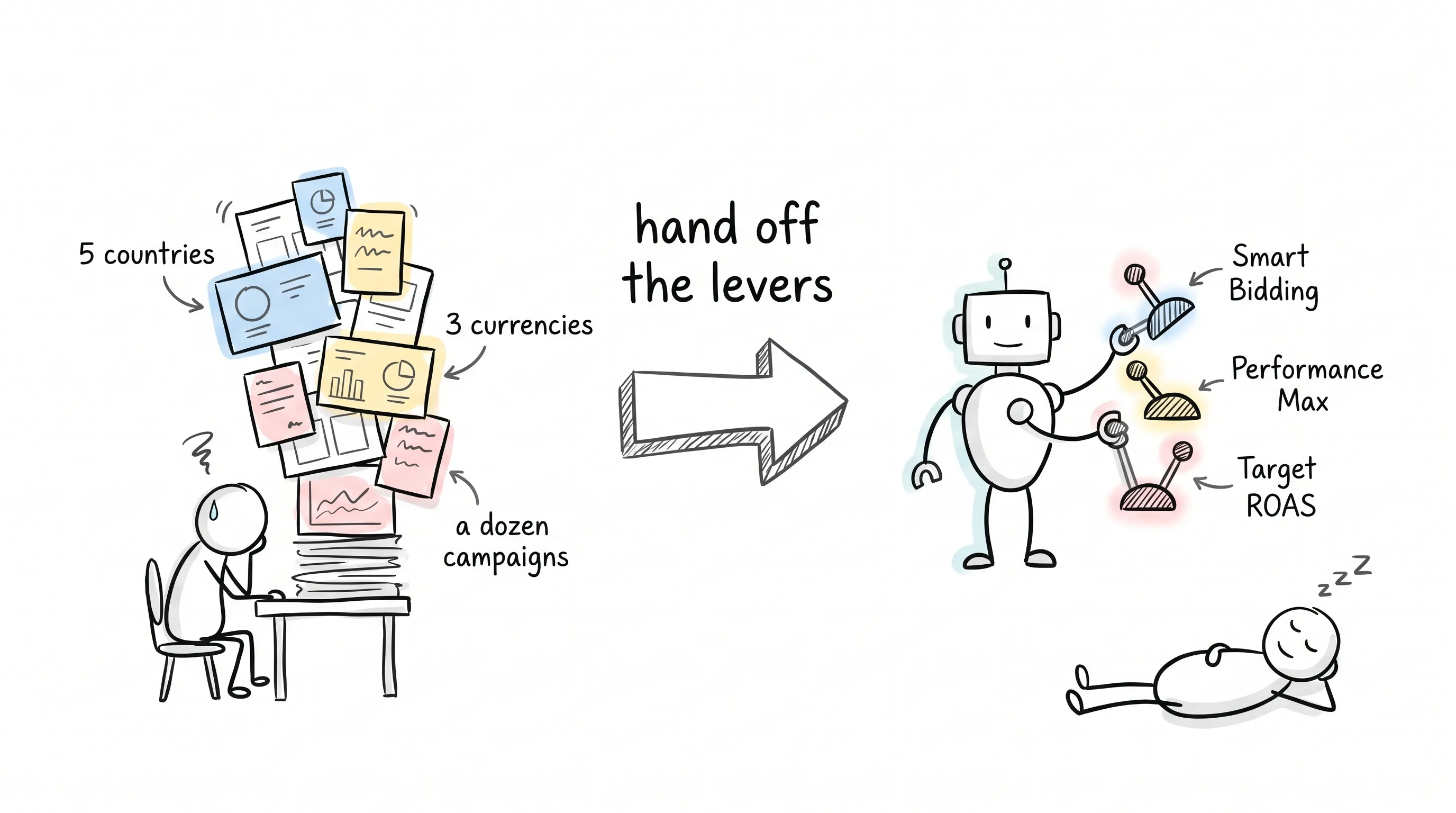
My friend's way out was to eventually hand bidding over to AI. Once the account settled down, he finally got his breath back.
Today I want to make three things clear: what AI Google Ads optimization actually is, what cross-border sellers can realistically do with it, and which potholes AI can't fill in on its own.
What Is AI Google Ads Optimization?
First, the concept.
What is AI Google Ads optimization? It means letting machine learning make the decisions you'd otherwise repeat every single day: how much to bid, who to show ads to, which copy to use, and which markets get the budget.
Google Ads has actually had a whole suite of this built in for years: Smart Bidding, Performance Max, Responsive Search Ads, automated audience targeting, conversion forecasting… The names are all over the map, but they're all doing the same thing: analyzing oceans of data in real time, then adjusting automatically.
Here's what AI is watching for you every day:
Which types of users are most likely to buy, which country is contributing the highest ROAS (return on ad spend), which keywords keep leaking money, which time of day performs best, and which copy lines get clicked more often.
You can do some of this by hand. But when you're managing five countries, three currencies, and a dozen-plus campaigns all at once, manual effort hits its ceiling. AI's value shows up exactly at the point where you can no longer keep up.
What Can It Actually Do for You?
From what I've observed, AI's impact on cross-border advertising is concentrated in five areas.
First: It Bids for You
When you're running multiple countries, devices, and audiences at the same time, there are countless bidding opportunities every second. Trying to track them yourself is like asking one person to stare at thousands of dashboards with the naked eye.
Google Ads offers Smart Bidding strategies like Target ROAS and Target CPA. The principle, stripped down to one sentence: estimate the purchase probability behind each impression, bid more when the probability is high, and pull back when it's low.
For example: a user in Singapore might be twice as likely to place an order as a user in another region. So the AI will bid twice as much for that person, and automatically hold back on low-probability impressions.
That's how the savings happen. What you save is the money you used to spray at the "just looking" crowd.
Second: It Finds the Right People for You
One of the biggest headaches in cross-border paid acquisition is that users look completely different from market to market: different interests, different incomes, different search habits.
AI can slice your audience by country, language, device, purchase intent, browsing behavior, and order history, so you can concentrate your budget on the people most likely to open their wallets.
A skincare brand, for instance, can push anti-aging products in colder climates and sunscreen in regions with brutal sun. Same brand, two playbooks, each doing its own thing.
Third: It Makes Your Ads Speak the Local Language
I want to spend a bit more time here, because this is where cross-border ads fail most often.
A lot of people assume localization is just translation. Wrong. Translation is the bare minimum.
What actually determines performance is how different markets react to different words, different emotions, and different moments.
A "winter sale" lands in Europe in December, but in Australia it's a disaster — because December is summer there. Some keywords that work beautifully in English-speaking markets have to be replaced with entirely different phrasing to work in Japan and Germany.
Where AI can help is translating copy, digging up local keywords, adapting landing pages market by market, and matching products to local demand. But note the word "help." Where those lines sit — that part comes later.
Fourth: It Fixes Things While the Ads Are Running
The traditional way of managing ads: the budget runs out, you pull the reports, do a retrospective, and adjust. It's like reading the ship's log only after the ship docks.
AI runs on an entirely different logic: it watches the ads' pulse in real time. Conversion rate suddenly drops, click costs in one market suddenly spike, a keyword group suddenly takes off, budget is burning in the wrong place. The moment one of these signals appears, it acts on the spot.
If competition in one market suddenly gets expensive, for example, the AI can automatically shift budget to another market that's running better.
This is why so many sellers are willing to invest in AI-driven paid acquisition: speed. What you save isn't just money — it's reaction time.
Fifth: It Tests Copy for You
A/B testing across multiple languages is painfully slow to do by hand. Five markets, three headlines and four descriptions each — the combinatorics add up to an astronomical number.
Responsive Search Ads take a different approach: hand the headlines and descriptions to the AI to mix, match, and try, keeping the winners and culling the losers until it lands on better combinations on its own. Click-through rate, relevance, and conversions all get nudged upward, bit by bit.
What Does All of This Add Up To?
Three things.
One, a healthier account: customer acquisition costs drop, ROAS rises, wasted spend shrinks. Two, faster trial and error in new markets: AI can probe which countries have demand and which keywords actually work before you dive in everywhere on gut feel. Three, scale without doubling your team: managing ten countries doesn't take dramatically more hands than managing three. The team can finally lift its head out of the drudgery of bid adjustments and think about strategy.
A More Realistic Example
Let me paint you a scenario. It's fictional, but extremely typical.
A US D2C apparel brand wants to enter Europe and Asia. At first it uses the dumbest possible approach: manually running Google Ads in five countries. Three months in, costs are climbing steadily and conversions are bouncing up and down.
Then it changes the approach: bidding goes to Target ROAS, it goes all-in on Performance Max, ads get localized market by market, audiences are split by country, and the system allocates the budget automatically.
A few months later, conversion rates are up, customer acquisition costs are down, the key markets have taken shape, and expansion into new markets is moving faster.
No magic involved. Just taking the "ten thousand daily repeated decisions" out of human hands and giving them to a machine that never gets tired.
But There's Always a Flip Side
AI isn't something you buy and it just works. There are three potholes you absolutely need to know about.
The first pothole: full hands-off automation.
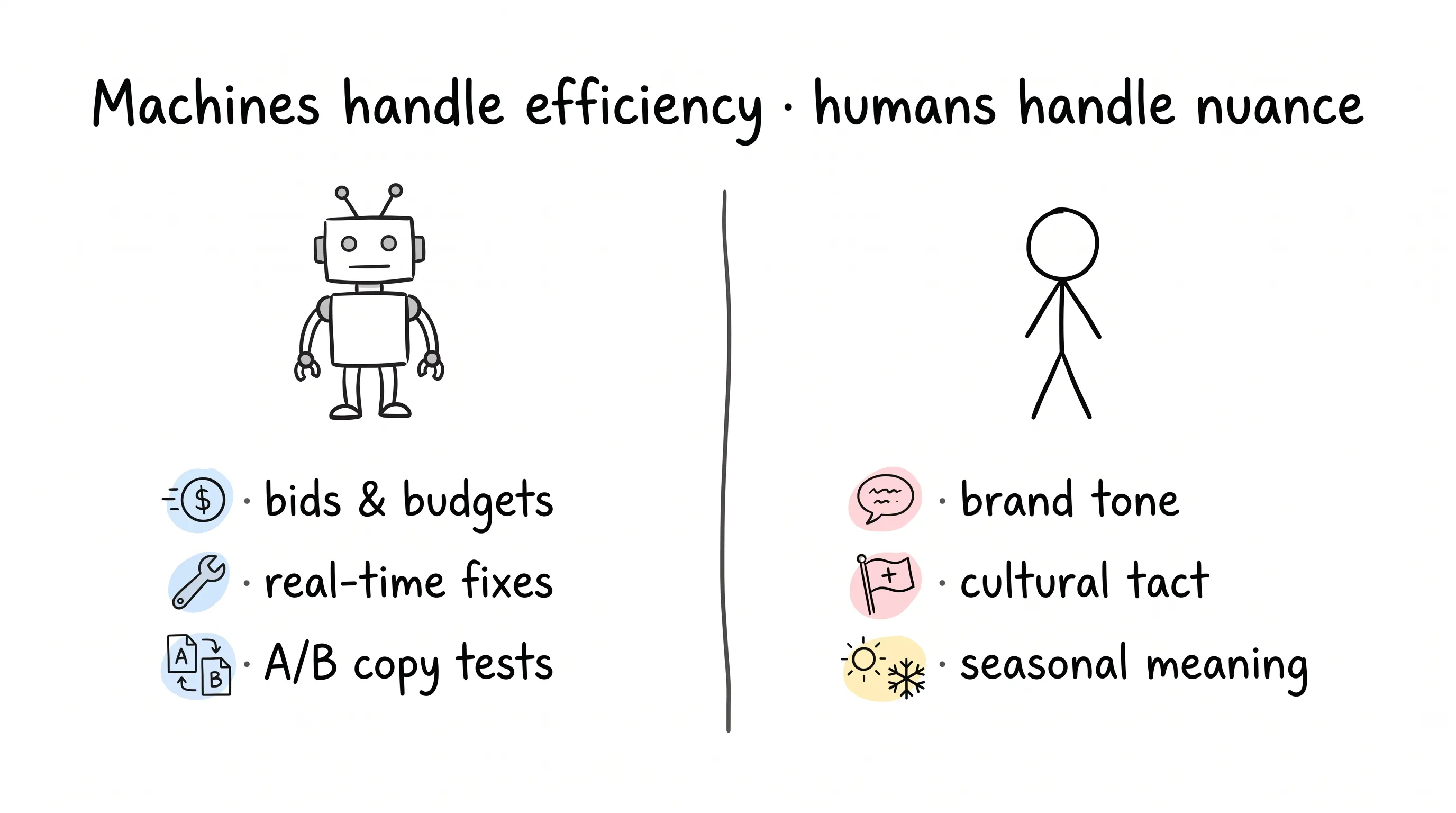
AI won't guard your brand for you. It can spend your budget with great efficiency, but whether it's spending it correctly, whether the tone is holding steady, whether the direction has drifted — someone has to watch. A completely unattended account is a crash waiting to happen. However good the autopilot is, the person behind the wheel can't step out.
The second pothole: without enough data, AI is just guessing.
Machine learning feeds on data. A brand-new campaign has little traffic and almost no conversion history, so the algorithm learns nothing useful — and the more it "optimizes," the more crooked things get.
So before you launch in a new market, get tracking installed, feed conversion data in accurately; don't squeeze the budget too tight; give the algorithm a learning period. Miss any one of these three, and AI can't perform.
The third pothole: culture is a hurdle AI can't clear — not yet.
Machines can translate words correctly, but they can't translate tact. Which expressions read as offensive in a given market, which humor falls flat in a given culture, which seasonal moments carry entirely different meanings locally — these need a human review. Especially in markets like Japan, where the precision of wording directly decides whether an ad lives or dies.
One sentence: Machines handle efficiency; humans handle nuance.
If You're Getting Started, My Advice
Four suggestions, all unglamorous.
First, lay the data foundation before anything else. GA4, Google Tag Manager, conversion tracking — all of it installed before you start spending. If the data is unreliable, everything built on top of it is a castle in the air.
Second, use full-channel campaigns like Performance Max so the AI optimizes uniformly across Search, Shopping, Display, and YouTube placements.
Third, don't blanket the entire globe in one go. Pick two or three countries, get things running smoothly, then scale up.
Fourth, watch ROAS, not clicks. Clicks are the process; orders are the result. No matter how pretty the traffic looks, if none of it turns into orders, it isn't worth a cent.
Finally, Back to My Friend
He later restructured the account: bidding and budget allocation went to the machine, while he put his energy into two things — the strategy behind the data, and the cultural nuance of each market.
That day over tea he said it felt like handing off a shift: he used to wrestle with bids every night before clocking out; now none of that was his to manage anymore, and for the first time he could actually fall asleep.
Cross-border advertising is only going to get harder, and the gap between players is only going to widen. Whoever first hands repetitive decisions to the machine and frees up their time for the things machines can't do — that's who pulls ahead.
Here's hoping you, too, can soon lift your head out of the exhaustion of watching the dashboards.
Continue reading
Related articles

It's 2026: Stop "Buying" AI Tools for Your Marketing Team — Start "Hiring" AI Agents
This learn article explains how AI agents differ from standalone AI tools in marketing, outlines three agent categories — build-your-own platforms, CRM-native agents, and vertical tools — and covers use cases across SEO, social media, advertising, and reporting, plus criteria for choosing one.

Did the Money You Spent on AI Marketing Ever Come Back?
A guide to measuring AI marketing ROI across three layers: ad reports, sales pipeline, and the financial ledger. Covers metrics such as ROAS and CPA, eight dashboard metrics, industry benchmarks, and common measurement mistakes.

How to Pick a Creative Automation Platform: First, Figure Out What These Eleven Actually Do
A learn article sorts eleven creative automation platforms — including Bannerflow, Celtra, Smartly.io, and Storyteq — into four functional groups and proposes five evaluation questions covering publishing reach, automation depth, ease of adoption, team fit, and verifiable evidence.