
Social Media in the AI Era: Capacity Is Cheap, Voice Is Priceless
An essay on social media marketing in the AI era, arguing that content production capacity is no longer a differentiator while an authentic brand voice is. It covers five AI use cases for small businesses, AI agents, and the risks of AI slop.
Say you run a coffee shop.
You hear that AI can help with social media, so you give it a try. One hour in the evening, and a whole week of Instagram posts is lined up: seasonal-drink captions, image ideas, posting rhythm — everything neat and tidy.
The tool is genuinely great. But a month later you notice something odd: the more you post, the fewer people watch.
Why?
Let's do the math first.
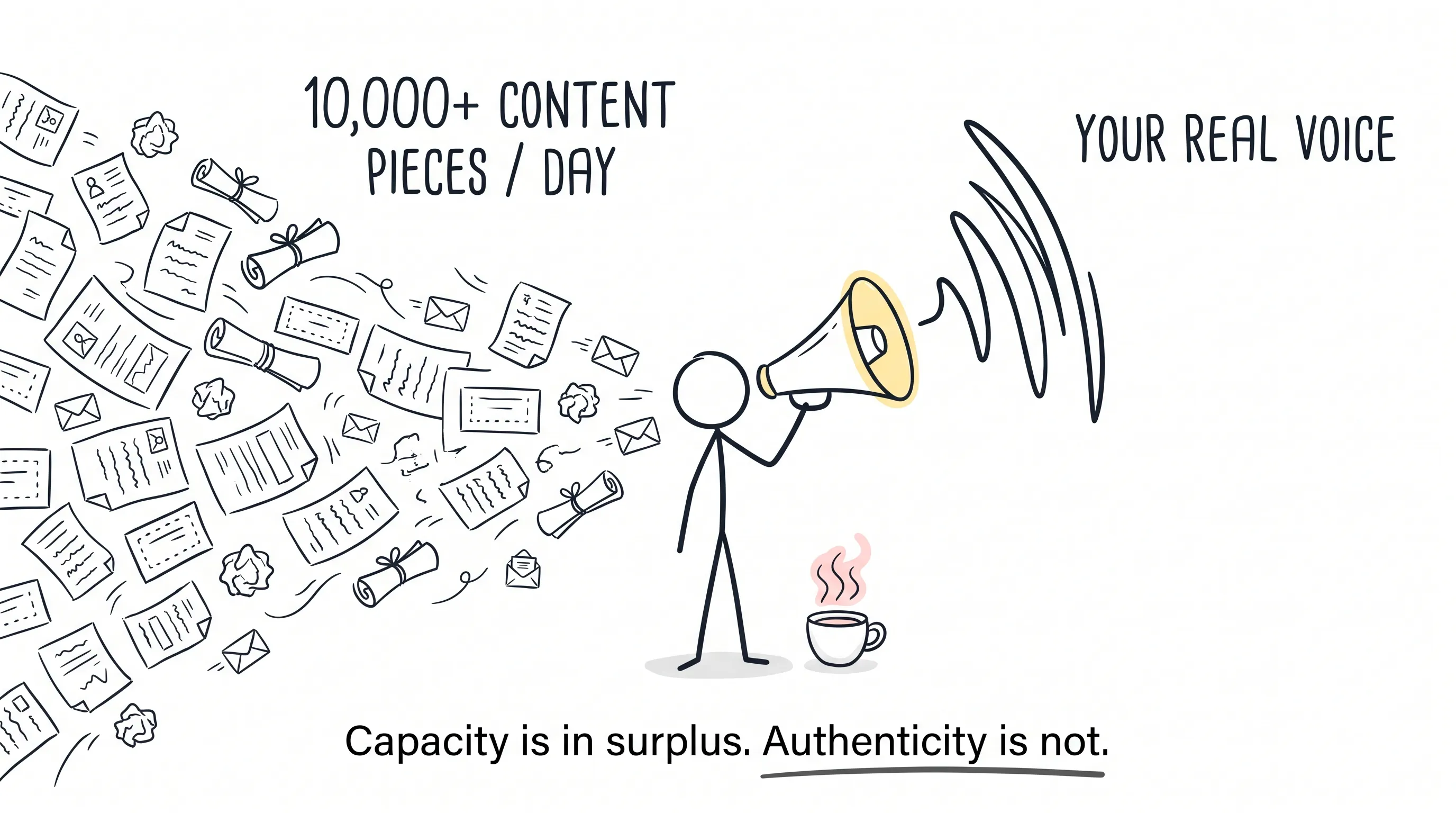
In the pre-internet era, a person saw roughly 500 to 1,500 ads a day. In the social-media era — the decade from 2010 to 2020 — that rose to 4,000 to 10,000. And today? AI has knocked the cost of content production down to rock bottom, and one person can effortlessly scroll past more than ten thousand pieces of content a day.
Ten thousand. Think about it: your post is squeezed somewhere in those ten thousand.
User attention saturated long ago. However fast you produce, you can't outrun the growth in supply. That's the confusion so many business owners feel: the tools keep getting better, yet the results keep getting worse.
So my judgment is this: Capacity is no longer a moat. Voice is.
The easier content is to generate, the more the thing that sets you apart is that real brand voice of yours — the one nobody else can imitate.
Of course, this doesn't mean AI is useless. AI is extremely useful. The precondition is that you put it to work on what it's good at.
For a small or mid-sized business running social media, I've counted roughly five things AI can help with.
First, writing content. Brainstorming topics, drafting copy, making visuals, even generating short videos. A small team with no dedicated designer can still maintain a respectable posting cadence. That coffee shop up above runs on exactly this.
Second, knowing your people. AI can slice your audience by behavior, interests, and spending habits, saying different things to different people. Far more precise than one piece of copy blasted at everyone.
Third, picking the moment. When you post has a big effect on reach. AI digs through your past engagement data and tells you when to post and what to post. One fitness studio found its audience was most active on weekday mornings, so it moved all of its content into that window.
Fourth, listening to the chatter. How are people talking about your brand on social media? Is the sentiment positive, neutral, or negative? AI can keep watch around the clock, and it can also catch bigger topic trends so you can adjust your play in time.
Fifth, managing the money. AI has already gotten very good at paid campaigns. One e-commerce store ran several versions of Facebook ads at the same time; AI tested them automatically, shifted budget to whichever version performed best, and shut down the underperformers in real time. What it saves you is pure profit.
One step further, and you're at AI agents.
What's an AI agent? If the AI of the past was an adviser — helping you brainstorm — an agent is an assistant that can actually do the work for you.
It can run three kinds of errands for you.
One is engagement. Replying to comments, answering DMs, handling those basic questions that get asked a hundred times. Customers don't sit waiting, and your team doesn't drown in messages. The complicated questions and high-value customers still go to real humans.
Two is getting more out of every idea. TikTok, Instagram, LinkedIn, Facebook — each platform has its own tone, length, and format. AI can take a single idea and adapt it into each platform's native version. One idea, blooming everywhere.
Three is the post-mortem. It reads your likes, comments, and shares for you, and suggests which content to prioritize and when to post it.
But the steering wheel must stay in your own hands.
Data can tell you what content performs well. But understanding your customers and judging where the business should go — you and your team are on the front line, and you understand that better than any tool. AI can optimize execution; it cannot replace strategic judgment or market instinct.
A steady playbook is: let AI handle the volume; humans own the soul. Hand it the high-volume, repetitive, mechanical work. Keep the high-value interactions, the strategic thinking, and the polishing of your brand voice for people.
But everything has a flip side.
Once the cost of content production hit rock bottom, it also created something new: AI slop.
What is AI slop? Put simply, it's the spam of social media. Email has spam; social media has slop.
It has a few hallmarks: mass-produced, low-quality, zero nourishment — grabbing attention through exaggeration, shock value, even fear-mongering. It isn't born to provide value; it's born to farm engagement.
The worst part of this kind of content is that what it wastes isn't just one moment of your attention. It is drawing down the trust of entire platforms. Once users have soaked in slop long enough, they second-guess everything they see. And that is how the differences between brands get smoothed away, bit by bit.
How do you keep from being dragged down with it? I have three takeaways.
One, guard the real. Your expertise, your tone, your point of view — these are things AI cannot steal. AI can help you produce, but every single piece you publish has to contain the part that only you have.
Two, humans must review. After AI writes, a person has to go over it. Whether the numbers are right, whether the tone has drifted, whether it's starting to read like "just another account anyone could run" — one look from a human tells you.
Three, use real people and real stories. Real customer stories, employee everyday moments, buyer reviews — these are the antonyms of slop. In a landscape of synthetic voices, genuine human warmth is the scarcest thing, and the most valuable.
Look at the benefits and the pitfalls side by side.
The benefits are tangible: content comes out faster, and small teams can hold an active presence; targeting gets sharper, so the right people see the right message; and you can spot trends from a pile of engagement data, predicting which content will take off.
The pitfalls are there too. Push it too hard, and your content starts looking more and more like everyone else's, blurring your positioning instead. AI will carry the biases it has learned into your copy, and even into your targeting. And once output scales up and review can't keep pace, what you publish gradually stops feeling like "yours."
None of these three pitfalls is AI's fault; every one of them is a problem of how people use it.
Back to the coffee shop from the opening.
The owner later changed his approach. Topic selection, first drafts, layout — still handed to AI. But before anything goes out, he edits it by hand, turning the "AI voice" into "their shop's voice." Sometimes he just posts a photo of the shop cat sprawled on the counter, without writing a single line of copy.
The strange thing is, the posts with the best engagement turned out to be those cat photos.
You see, readers aren't fools. In a flood of ten thousand pieces of content, what they've been looking for all along is the real you.
Capacity will be in surplus. Authenticity never will.
May your little shop, in the daily torrent of ten thousand pieces of content, be instantly recognizable as you.
Continue reading
Related articles

What Is an AI Marketing Agent? From "Using AI" to "Delegating to AI"
A learn article explaining what an AI marketing agent is, how it differs from rule-based automation, and which repetitive tasks such as lead qualification, reporting, and campaign monitoring can be delegated while humans keep key decisions.
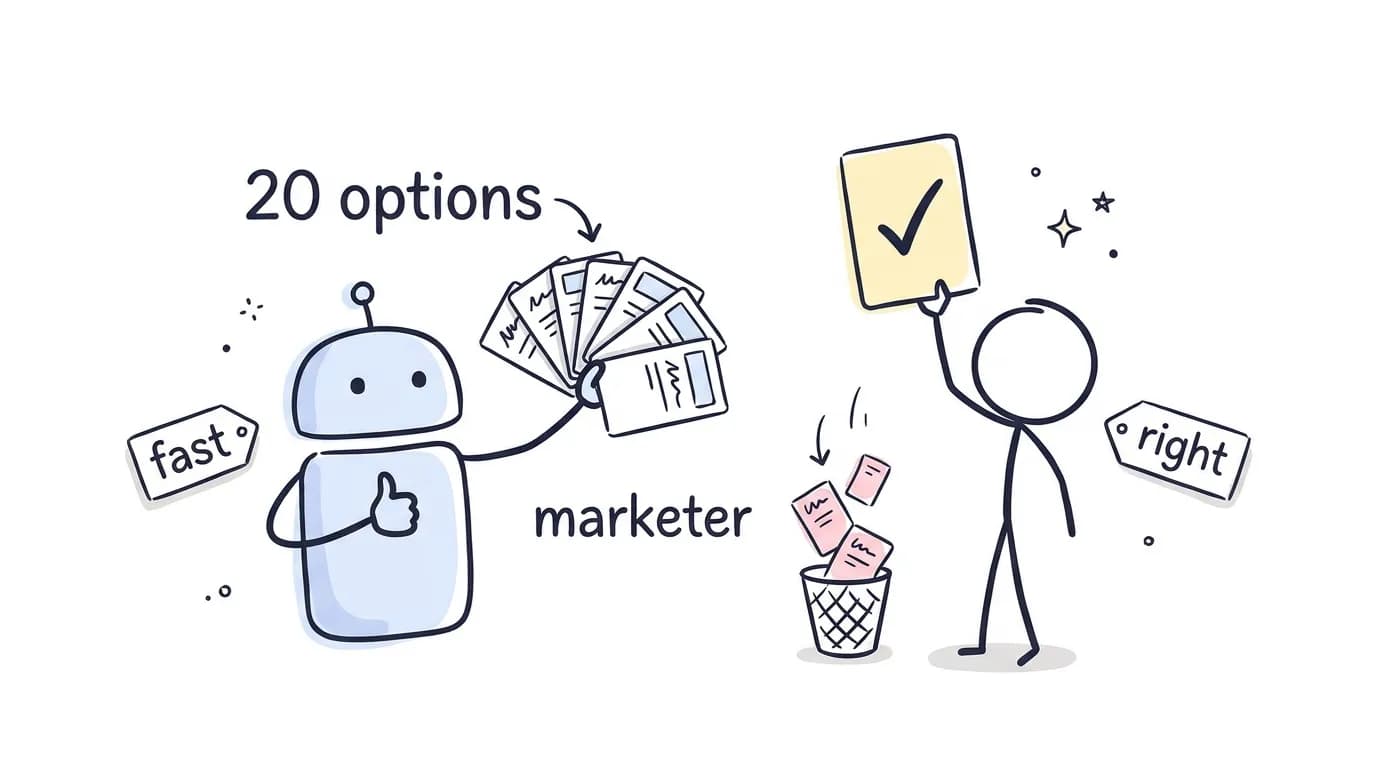
If AI Can Write the Copy, What's Left for Social Media Marketers?
A long-form guide on how AI reshapes social media marketing work, covering content creation, advertising, listening, community management, and data interpretation. It argues that AI accelerates production while humans keep strategy, judgment, review, and accountability.
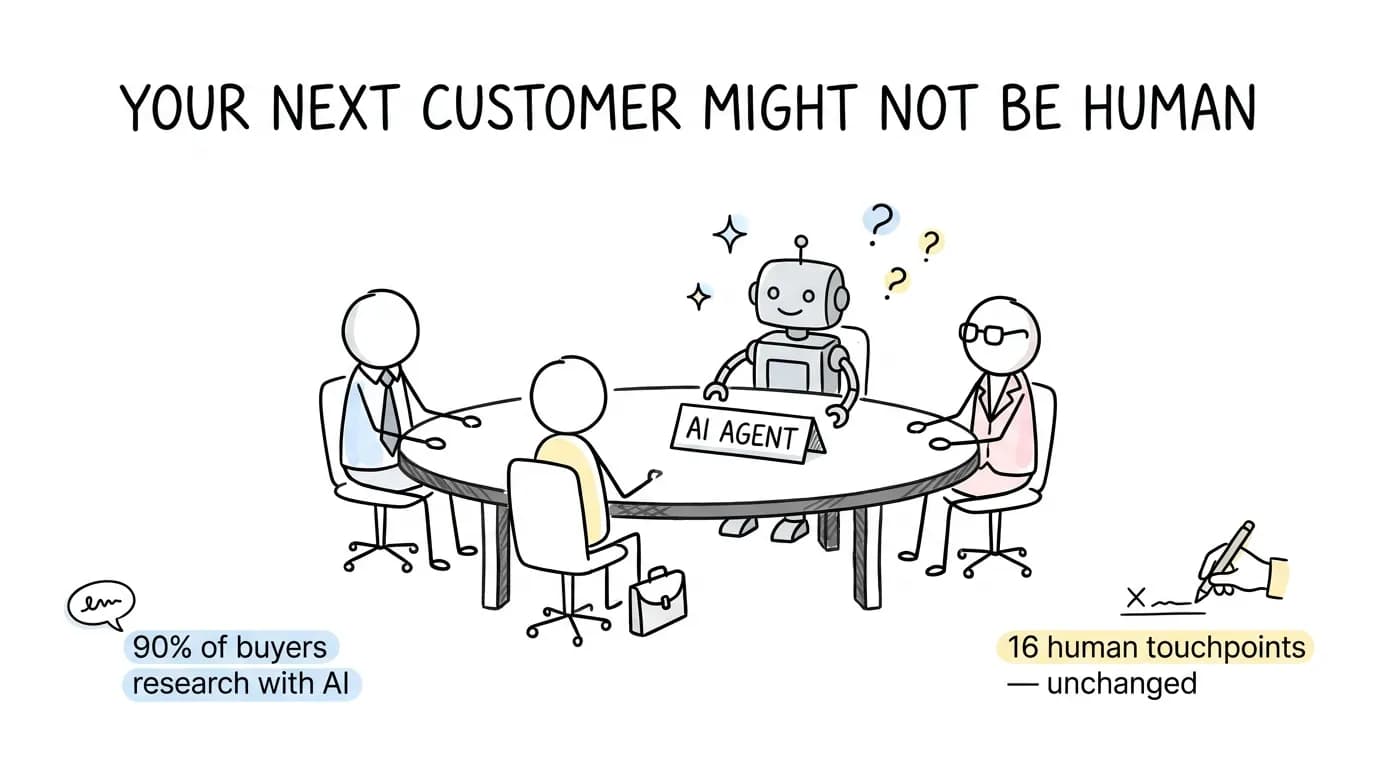
Your Next Customer Might Not Be Human: What Changes — and What Doesn't — in B2B Marketing, 2026
A long-form analysis of 2026 B2B marketing predictions covering AI agents joining buying decisions, visibility in AI answers, email filtering, trust, and first-party buying signals.