
From SEO to GEO: In Search's Second Half, the Game Is Getting Cited
An explainer on the shift from SEO to GEO: how AI-generated answers reduce clicks, why being cited inside AI responses matters, and six practical steps brands can take to improve visibility in generative engines.
A few days ago, I looked something up in ChatGPT. It wrote the answer out for me directly. Sources, comparisons, a conclusion — all right there.
From start to finish, I didn't click a single link.
When I put my phone down, something suddenly hit me: the motion I'd been repeating for nearly twenty years — open the search box, type in keywords, click the first result, and if that's not right, click the second — is disappearing.
Not shrinking. Disappearing.
Search engines used to be like a receptionist. Their job was to walk visitors to your front door. Once the visitors were led there, mission accomplished. Now the receptionist finishes the whole job by itself. Google's AI Overviews summarizes the answer for you right at the top of the results page; Bing's Copilot pulls you into a conversation; ChatGPT and Perplexity go one further — they don't need you to "search" at all. You ask, they answer.
The visitor no longer needs to walk to your front door. They finish the conversation right there at the front desk.
This is what's happening in search right now. And I'd argue it may be the biggest change since search was born. Keywords gave way to long-tail phrases, desktops to phones, typed queries to voice questions — those were all changes in "how we search." This time is different. This time, what changes is "where people go after the search."
So what should brands do?
What Is GEO?
What is GEO? Generative Engine Optimization.
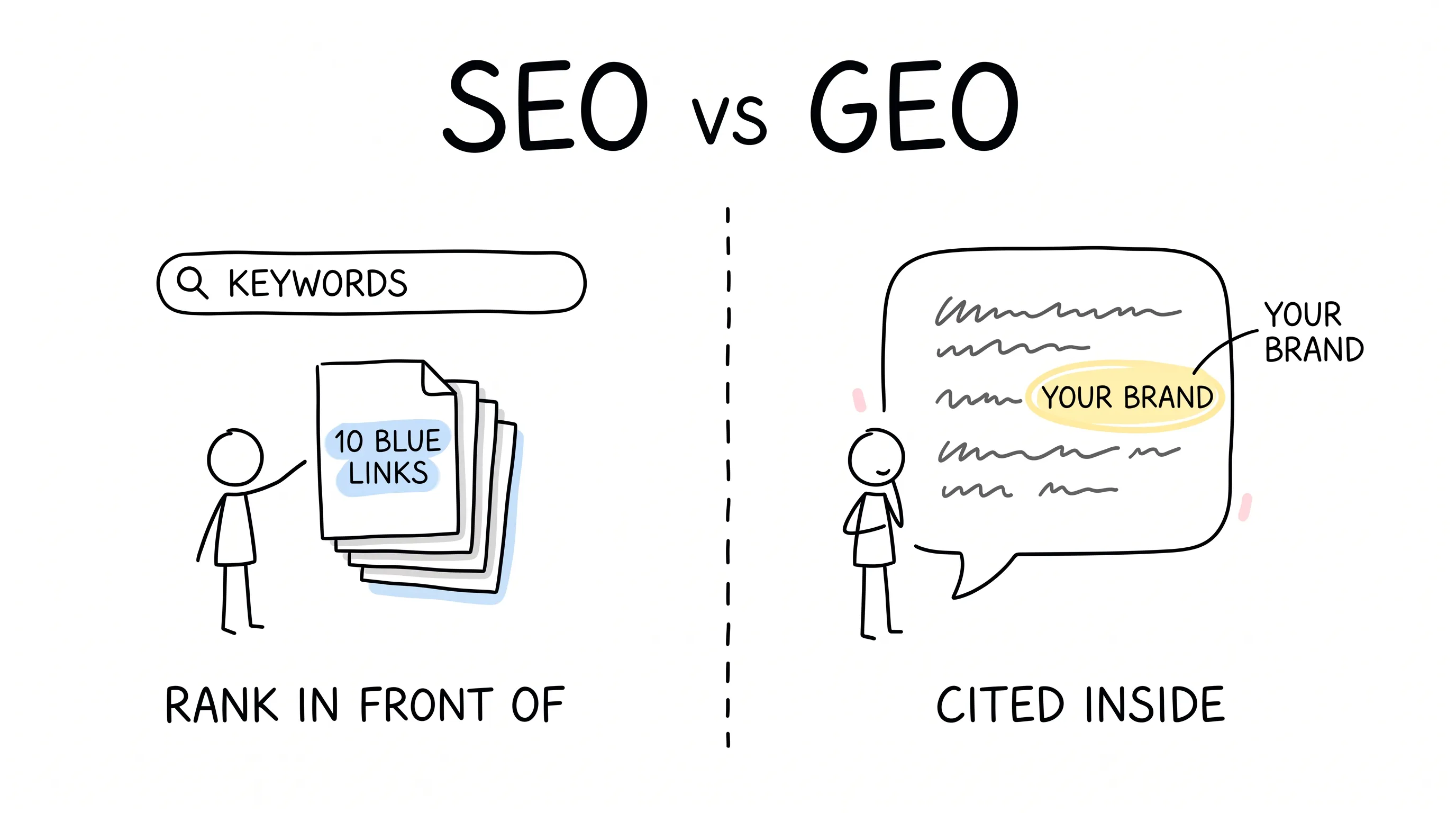
Put plainly: SEO asks how to get your web pages ranked at the front of the results page; GEO asks how to get your brand to appear inside the AI's answer.
Notice the difference between those two words. In front of, and inside.
Rank in front, and the user may still not click. Appear inside, and the AI is already out there telling your story for you.
People often ask whether GEO will replace SEO. My judgment: no. It's the next chapter in the book of search.
Why do I say that? Let's run two numbers first.
First, Let's Run Two Numbers
The first number is about clicks.
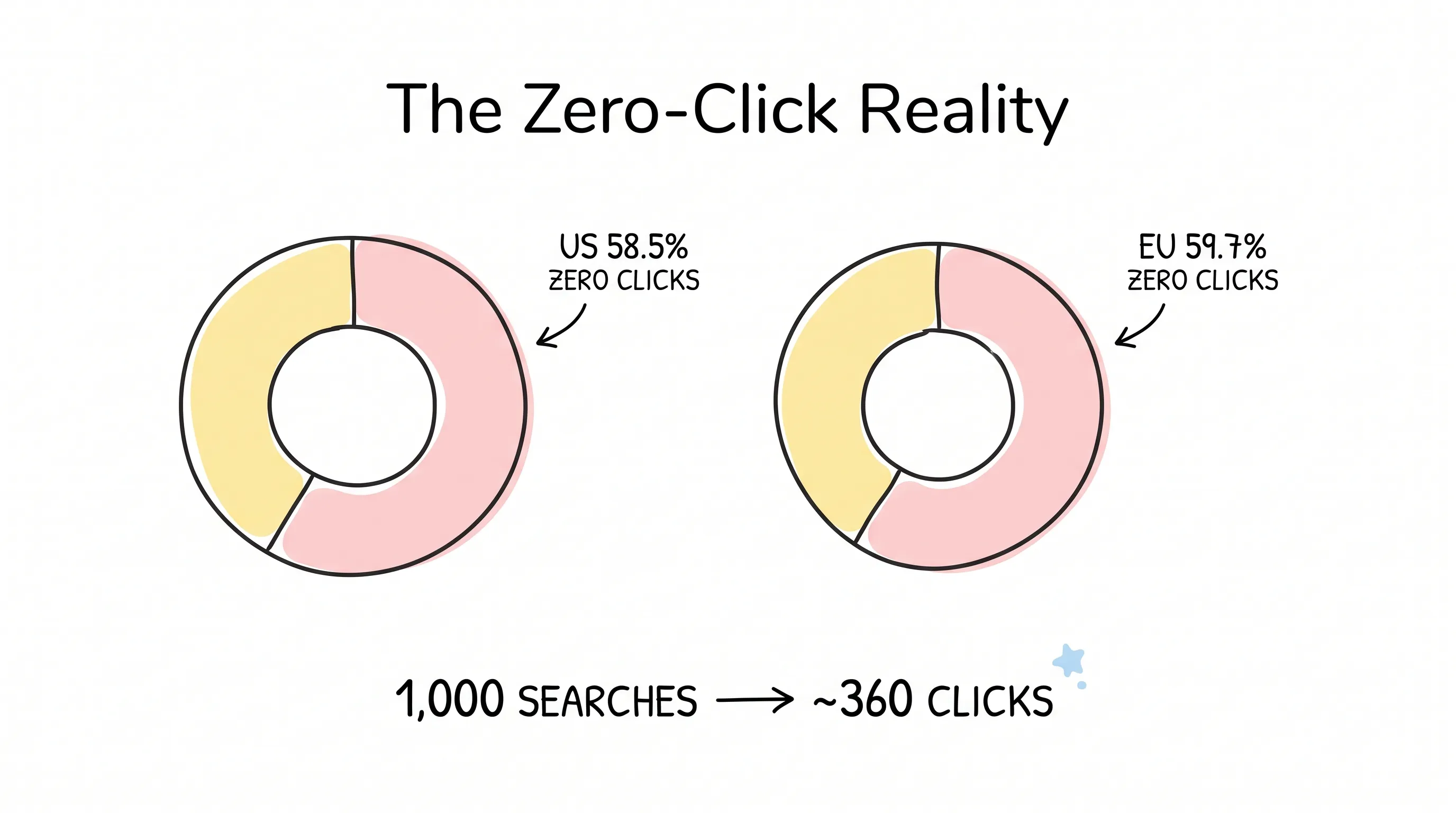
The marketing research firm SparkToro ran a "zero-click search" study in 2024, and the conclusion stings: about 58.5% of searches by U.S. users on Google end with zero clicks; in the EU, it's higher at 59.7%. Do the math: for every 1,000 searches in the U.S., only about 360 clicks flow to the open web beyond Google. In the EU, 374.
What does that mean?
You worked hard to rank on the first page of results. And then? The user hears the answer at the front desk and walks away without a backward glance.
Even if you rank first, the user may never visit your website in their lifetime.
Say it five years ago, it's alarmism. Say it today, it's just reality.
So the word "visibility" needs redefining. Visibility used to ask "can users see your link?" Now it asks "when the AI answers this question, will it mention you?"
The second number is about the funnel.
In the traditional search era, the funnel ran straight downward: rankings brought traffic, traffic brought consideration, consideration brought sales. Step by step, filtered layer by layer.
AI has dismantled that assembly line.
In the instant of searching, the user simultaneously discovers you, learns about you, and leans toward you. Discovery arrives earlier, decisions come faster, and brand influence no longer rides on clicks alone — it starts to ride on "being there."
The funnel didn't get smaller; its order got reshuffled.
Look at the top of the funnel first. Once your brand is cited in an AI answer, you land early on the user's "mental shortlist." They didn't click in, but they keep seeing your name, your viewpoints, your expertise. Once barely registers — what about ten times? Familiarity and trust are banked exactly this way, bit by bit.
Now the bottom. The closer users get to a purchase, the more the AI generates comparisons, recommendations, and "best choice" lists. Between a brand that has shown up repeatedly in answers and a brand being mentioned for the first time, which one gets picked?
The first brand isn't discovered. It's confirmed. Users choose it not because they just met it, but because "oh, it's you again."
Visibility compounds. The more you get cited, the easier it is to keep getting cited. Even if the short-term traffic report looks bad, this asset keeps quietly growing. It's a bit like brand advertising: the effect can't be attributed right away, but the seed is planted before your need has even surfaced.
GEO and SEO: What Exactly Is the Relationship?
At this point, let's be blunt: SEO is not dead. Whoever shouts "SEO is dead" is just fishing for attention.
What does traditional SEO do? Keyword rankings, page optimization, click-through rates, backlink authority. Still useful? Yes. Google still crawls, ranks, and distributes web pages. Throw away the fundamentals of SEO and you're tearing up your own foundation.
But a foundation alone doesn't build a tower. GEO values a different set of things: topical authority across the content ecosystem, structured expression that AI can easily read, presence in "answer-type" scenarios, and the trust signals that make an AI willing to write you into its answers.
Why is this lesson non-negotiable? Think about it: the moment AI Overviews arrived, it took the best spot on the search page, and the top-ranked organic result got pushed below the fold. The No. 1 ranking no longer buys No. 1 attention. Content can fully satisfy users without ever producing a click.
So if clicks are your only KPI, you're seeing half the battlefield.
And in that half hides a new asset: citation capital. SEO gets you indexed and ranked. GEO gets you cited and retold.
SEO writes you into the catalog; GEO writes you into the answer.
This is not an either-or choice. Grown-ups, of course, take both.
How Do You Actually Do It?
Enough reasoning — here's what you can act on. GEO has to be treated as a serious piece of strategic homework, just like SEO. This game rewards persistence and punishes opportunism.
I've broken it into six things.
First, define your core topics. Who do generative engines favor? Brands that demonstrate expertise in a long-term, steady, credible way. They don't reward keyword-chasing clickbait. So work it out first: what do you want to be known for? What problems are you best at solving? What do your customers keep asking? Once that's clear, build a set of mutually reinforcing pieces of content around those topics — a topic cluster.
Stop asking "which keywords should we rank for?" Start asking "which conversations should we show up in?"
Second, write content for the answer. AI reads content differently from humans; it can't digest the padded 500-word article that delivers 50 words of substance. What does good GEO content look like? It answers real questions directly; its headings state the user's intent; it explains concepts in plain language first, then goes deeper; and every claim carries data, a case, or expert backing.
The logic underneath is plain: the easier content is to summarize, the easier it is to cite; the easier it is to cite, the more often it shows up in AI conversations.
Third, weave the structure and context. Internal links, consistent terminology, structured data, clear page hierarchy, coherent topic clusters. These are the signposts for AI to read. They tell the generative engine: this brand knows this domain, and the knowledge is systematic — not scattered, one-off fragments.
Fourth, lengthen your measuring stick. Beyond clicks, watch a few new signals: among queries that trigger AI Overviews, are you getting exposure; under branded terms and non-branded topics, do you have visibility; in AI answers, are you mentioned or cited; and are branded search volume and direct visits trending up or down.
Keep watching rankings and traffic as before. The ruler doesn't need replacing — just add one more. GEO's effect happens before the user fills out a form or picks up the phone.
Fifth, bolt the three teams together. The SEO team understands technical structure and discoverability; the content team understands clarity and depth; the brand team understands tone, positioning, and trust. GEO naturally requires all three to sit at one table. Only when your messaging is consistent across channels and your content tells the same story will generative engines trust you — and know when to serve you up.
Sixth, accept that this is a long-distance race. Visibility compounds over time: authority grows, citations grow, and user familiarity grows too. Brands that start early build a lead latecomers will find hard to chase. Especially as AI answers get more crowded and more homogeneous, the early faces on the scene are the easiest to remember.
A Final Word
Back to where we started. That day, after I finished looking things up in ChatGPT, I hadn't clicked a single link.
And I thought: if that's how I behave, that's how everyone behaves.
Search's main battleground is shifting from "ranking links" to "citing answers." SEO gets you found; GEO gets you remembered.
Clicks still matter, of course. But don't lose sleep over the few clicks you're missing today. The real homework is this: tomorrow, when users ask their question, will the name the AI speaks be yours?
Continue reading
Related articles

It's 2026: Stop "Buying" AI Tools for Your Marketing Team — Start "Hiring" AI Agents
This learn article explains how AI agents differ from standalone AI tools in marketing, outlines three agent categories — build-your-own platforms, CRM-native agents, and vertical tools — and covers use cases across SEO, social media, advertising, and reporting, plus criteria for choosing one.

What Is GEO? How Your Brand Gets "Mentioned" in the Age of AI Search
An explainer on GEO (Generative Engine Optimization) for e-commerce and DTC brands: how it differs from SEO and AEO, why AI answers shape brand visibility, and eight practices covering question-focused content, consistent brand messaging, structured pages, external evidence, comparisons, and AI mention tracking.

AI Is Already Making Decisions for Your Customers. Are You on the List?
A learn article explains GEO (Generative Engine Optimization): why AI-generated answers now shape which brands customers see, and how SEO fundamentals, entity clarity, citable evidence, and monthly measurement affect visibility in AI answers.