
Marketing: Why Is It Always the First Department That AI Transforms?
A learn article explaining why marketing is often the first department transformed by generative AI: its raw material is content, AI enables one-to-one personalization beyond segmentation, and insights, content, and personalization form a reinforcing loop, citing 2023 survey data.
A couple of days ago I was flipping through some old data, and somewhere along the way, I stopped.
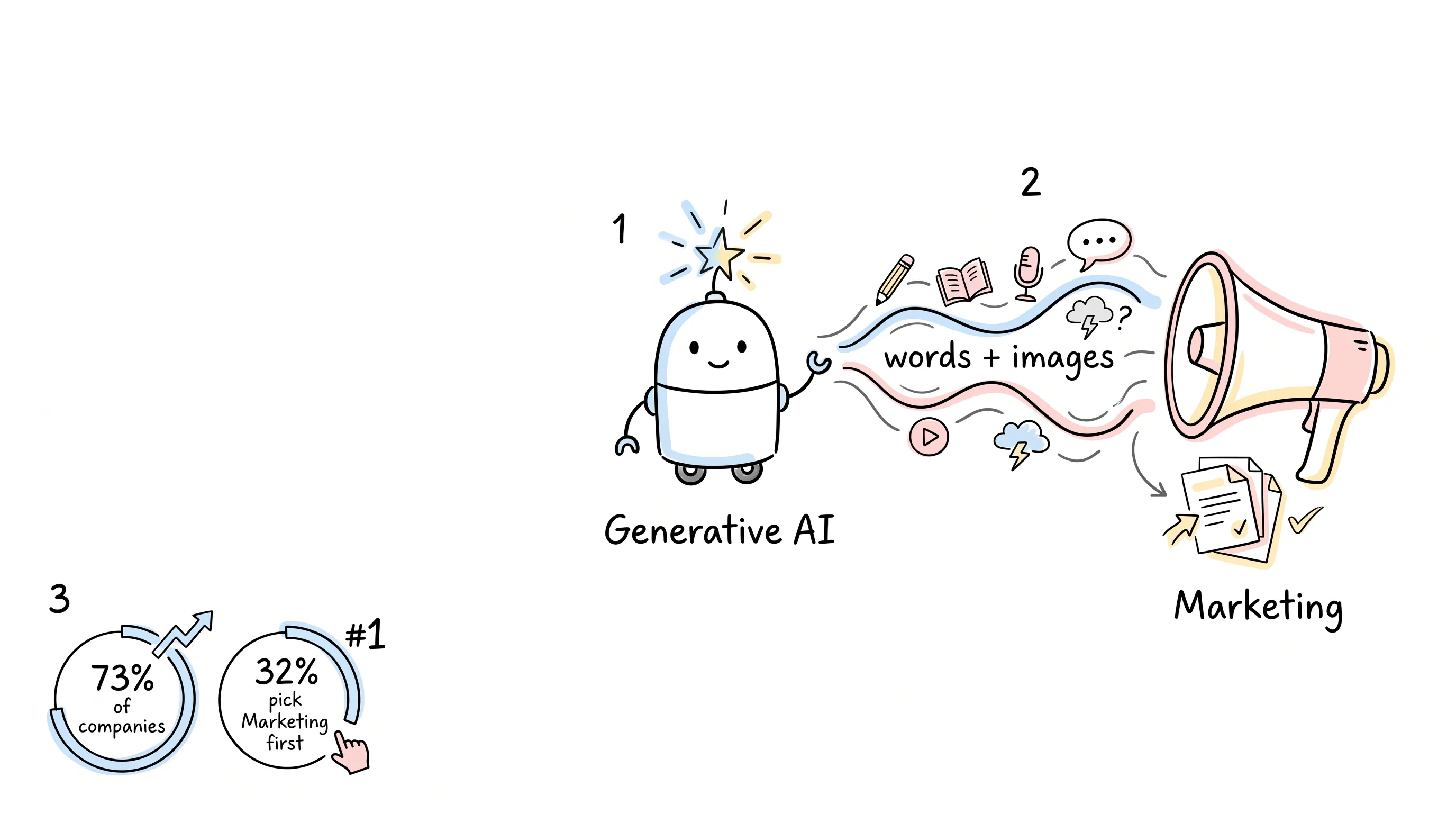
In March 2023, a survey in the United States found that 73% of companies had already used generative AI in their marketing activities. Writing copy, chatbots — it all counted.
73%. What does that mean?
Around the same time, another survey asked companies' chief data officers and chief AI officers: where do you most want to put AI to work first? 32% said marketing and sales. 44% said customer operations — customer-service bots, for instance.
In other words, when AI walked in through the company's front door, marketing was the first place it wanted to go.
That's odd. A company has so many departments — finance, legal, R&D, supply chain. Which of them isn't "harder" than marketing? Why is it marketing, of all of them, that gets transformed by AI first?
Today, I want to explain this thoroughly.
First, Let's Be Clear: What Is Generative AI?
What is generative AI?
A type of AI that "makes things." Give it a sentence, it gives you back a passage of text; give it an idea, it gives you back an image or a video. The key is the word "make": what it produces didn't exist before.
What about the AI of the past? It "recognized things." Show it a photo, and it tells you whether it's a cat or a dog. Judgment only, no creation.
Generative AI flips that around. It creates.
That single shift swung open doors across whole industries. But the door pushed open widest was marketing.
Why Marketing, of All Places
Think about what people in marketing do every day.
Write copy. Write social posts. Write product descriptions. Write campaign emails. Dream up ideas for ad visuals.
At its core, marketing is an industry that "produces content." High-quality words and images are marketing's raw material.
And generative AI happens to be best at producing exactly that — words and images.
When the sickle appears, the work in the wheat field is the first to change. Marketing is the first wheat field of the AI era.
No wonder the AI tool that broke out most in that period was OpenAI's ChatGPT. In June 2023, Bank of America asked 1,100 American internet users — 59% had used it.
The market voted with money, too. In 2021, the "AI marketing" market was estimated at roughly $15.8 billion; the forecast at the time was $107.5 billion by 2028.
But Saving Time Isn't the Point
Many people's understanding of AI marketing stops at "cut costs, save time." Copy gets written faster, images get made faster, headcount is saved.
True — all of that is correct. But these are just the appetizers.
The real change is that it can turn "one-to-one personalization" from a slogan into reality.
What is one-to-one personalization?
When we talked about personalization in the past, what did it actually look like? Segmentation. Split 1 million users into 20 groups, and push one set of content to each group. Sounds quite personalized, right? But think about it: one group holds several thousand people, and they all see the same sentence.
It's like a tailor shop advertising "made-to-measure" suits — but stocking only sizes S, M, and L.
Generative AI is different. Based on one specific user's data, at the right moment, it generates words, images, and recommendations that belong only to that person. A bespoke message for every single person — at negligible cost.
Here's an example. Say you sell running shoes. At 2 a.m., a user looks at a pair in your store, hesitates for ten minutes, and leaves. At 7 the next morning, the push notification they receive isn't "20% off new arrivals." It reads: the pair you looked at yesterday is back in stock in your size — only a few pairs left.
They clicked through.
No human team can watch every customer closely enough. And no set of hard-coded rules could ever write such a message. Only an AI that both reads data and writes copy can pull this off.
Personalization used to sort people into groups. AI's personalization calls each person by name.
Three Things, Joined Into a Loop
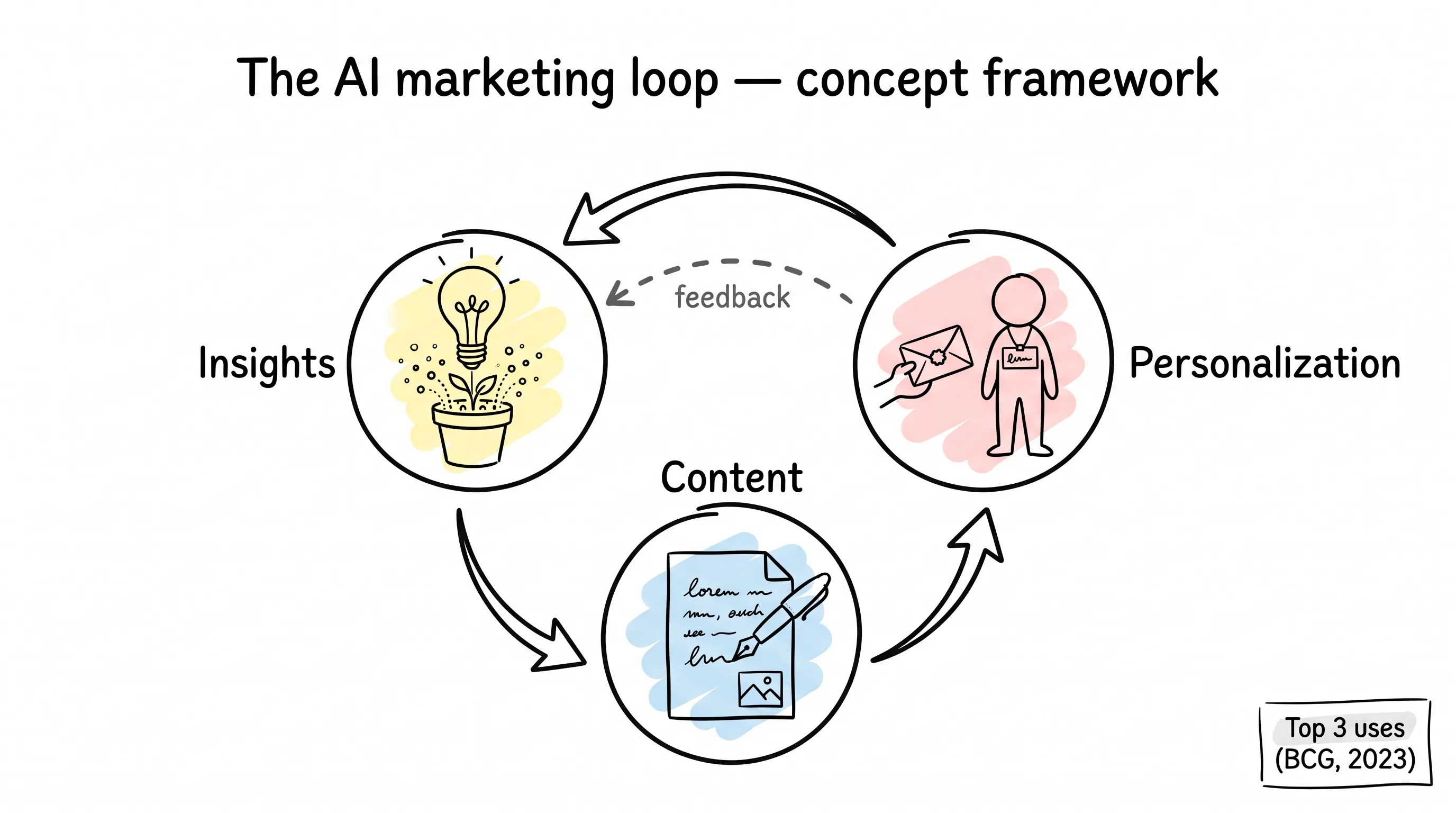
So where in marketing is AI used the most? A Boston Consulting Group survey in April 2023 ranked the top three: personalization, insight generation, content creation.
Three terms — unremarkable apart, interesting together.
AI first grows insights out of data: which kinds of people like what, which words move people most. The insights feed content creation, producing material that hits the mark. The content then lands in personalization: whom to speak to, when to speak, how to speak. The feedback personalization generates becomes new insight in turn.
Insights nurture content, content powers personalization, and personalization feeds back into insights.
A loop — once it spins, it doesn't stop.
Then Comes the Bill
Everything has a flip side.
AI is useful, but it isn't free. Microsoft's Copilot costs enterprise users an extra $30 per person per month. And to use the then-strongest GPT-4, ChatGPT Plus is $20 a month.
$30 doesn't sound like much? Do the math. A 100-person company putting every employee on Copilot: $3,000 a month, $36,000 a year. Pocket change for a big company; for a small firm of a few dozen people, it's a budget item that needs its own dedicated meeting.
So you'll notice an interesting pattern: the ones using AI most aggressively are often not the senior marketers with the biggest budgets, but mid-level and junior marketers. The Conference Board's survey found this; a Pew Research Center survey in July 2023 saw a similar pattern in the broader population — heavy use concentrated among the relatively young.
Why?
Because for young people, AI is right at hand — no reason not to use it. What it solves is the question of whether they can get home early today.
Big companies are holding meetings to evaluate. Young people are already moving at full speed.
Back to the Beginning
Now the opening question can be answered.
Why does marketing get transformed by AI first? Because its raw material is content, and generative AI happens to make content; because every link in its chain feeds on data, and AI happens to be best at growing insights out of data.
AI's transformation of marketing was never about doing the old work faster. What it truly did was turn work that simply couldn't be done before into everyday routine.
That 73% figure is a 2023 number. Looking back today, the directional calls were all correct. And that loop — insights, content, personalization — will only spin faster.
The next round of competition isn't about who uses AI to write copy faster.
It's about who can carry "one person, one face" all the way through.
Here's to getting in early.
Continue reading
Related articles

It's 2026: Stop "Buying" AI Tools for Your Marketing Team — Start "Hiring" AI Agents
This learn article explains how AI agents differ from standalone AI tools in marketing, outlines three agent categories — build-your-own platforms, CRM-native agents, and vertical tools — and covers use cases across SEO, social media, advertising, and reporting, plus criteria for choosing one.

Did the Money You Spent on AI Marketing Ever Come Back?
A guide to measuring AI marketing ROI across three layers: ad reports, sales pipeline, and the financial ledger. Covers metrics such as ROAS and CPA, eight dashboard metrics, industry benchmarks, and common measurement mistakes.

How to Pick a Creative Automation Platform: First, Figure Out What These Eleven Actually Do
A learn article sorts eleven creative automation platforms — including Bannerflow, Celtra, Smartly.io, and Storyteq — into four functional groups and proposes five evaluation questions covering publishing reach, automation depth, ease of adoption, team fit, and verifiable evidence.