
SEO Isn't Dead, but It's Not Enough: What Is GEO?
Explains GEO (Generative Engine Optimization) as an extension of SEO for AI search: how AI-generated answers change how users find products, and four actions companies can take, including structuring content with schema, monitoring brand visibility in AI answers, and aligning marketing with IT.
A few days ago, I wanted to buy a pair of shoes.
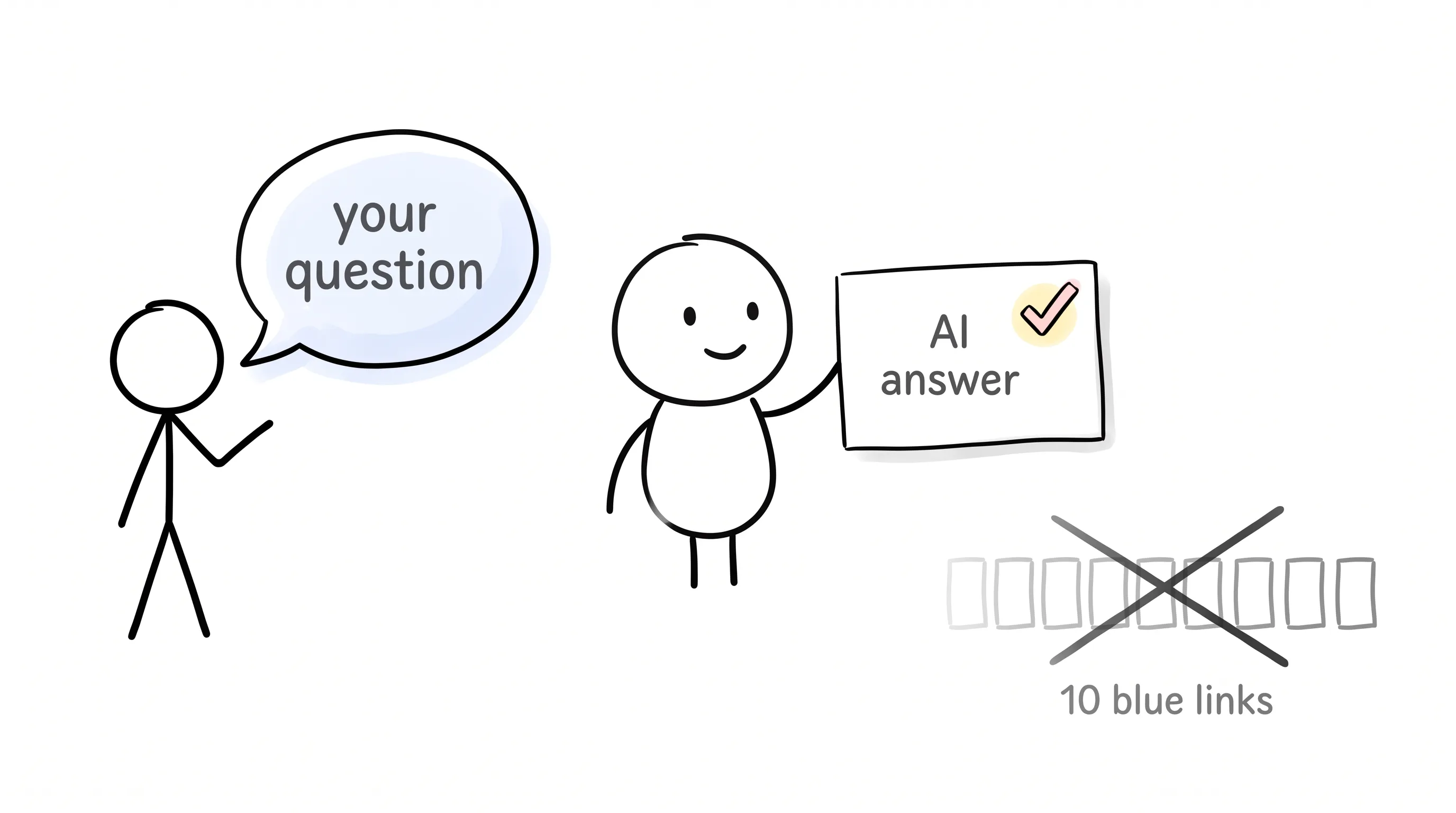
I'm going hiking in June and wanted something lightweight and waterproof, with a budget under 2,000 yuan. I didn't open a search engine, and I didn't open a shopping app. I asked an AI directly.
I described my needs in plain language: where I was going, when, what kind of terrain, what I cared about, how much I wanted to spend. In a minute or two, I had a shortlist — specific styles, specific price points, links included. The whole experience was unsettlingly smooth. Then it hit me: if I shop this way, how many other people do the same — without even realizing it's changed?
One number stopped me cold: 78%.
McKinsey's report shows that 78% of organizations used AI in at least one business function in 2024, up 23 percentage points from 55% just one year earlier.
And this isn't some macro statistic removed from everyday life. It means AI search is no longer a "new channel" or a "tech trend." It's a structural change — one that rewrites how customers find products, how brands build awareness, and how companies win customers.
Users have already changed. The question is whether companies have.
Let's look at what's actually happening.
Google's AI Overviews now appear in about 13% of searches — roughly one in every seven or eight. And it's not just Google. ChatGPT, Perplexity, and a wave of AI assistants have become the new front door to information. More and more people skip the search engine entirely and go straight to an AI.
Users' habits have changed too. They no longer type a string of keywords like "summer jacket men short." They ask a full question: "What jacket is good for commuting to work, with a bit of style?"
What they get back isn't a list of links. It's a direct answer — with a comparison, a recommendation, and reasons.
Here's what that means: a user may never visit your website at all, yet still form a judgment about you — and even make a purchase decision.
This is the era of zero-click — where users get answers without clicking. And here's the catch: in the zero-click era, users can get their answer right inside the AI's interface, without ever clicking through to your website. So no matter how good your article is, if the AI never surfaces it, it brings you no traffic and no conversions. Search volume doesn't necessarily drop; it changes shape. Traffic may fall, but the traffic that does arrive is higher-intent and higher-quality — because before they ever reach your page, the AI has already answered most of their questions for them.
The smart players have already moved
While we're still asking "is this a big deal," some companies have already woven AI search into their business — quietly, but deeply.
Take customer service. A lot of the questions customers ask are standard: how to return something, how to install something, what's covered by warranty. Companies are feeding this knowledge into AI systems so customers can ask an AI directly and get an accurate, structured answer on the spot. The result: shorter support wait times, a better customer experience, and — on the back end — added capacity without expanding the server room. Human agents focus on the genuinely complex cases; the AI handles the routine ones.
Take the content hub. Product manuals, how-to guides, FAQs — this kind of content used to exist mainly for people who already knew you. Now it has a second audience: AI systems. The companies that systematically restructure this content — clear headings, precise answers, clean markup — are the ones AI understands, cites, and recommends. When a user asks a related question, the AI can name you and explain what you do.
Take marketing. The marketing team's focus is quietly shifting from "ranking" to "share of voice." Traditional SEO watched keyword rankings. AI search optimization watches something else: across a whole set of real user questions — every angle of "which one should I buy," "how do I solve this problem" — how often does your brand come up in the AI's answer? How does it compare with competitors? Is the framing accurate?
And here's the hard truth: AI ranking optimization is even more competitive than SEO — because you're no longer competing for ten blue links on a page. You're competing with every other brand for a single slot inside one generated answer. That's why many companies are also looking beyond their own sites: getting mentioned and cited in Reddit threads, community Q&A, and genuine user reviews, because that's where AI goes to learn what people actually think.
On top of that, conversational buying is emerging: a user plans an entire purchase — comparing options, confirming details, even completing payment — inside a single conversation with an AI. The interface is clean: no pop-ups, no flashing banners, no bids-based ranking games. The AI understands what you mean and hands you what you actually need. Compared with a traditional search results page cluttered with ads, the difference in experience is striking.
And this list is still growing.
Four things companies can do right now
The good news: this isn't a game only for tech giants. Generative Engine Optimization (GEO) — the AI-era upgrade of SEO — has a much lower barrier to entry than most people imagine. Here are four moves any company can make:
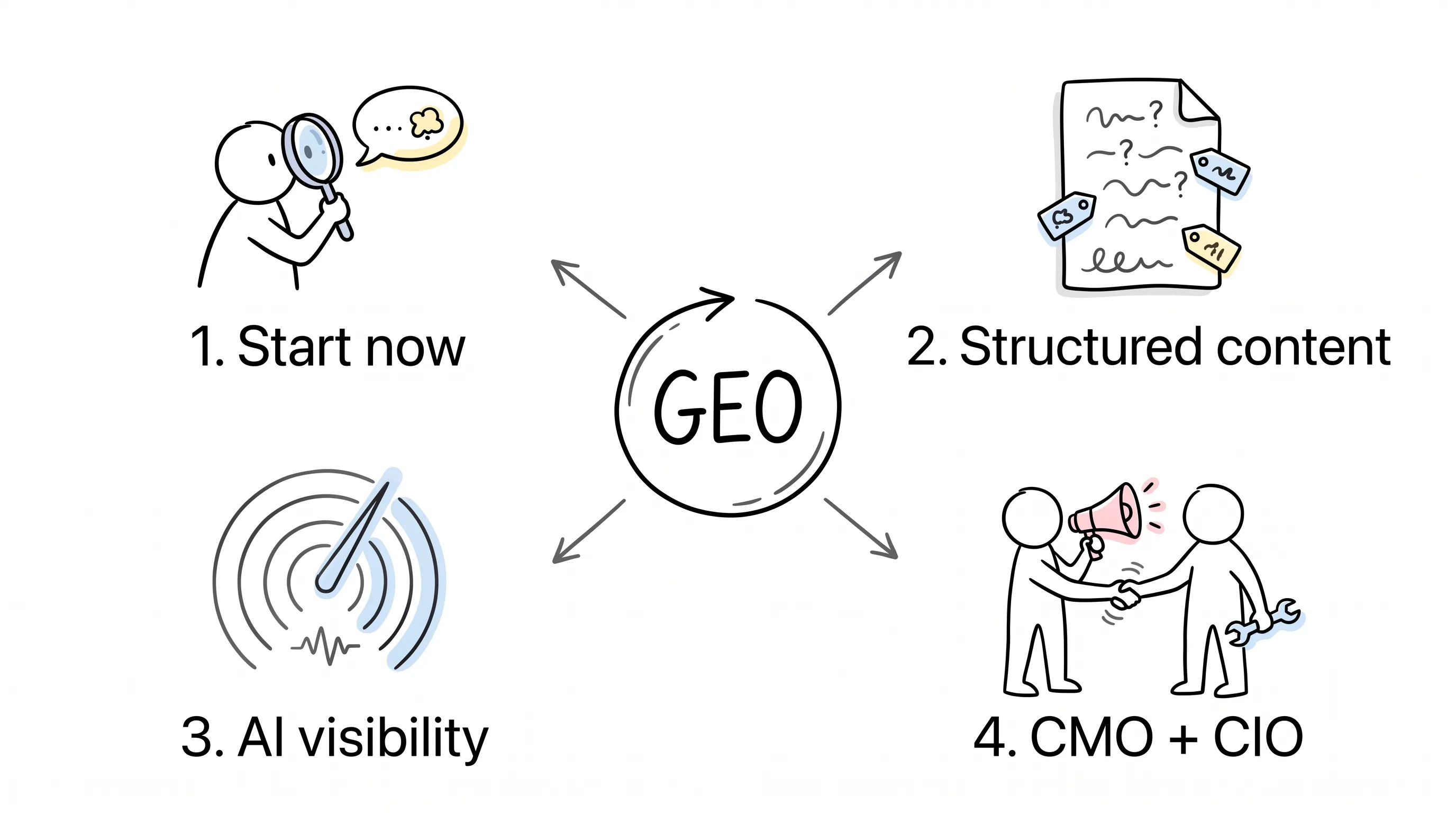
1. Start GEO now. Don't wait until AI search has fully rewritten the rules of traffic — by then, the track will already be packed. Learn the basics of GEO and run a simple test: ask ChatGPT or Perplexity a question about your own products and see whether the answer mentions you — and whether it gets you right.
2. Retrofit your content for AI. Go through your existing content — product pages, FAQs, help docs — and upgrade it: add structured data like FAQ schema, HowTo schema, Product schema; write in clear Q&A form; state facts directly instead of wrapping them in dense marketing copy. AI values one thing above all: accurate, structured, and easy to extract.
3. Monitor your AI visibility. Track brand mentions across mainstream AI platforms, sentiment analysis, and the accuracy of the answers given. Many traditional SEO tools already include this — it's an upgrade to your rank tracking, not a replacement. Eight out of ten companies haven't started yet. Do it now, and you're already ahead. And one more thing: today's numbers won't guarantee tomorrow's answers. Calibrate your AI visibility once a month.
4. Get marketing and IT pulling in the same direction. AI search optimization isn't a solo job for marketers. Content governance and structured markup require technical support; meanwhile, IT teams are asking for marketing input to plan what to build and where to invest. CMOs and CIOs need to sit down at the same table — set clear goals, split the work, and move together.
A closing thought
There's one more benefit worth mentioning: hyper-personalization. By analyzing data on user behavior, preferences, and context, AI can tailor content, product recommendations, and marketing messages to each individual — the "personal touch for every single person" that marketing has dreamed of for years is finally becoming practical at scale.
But that's a story for another day. The one thing worth remembering today is this:
AI search is not "a new traffic channel." It's a structural change in how information is distributed.
Just like a stock portfolio shift: this isn't about holding a bit more or a bit less — it's about rebuilding what you own and re-planning where growth comes from. The companies that adapt first will take the initiative; the ones that hesitate will watch the rules change beneath them, only to find that all the good seats are taken.
Don't wait until June.
Just like me buying shoes: I'll be on the mountain in a pair of lightweight, waterproof boots — bought on an AI's recommendation, half a size up, because it reminded me that hiking boots are best bought half a size up.
If even a pair of shoes can find its owner through AI — how long can your business wait?
Continue reading
Related articles

It's 2026: Stop "Buying" AI Tools for Your Marketing Team — Start "Hiring" AI Agents
This learn article explains how AI agents differ from standalone AI tools in marketing, outlines three agent categories — build-your-own platforms, CRM-native agents, and vertical tools — and covers use cases across SEO, social media, advertising, and reporting, plus criteria for choosing one.

What Is GEO? How Your Brand Gets "Mentioned" in the Age of AI Search
An explainer on GEO (Generative Engine Optimization) for e-commerce and DTC brands: how it differs from SEO and AEO, why AI answers shape brand visibility, and eight practices covering question-focused content, consistent brand messaging, structured pages, external evidence, comparisons, and AI mention tracking.

AI Is Already Making Decisions for Your Customers. Are You on the List?
A learn article explains GEO (Generative Engine Optimization): why AI-generated answers now shape which brands customers see, and how SEO fundamentals, entity clarity, citable evidence, and monthly measurement affect visibility in AI answers.