
AI Marketing Daily · 2026-10-23
Daily AI marketing briefing covering GEO and AI search investment: IAB survey data on creator content entering AI recommendations, conflicting traffic and conversion statistics for ChatGPT referrals, GEO monitoring tool comparisons, agency selection guides, and a playbook for building reliable knowledge sources for AI.
Nearly all of today's 13 items are answering the same question: is AI search actually worth investing real money in. The top story looks at how creator content is entering AI's recommendation pipeline, with IAB bringing survey data from five countries; the data section hands you two sets of numbers that disagree — one says ChatGPT referrals amount to less than one percent of Google's, the other says visitors from AI channels convert at 8 times the rate. The tools section rounds up 10 GEO monitoring tools and two agency-selection guides; the playbooks section shows you how to build a reliable knowledge source for your AI agent. Read on — every item comes with a practitioner's take, and the top story stands on its own as a deep read.
🎯 Top Story
Creator Content Is Rewriting AI's Recommendation Lists
Last week, someone asked an AI which camera was worth buying according to the latest reviews. But behind that answer actually stood a group of creators. On October 22, MarTech published a piece by Carryl Pierre-Drews, Chief Marketing Officer at IAB, who wants to make one thing clear: AI is changing how consumers discover products, and creators' reviews, demos, and first-hand experiences are becoming the raw material that AI recommendations are built on. Ask an AI today whether any product is worth buying, and a large share of what it reads while assembling its answer was written by real human creators.
IAB ran a survey through its own Insights Engine, covering five markets — the US, UK, Australia, Mexico, and India — and 2,200 consumers who had recently used AI for shopping research. 56% of respondents want AI shopping recommendations to include creators' or influencers' perspectives, and the appetite is stronger among younger groups. 51% of Gen Z and 46% of millennials say they have discovered new creators through AI search results. In other words, AI isn't just selling your products — it's helping creators grow their followings, which in turn feeds AI even more human-made content.
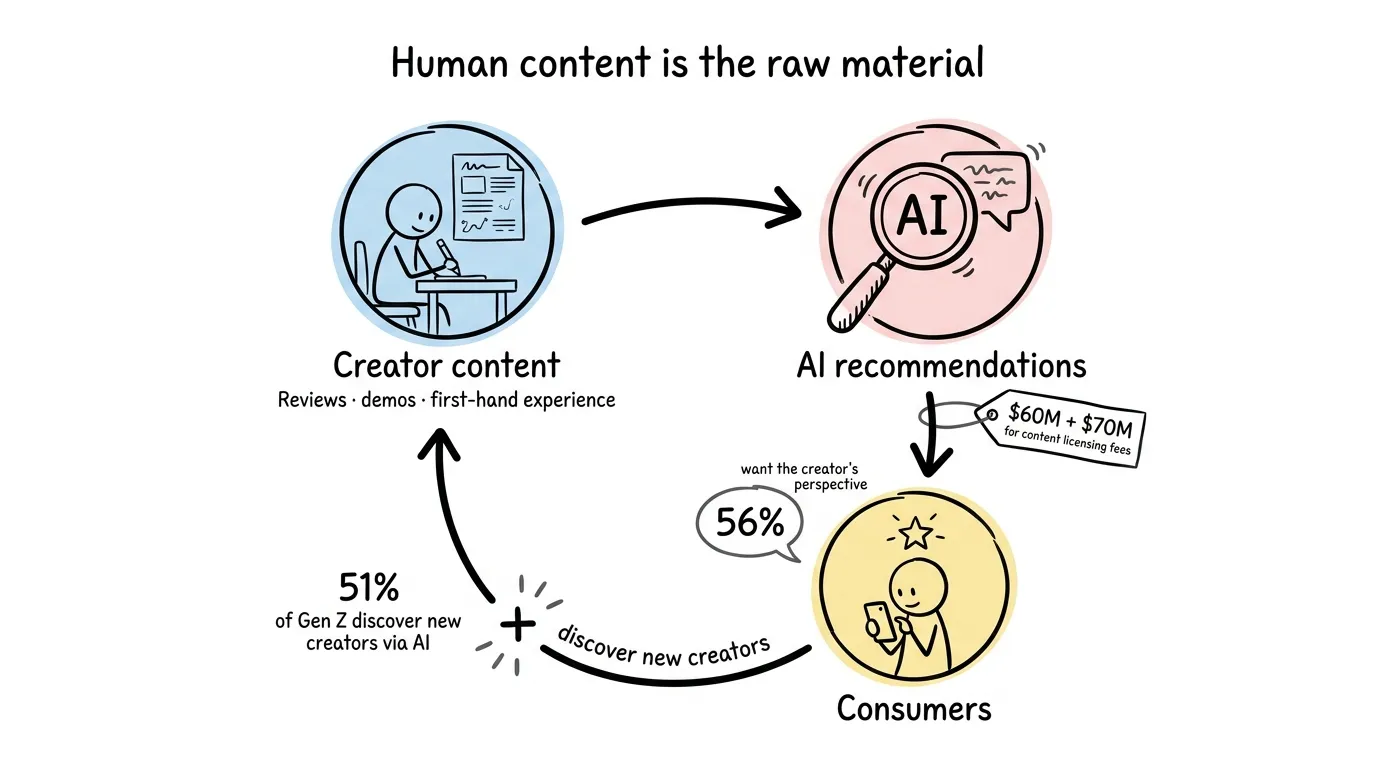
You can gauge how much weight this carries from the two licensing fees Reddit commanded. In February 2024, Google paid roughly $60 million a year for Reddit's Data API; that May, OpenAI signed a similar deal at about $70 million a year. Reddit CEO Steve Huffman put it bluntly on an earnings call: the more machine-written content floods the web, the more expensive human content becomes — and Reddit has been accumulating authentic conversations for nearly twenty years.
The article gets specific about how AI consumes creator content. A new-phone review published last week answers today's questions better than a 2022 review ever could — that's a freshness signal. When complaints about swollen batteries suddenly spike in a phone's negative reviews, AI picks up on the shift in sentiment and treats it as a quality warning. Ask whether a mirrorless camera is worth buying, and AI will stitch creator reviews together with other sources into a full product picture. Damon Jones, P&G's Chief Communications Officer, said at Cannes that consumers need to hear three voices: the brand's own, the expert's, and that of fellow consumers — and creators are filling the expert seat. Pierre-Drews offers her own metaphor: in a physical store, the clerk will pick out a few items for you to try on, but what actually convinces you to buy is often the opinion of another shopper standing outside the fitting room. The creators showing up in AI recommendations are that shopper outside the fitting room.
For marketers, the impact lands on three roles. If you source influencers, your selection criteria need to shift from follower counts to genuine expertise and hands-on product experience — Mina Haque, global CEO of Tony Roma's, has a line worth pinning above your desk: reach is rented, trust compounds. A creator with 5,000 highly engaged followers may well outperform an account with 100,000. If you make content, make sure AI can actually parse the reviews on your pages — don't make it guess. If you monitor brand sentiment, comment sections have become the new radar, because AI is reading them too.
Three things you can do this week. First, audit your existing influencer roster and move anyone with real hands-on product experience to the front of the partnership priority list, even if their following is small. Second, add structured data to the creator reviews on your website, explicitly marking the creator's identity, product name, rating, and publication date — and keep that information visible on the page as well. It won't guarantee a slot in AI recommendations, but it helps AI understand the page correctly. Third, make comment-section monitoring a standing routine; abnormal swings in negative sentiment are now both a PR signal and an input to AI recommendations. The article's advice to AI platforms is worth brands noting too: let credible creator perspectives into the shopping journey. What consumers want is brand information converging with real experience — whoever gets this meal right first is the first to collect the trust dividend.
Don't skip the tip for the creator side, either. The article advises creators to write more substantive text in their content so AI can recognize their expertise — after all, AI is already an acquisition channel for creators, with over half of younger users discovering new influencers through AI results. The more solid the professional detail in your content, the better your odds of being recognized by AI and recommended to the next consumer.
My read: the real value of this piece is that it splices the GEO (Generative Engine Optimization — the practice of making content citable by AI answers) and KOL budget lines together. Influencer content used to belong to the social team; search visibility belonged to the SEO team; the two spent their own money and filed their own reports. Now AI's recommendation pipeline has strung the two into a single chain: human content is the raw material, structured markup is the packaging, and comments are the fermentation tank — miss any link and the whole chain underperforms. If your 2026 budget still approves these two separately, start with a merged pilot on one product line, run it for a quarter, then decide how to reorganize. One more thing: coming from an industry body like IAB, a survey spanning five markets and two thousand-plus respondents carries more credibility than a vendor blog — cite it with confidence.
🔗 Further reading: Read the full article
🏷 Industry Data
ChatGPT Sends Websites Less Than One Percent of Google's Traffic
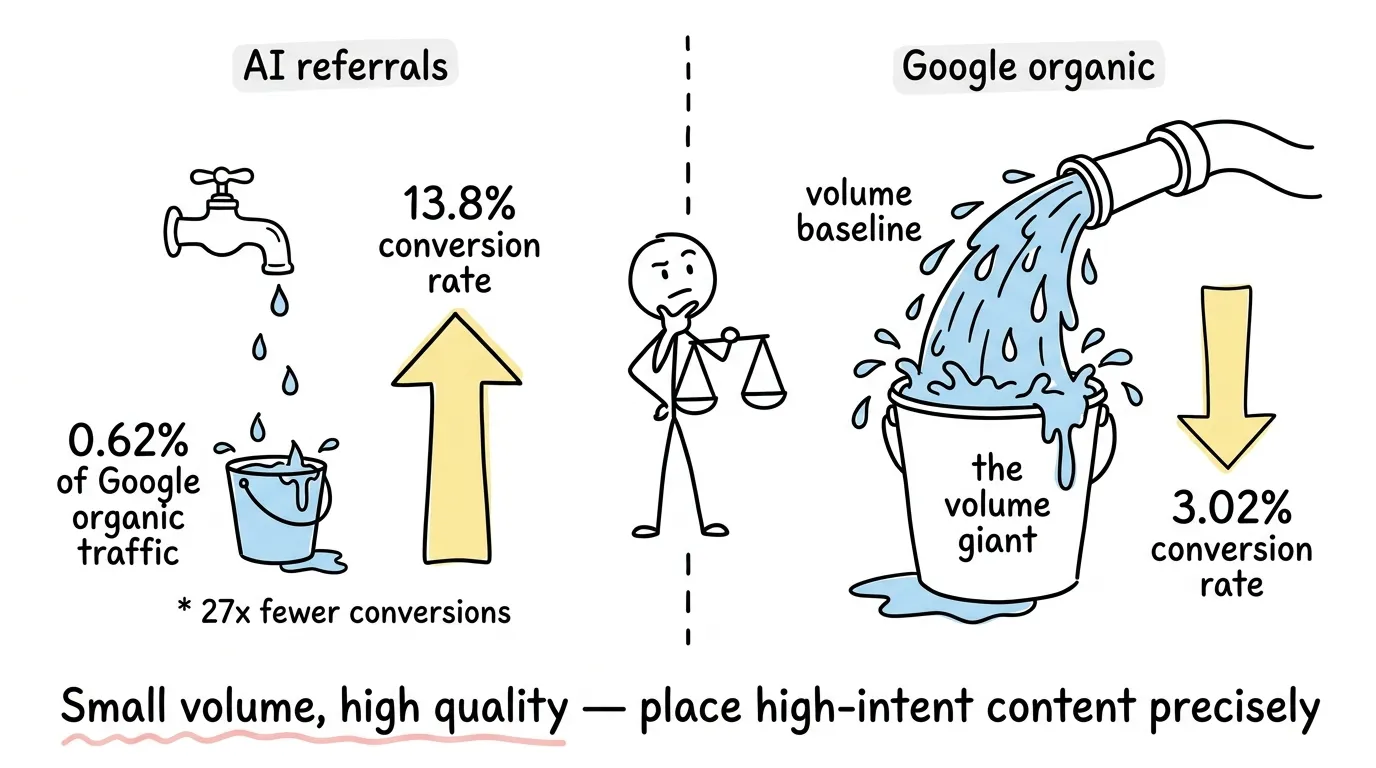
On October 22, MarTech covered a GA4 analysis from SEO practitioner Marie Haynes: 100 websites, 12 months, more than 145 million sessions. The conclusion pours cold water on the GEO hype — ChatGPT referral sessions amount to just 0.62% of Google organic search, and even adding every other LLM only brings that to 0.73%. Note that the baseline here is Google organic traffic, not total site traffic.
Conversion rates, though, genuinely flip the story. Across the 55 sites with conversion tracking configured, ChatGPT visitors converted at 13.8% while Google organic visitors managed only 3.02%. But the conversion-volume gap is right there in the open: conversions from Google organic search were 27 times those from all LLMs combined. Haynes accordingly calls GEO a distraction — her point being that the AI search actually delivering people to a business's doorstep today isn't ChatGPT, it's Google's own AI Overviews.
One overlooked trend point: ChatGPT referral traffic stopped growing exponentially as of August 2025 and has since begun to decline. The report is honest about its limitations, too — industry mix, conversion definitions, and the measurement window are all undisclosed, and changes in Google's own traffic weren't measured.
💬 Practitioner's take: use this dataset to calibrate your budget cadence, not to sentence GEO to death. Run a quick exercise this week: pull the real LLM referral sessions and conversions from your own GA4. If they're under even 0.5%, move GEO from a core budget line to an experimental one and route the savings back into paying down SEO technical debt. Visibility inside AI Overviews still rests on traditional rankings — that logic hasn't changed.
🔗 Further reading: Read the full article
HubSpot Compiles 24 GEO Statistics — Use Them as Ammo for Your Reporting Deck
This statistics roundup, updated on the HubSpot Marketing Blog in July, sorts the GEO numberscape into four groups. Scale: ChatGPT counts 900 million weekly active users, and Perplexity's monthly queries have climbed from 230 million to 780 million. SERP: 60% of Google searches end in zero clicks, and AI Overview trigger rates have fallen from 91.3% on informational queries to 57.1%, while the share on commercial and transactional queries is rising.
The citation-landscape numbers are where the real gold sits. The top 5 domains take 38% of citations and the top 20 take 66%, which means smaller brands break through via structured content and long-tail questions. Reddit's citation volume jumped 450% in three months and now accounts for 21% of Google AIO citations. By content format, video is the most-cited single type, YouTube alone claims nearly a quarter of citations, listicles see a 25% citation rate versus just 11% for long narrative pieces, and structured content (headings, lists, tables) earns 28% to 40% higher citation rates. The roundup is transparent about provenance — the ChatGPT weekly-active figure is sourced from a February 2026 TechCrunch report, so you can trace it back.
The pacing numbers are useful for planning: structural GEO optimizations show results in 30 to 60 days, far faster than SEO's 6 to 12 months; AI-referred visitors convert at 4.4 times the rate of organic search visitors; and 99% of AIO citations come from the organic top 10 — meaning GEO is an add-on to SEO, not a replacement. The piece closes with five metrics for exec reporting: citation frequency, brand visibility score, AI share of voice, citation sentiment, and AI traffic conversion rate.
💬 Practitioner's take: the right way to use this roundup is to pick five numbers for your quarterly review deck. "Commercial-query AIO on the rise" plus "the top 20 domains monopolize 66% of citations" is enough to convince management to schedule the structured-content overhaul into the next iteration. Every figure here is secondhand, though — click through to the original sources before citing, so you don't stall when the boss asks where a number came from.
🔗 Further reading: Read the full article
Neil Patel's GEO Stat Library: AI Visitors Convert 8x, List Content Cited at 48%
Neil Patel's team runs a continuously updated stats column on AI and GEO — a library of data cards, each drawn from NP Digital's first-party research. A few you can quote directly: visitors from AI channels convert at 8 times the rate of traditional traffic and convert 62% faster; list-format content is cited by AI most often, at 48%; Google remains the first stop for answers, but AI channels already account for 36%.
One more finding speaks directly to distribution strategy: the number of channels you publish on each month correlates positively with AI mention volume — multichannel distribution genuinely lifts AI visibility. The library also holds framework cards like a GEO tactics ROI matrix, a seven-layer AI visibility stack, and a 90-day action plan. One caveat: this is an index page, not a written analysis, so verify the methodology behind any single stat on its subpage before relying on it.
💬 Practitioner's take: bookmark this library and come here first when you need a benchmark for a proposal — far more reliable than inventing numbers on the spot. The 8x conversion stat only gains meaning when read next to Haynes's 0.73%: volume is small but quality is high, so the conclusion is precision placement of high-intent content on AI channels, not carpet-bombing your whole site. On the distribution correlation — check this week whether your content is actually synced to at least four channels.
🔗 Further reading: Read the full article
Gen3's Consumer AI Usage Data: 43% Use It Daily, 62% Trust AI to Lead
Gen3 Marketing's GEO services page wears its promotional intent openly, but the consumer behavior data it compiles all comes with sources — traceable to Search Engine Land, Marketing Dive, and others. The numbers: 72% of people regularly use AI tools, 43% use them daily, 62% trust AI to guide their brand choices, 51% say AI influences purchase decisions, and 42% use AI Overviews and traditional search side by side.
The page also offers a weighting judgment across channels, useful for anyone running omnichannel: performance PR has the most direct effect on AI visibility, because media coverage feeds the authoritative sources LLMs draw on; affiliate and influencer have a moderate effect on AI presence, with the latter acting more on brand sentiment and reach. GEO work breaks into three streams: coverage of key queries, brand sentiment management, and correcting misinformation in AI outputs.
💬 Practitioner's take: the point here is ranking your channel mix. If this year's PR budget still chases nothing but traditional media exposure, move a quarter of it to industry publications and review sites that LLMs can crawl — one of the highest-leverage moves available. The misinformation-correction piece is easy to overlook: this week, search AI for the common wrong descriptions of your product, then counter whatever you find with official content.
🔗 Further reading: Read the full article
🏷 Marketing Tools
10 GEO Monitoring Tools Compared: Every Price Band from Free to Custom
This comparison, updated on the Answer Socrates blog on October 20, is a rare side-by-side table of GEO tools, listing starting prices, ideal users, strengths, and weaknesses. The price bands are clear: entry level runs free to $49 a month, the mid tier is $99 to $129 (Semrush AI Toolkit at $119.95, SE Ranking at $129), the high end has Cognizo at $499 (clients include Kraft Heinz and LG), and Profound goes custom-priced on the expensive side.
A few tools' differentiating capabilities are worth noting on their own. Shop Mentions is Shopify-native, product-level AI mention tracking — it can pinpoint where a single product shows up in AI recommendations. SEOTesting runs LLM-traffic controlled experiments on your own GA4 data, for teams that would rather prove things themselves than swallow vendor narratives. Cognizo closes the loop with tracking plus managed operations. The underlying driver for the whole category: AI Overviews have siphoned off more than 35% of clicks. Keep one thing in mind — the publisher's own product, Answer Socrates, sits at number one, a recognizable conflict of interest.
💬 Practitioner's take: don't build your monitoring stack by jumping straight to Profound. Start on the free tier, assemble a fixed set of buyer prompts, run them for two weeks to learn what you actually need to measure, then decide what to buy. Ecommerce teams should look directly at Shop Mentions — product-level granularity is something nobody else offers. If your budget is stuck around the $100 tier, the Semrush AI Toolkit makes sense as an add-on for teams already on Semrush; as a standalone purchase, it isn't worth it.
🔗 Further reading: Read the full article
Choosing a GEO Agency by "Where Does It Hurt": 12 Quotes, All Verified
This selection guide, published by PitchKitchen on October 5, makes a smart cut: instead of ranking agencies by fame, it groups them by failure type. Enterprise-scale technical site problems call for the likes of iPullRank, Seer, and Go Fish; B2B teams needing a citation-earning content engine should look at Omniscient, Siege Media, and Animalz; those wanting growth-program integration map to Directive, First Page Sage, and NoGood. Every quote was verified as of October 2026: Omniscient starts above $10,000 a month, NoGood averages $20,000 a month, and sprint-based projects run $15,000 to $45,000.
The most valuable part of the guide is Seer's research data: across 3,119 queries tracked over 15 months, organic clicks dropped 61% once an AI Overview appeared — yet brands cited in the AIO gained 35% more organic clicks, because clicks flowed to the brands named in the answer. The author is also explicit about two things money can't buy: paid placement in recommendations doesn't exist, and the so-called magic schema file doesn't exist either — Google's official line is that there are no special optimization requirements. The guide adds a five-component AI visibility system — a fixed set of buyer prompts, a unified source of truth, an answer-shaped content publishing loop, third-party corroboration channels, and a measurement cadence. Benchmark your in-house capabilities against it before picking an agency. The author's own shop is on the list, which makes this a self-recommendation — read it with a discount in mind.
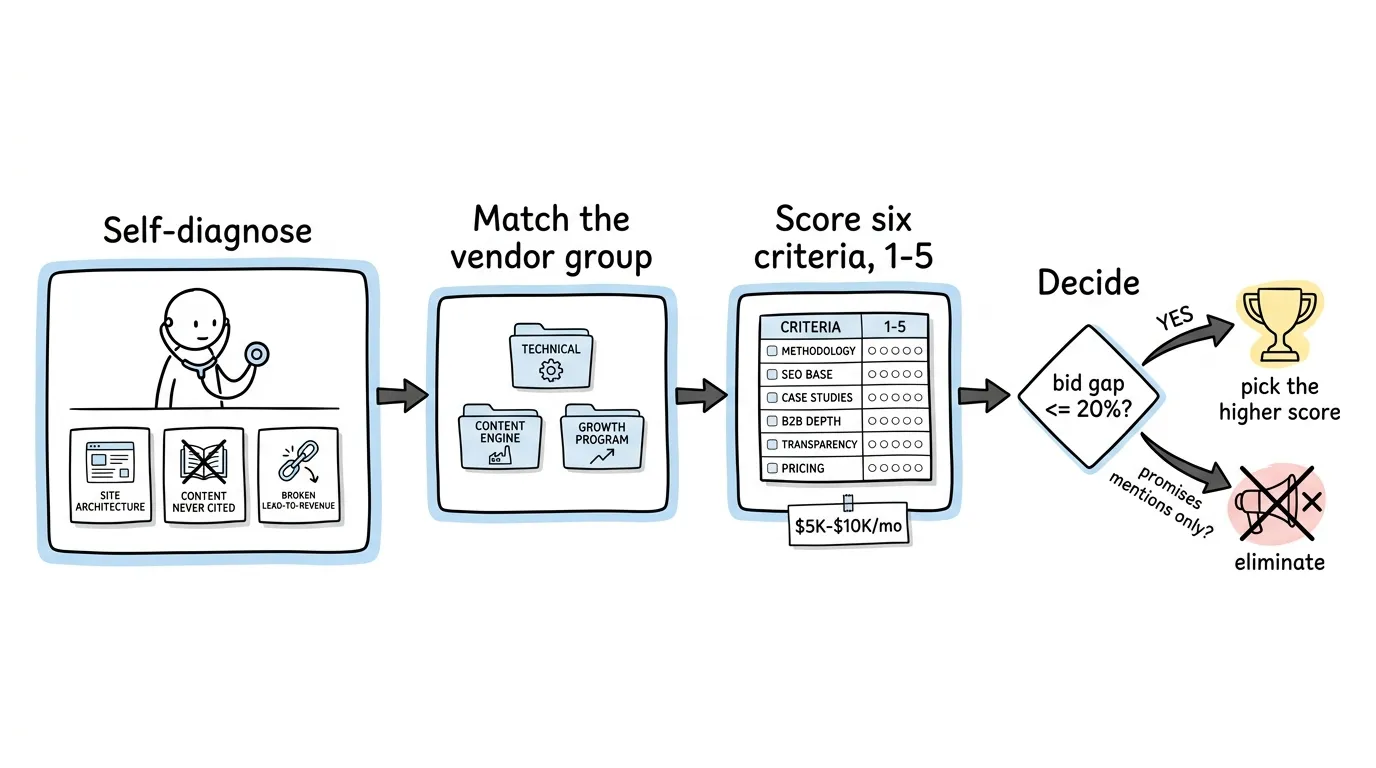
💬 Practitioner's take: run a fault self-diagnosis before choosing an agency. Is your problem technical site architecture, content that never gets cited, or a broken lead-to-revenue chain? Match the symptom to the corresponding vendor group and you'll skip at least two rounds of mismatched pitches. Bring Seer's 61%-versus-35% numbers into your internal deck — they're the most powerful contrast available for explaining "why being cited by AI is worth paying for."
🔗 Further reading: Read the full article
A List of 15 GEO Agencies — Read It for the Pricing Benchmarks and the Six Screening Criteria
This list, updated by Perceptric on October 14, ranks itself first — note the conflict of interest — but the market benchmark data is useful. Most companies budget $5,000 to $10,000 a month for SEO plus GEO, and agency quotes range from $3,500 to north of $15,000 a month, or custom. Use this range directly as your anchor in negotiations.
The six-dimension screening criteria are worth stealing: is the GEO methodology clear, is the SEO foundation solid, are there quantifiable case studies, how deep is the B2B experience, how transparent is the methodology, and what's the pricing model. The author stresses that the center of gravity in screening is whether an agency can connect AI visibility to pipeline and revenue, not just report vanity metrics like AI mention counts. The 15 agencies each have their own positioning, spanning enterprise, content-engine, and growth-experiment types — Skale, Grow & Convert, Virayo, Siege Media, and WebFX are among those listed.
💬 Practitioner's take: turn the six criteria into a scorecard, rate each candidate 1 to 5, and when total bids are within 20% of each other, go with the higher score. Any vendor that only promises growth in AI mentions and never talks about pipeline attribution should be eliminated on the spot — they're selling something unverifiable. Read this list alongside the PitchKitchen guide above; agencies that appear in both earn a credibility bonus.
🔗 Further reading: Read the full article
🏷 Playbooks
Building a Reliable Knowledge Source for AI Agents: The Problem Usually Isn't the Model, It's What You Feed It
On October 22, MarTech ran a hands-on longread by Margaret Lee, CMO of TMetric under Devart, with a blunt thesis: when AI agent output is poor, the root cause usually isn't a weak model or a bad prompt — it's that the material the agent reads is a mess. The article lists six failure modes: heavy AI-speak, positioning drift, inaccurate product feature information, misjudged competitors, inconsistent team messaging, and missing SEO rules. Every one of them traces back to the knowledge source.
The build recipe is copyable. First fence off the agent's scope of responsibility, then allow exactly one official source per fact, tagged with the date it was last verified and the person who verified it — a definition confirmed eleven months ago and one confirmed last week are two different levels of credibility to an agent. Write the material for retrieval: cut it into citable chunks, give the answer in the first sentence, and use Markdown. Structure it in three layers: a knowledge base holding positioning, tone of voice, SEO rules, and verbatim customer language; an examples layer holding editorial redlines and good-draft-versus-bad-draft comparisons — the author considers redlines the most valuable material, because a finished piece only shows you the destination while the revision process shows the agent how to get there; and a sandbox layer holding realistic sample data plus human review checkpoints. Most teams build only the knowledge base — which is precisely the least important layer.
Measure one number only: grounding rate (the share of output traceable back to your source material). Pick 10 real questions the agent once got wrong as a regression set; when the metric drops, fix the material, not the prompt rules. Build an explicit negative list too: unreleased roadmap features, statements requiring legal approval, data that can't stay fresh — write these into the exclusions.
💬 Practitioner's take: the smallest action you can start this week is writing down the tacit rules locked in your team's heads. The author's own method is a 30-minute chat with a strategist, transcribed into a doc — the cost is nearly zero. Build the regression set before touching prompt optimization; this one step saves you countless rounds of mystical guesswork tuning, and checking the grounding rate once a week is enough.
🔗 Further reading: Read the full article
SEO.com Lists Six GEO Trends for 2026 — Use It as a Planning Checklist
seo.com, owned by WebFX, updated its GEO trends guide on October 20, pairing each of six directions with concrete steps to put them into practice. Topic coverage beats keyword matching — generative engines decide whom to cite based on topical completeness. Shape your content like an answer: give the answer immediately after the question, keep the heading hierarchy clean, and make it easy to excerpt and cite. The unit of competition has shifted from ranking positions to brand mention volume; guest posts, original viewpoints, aggregator inclusion, and genuine Reddit participation are all levers for raising mentions.
The remaining three: personalization deepening; platform loyalty forming between generative engines (users settle on either ChatGPT or Perplexity, so optimization effort should be allocated by where your audience actually is); and investing in tools that track AI search performance. The piece closes with tool recommendations — OmniSEO, Otterly, Rankscale, Ahrefs Brand Radar, xFunnel, and others. The source is a vendor blog with no original data and a service pitch at the end; just read it with that in mind.
💬 Practitioner's take: use the six as a checklist for your 2026 content plan — tick or cross each one, and whatever you can't tick becomes the gap to close in next year's Q1. The platform-loyalty point is a reminder to first check how AI tool usage is distributed across your buyer personas before deciding which engine to optimize for; don't spread the effort evenly.
🔗 Further reading: Read the full article
Your 2026 Marketing Strategy Starts with Auditing Your Leads — and Your Attribution Survey Needs an AI Option
Episode 3 of Exposure Ninja's 2026 marketing strategy podcast series covers how to build a digital marketing strategy that actually makes money. The argument: return to the fundamentals — inventory your existing lead sources, the cost of each lead, and the close rate, then let the data decide where the budget goes. One manufacturer case from the show: referral leads came in high volume but closed at a miserable rate, while the website's organic-search leads were few in number yet high in quality — volume is not the same as profit. The biggest bottleneck named: CRM data hygiene. If sales won't fill in the source field, even the best tools leave you with a pile of unknown values.
One new signal worth noting: more and more businesses are adding a ChatGPT or AI option to their "how did you hear about us" survey field, to capture the new acquisition entry point that AI search is creating. The mix between brand budget and performance budget ultimately has to align with the metrics executives actually care about — profit and LTV.
💬 Practitioner's take: two moves from this episode you can land today. First, add ChatGPT and other AI tools to the channel options in your attribution survey — it costs nothing, and from tomorrow you start accumulating first-party AI channel data; three months of it gives you a basis for decisions. Second, spend half an hour pulling the distribution of source fields in your CRM — if unknown values exceed 30%, fix the entry discipline before talking about attribution optimization.
🔗 Further reading: Read the full article
🏷 Trends & Horizons
Coursera Rounds Up Nine Marketing Trends for 2026 — Your Background-Board Numbers for Management
Coursera's trends roundup, updated in late July, has no original thinking of its own, but the figures it relays all come from major-vendor reports — fine material for a background board. HubSpot's 2026 report says 80% of marketers already use AI for content creation, and 68% of teams say the time saved has been redirected into strategy work. Gartner predicts that by 2028, 60% of enterprises will hand customer engagement tasks to agentic AI, moving marketers into a supervisory role. In Adobe's trends report, 89% of organizations already have the GenAI technical foundation in place, and 63% say it has freed up employees' creative time.
On the consumer side there's UGC data: over 80% of consumers say user-generated content improves product discovery, brand trust, and experience. The remaining trends cover short video, community operations, case studies, AI chatbots, and personalization. Course placements are dense throughout and every viewpoint is secondhand — read it as an index and nothing more.
💬 Practitioner's take: the right use for these numbers is setting the tone in internal reporting — cite the Gartner figure to argue for an agentic AI pilot budget, or the HubSpot figure to explain why team hours should shift from output to strategy. Flag them as relayed sources when you cite, and verify the details in HubSpot's and Gartner's original reports.
🔗 Further reading: Read the full article
A Straw-Hat Factory's AI Going-Global Paper: Method Transfers, Case Too Vertical (On the Thin Side)
PLOS One published a case study in December 2024 taking straw-hat manufacturers in Zhejiang as its sample to examine how AI and big data affect cross-border ecommerce. Machine learning was used to analyze ecommerce data, identifying demand trends and consumer preferences in overseas markets from the associations among word clouds, styles, and sales; generative AI then connected the design-to-production pipeline, compressing new-product launch cycles and letting factories respond quickly to overseas consumer feedback. The paper concludes that AI plus big data significantly improved cross-border ecommerce firms' market responsiveness and sales performance, and offers a going-global framework for small and micro enterprises.
This daily pack only captured the abstract and the figure list — the full text is in the PDF, so this item is written up from the abstract alone. Two cautions: the paper was published in December 2024, so its timeliness is weak; and straw hats are an extremely vertical industry — the method generalizes, but the conclusions can't be transplanted directly.
💬 Practitioner's take: for brands going overseas, the value here is the method skeleton, not the industry conclusions. Take the two steps — ML-driven demand identification and AIGC rapid prototyping — and fit them to your own category, starting with small pilots in product selection and design. If you need a rigorous citation, verify the original data in the PDF before you put pen to paper.
🔗 Further reading: Read the full article
💡 Today in One View
Lay today's 13 items on one table and you can see AI search moving out of the concept phase and into the spreadsheet phase. In the first half of the year, people were still asking whether to do GEO; today's news asks how much to invest, how to measure it, and who does the work.
The data section serves up two sets of conflicting numbers, and that is precisely where the information lives. Haynes uses 145 million sessions to say LLM referrals fall under one percent of Google; Neil Patel says AI-channel visitors convert 8x; HubSpot says 4.4x. Both sets can be true at once — volume is small but quality is high — which means AI channels today suit precise placement of high-intent content, not blanket coverage across your whole site. Which set holds for your business? Don't guess; measure it with attribution fields. Today's Exposure Ninja item gives you a zero-cost way to start.
On the supply side, two certainties are worth betting on. Human content is rising in price — Reddit's two licensing deals in one year total $130 million, and 56% of consumers explicitly say they want the creator's perspective. Structured content is gaining value — listicles get cited at 25% versus 11% for narrative pieces, and structural rework shows results in 30 to 60 days. One governs the raw material, the other the packaging; work both ends.
On the organizational level, today's top story and the agent-knowledge-source piece are really telling the same story: competitive advantage in the AI era doesn't live in the model — it lives in the material you feed it and the word-of-mouth it reads. Comment sections, creator reviews, internal knowledge bases: assets that yesterday belonged to separate teams become, tomorrow, inputs to the AI recommendation pipeline. Budgets can start with a merged pilot; data governance can start this week.
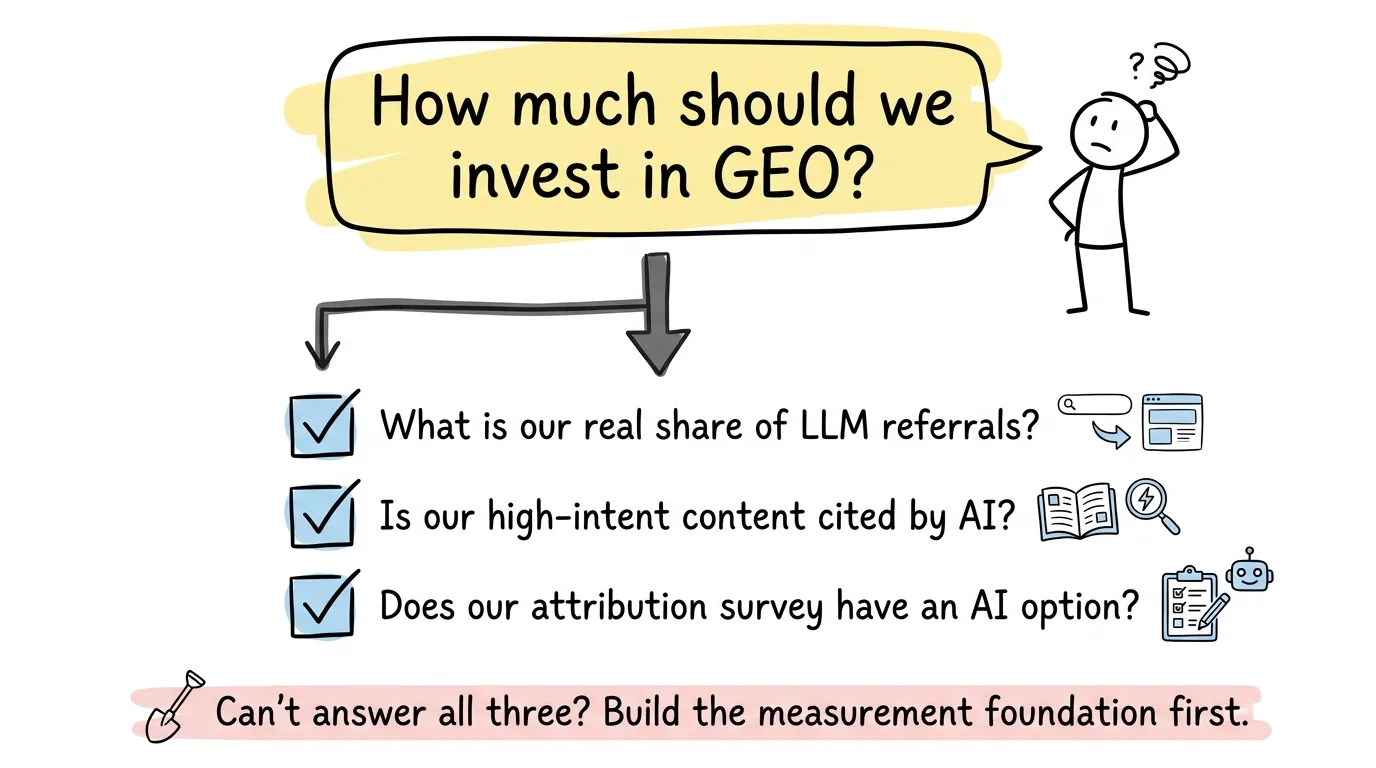
For anyone who finished today's issue still undecided, one closing move: rewrite the question "how much should we invest in GEO" as three smaller ones — what is our real share of LLM referrals, is our high-intent content being cited by AI, and does our attribution survey have an AI option? If you can't answer all three, you haven't reached the spending stage yet; spend an afternoon laying the measurement foundation first. If you can, then double down where the data is good and fix the material where it's bad — that's how the spreadsheet phase is meant to be played.
Continue reading
Related articles
AI Marketing Daily · 2026-11-22
AI Marketing Daily for 2026-11-22 rounds up 20 items led by Microsoft opening Bing AI Overviews to ads and Google expanding AI Mode ads to ten countries, plus GEO guides, ad automation delegation guidance, AI Overviews CTR data, and a legal-risk checklist for AI-generated creative.
AI Marketing Daily · 2026-11-21
A November 21, 2026 AI-marketing daily covering AI search visibility, GEO methods, Google AI Mode ads expanding to ten countries, Meta's pre-Black Friday changes, agentic shopping, and industry adoption and ROI data.
AI Marketing Daily · 2026-11-20
AI Marketing Daily for 2026-11-20 rounds up 19 items centered on measurement: OpenAI's ChatGPT Business Hub dashboard, EU rules for agent-mediated purchasing, Meta pausing four AI terms, and B2B data on shortlists and the dark funnel, each with action advice.