
Is Your Marketing Making You Money?
A summary of a marketing podcast discussion on building a profit-focused digital marketing strategy, covering lead source tracking, channel budgeting, CRM hygiene, agency selection, and AI search optimization.
A while back, I listened to a marketing podcast. An agency that has spent more than a decade doing search marketing — Exposure Ninja. Three people talking for nearly an hour about one single thing: how to build a digital marketing strategy that actually makes money.
Honestly, I didn't expect much from this kind of topic. Most content about marketing strategy starts reciting its lines within the first five minutes: funnels, closed loops, omni-channel mindshare.
But this episode was different. The three of them talked like three business owners anxious over their budgets, and all they discussed was the dirty work: where leads come from, what they cost, where you're leaking, where to pile the money on.
I've sorted out the most useful parts for you.
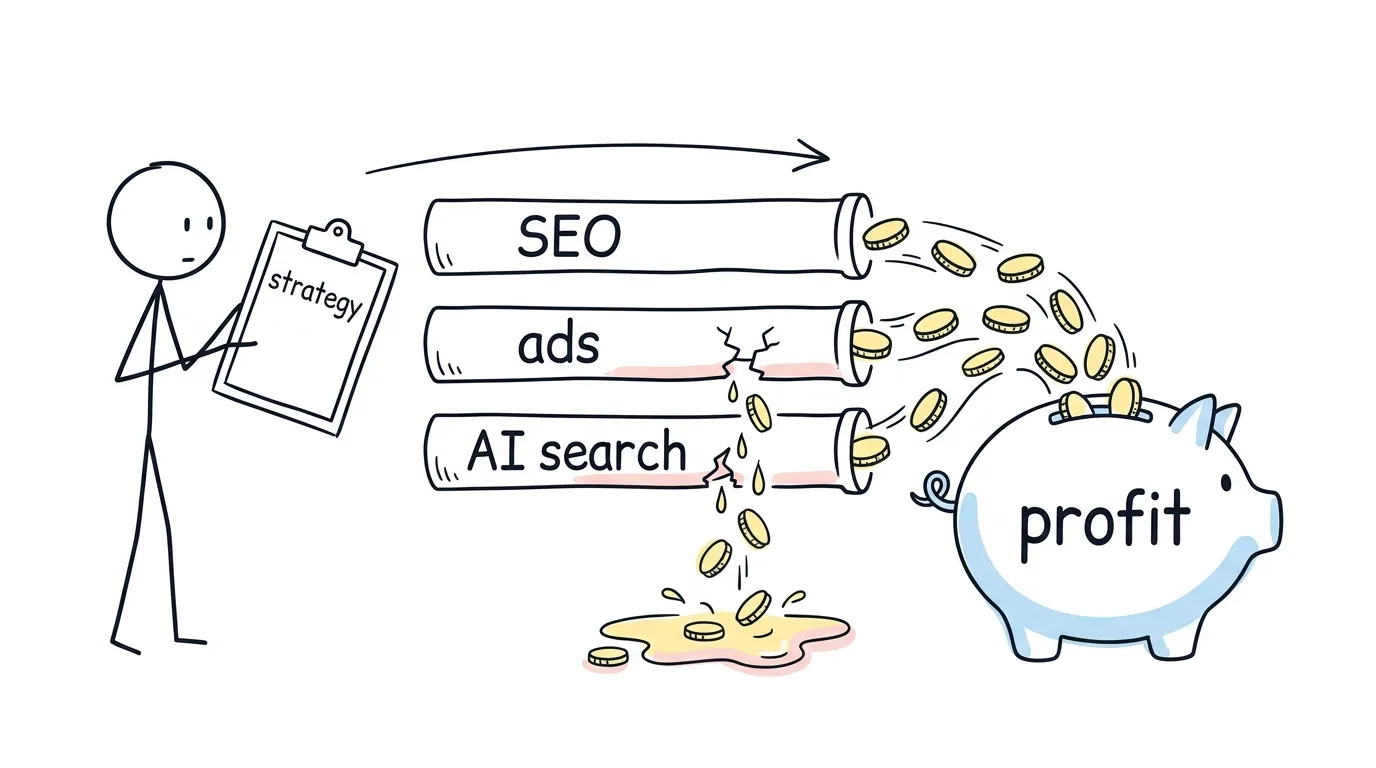
First, Get Clear on Where Your Customers Come From
The host asked the CEO where a marketing strategy should start.
The CEO said: start from the ugliest place — your existing customer pipeline.
What is the existing pipeline? Simply this: the customers you have right now — where exactly did they come from?
How do you find out? The low-tech way.
Add one field to your forms: "How did you hear about us?"
When sales chats with a customer, ask one extra question: "Where had you seen us before?"
It's that simple. Of course, it's not accurate — people only name the channel that impressed them most. But it beats nothing: get the ledger first, then talk about precision.
The host also added a detail I thought was especially clever.
They said many companies have recently added ChatGPT to that list of options, because people really have started filling it in. The few checkboxes once hidden under "Other", now that they've become a proper option, show up even more often.
The world of channels has quietly changed. Your form may still be stuck a few years back.
Volume Lies; Close Rates Don't
Knowing where leads come from isn't enough.
You still have to run the numbers: how much does each lead cost? And how many of them end up becoming customers — real money?
The founder told an example. Their group acquired a home-energy company called Elite Renewables. In peak season, leads came pouring in:
Partner vendors pushed at most 50 leads a week. The website, 25 a week.
Think about it: which would you pick? Most likely the vendors. 50 leads — double the website.
Then they pulled the data and were stunned. The vendors' leads were high-volume and low-quality, with a pitifully low close rate. The website's leads were fewer but sharper, closing a whole notch higher.
Lead volume lies; lead close rates don't.
To know the lead quality of every channel, there's an easy shortcut: go ask your salespeople.
They soak in leads every day. Which channel's people are worth talking to, and which channel's people are only there to fish for a quote — they know exactly.
Why so clear?
Because it's tied to their commission. A person's sensitivity to their own income will always beat their sensitivity to any report.
The Most Boring Stuff Is the Make-or-Break
Next they talked about CRM. The CEO apologized first: sorry, this next part is boring.
Boring — but lethal.
They use HubSpot, and they're even a HubSpot partner, usually helping clients set up CRMs. But her exact words were: no matter how good the tool you buy, if nobody fills data into it, or everything filled in is wrong, that money is simply wasted.
The hard part isn't buying the tool. It's getting sales to fill it in.
What's a salesperson's nature? Close deals on the phone, earn commission. Not stopping to type field after field into a system.
Especially the leads that never touch the website: forwarded by email, sent by LinkedIn DM, referred by existing customers. Whoever takes one has to tag the source while they're at it. Otherwise the whole CRM fills up with "unknown".
So what do you do? The marketing team has to learn to speak salespeople's language. Don't open with "please cooperate and fill in this form". Say this instead:
I want to feed you good leads, and I don't want to waste your time. Fill in these few fields, and I can go find a hundred more customers just like this one. If you don't, I'm left guessing blindly — and you keep fishing through a pile of junk leads.
What salespeople lack has never been discipline. It's a reason that can actually persuade them.
The Goal of Marketing Is Profit
Halfway through, the host threw out a big question: should a marketing strategy chase performance, or brand?
The CEO's answer was crisp: the goal of marketing is profit.
If the business wants to make money, marketing has to explain clearly how it helps the business make money. Traffic and exposure — fine, ask for them. But they're only a progress bar toward profit, not the endpoint.
The founder's follow-up cut deeper.
He said that the "brand marketing" in many people's mouths boils down to four words: "we don't do accountability."
Harsh, isn't it? Do you have a comeback?
He also said something brutal: no marketing director was ever fired for making their ROI look too good.
Right. The reason for getting fired is always the same: plenty of money spent, and the numbers don't add up.
And besides, you never have to choose between performance and brand. The DTC (direct-to-consumer) brands that rose during the pandemic ran on direct-response ads on Facebook — every cent of ad spend had to show a return — and they still built their brands. Flip it around: a blimp dragging a banner over a stadium won't necessarily build a brand either.
A lead that makes money, a delivery that doesn't disappoint — every one of them is brand-building.
Big Companies and Small Companies Don't Struggle with the Same Thing
So is marketing hard for big companies the same way it's hard for small ones?
The goal is the same: get people to your website, then get them to pay. On this point, a corner plumbing shop and Amazon are no different.
Where it's hard is completely different.
Small companies struggle with cash flow. Ads you run today have to show movement by next week; there's no six months of patience for you to test slowly. The upside: one person makes the call, what you change today you can change back tomorrow, and what works you can double down on immediately.
Big companies struggle with process. The content team signs off, the brand team says the tone is off; the brand team signs off, legal says there's compliance risk; everyone signs off, and the executives' side still needs another round. Speed is never on your side.
So when a big company wants to change its play, don't count on winning people over in meetings. Run a small-scope proof of concept first, and take the data into the meeting.
By the way, a case they took on. A global big brand came knocking — and note, they never once said "help us make more money". But the agency quietly added a goal of its own: make you a bit more money along the way.
The result: just by untangling the content sections of the brand's website and reordering them around the logic of selling, revenue rose 450%.
A big brand, growing at a startup's percentage.
The bigger the company, the more money leaks through the basics.
Choosing an Agency: Describe the Illness, Don't Hand Over a Prescription
So how do you pick an agency?
The CEO gave a counterintuitive answer: don't tell the agency what to do; tell them where it hurts.
When big companies run a pitch, nine out of ten requirement documents sent to agencies are half-finished diagnoses: we've already guessed the answer, just follow it and execute.
What's that called? You go see a doctor, don't describe your symptoms, write the prescription yourself, and have the doctor fill it.
A better approach is to sit down and talk: we've run into this problem, we have a few candidate directions in hand — what do you think? And this is exactly the step most pitch processes skip.
The founder added something even more brutal: beware of one-trick agencies.
Find a company that only does VR booths and ask how to lift profit. What's the answer? Rent a few more booths.
To a man with only a hammer, everything looks like a nail.
Before choosing, first get clear on where the agency's incentives sit. Incentives decide how much their advice is worth.
How to choose, concretely? Three moves:
- Don't look at the logo wall; look at the track record. Find cases with pain points similar to yours — they don't have to be from your industry. Bound by NDAs? Fine. Ask them to describe the case type and the result. The ones who can tell it crisply are most likely real.
- See through the beautiful proposal. Ask exactly this: which parts of this deck will you actually go and do?
- Meet them. You'll be meeting your contact every week anyway; chat for five minutes and you'll know whether this person can be trusted. If your gut says no, don't force the signature.
A beautiful proposal is a bonus. But what you want is the numbers behind the beautiful proposal.
Stuck in a Contract? Don't Sit on Your Hands
Someone may say: I understand all the logic, but my contract with the current agency still has nine months left. Can't move.
So — do nothing?
The CEO's advice: go talk to them. Book the account manager, or someone more senior, and discuss how the remaining contract period could still be used — whether it could be used differently.
An agency doesn't want a miserable client either. They want success stories; you want results. There's a deal to be had here.
One thing to watch when you talk: don't spread your effort evenly.
You want to tweak every channel a little? No. Your energy won't allow it — do that and you'll burn yourself out, everything done half-baked.
Press your weight on the channels that have already won.
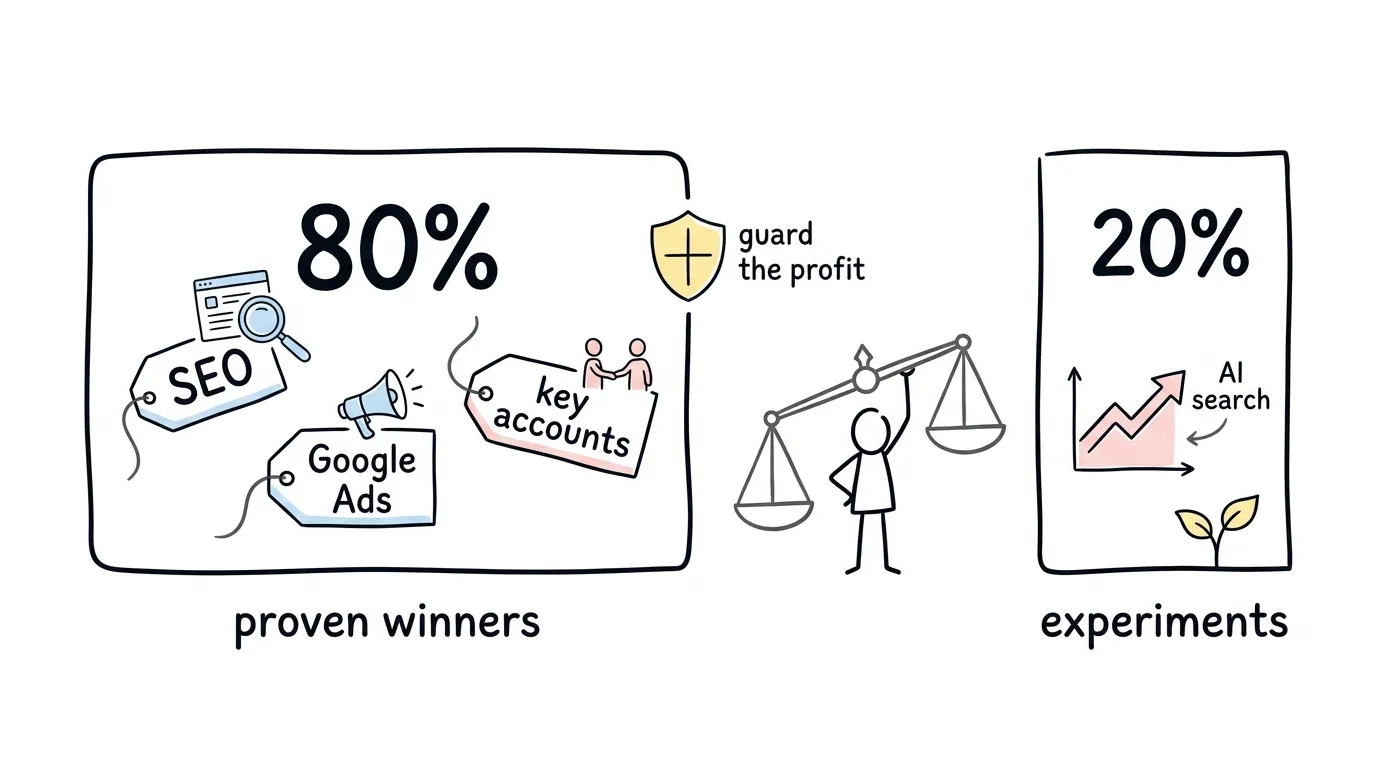
Channels that make money: double the bet first and guard the profit. Then squeeze a little time out of what's left for experiments.
AI Search: A Changing of the Guard Already Underway
In the whole episode, the segment that stuck with me most was their judgment on AI search.
The big companies, they said, are already off to an early start. At the Fortune 500 level, plus some companies among the UK's FTSE 250 and the top 30 of Germany's DAX, serious AI search optimization has already begun. Their own agency has already started taking this kind of work.
The logic is simple: the bigger the company, the less it can afford to lose its position, and the more it must grab the first move.
And smaller businesses? Many have only just come around to the fact that this needs doing; some haven't even considered that it could become a growth channel.
There was an interlude in the middle. Someone online said: AI search optimization — isn't that just SEO? Then no need to start from scratch; just keep working as before.
This sounds very comfortable. Comfortable answers are usually the most expensive.
The foundations of traditional SEO are of course useful; in the new environment they're a bonus. But relying on them alone isn't enough. This changing of the guard is bound to produce winners and losers, and the losers will be exactly the ones who said, breezily, "isn't that just SEO".
The real situation today: conversions from ChatGPT still lag far behind Google. But no one dares bet it won't catch up.
Ten years ago, who was doing marketing on TikTok? Almost nobody. But brands eyeing the young demographic should have understood one thing back then: where people go, money should follow.
By the time you can see a trend clearly, it's no longer yours to catch.
How to Split the Money? 80/20
Down to the budget, then: how to divide it?
The CEO gave an especially plain framework: 80/20.
80% goes on channels you've already proven are winners. For most businesses, that's organic traffic like SEO, plus paid placement like Google Ads. If you're in B2B, add key-account marketing.
The remaining 20% is for experiments. Which channel might be the next growth engine? Watch its early signals.
Say you're already tracking the traffic and conversions coming from AI search. Its share today may be pitifully small, but as long as the curve is climbing, it deserves a budget from that 20%.
But 80/20 alone isn't enough. Underneath sits one harder rule: organic and paid must walk on two legs.
Paid is fast. Scale up, fill a gap, switch it on and off at will. The downside: it's expensive — every visitor is bought.
Organic is cheap. The downside: it's slow — and organic isn't free; you pay for it with manpower.
The DTC brands that collapsed during the pandemic mostly died the same death: paid only, shoveling everything into Facebook. A mattress seller whose customers buy once every seven years — after the ads have harvested the latent demand, then what? Acquisition costs kept climbing, and the leg gave out.
Paid is the crutch; organic is the leg. The crutch lets you run fast, but you need legs of your own.
One more thing while we're here: don't keep just one main channel. Two to three channels that steadily produce returns is a sturdier setup. If some channel's bidding gets driven to the sky by competitors, you still have somewhere to stand.
The Most Underrated Profit: Existing Customers
Looking back over the whole conversation, the segment I personally found most valuable was the least sexy one: existing customers.
People have enormous enthusiasm for acquiring new customers, and no interest in retention. Search a video site: plenty of videos teaching you to acquire new customers; teaching you to lift repurchase by 20% — barely any.
Why?
Acquiring is like hunting — fresh and exciting. Managing existing customers is like farming — dull.
But the math doesn't work that way. Acquiring a new customer costs far more than keeping an existing one. And basically every email sent to your existing-customer list brings money in. On this, all three reached consensus on the spot.
The founder had a story from his own experience. The most miserable month in the agency's history was October 2014. So miserable that he personally stepped in to sell — and while he was at it, built an email automation setup, triggered by pipeline stage.
It took a few days to build. And then?
That automation ran untouched for four or five years, steadily producing orders.
There are more everyday uses too. For leads that inquired and then vanished, set one automated follow-up three months later. Build it once; it may run for ten years.
And this stuff can be wired into paid media. The customer list in your CRM, connected into ad platforms — for remarketing, for lookalike audiences. B2B can even target by the customer-company list. The existing-customer assets you worked to build turn around and cut the cost of new customers — two birds with one stone.
High-leverage things usually look unremarkable.
Always Showing Up Is the Cheapest Marketing
The founder also told a headhunter story.
There was a headhunter who messaged him every week, asking every now and then: any roles to fill?
No. Asked again next month.
For a while it drove him nuts: what's wrong with this guy — can't he take "no" for an answer?
A few months later, he actually had a role to fill. The first name that came to mind — whose?
Exactly that headhunter who shows up once a week.
Needs change. Not needed today doesn't mean not needed tomorrow. You don't have to chase people around selling every day. You just have to always be present. The moment they truly need it, the name that pops into their head is yours.
Always showing up is the cheapest marketing there is.
Pick Up the Pen and Write It Now
Finally, the whole conversation distilled onto a single page. If you pick up the pen right now to write a marketing strategy, here's the order:
- List your lead sources. Where do customers actually come from — and through which channels do leads end up as customers who make you money.
- Run the acquisition math. Which channels are leaking money — and which are pouring it in.
- Circle your high-value customer groups. Get clear on exactly whom you should be chasing.
- Divide the budget. How to cut among channels, with what remains left for experiments.
- Leave a place for existing customers. The money for retention and repurchase can't be cut.
- Set the review cadence. Set direction at the start of the year; recheck every quarter: is the channel mix still the right one?
The plan you write at the start of the year isn't carved in stone. The market changes, customers change, and the cost of channels changes too. What worked last year may not this year; what works this year may not next year either.
At the end of that podcast, the three thanked each other and tossed in a joke: follow this process through, and your year-end strategy shouldn't differ much from the one you wrote at the start of the year — unless you made some odd calls back in January.
I pass that composure on to you, exactly as it was.
May every dollar of next year's marketing budget earn itself back.
Continue reading
Related articles

It's 2026: Stop "Buying" AI Tools for Your Marketing Team — Start "Hiring" AI Agents
This learn article explains how AI agents differ from standalone AI tools in marketing, outlines three agent categories — build-your-own platforms, CRM-native agents, and vertical tools — and covers use cases across SEO, social media, advertising, and reporting, plus criteria for choosing one.

What Is GEO? How Your Brand Gets "Mentioned" in the Age of AI Search
An explainer on GEO (Generative Engine Optimization) for e-commerce and DTC brands: how it differs from SEO and AEO, why AI answers shape brand visibility, and eight practices covering question-focused content, consistent brand messaging, structured pages, external evidence, comparisons, and AI mention tracking.

AI Is Already Making Decisions for Your Customers. Are You on the List?
A learn article explains GEO (Generative Engine Optimization): why AI-generated answers now shape which brands customers see, and how SEO fundamentals, entity clarity, citable evidence, and monthly measurement affect visibility in AI answers.