
Your Customers Have Stopped Searching
An analysis of how AI answer engines are replacing traditional search clicks, explaining GEO (Generative Engine Optimization), which content formats get cited by AI, and practical steps for optimizing brand visibility in AI-generated answers.
A few days ago, I asked a young teammate to look up a set of numbers.
Ten minutes later, he came back and said he was done.
I asked what he'd used to look them up.
He said, ChatGPT.
I asked, what about Google?
He said, I asked Google a quick question too, and it handed me a summary right away, so I never clicked through.
That kept me thinking all night. What caught my attention wasn't the numbers he found — it was the move he made: he skipped the "dig through the links" step. For the past fifteen years, everything we've built in search optimization has rested on one cornerstone: users search, scan the results, and click into your page.
That cornerstone is now being pulled out.
Exactly how far has it been pulled? I later went through a batch of statistics myself, and the more I read, the more alarmed I got. Today I'll break those numbers down for you piece by piece — and along the way, talk about the one thing marketers should actually be doing about them.
First, How Bad It Is
What is GEO? GEO — Generative Engine Optimization — means making your content easier for AI answer engines like ChatGPT, Perplexity, and Google Gemini to cite. Some in the industry also call it AEO, Answer Engine Optimization. Different name, same job: you used to optimize content to rank high in search results; now you optimize it to get named in the answers AI gives out.
Why did this suddenly start to matter? Look at a few numbers.
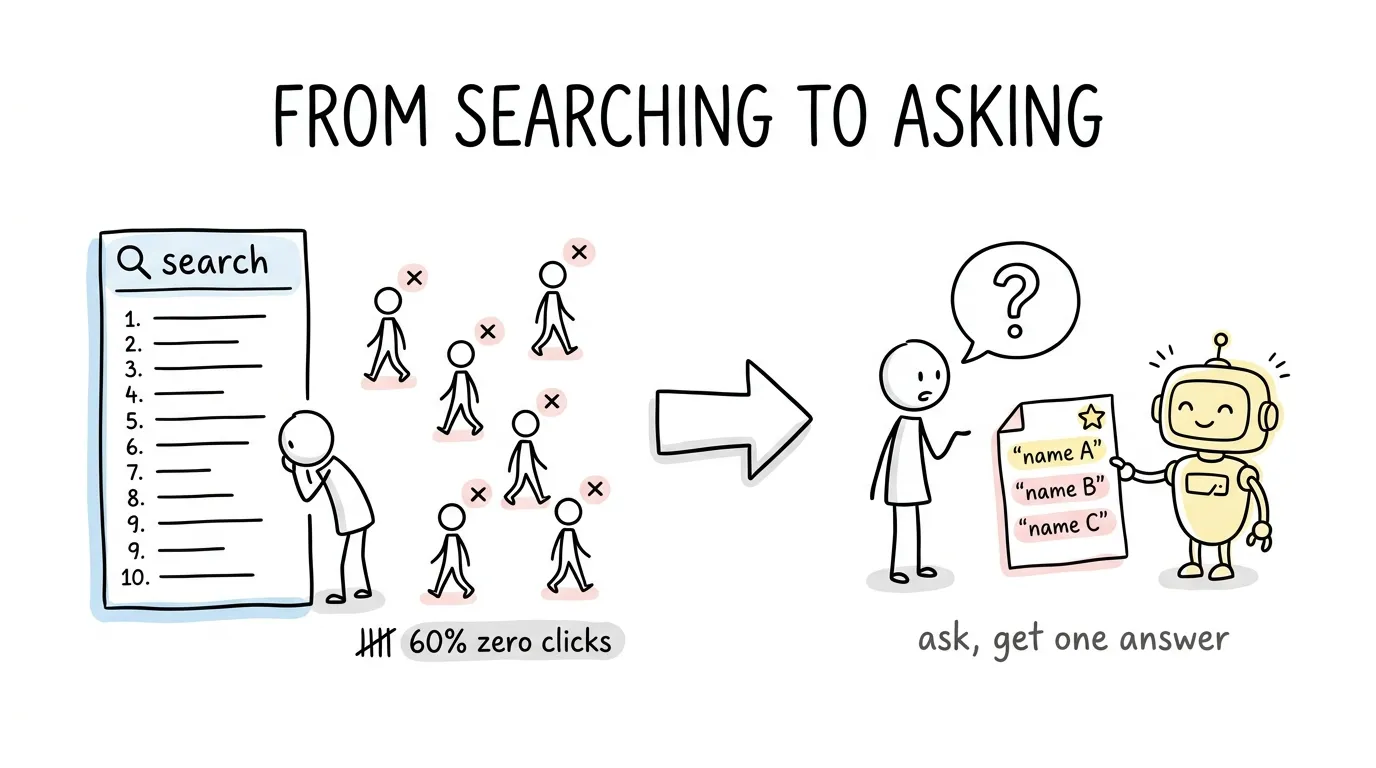
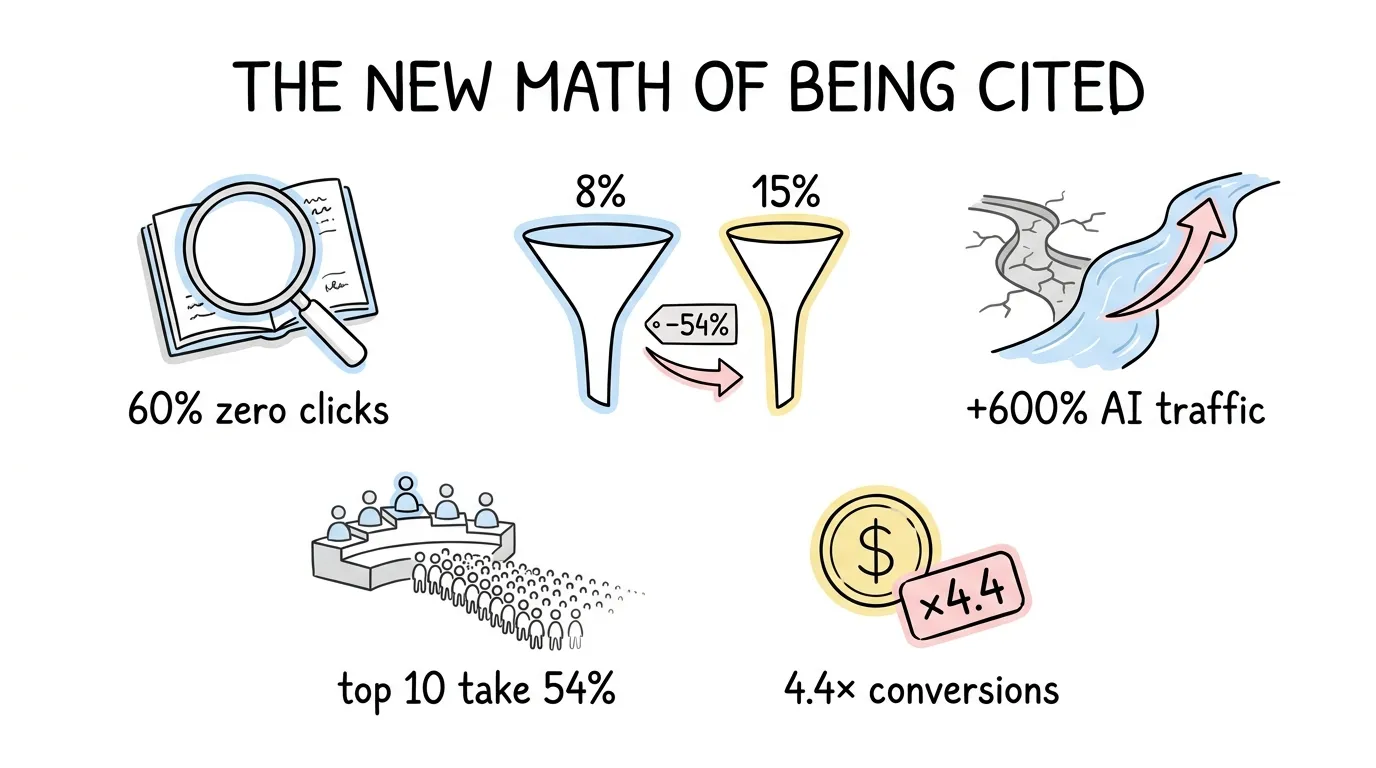
Globally, roughly 60% of Google searches end with zero clicks. Users read the AI summary on the results page and walk away.
What does 60% mean? Imagine you run a shopping street where six out of ten passers-by look at your signboard and leave without stepping inside.
Here's another set. In searches where an AI summary appears, the share of users clicking traditional links is only 8%. Without an AI summary, it's 15%. Net effect: click-through fell 54%.
Steep? Steep.
But the other side is the interesting one. From January 2025 to now, traffic from AI answer engines into websites grew 600%.
Unbelievable. On one side, traditional clicks get cut in half; on the other, AI-driven traffic explodes sixfold. This isn't the same pool gaining or losing water — the water found a new riverbed.
The engines are sprinting too. Data released in February 2026 put ChatGPT's weekly active users past 900 million; in the first half of 2025 alone, its query volume grew nearly 70%. Perplexity now handles 780 million search requests a month; in August 2024, that figure was 230 million. A little over two years — more than tripled.
And the users? 31% of Gen Z already pair answer engines with traditional search; 39% of consumers use AI to find products, and among young people it's more than half; 83% of users believe answer engines are more efficient than traditional search; 80% of consumers lean on AI-written summaries for at least 40% of their searches.
One firm predicts that by 2028, AI search visitors will outnumber traditional search.
Line these numbers up and only one conclusion remains: the way people "look things up" has switched engines.
Who Gets Named by AI
Once the river changes course, a new question follows: when AI hands out answers, whom does it cite?
Start with the bad news.
AI Overviews list an average of just 5 sources. The 5 most-cited domains take 38%; the top 10 take 54%; the top 20 take 66%.
In other words, at this new table, the seats left for small sites and new players are very few.
Then there's a number that sent a chill down the spines of many SEO veterans. In September 2025, Google made an adjustment to how impressions are counted (the num=100 update), and 77% of websites watched their impressions drop straight down in their monitoring tools. Plenty of teams panicked, thinking something had gone badly wrong — when in fact the measuring stick had changed.
See, even "knowing how much exposure you still have" has become complicated. 67% of digital marketers admit that tracking GEO is harder than tracking traditional SEO.
Now the good news.
One phenomenon is especially worth chewing on: between March and June 2025, the amount of Reddit content cited by AI exploded by 450%, and today Reddit alone accounts for 21% of Google AI Overview citations.
How does a forum pull that off? Because it's real people telling it straight. When AI hunts for answers, it places special trust in content where "someone actually used it, actually argued about it."
There's another layer. A 2025 analysis found that among searches that triggered AI summaries at the start of the year, 91.3% were informational queries; by October, that share had fallen to 57.1%, with commercial and transactional queries rising fast.
In plain terms: AI answers are moving from "answering knowledge questions" toward "helping you buy things." Getting closer to the money.
What Kind of Content Gets Cited
So what content does AI actually want to cite? The statistics answer this too.
First: structure beats style. Content with clear hierarchical headings, lists, and tables is 28% to 40% more likely to be cited than narrative long-form. Listicle-style articles have a 25% citation rate; narrative blog posts and opinion pieces only 11%.
Second: hand over the answer directly. FAQs are among the most-cited formats, because they're born "one question, one answer" — exactly the way users ask AI. Comparison lists, how-to guides, and FAQs win favor across every platform.
Third: video. In nearly every vertical, video is the most-cited content type, and YouTube alone accounts for nearly a quarter of all citations.
Put these three together and you get a plain truth: AI doesn't admire essays. AI dismantles them for answers. The more you write like a composition, the less use it has for you; the more you write like an answer, the more it can't do without you.
How to Get Started
The direction is clear. What do you actually do? My take, in three moves.
Move one: don't throw away SEO. One statistic says 99% of the pages cited in AI Overviews come from the top 10 organic results. So GEO isn't a replacement for SEO — it's "SEO plus." No ranking yet? Then there's nothing to cite. Teams who moved early also say GEO-ready content gets discovered by generative engines 10 times faster than with organic SEO alone — but the precondition is the same precondition: the content has to stand on its own first.
Move two: start where the return is best. The fastest-acting tactic is to take content that already ranks decently and add concrete data, clean subheadings, and an answer-first structure. Moves like that show changes in citations within 30 to 45 days; structural adjustments like schema (the structured-data markup behind the page) and formatting take 30 to 60 days to pay off; building original research and accumulating authority signals is slower — 3 to 6 months. The six-months-and-up wait of traditional SEO is much shorter here.
Move three: when you report, speak human. Five metrics are enough for your boss: how often your brand gets cited on your target questions; your citation rate against competitors; your share of all category mentions; whether the sentiment of citations praises you or knocks you; and the most critical one — conversions coming from AI traffic.
Why is that last one the most critical? Because the data says visitors who arrive from answer engines convert at 4.4 times the rate of traditional organic search.
4.4 times. One AI citation is worth four and a half old-school visitors. Any boss can do that math.
On the tools front, ready-made helpers exist now — for example, HubSpot's AEO product line, which shows how your brand shows up across answer engines and offers optimization suggestions; its AEO Grader can start by scoring where you stand today. Whether you use it is secondary; the mindset is mandatory: manage "being cited by AI" as a metric you can monitor and optimize.
Let me also answer a question many teams keep wrestling with: if AI wrote part of your content, will AI look down on it?
Quite the opposite. The vast majority of content cited in AI Overviews was itself generated with at least some AI involvement. What matters isn't who wrote it, but whether someone who knows the field checked it: was the data verified, does the piece carry anything genuinely original, is the answer one AI would actually want to lift.
Finally
Back to that young teammate from the opening.
In those ten minutes, he may have just bulldozed the most valuable piece of real estate the marketing industry owned for fifteen years: the position on the search results page.
People used to compete over who ranked first. From now on, they'll compete over who gets named in AI's first sentence.
What users always wanted was never links — it was answers. The answers used to be scattered across the links; now AI has gathered them in. Whoever makes it into the gathered list still has a seat at the table.
Some day down the road, you ask AI a question, get an answer that's accurate and genuinely useful, and it happens to mention your company's product. Don't be surprised. That's something you will have earned, bit by bit, starting today.
Here's to getting named by AI, sooner rather than later.
Continue reading
Related articles

It's 2026: Stop "Buying" AI Tools for Your Marketing Team — Start "Hiring" AI Agents
This learn article explains how AI agents differ from standalone AI tools in marketing, outlines three agent categories — build-your-own platforms, CRM-native agents, and vertical tools — and covers use cases across SEO, social media, advertising, and reporting, plus criteria for choosing one.

What Is GEO? How Your Brand Gets "Mentioned" in the Age of AI Search
An explainer on GEO (Generative Engine Optimization) for e-commerce and DTC brands: how it differs from SEO and AEO, why AI answers shape brand visibility, and eight practices covering question-focused content, consistent brand messaging, structured pages, external evidence, comparisons, and AI mention tracking.

AI Is Already Making Decisions for Your Customers. Are You on the List?
A learn article explains GEO (Generative Engine Optimization): why AI-generated answers now shape which brands customers see, and how SEO fundamentals, entity clarity, citable evidence, and monthly measurement affect visibility in AI answers.